

Let’s agree on something from the start. Honestly, most of us have a wrong idea about losses in the market.
This wrong idea says: if you lose 20%, make up for it with a 20% profit.
Alright, we’re back to the same point.
But what we’re saying here is far from being correct.
The matter is simpler than you think, but its impact is very deep.
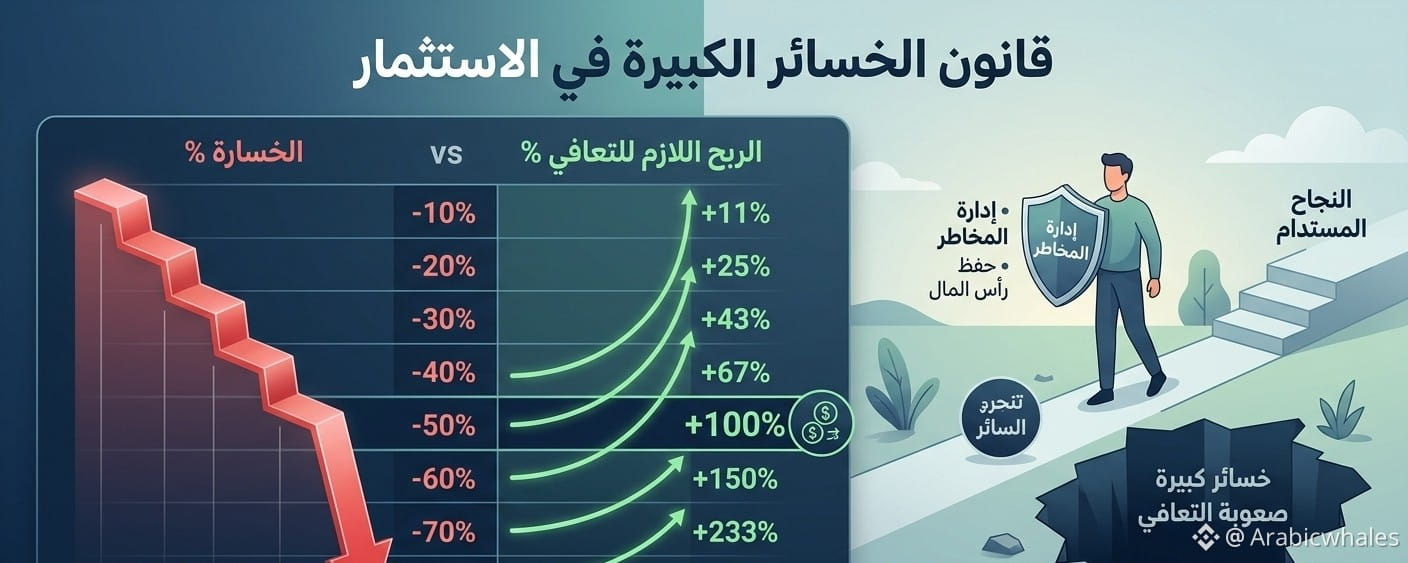
The picture you’re talking about—the “law of large losses”—explains this exactly.
A simple arithmetic principle, but it flips the balance of investment thinking.
So what does this law say specifically?
What it says is clear.
The more your portfolio drops, the higher the profits you’ll need just to return to the same first point.
Meaning the relationship isn’t equal, ever.
Let’s simplify it with a quick example.
Imagine you lost only 10% of your investment.
To get back to zero, you only need a modest gain—just 11%.
Things here are easy and reasonable.
But listen to this thing.
If the loss becomes 50%, then the disaster begins here.
You need a 100% gain—so you double all of the remaining capital, just to get back to where you were first.
Meaning you go back to zero.
And the deeper the loss goes—say 60% or more—the situation approaches the impossible without extreme risk, or without a very long time to recover.
That’s where the idea starts to become clear.
The picture here becomes easier.
Preserving capital is more important in the later stages than chasing imaginary profits.
A sharp market drop wipes out years of gains in just a few days.
That’s why seasoned professionals put risk management above everything else.
Resilience comes from caution, not from excessive boldness.
Sustainable success in investing doesn’t depend on precise predictions; it depends on your readiness for the worst.
And notice something important.
A good annual return by itself isn’t enough if there isn’t clear discipline in stopping losses.
You might achieve 30% in a year, then collapse in the second year and lose 40%, and everything you collected falls apart with it.
When you look at the subject this way, you discover a clear mathematical truth.
Big losses consume double the time and double the effort to make up for them.
I see the idea here clearly: survival in the market is sometimes more important than outperforming it.
This means that hedging tools, diversification, and loss-stop limits become essential for any responsible investor.
Not just extra options.
Remember this always, especially during times of big volatility.
What’s not required is that you’re always profitable.
What you need is to know how to reduce the loss when it hits you.
In the market, like life, whoever falls can get back up quickly from a minor slip.
As for the one who drops a lot, imagine it like a deep pit.
Getting out of it is very difficult, and maybe you’ll never return.