
 What happens when a blockchain becomes successful enough that its own popularity starts creating new challenges?
That question is one reason I find Arbitrum interesting. Ethereum has established itself as one of the most important platforms for smart contracts and decentralized applications, but increased activity can also mean higher fees and competition for blockspace. Layer 2 networks such as Arbitrum approach this problem by moving much of the transaction execution away from Ethereum while using Ethereum as the underlying security and settlement layer.
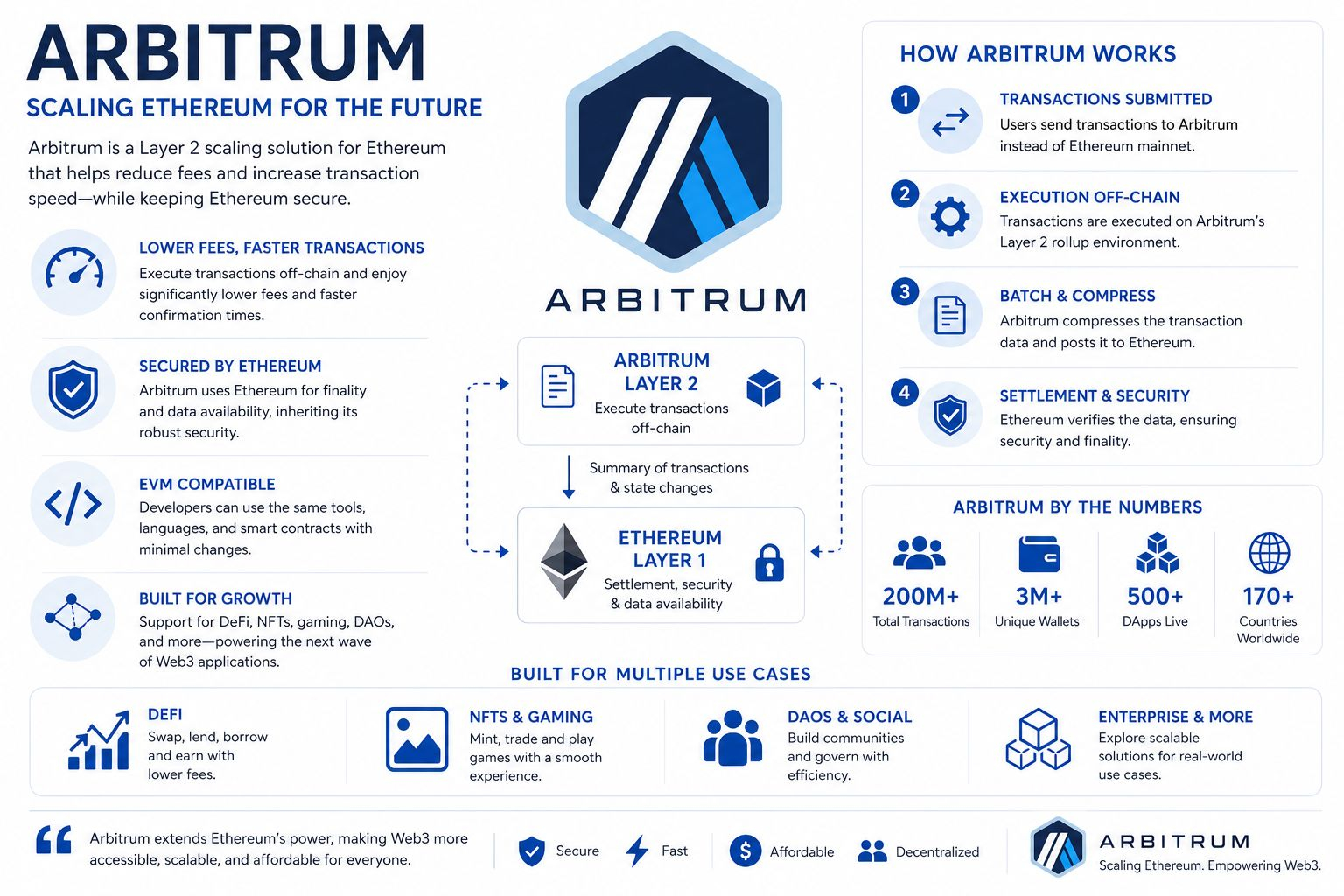
The basic idea sounds simple, but the architecture represents an important change in how blockchain networks can scale. Instead of forcing every transaction to be processed directly on Ethereum's mainnet Arbitrum can execute transactions on its Layer 2 environment, bundle the results, and ultimately post relevant data and proofs back to Ethereum. This allows users to interact with applications while potentially benefiting from lower transaction costs and faster execution.
What I find particularly interesting is that scaling Ethereum doesn't necessarily mean replacing Ethereum. Arbitrum demonstrates another approach: extend the capabilities of the existing network while keeping Ethereum at the center of settlement and security.
This distinction matters because blockchain ecosystems are becoming increasingly modular. Different networks can specialize in execution, data availability settlement or specific applications. Rather than one blockchain handling every responsibility multiple layers can work together.
For developers this creates another important advantage. Building on a mature Ethereum compatible environment means teams can work with familiar smart contract tools and existing developer infrastructure while gaining access to a different execution environment. This can make it easier to experiment with DeFi, gaming, social applications, and other Web3 products.
However, Layer 2 technology also introduces questions worth considering. Users need to understand how assets move between Ethereum and Layer 2 networks, how withdrawals work and what security assumptions each scaling system makes. Lower fees are valuable, but understanding the underlying architecture is equally important.
The bigger lesson I take from Arbitrum is that blockchain scalability is not simply a race for the highest transaction count. It is an architectural challenge involving execution, security, decentralization and user experience. A successful scaling solution needs to balance these elements rather than optimizing only one metric.
As Ethereum continues to develop, Layer 2 networks may become an increasingly important part of how users interact with the ecosystem. The future may not be about choosing between Ethereum and Layer 2s. Instead it could be about creating a connected environment where each layer performs a specific role efficiently.
For me, that's what makes Arbitrum worth watching: it represents a broader shift from thinking about blockchains as isolated networks toward thinking about them as interconnected layers of infrastructure.
Do you think Ethereum's future depends more on improving the mainnet itself, or on building stronger Layer 2 ecosystems around it?
#WriteToEarn #ARBİTRUM #Ethereum #Layer2 #Blockchain
