

Today we will take FHE, a heavily controlled altcoin, as an example to analyze how to play during the mid-stage of an upward trend after a rise.
The full text is quite long, please read patiently. If you find it useful, please like and follow.
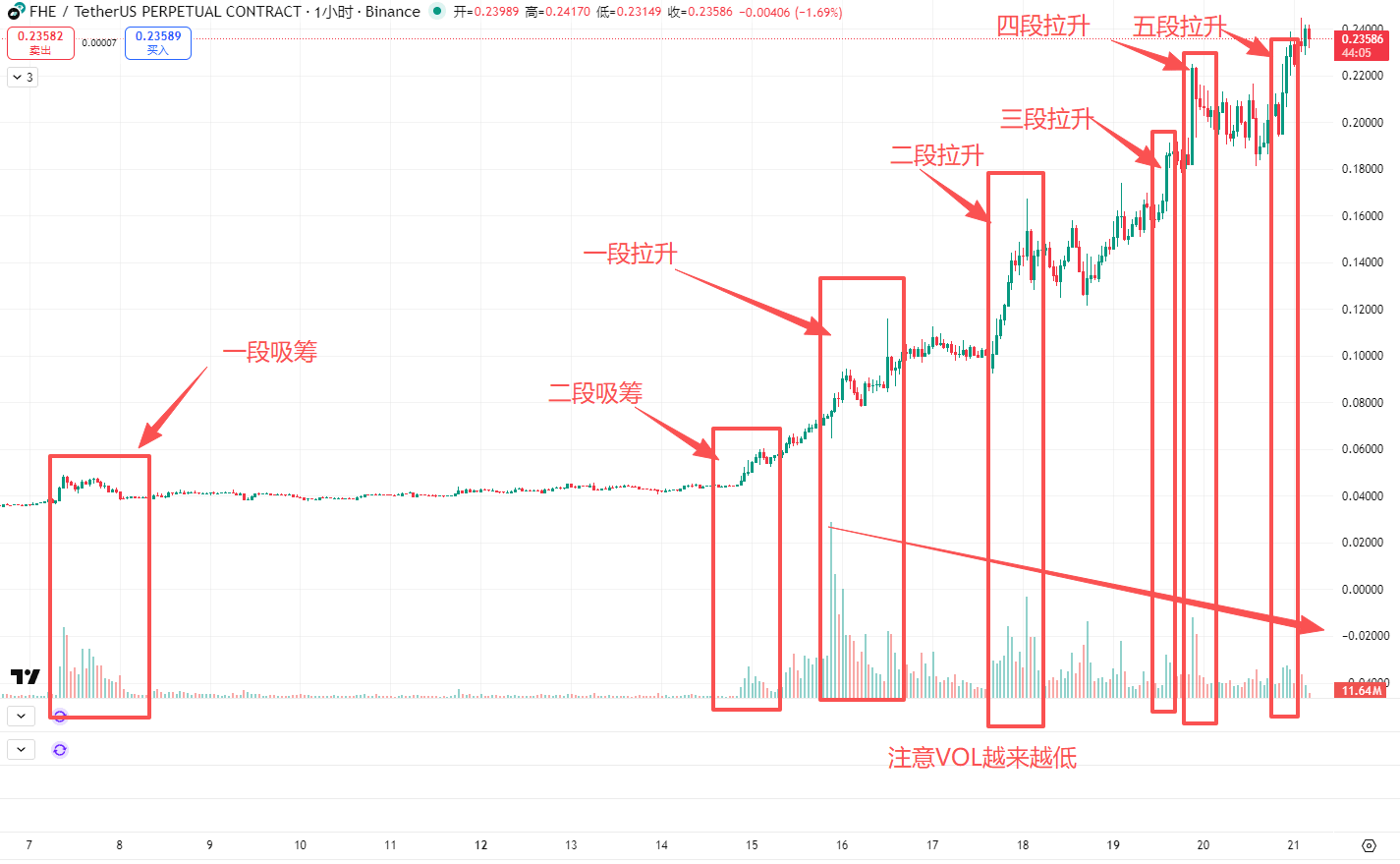
Accumulation only counts obvious market explosions; I won't describe those subtle accumulations.
In the image, you can see that after January 7th, FHE mainly underwent two rounds of observable accumulation, followed by five phases of price increase. One key point here is that the volume has been continuously declining, which is technically referred to as a shrinking increase, where transaction volume contracts but prices keep soaring. If we disregard the presence of market makers, this is when we should be cautious of a market reversal, because there’s no trading volume while prices are still rising. Normally, a value correction should occur.
However, discussing technical aspects on a market controlled by a market maker is foolish. When a volume decrease occurs during a price increase in altcoins controlled by market makers, it indicates that the chips are being further concentrated.
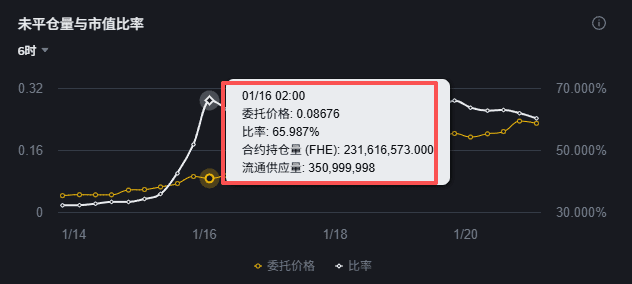
On the 16th, the market maker had already completed controlling the market. This ratio of 65.98 cannot appear in a normal altcoin market. Remember what I said: FHE has been completely controlled by the market maker since January 16, so FHE is a very clear altcoin with a market maker present, and this market maker has big ambitions.
Returning to today’s topic, in this severely controlled altcoin market, what should we do?
First, the first point is to stay away from retail investors; this is very important. Think about it: who is the market maker’s hunting target? Isn’t it retail investors? If you are still standing with retail investors, you are just a target for the market maker.
Today, I won't talk about trends or how to find potential surge opportunities for a coin, just discuss the mid-stage market after a surge.
In the picture, I have drawn a red frame for everyone. The market maker's price surge occurs in segments; it is not a one-shot deal. During the price surge, there will also be interspersed ups and downs. We call the interspersed part liquidity cleansing, which is an important source of profit for the market maker, harvesting high-leverage retail investors and washing out retail investors who entered the market in the middle. What we discuss today is how to navigate this stage of the market.
This leads to a topic: what does the market maker need to pay before a price surge?
1. The profit selling pressure of longs during the price surge.
2. Maintenance of the market during the accumulation phase, accumulation brushing transaction volume OI costs.
3. The cost of counterparty suppression during the price surge.
4. Account maintenance costs (multiple accounts need to be opened within the exchange, usually done through APIs. Generally, this involves asking the exchange for data ports; if you don't have some money, you can't even ring the doorbell).
5. Capital usage cost (this is substantial; currently, the monthlyized rate in the industry is between 10-20%, which is not much different from high-interest loans, but there will be risk agreements).
6. Insider trading early exit costs (people who understand social dynamics know, if I control the market, I will definitely give everyone hints).
7. The cost of hedging short positions during spot price surges (for small market makers, during price surges, they need to control costs and will open short positions for hedging; this part incurs capital costs).
8. Slippage price differences in transactions (actually, this part of the cost is not small. The market maker's overall position is very large, and if they want to execute trades, large orders will generally be done at limit prices, while small orders at market prices can sometimes experience slippage of over 1%).
9. On-chain bribery costs (targeting the primary market, market makers also fear trap robots).
10. OI liquidity cost (it is impossible to have enough short costs during a violent surge phase because initially, no one would be foolish enough to open a short position with large funds. The market maker pushes up the spot price, and for the contract to go long, someone must go short. If no one goes short, the market maker goes short. Remember, during the price surge, the market maker will go short. You must remember this, or you will foolishly watch how much the smart money has lost while their short positions are ridiculously low, and don’t think that because smart money has a large short position means some big whale is shorting. That’s the market maker losing money themselves. Do they really think those holding hundreds of thousands of USDT in the crypto space are just foolish leeks?)
The above are the costs I can think of in the early stage. The following are the costs after the initial surge ends and during the mid-stage market.
1. Capital cost.
At this stage, the capital cost is substantial because the market maker has opened a large number of positions and has gathered a lot of chips in the spot market. This part of the capital is losing money every day, paying interest every moment.
2. Transaction slippage.
In market trading, if you open a small position, you might not feel the presence of slippage. However, if you open a large position, this slippage becomes quite apparent. For example, if a coin is priced at 10 USDT and you hold a position of 200,000 USDT, when you place a market order, the price might directly jump to 9.5. During the market maker's price smashing, they cannot use limit orders; they use market orders for both smashing and surging, so this part mainly relates to the wear and tear during the mid-stage market washout.
3. The costs of large investors jumping in midway.
During the price surge, it is inevitable that large funds come in to ride the trend; this cannot be avoided. Usually, the market maker has funds to protect the market, optimizing the impact brought by such jumps.
Next, I will delve deeper into the topic.

First, pay attention to the two data points in the red frame. I am now telling you that these two data points are both manipulated. This is also a significant expenditure for capital costs. In the mid-stage market, the largest expenses are the market maker’s volume brushing, trading wear and tear, and market maintenance (because the mid-stage market has basically completed chip accumulation).
For a transaction volume of 100 million, the cost on paper is 20,000 USDT, but it might actually reach 25,000 USDT. The transaction wear and tear differs for each market maker, but after a round of washout, the wear and tear is estimated to be around 10,000 USDT. Market maintenance involves absorbing selling pressure, and the funds needed for this part generally exceed 2 million USDT. For FHE, the basic fixed daily expenditure is 30,000 USDT (it will only increase, not decrease; I am just roughly calculating; this is cost, not profit. Some people should not be blinded by others saying they made tens of thousands of USDT; 30,000 USDT converted to CNY is also over 200,000 a day).
After summarizing the above data, let's discuss how to deal with these severely controlled and previously expensive altcoins.
(This only targets those altcoins with high initial costs and severe control, not particularly trash altcoins; don’t casually identify with it).
I want to mention something here; generally, these altcoins will have a price safety zone, which is specifically for insider trading. For example, if you are my cousin, and I am a little brother to the market leader in Malaysia, now the market leader asks me to push up a coin, I will inform you after receiving the news to mortgage your house and raise 500,000 to enter the coin market before I push up the price at a certain price (refer to PIPPIN’s Shenzhen driver). Once the insider trading has accumulated enough, the price can be pushed up. This price safety zone is usually a threshold that the market maker will not break (if you ask why, that’s just social dynamics). I can guarantee you that insider trading exists in the crypto space. If you still naively believe that there are no contract rat traders in the crypto world, then you really deserve to lose money; it would be unreasonable if you didn’t lose).
First, let's discuss the initial surge and second surge.
The goal is to clean up retail investors who jumped on the bandwagon midway. I have mentioned multiple times that the market maker doesn’t fear you making money; what they fear is you not participating, fearing that you have obtained bottom chips. They need to maintain control over the market, and if you become a lucky investor, the market maker has no choice but to acknowledge your position, because this is caused by the contract mechanics. However, they can cheat and force you out. Moreover, the market maker also needs sideways movement to attract retail investors to establish liquidity (this is a psychological game. You might see them rising in the early stage and hesitate about whether to enter. When they finally start surging, you slap yourself for not entering and then think the price has risen too much and must fall). Therefore, the first and second stages are generally used by the market maker to increase exposure, which is to attract attention and tell you that I have high volatility—retail investors love highly volatile altcoins.
After the basic second surge ends, the market maker's exposure has already increased, and the market will gather a large number of retail long and short positions. Usually, the market maker will choose to wash the market after the second surge, with the purpose of washing out retail investors who follow the trends and killing high-leverage retail investors (retail investors are the ones who will open high leverage on altcoins that are highly controlled; those holding positions more than 5 times are generally foolish. You are just here to give money. If you make money, it's just due to luck; it has nothing to do with your judgment. Don’t come here and show off when you make money; I find it really amusing).
Next comes the main topic.
If we miss the bottom and miss the first surge and second surge, but you feel the urge to open a position, what should you do?
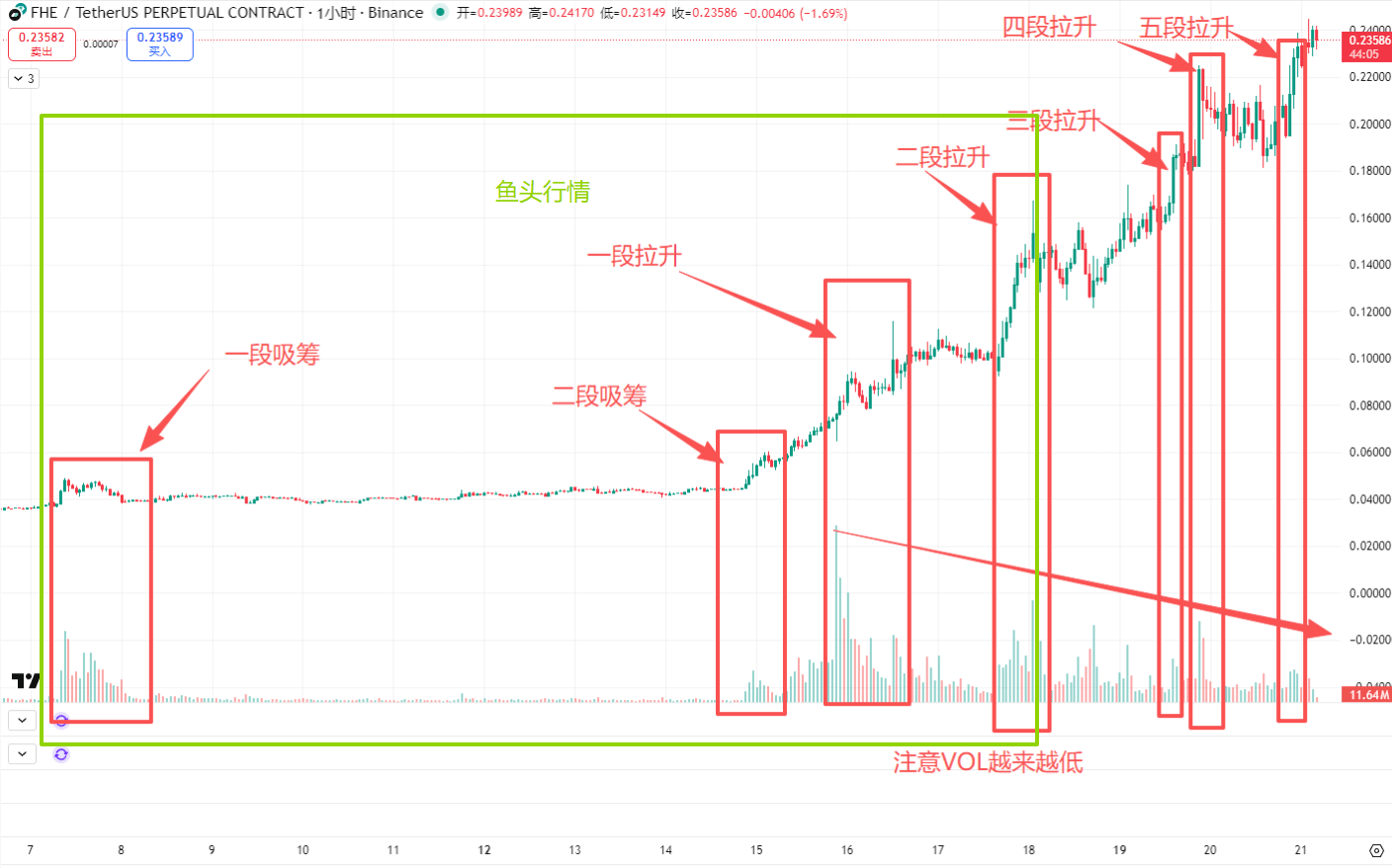
First, in the fish head market during the accumulation phase, you need to have vision (I have a decent vision; basically, I have publicly posted about the recent explosive coins, interested parties can search for themselves; don’t say I post 100 coins a day and shout one; I can only manage to post 10 to 20 altcoins in a month at most). The early stage of the surge requires courage (vision + risk-taking; I personally lack risk-taking).
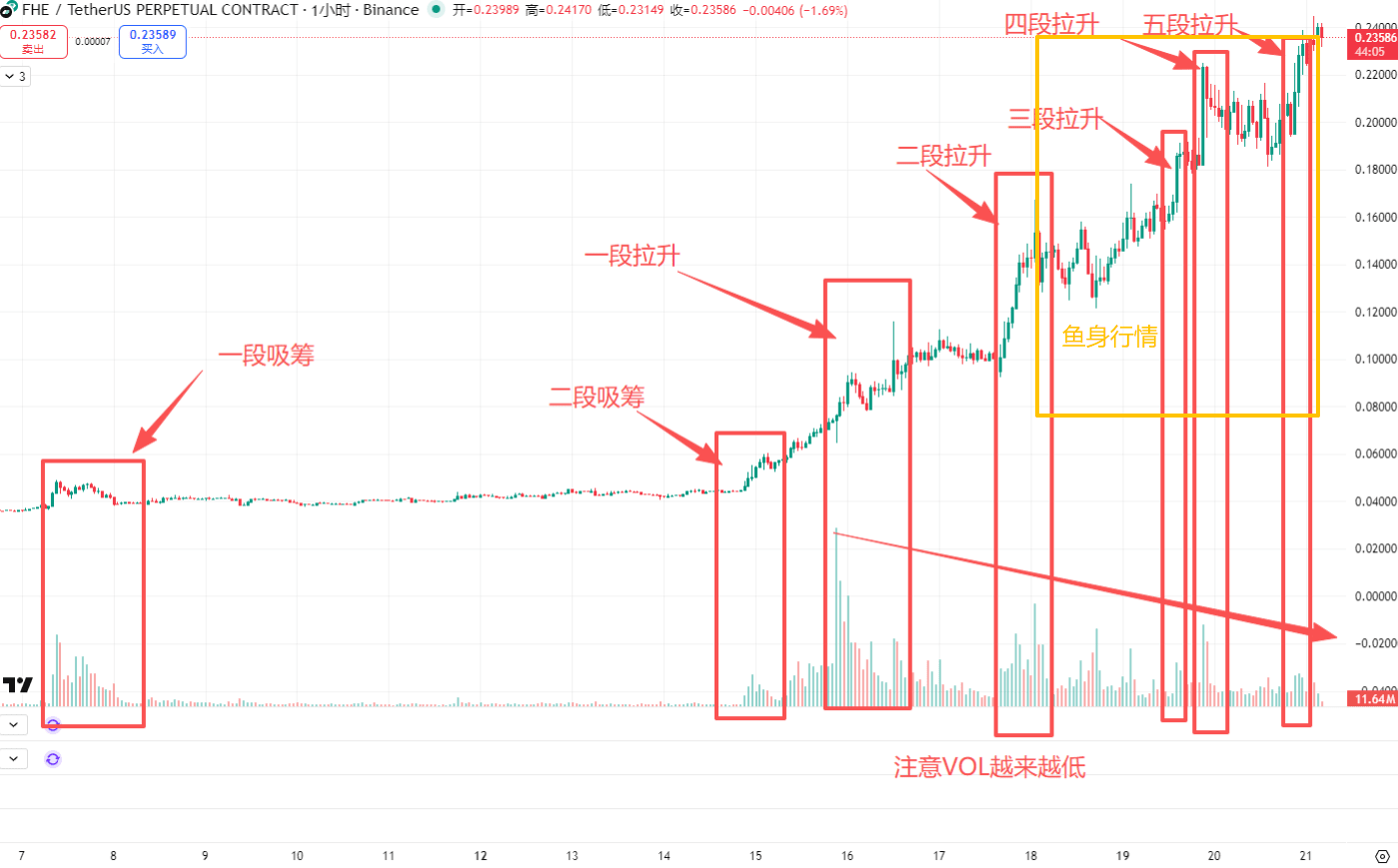
Thus, what we need to discuss is the fish body market, which is also the part with the highest participation from retail investors and an important component of the market maker's profit (important point; I know you like to participate in high-volatility markets).
A large number of retail investors are crowded at the fish head, trying to short at the top. These retail investors have already contributed to liquidity and assisted the market maker during the price surge. The fish body is the critical moment for the market maker to violently intersperse and slaughter the leeks.
Previously, I specifically mentioned the market maker's cost issue. In this early cost phase, the fish head accounts for a large proportion of expenses. After the market maker completes the layout and the market is exposed, they need to start harvesting. This part is simple and straightforward: slaughter liquidity and wash away most of the retail investors (during this phase, you will feel that whenever I go short, you push up the price, and whenever I go long, you smash it).
Here, I want to emphasize the thought process for opening positions.
Taking FHE's second surge market as an example, it is known that the market maker incurred a huge cost in the early stage. So why does the market need to fall? After the second surge, the market maker smashes the market; can they really profit? (The answer is that it is 100% impossible to make money. If they smash after the second surge, they will go bankrupt. After the second surge, in the OI data, the market maker occupies at least a large part. The price difference they create by directly smashing the market can still fill their pockets because the liquidity at this point is simply insufficient; direct smashing cannot cover the costs already incurred).
So what do you think the 20-point price fluctuations you see in the second-stage market are doing?
The market maker cleans up retail investor chips; this is the first profit after initial layout, and the cleaning magnitude will not be very large because at this time, market liquidity is insufficient. If the market maker directly washes violently, the huge price difference created and the market order book will not be easy to control, and they may even be taken advantage of by retail investors (what I want to talk about is how to become someone who takes advantage).
Therefore, in the first stage of market cleansing, the market maker has a short-term price upper limit and lower limit. This range becomes our important price range for trading (during this phase, I do not recommend going short; I highly recommend going long. If you are very good at using stop-loss and can control it perfectly, you can try trading in both long and short).
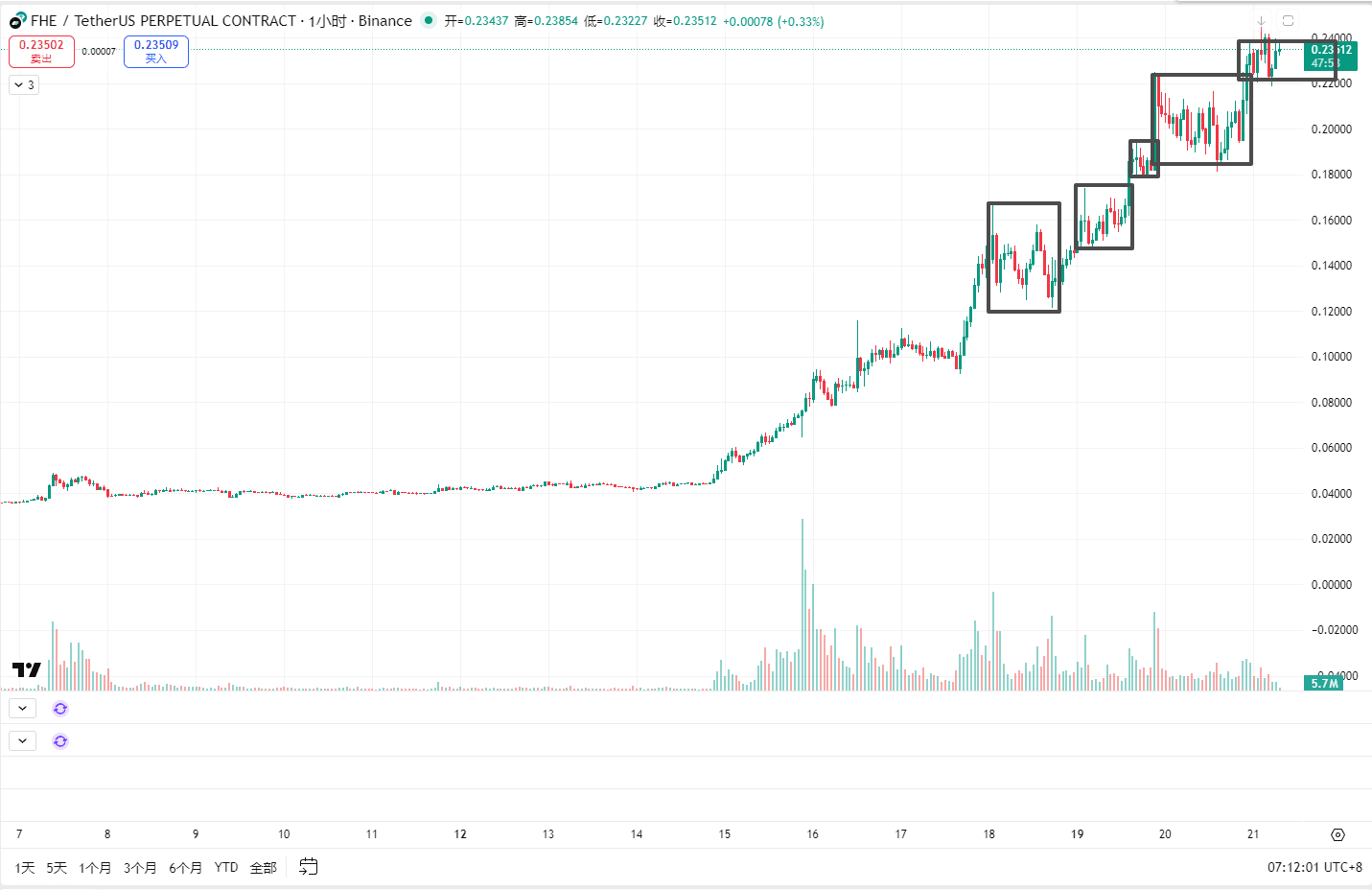
The reasons for recommending going long.
First, the market maker has spent a large amount of capital in the early stage. Directly smashing the market does not make much sense. Moreover, the market maker has a lower limit for smashing the market because they need to maintain control over the order book. If they smash too much, it will disrupt the chip structure they hold, and they might lose control.
Therefore, when you can determine a market as strong and highly controlled with a large cost, you can use the price tops and bottoms after each surge to create a price range, and within that range, enter long positions and make short positions.
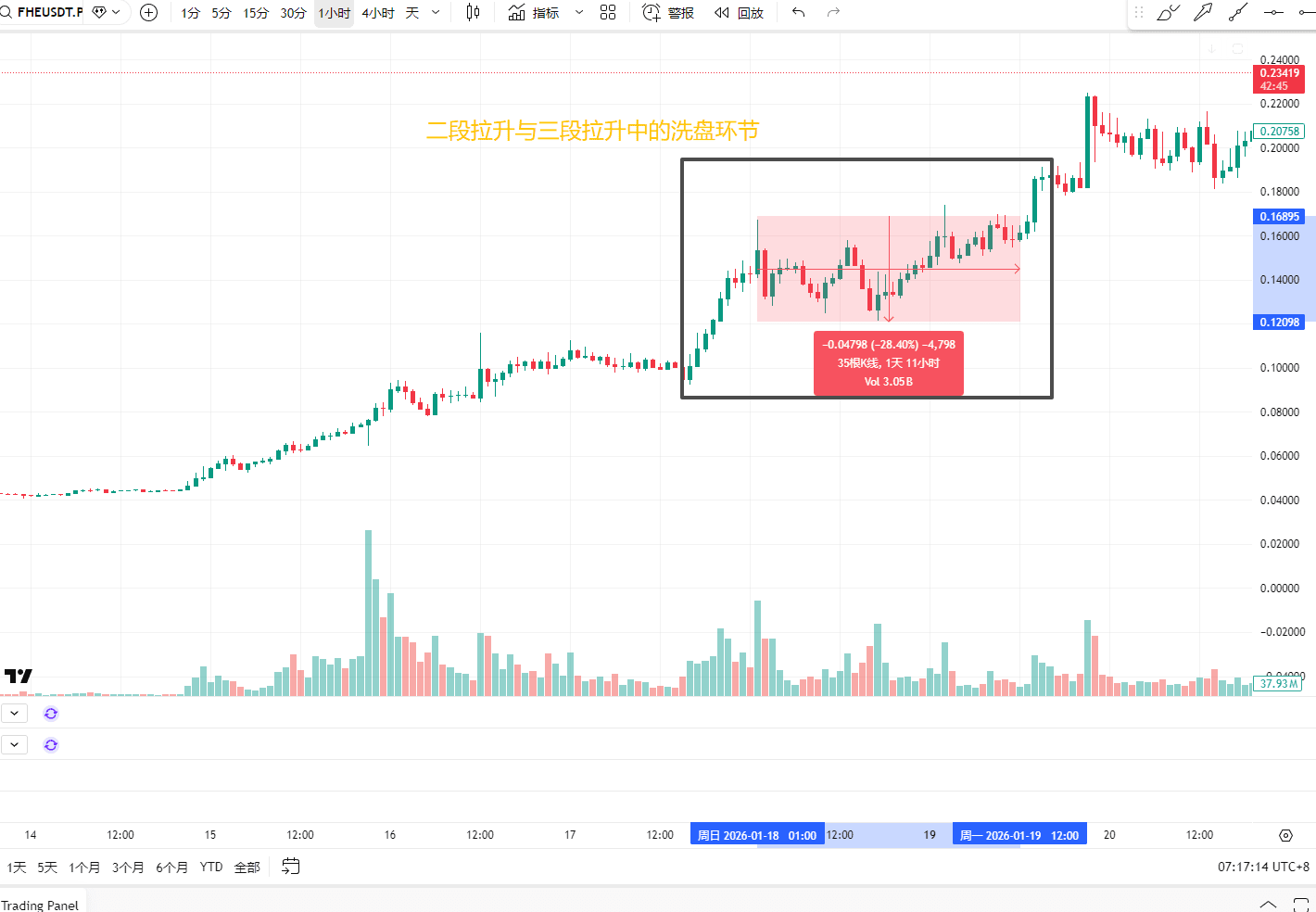
Remember this logical premise: after the market maker spends a large amount of time and capital, directly smashing the market will only lose money, not make money. For these types of altcoins, the earlier the surge and washout phase, the more effective my trading plan is (this is also why I say positions that are 5 times the principal are liquidity suppliers. You make money because of luck, not because of good judgment. This kind of washout can easily fluctuate 20 to 30 points. With such a holding range, you can easily explode). (The premise is that the altcoin you choose is strong enough, and the market maker has enough money and strong control over the chips).
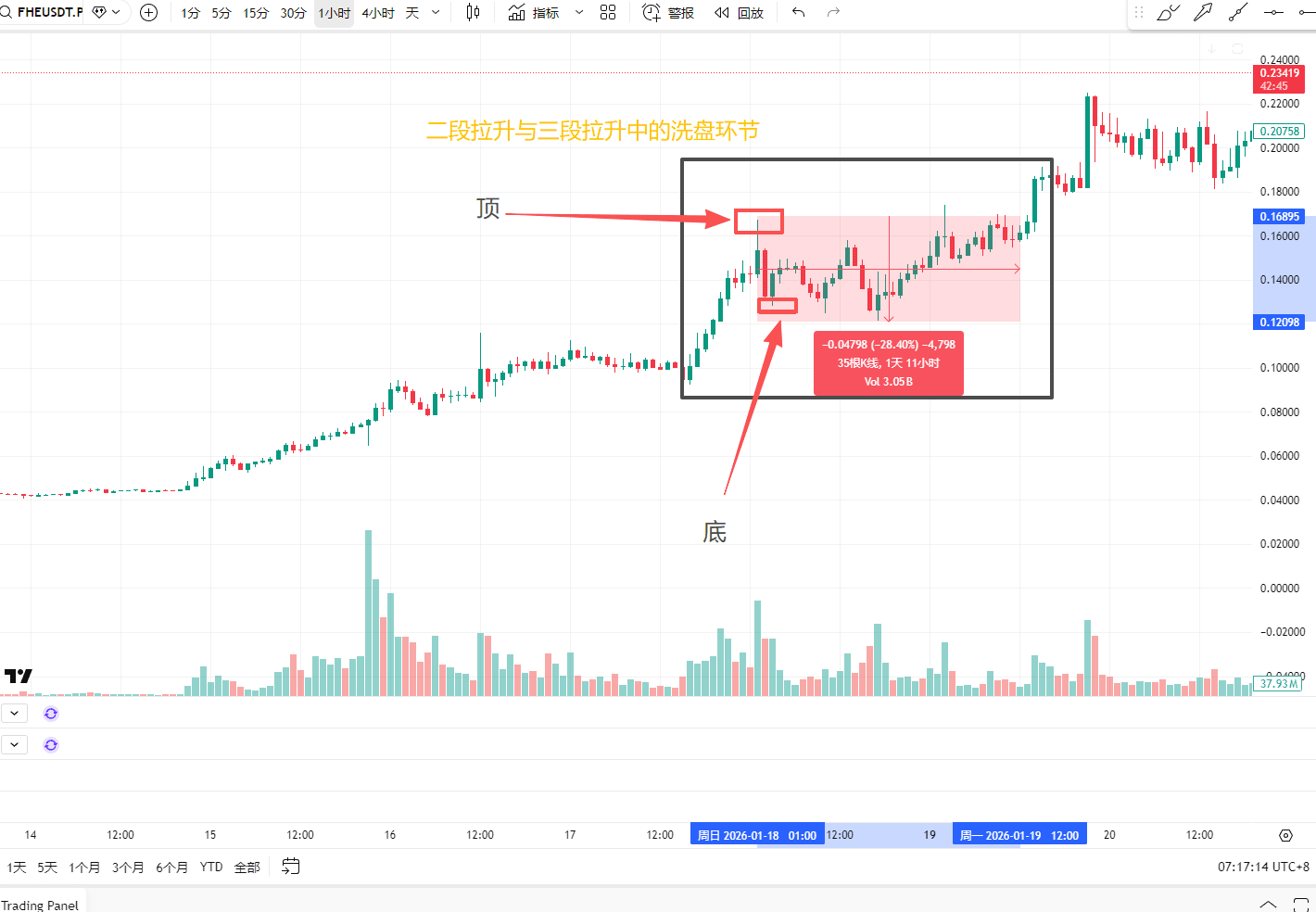
Taking the upper limit of the price surge as the top, the first round's lower limit as the bottom (not every altcoin will be exactly the same; I certainly can’t predict every altcoin, but the underlying principles remain the same. This is market rules and basic trading principles; specific situations need to be analyzed accordingly. Once you’ve entered the threshold, you can look for my analysis of coins; I will provide it). Stop-loss for the tops and bottoms should be 10-15 points (not using stop-loss in altcoins is just looking for losses).
If you are interested, you can backtest some altcoins yourself; PIPPIN, RIVER, ICNT, BEAT are all based on this model.
To summarize again.
The market maker's violent price surge in the early stage cannot obtain sufficient liquidity. They cannot make money during a surge because even if they want to, no one will explode. In the case of a trash altcoin, would you seriously open a large short position? So during the first and second surges, the market maker can hardly make money unless they are some trash market makers who start to wash the market after doing a first and second surge (in fact, large market makers can judge from the early chip structure whether they will perform multiple surges). When an altcoin's early chip structure is very solid, it has the potential for a second surge after a violent price surge because directly smashing the market would lead to losses; this is the market logic of the market maker, which is also one of the reasons I said FHE must surge.
In strong market maker positions, they will hold a large number of long and short positions. Once the market starts to have liquidity, the market maker can completely take advantage of both sides and sell the chips they hold by leveraging retail investors' buying power (this is also one of the reasons for market maker washouts).
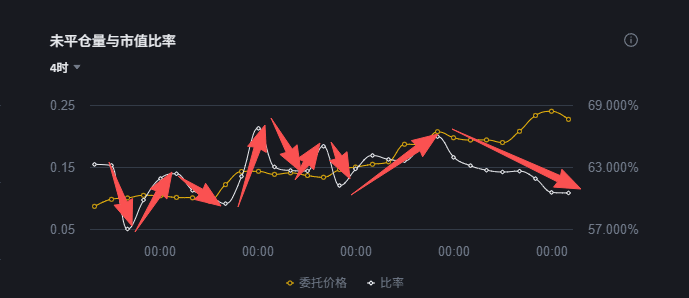
The image clearly shows the market maker's chip cleaning and selling. The early cleaning is very tight; although the price rises later, the chips begin to obviously decrease.
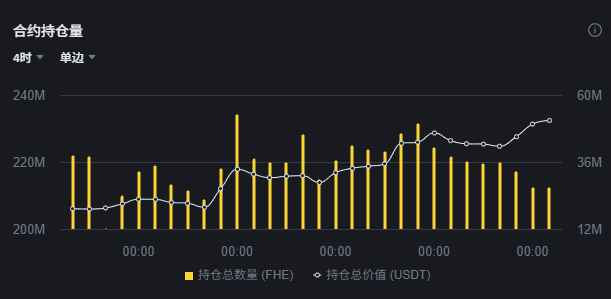
For strong market maker positions, you can follow their liquidity cleansing phase and join them in eliminating retail investors (this requires some skill, which is why this is an advanced altcoin strategy. In any case, you will definitely have to pay some tuition upfront; no one can play contracts without paying tuition. The more you lose, the more skilled you become, or you can just pay tuition to me). The window for strong market maker control will be very short, so don’t learn this if you can only look at the market twice a day; basically, if you don’t monitor closely, you might get wiped out by the next time you check. At this point, don’t blame me; I only discuss logic, not profits and losses.
Retail investors mainly play in the fish body market, which is also where retail investors lose the most money. This contains both the market maker's logic and the psychology of retail gambling. If retail investors do not lose money, why would so many market makers spend millions to set up a stage to perform? Contracts are zero-sum games; the cost of one performance is several million. The market maker needs to recoup multiple times that amount. I have laid out so much in the previous text mainly to clarify the preconditions for the viewpoints in the later text. If you want to learn, I am willing to teach; it’s a mutual willingness.
Additionally, I provide analysis of altcoin markets. Pay me for my time so you can understand your losses.
This article will provide deeper insights into the fish body reversal analysis (after the price reaches the top and bottom, under what circumstances can one enter short or long). This part requires payment; after entering the threshold, all subsequent breakdowns will have a one-time fee.
I am Ruijie. If you find my article helpful, please like and follow; I will continue to provide valuable content.