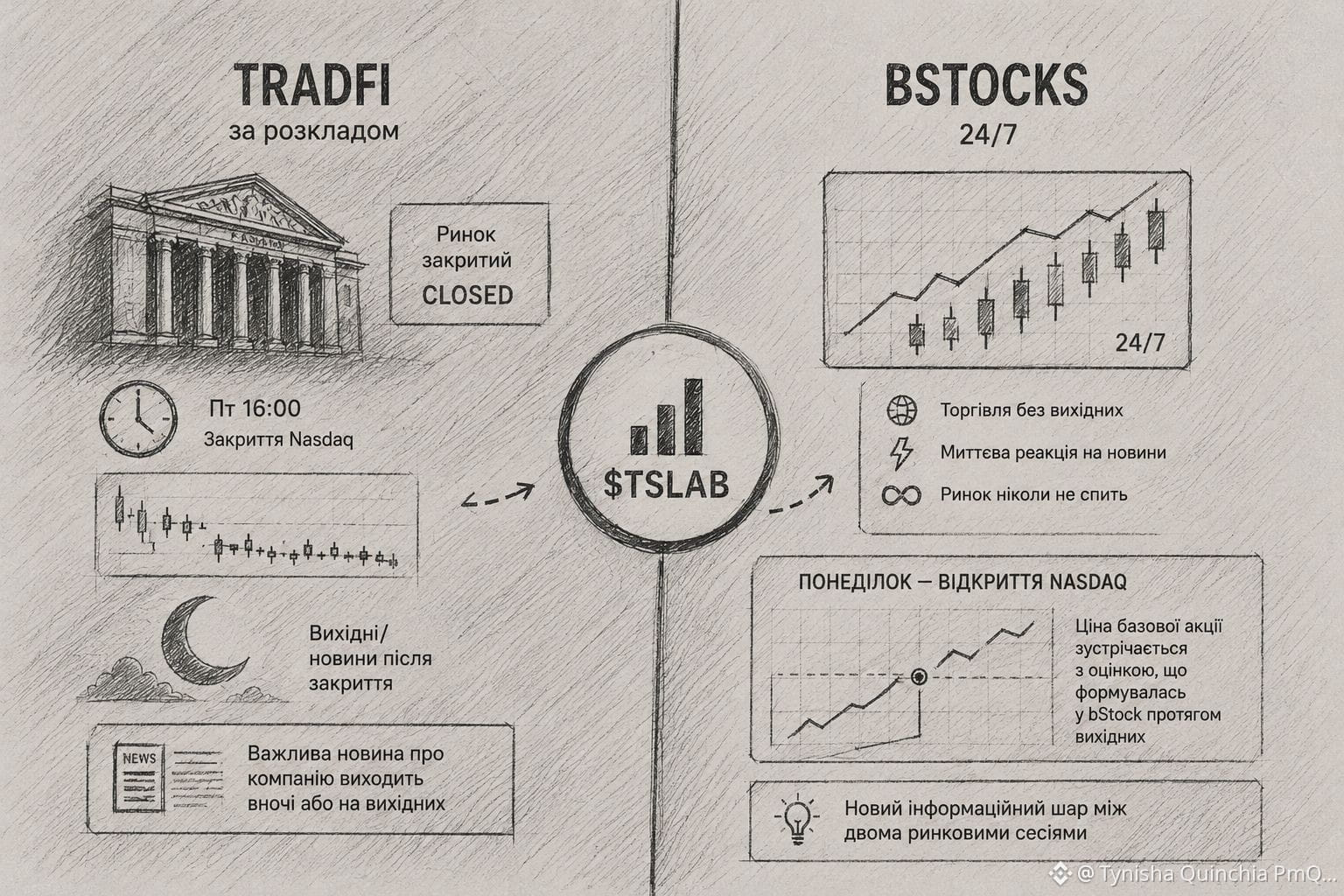
The token trades while the underlying stock is asleep. And this may be bStocks’ most interesting feature.
Imagine it’s Friday after the Nasdaq close. For a traditional investor, the day is over. For $TSLAB — not so.
bStock continues trading on Binance 24/7. And if, on Saturday, news breaks about the company, the market may already react to it— even though the stock itself, on the U.S. exchange, doesn’t yet have a new quoted price.
That creates an interesting setup:
- the real asset — according to the TradFi schedule;
- its tokenized exposure — around the clock.
But the most interesting part happens on Monday.
Nasdaq opens—and the price of the underlying stock meets a valuation that was formed on bStock over the weekend.
In other words, bStocks potentially create not just a “stock that trades 24/7,” but an additional layer of price discovery between the two market sessions.
And that’s exactly why I’m looking at tokenization more broadly.
Could a market that never closes one day become a sort of pre-market for TradFi?
#bstockscis @BinanceCIS $TSLAB