【Why Bitcoin’s Real Bear-Market Bottom Must Be a “Flat Bottom” of Ultra-Low Volatility】
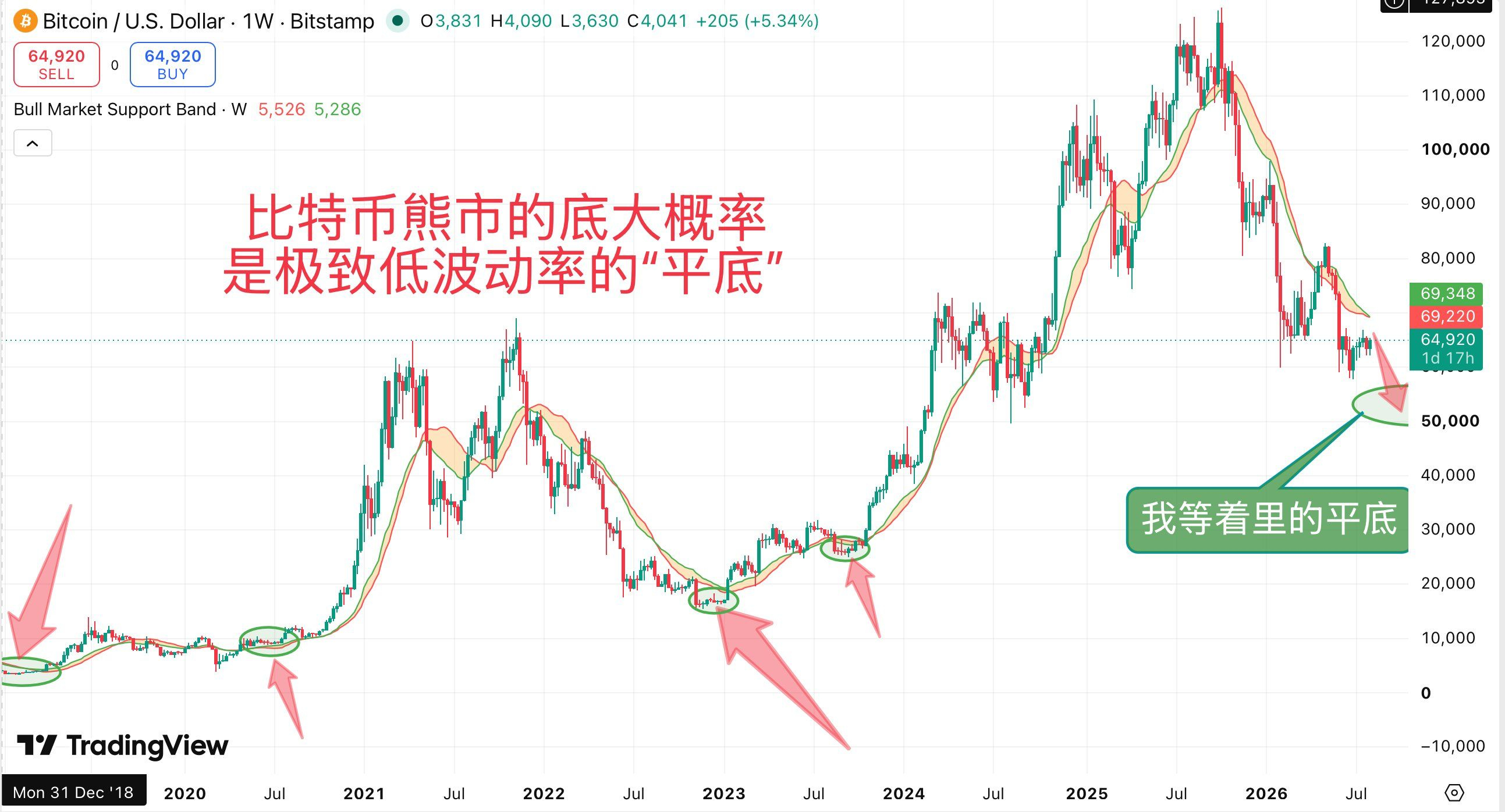
Looking back at the bear-market bottoms of the past two cycles (2018–2019 and 2022–2023), Bitcoin’s true bottom has never been formed by a single, sudden spike downward. Instead, it consistently shows a “flat bottom” structure characterized by ultra-low volatility.
This phenomenon is strongly supported by on-chain metrics and game-theory logic:
The essence of clearing positions: A sharp sell-off (a dimensionality-reduction strike) can only liquidate high-leverage traders and panic-driven orders, but it cannot completely wash out committed long-term holders (LTHs). A real bottom requires time plus extremely narrow-range oscillation to grind down market sentiment. When turnover rate falls to a near-zero level, the SOPR stays below 1 for the long term and volatility converges; then positions shift decisively from short-term hands to long-term hands, and only then can a flat bottom be established.
Liquidity exhaustion and clearing: In a flat-bottom zone of ultra-low volatility, market liquidity becomes depleted. Selling pressure (as Unrealized Loss gradually gets fully realized) and buy pressure reach a very fragile balance—until volatility compresses to a historical extreme, at which point explosive buying power begins to rebuild.
Back to the current market perspective: At the moment, the price location and volatility have not shown “near-zero” characteristics. Considering the on-chain cost-basis structure and the distribution of holdings, the real cycle bottom is likely still at a lower level (e.g., below $50,000). Before the market forms a base, it will most likely need to experience one last, extremely violent final sell-off that fully breaks through the market’s final psychological defense and liquidates remaining dip-buy leverage.
Sell into panic to reveal the true bottom. Waiting patiently for this final washout and the subsequent construction of a flat bottom is the most reliable entry signal for long-term capital.
Looking back at the bear-market bottoms of the past two cycles (2018–2019 and 2022–2023), Bitcoin’s true bottom has never been formed by a single, sudden spike downward. Instead, it consistently shows a “flat bottom” structure characterized by ultra-low volatility.
This phenomenon is strongly supported by on-chain metrics and game-theory logic:
The essence of clearing positions: A sharp sell-off (a dimensionality-reduction strike) can only liquidate high-leverage traders and panic-driven orders, but it cannot completely wash out committed long-term holders (LTHs). A real bottom requires time plus extremely narrow-range oscillation to grind down market sentiment. When turnover rate falls to a near-zero level, the SOPR stays below 1 for the long term and volatility converges; then positions shift decisively from short-term hands to long-term hands, and only then can a flat bottom be established.
Liquidity exhaustion and clearing: In a flat-bottom zone of ultra-low volatility, market liquidity becomes depleted. Selling pressure (as Unrealized Loss gradually gets fully realized) and buy pressure reach a very fragile balance—until volatility compresses to a historical extreme, at which point explosive buying power begins to rebuild.
Back to the current market perspective: At the moment, the price location and volatility have not shown “near-zero” characteristics. Considering the on-chain cost-basis structure and the distribution of holdings, the real cycle bottom is likely still at a lower level (e.g., below $50,000). Before the market forms a base, it will most likely need to experience one last, extremely violent final sell-off that fully breaks through the market’s final psychological defense and liquidates remaining dip-buy leverage.
Sell into panic to reveal the true bottom. Waiting patiently for this final washout and the subsequent construction of a flat bottom is the most reliable entry signal for long-term capital.