


Most projects talk about a burn mechanism—about how much we will burn. I’m more curious about the upstream part: where did those burned tokens originally come from? Rayls’s design answers this in a way that surprised me—it starts with a fiat payment.
First, the conclusion. The starting point of the entire chain isn’t in the world of encryption; it’s a fiat payment issued by an institution in its own country.
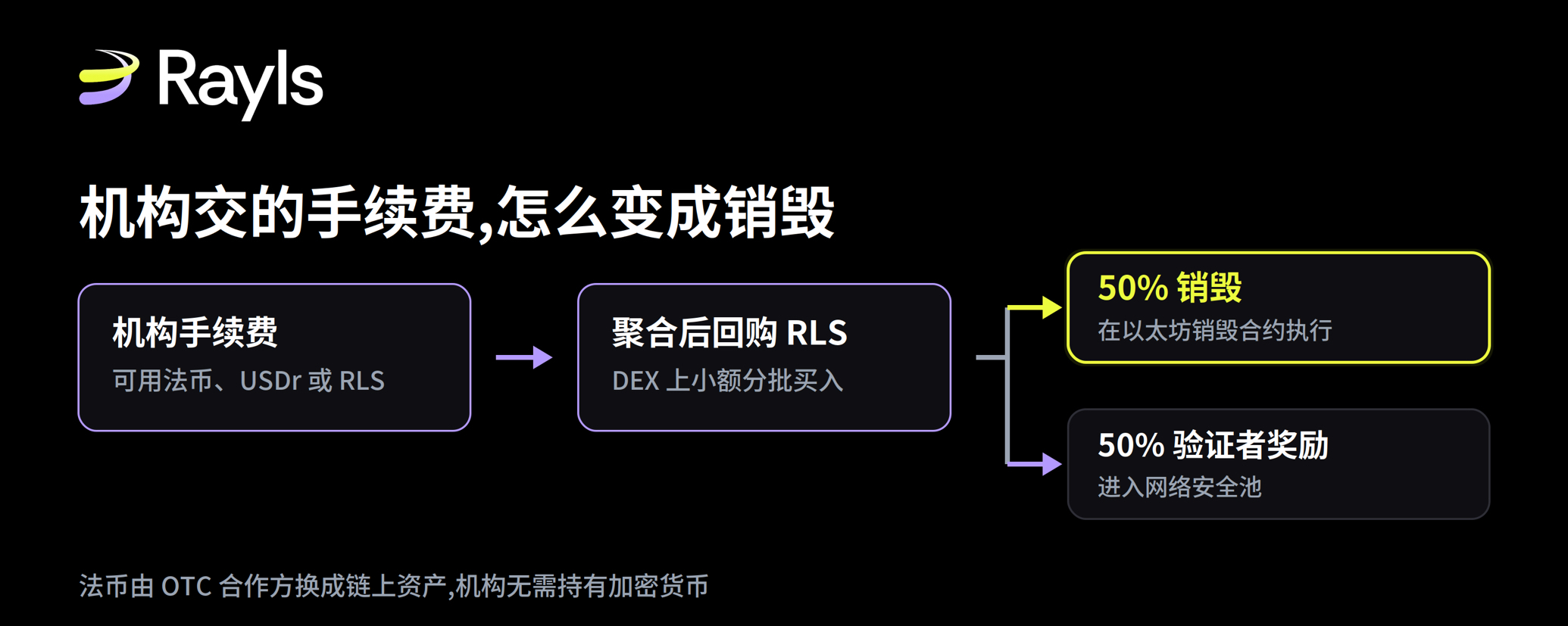
When an institution conducts business on Rayls through privacy nodes, it generates fees. The key design is that they can settle directly in fiat, or choose to use USDr or RLS.
This part is easy to gloss over as a minor detail, but in reality it solves the most practical hurdle in institutional rollout. Compliance, finance, and audit processes generally don’t want crypto assets to appear on the balance sheet, and holding the coins themselves is something that requires additional explanation. Allowing payment with fiat effectively moves this hurdle away from the customer.
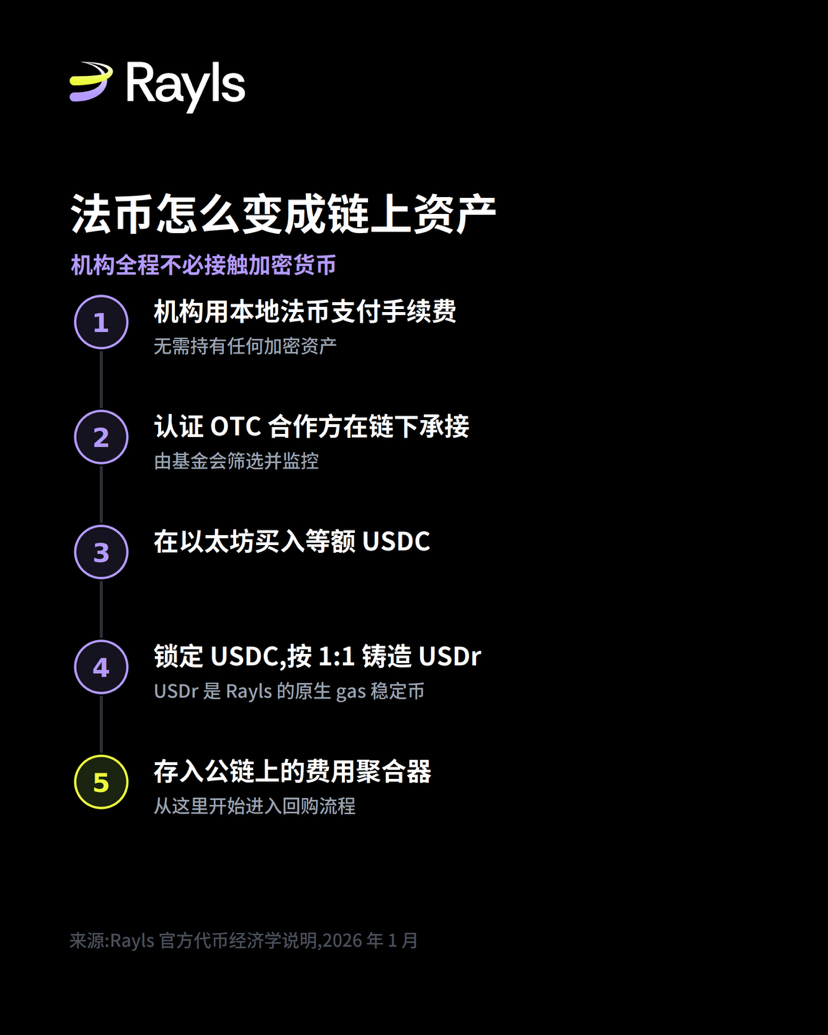
How does fiat become an on-chain asset?
This section is the most concrete part of the entire mechanism; the official documentation is very clear.
OTC partners certified and monitored by the foundation take custody of this fiat off-chain. Using USDr as an example: the partner buys an equivalent amount of USDC on Ethereum, locks that USDC, then mints USDr 1:1 on the Rayls chain and deposits it into the fee aggregator account.
USDr is Rayls’ native gas-backed stablecoin, and the value backing it is that locked-up amount of USDC.
These OTC partners operate by region and are responsible for receiving local fiat in their local markets. The official also says they will publish a registry of partner address registrations on the public chain, so anyone can track the inflow of institutional fees.
Why does the buyback need to be broken into small random executions?
The aggregator holds both USDr and RLS. USDr is exchanged into RLS via a DEX; this step is what’s called an automatic buyback.
In my opinion, the execution method is more worth talking about than the ratio. The official explicitly states that the exchange will be split into multiple smaller transactions, executed with randomization, and with strict slippage constraints.
The reason is very practical. If the buyback were a scheduled, fixed-amount large purchase, MEV bots and frontrunners could easily predict it and set up positions in advance—the protocol would basically be handing them money. Splitting it into small amounts and executing at random time points greatly reduces that arbitrage space.
The official explanation is that using smaller day-to-day exchanges combined with strict slippage can deepen the order book and dampen volatility—rather than creating predictable buy spikes.
In the early stage, this buyback is triggered manually on an irregular schedule—again to avoid being predictable. In the future, it will shift to a two-layer strategy: one layer is a deterministic framework that decides when funds are eligible to be passively used based on conditions like account balance thresholds; the other layer keeps the execution itself randomized and executed in batches.
Half goes to burning, half goes to validators.
The RLS from the buyback is split into two parts. 50% is sent to an RLS burn contract on the Ethereum mainnet, permanently removed from circulation; the other 50% goes into the network security pool as rewards for validators.
The burn is executed on Ethereum because RLS is minted there initially. The portion to be burned stays in the contract; its status is publicly visible, and then bulk burns occur when the term expires.
The 50% figure is a fixed ratio at launch, not a permanent setting. The official says it will be adjusted in the future according to two variables: how much of the original supply remains, and the price of RLS. As supply decreases, the burn ratio will be lowered accordingly, with the goal of smoothing the entire economic curve rather than creating drastic volatility.
The other half that isn’t burned is currently used entirely for validator rewards. The official notes that only after the network security pool is large enough to be self-sustaining will they consider allocating a portion to ecosystem building and foundation operations. The allocation ratio is adjusted in stages based on network maturity: in the early phase, prioritize security; during the growth phase, increase ecosystem investment; in the mature phase, strike a balance.
If you want to track it yourself, you can look at these places.
The transparency portal lets you look up the cumulative amount burned. As of August 8, the cumulative burn is 48.247 million RLS, which is 0.48% of the initial total supply of 10 billion.
The burn contract on the Ethereum mainnet allows you to see both the portions pending burn and those already burned.
If the OTC partner address registry goes live as the official says, that would be the most valuable place, because it reflects the actual inflow of institutional fees—i.e., the fuel for the whole mechanism.
One thing to note
This tokenomics document was published in January 2026, before the mainnet went live in April of the same year. Many parts in the article were plans at the time—such as the deterministic triggering framework, the allocation model adjusted by maturity level, and the transition of validators from permissioned governance to DAO governance. For what’s already been implemented versus what’s still being developed, it’s recommended to verify against the latest announcements—don’t treat the old document as the current state.
My take
In this model, the smartest part, in my view, is not the burn ratio—it’s the fiat on-ramp.
It allows institutions to pay exactly in the traditional finance way—without touching crypto and without changing their financial processes—while their business volume still translates into real buy demand for RLS on-chain. For a chain that primarily targets the institutional market, this design is more critical than any burn number.
And precisely for that reason, the factor that determines how strongly this mechanism operates is never the burn ratio itself, but how many institutions upstream are truly using it. How much gets burned depends on how much is used.
Reference sources: Rayls official blog (Rayls Tokenomics: Automated buybacks, burn, and the Rayls Reserve) (Peter Bidewell, January 19, 2026); Rayls transparency portal (data as of August 8, 2026)