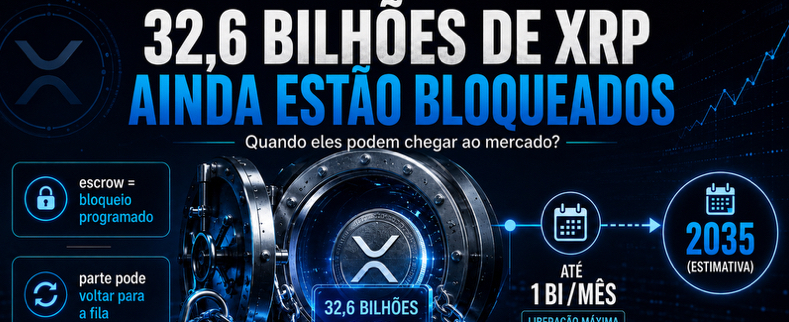

This question came up in a comment on one of my posts about $XRP . I found the point interesting and decided to look at the numbers and make a projection based on the scenario we have today.
A $XRP it was created with approximately 100 billion tokens.
According to Ripple, on 30/06/2026:
➡️ 62.33 billion XRP already distributed
➡️ about 5.06 billion are in Ripple’s own wallets, outside escrow (scheduled lock)
➡️ 32.6 billion were still locked in escrow
📌 How does this release work?
1 billion XRP is unlocked per month and becomes available to Ripple.
But that does not mean 1 billion new enters the market every month.
Ripple keeps part of it outside escrow and the rest is locked again at the end of the queue, for FUTURE RELEASE.
*** PROJECTION CALCULATION:
From March 2025 to June 2026, that is, 15 months, the locked balance fell by about 4.53 billion XRP.
This represents an average net reduction of nearly 302 million XRP per month.
In practice, although up to 1 billion is unlocked monthly, looking at this average, about 700 million per month end up returning to the escrow mechanism.
📊 So, when could the remaining 32.6 billion leave escrow?
If the balance continues decreasing at the same average rate of approximately 300 million XRP per month, it would take about 9 years:
➡️ Projection: approximately 2035.
Important: 2035 is NOT an official Ripple date. It is MY mathematical projection based on the observed net pace.
If a larger portion returns to being locked, the net reduction will be smaller and the timeline could extend beyond 2035.
There is also the XRP Ledger transaction fee burn, which permanently destroys small amounts of $XRP . It reduces supply over time, but today its impact is very small compared with tens of billions of tokens.
For me, this exercise shows why, when talking about price projections for XRP, it is NOT enough to look only at the unit price.