
Today is January 19th. I saw a statistic from the Bureau of Statistics, and I have some feelings about it. However, this is a sensitive topic, so I will try to analyze it from an economic perspective. This is just a rational discussion, please do not delete it.
1.
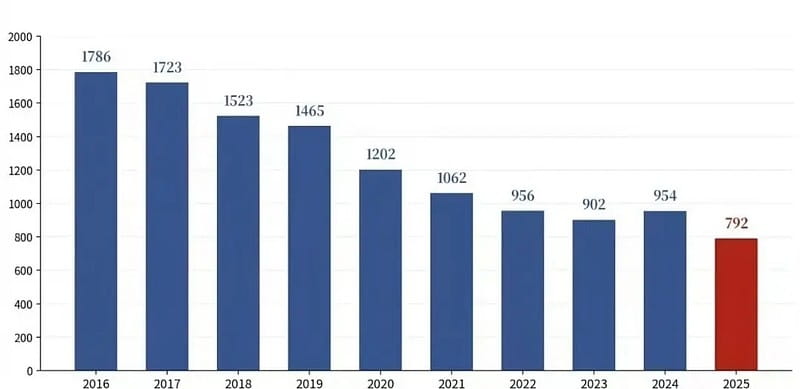
In 2025, China's new population will be 7.92 million, falling below 8 million, marking the lowest historical point since 1949.
According to this calculation, China's total fertility rate in 2025 will be 0.91, a decrease of 0.17 compared to 1.08 in 2024.
Currently, the country with the lowest birth rate in the world is South Korea, at only 0.72, firmly ranking last globally. China's data can probably rank among the bottom 10 in the world.
Two,
To explain, the birth rate represents the average number of children a woman has in her lifetime, and 2.1 is the replacement level needed to maintain a stable population.
Among the ten regions with the lowest fertility rates globally, six belong to the East Asian Confucian cultural circle. This indicates that, aside from economic factors, the unique characteristics of this cultural circle, such as 'high investment in education,' 'extreme competition,' and 'family responsibility' models, may have become the strongest inhibitors of fertility in modern society.
Three,
Why is everyone reluctant to have children? A few examples from around me make it clear.
The first case, a relative recently developed anxiety and went to another city for hospitalization.
The reason is that their son doesn't study well, exhibits a laid-back attitude, seems not to have attended university, and is now doing security work or something similar. The relative worked hard all their life to earn money, but they never expected their son to turn out this way, which led to depression.
The second case is also a child from a relative's family. The family bought a house for him, but he is now in his 30s or 40s, working through a relative's introduction, earning 3000 or 4000 in a first-tier city, and unable to find a wife.
After dating a few girlfriends and spending quite a bit of money, needing to buy a phone and other things, it feels like they were just after his money, and now that he can't offer much, they have also left.
The family is also worried.
The third case is a child from an acquaintance's family.
Two children from an acquaintance's family are both unemployed in middle age, now in their 40s or 50s, and are together relying on their elderly parents' pensions.
There are also some hidden forms of relying on parents, such as some acquaintance's children who go abroad to study music, art, and other majors, with tuition and living expenses amounting to millions, unable to stay abroad, returning home to earn a few thousand a month.
The economic returns are negative no matter how you look at it.
Four,
So it is very clear why everyone is reluctant to have children; it is due to the massive changes in social models and economic structures.
Why could people have children in the past?
Because it was an agricultural society at the time, children were 'productive resources' with low expenses. As long as there was enough food, there was no need for expensive houses in good school districts or tutoring classes.
Children could start working at a very young age, providing labor.
Functionally, raising children serves as a safeguard against old age. Children are a natural source of retirement insurance and cash flow.
Conclusion: In an agricultural society, having children is a high certainty positive return asset.
Why are modern people reluctant to have children?
In a post-industrial society, children have become 'durable consumer goods' or even 'liabilities.'
Capital expenditure is extremely high. In first- and second-tier cities, the prerequisite for having children is often owning a high-priced property with a good school district (the entry ticket), which requires a huge initial investment.
Operating costs are extremely high and rigid. Educational competition has led to an 'arms race'; to prevent children from falling in social status, a large amount of money must be invested in 'research and development' (tutoring, special skills).
The cost of raising children in China relative to GDP (about 6.9 times) ranks among the highest in the world.
Cash flow: Long-term negative. This is the famous 'four-legged cash-eating beast.'
Exit mechanism: Invalid. Modern retirement relies on social security and assets, rather than children.
After children become adults, they may even require 'six wallets' to support buying a house, which not only does not provide cash flow but also requires additional investment.
In investments, if a project has a high risk, investors will demand a very high rate of return; otherwise, they won't invest.
Currently, educational investments no longer guarantee returns. In the past, 'getting into university' equated to 'financial freedom/social mobility'; now, degrees quickly depreciate, and graduating from prestigious universities may just mean becoming a 'consumable' in a major company or facing unemployment.
As far as I know, even in first-tier cities like Shenzhen, many graduates can only earn around 4000, barely making ends meet. I know some master's graduates from New National and Nanyang Technological University, ranked in the top 20 by QS, who also cannot find jobs, earning a few thousand a month.
Don't think it's unbelievable; this is the reality.
Investing millions in raising a child, sending them abroad to a prestigious university, may ultimately result in an ordinary worker earning a few thousand a month, with a P/E (price-to-earnings ratio) that is too high, simply a market dream rate, with valuations that cannot be digested.
In the current macroeconomic environment, ordinary people have calculated that holding cash or investing in themselves yields much higher risk-adjusted returns than investing in the 'next generation.'
This is an extremely rational market choice and a projection of 'high-net-worth pragmatism' at the population level.