


When I look at lockup announcements, they usually only care about one thing: whether this commitment can be verified. Most projects’ “team lockup” ultimately comes down to a single sentence—you either choose to believe it or you don’t. This time is a bit different, so I checked on-chain.
First, let’s state the facts clearly. Parfin is the core technology provider behind Rayls. It is responsible for developing privacy nodes, the private network, the Enygma privacy framework, and the Rayls mainnet. As compensation for its work prior to the TGE, it received 1,070,493,535 RLS tokens—about 11% of the initial total supply of 10 billion.
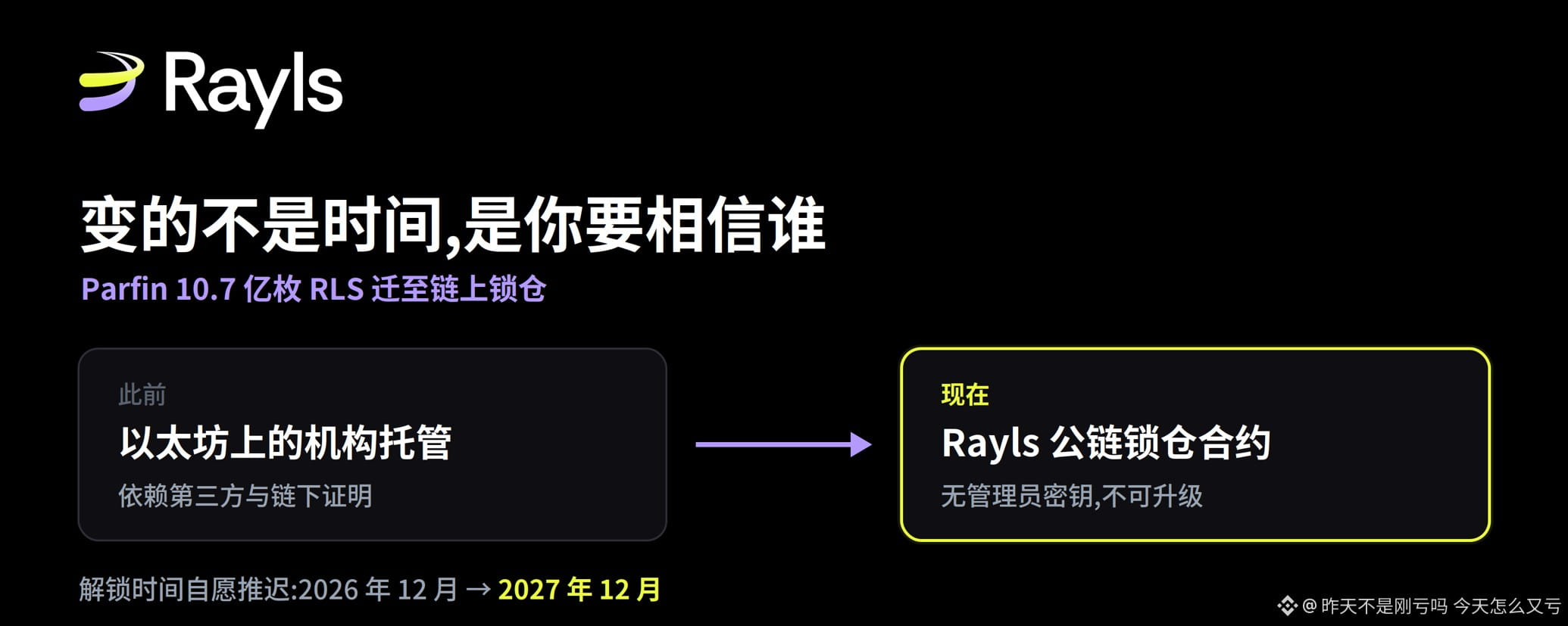
This batch of tokens was previously held by an institutional custodian on Ethereum. The reason is straightforward: at the time of the TGE, the Rayls chain hadn’t gone live yet, so the tokens could only be held in custody. Now that the mainnet is available, this batch has been migrated to the Rayls chain and locked in a smart contract that can be publicly verified. At the same time, the unlock date has been pushed back from December 2026 to December 2027.
The official statement also makes one thing clear: this extension is not required by the contract—it’s a proactive choice.
The real change is in the “object of trust.”
The token amount hasn’t changed, and the holders haven’t changed. What’s changed is what you’re supposed to trust that it’s actually locked.
The old model was: trust a custodial institution, and trust the off-chain proofs it provides. That’s standard practice in traditional finance, but its credibility depends on the third party’s reputation and processes.
Now the model is: that contract has no admin keys, and it can’t be upgraded. The lock-up terms are hard-coded on-chain—immutable and auditable by anyone. In other words, Parfin itself has no switch to change the terms mid-way or allow early withdrawals.
This is the most worthwhile part, in my view. If a commitment requires you to trust the trustworthiness of the person making it, then it’s still just a promise. But if it’s written into immutable code that everyone can verify, then it becomes a constraint.
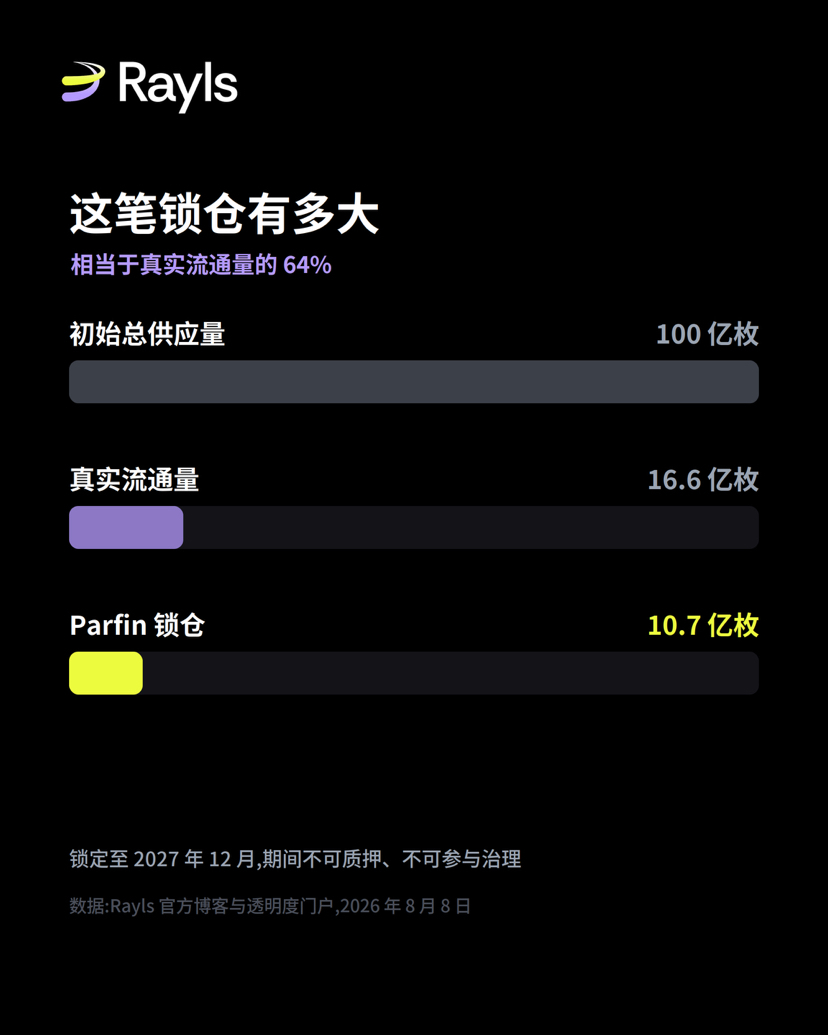
By the way, during the lock-up period, these tokens can’t be used for staking and can’t participate in governance. This is easy to overlook, but it means this amount won’t turn into voting power or network rewards before it unlocks.
How can you verify it yourself
This is the most practical part of this announcement, and it doesn’t require any technical background.
Rayls’s official blog directly gives the contract address: 0x1463889D3a5EAAEE3f066d1CF438A8957F7Db98E. Open this address on the Rayls block explorer (explorer.rayls.com). You can see the locked balances and the unlock parameters, and you can also inspect the contract itself.
My recommendation is to focus on three things: whether the locked balance matches that figure of 1.07 billion tokens; whether the unlock time is December 2027; and whether the contract has admin privileges or an upgrade entry point. The first two are obvious at a glance—the third is in the contract code.
The point of this action is that you don’t have to trust anyone—including me. Just look for yourself.
How big is this amount, really?
1.07 billion tokens sounds abstract—put it in context and it becomes clear.
Based on the transparency portal’s data for August 8, the real circulating supply of RLS is about 1.66 billion tokens. That means the size of this locked position is roughly 64% of the current real circulating supply. I calculated this ratio myself using portal data, not an official metric—but it shows the weight of this amount in the overall market.
Based on the price of $0.0020133 at the time, this batch of tokens is worth about $2.16 million, which matches the official blog’s “about $2 million.”
But there’s a potential misunderstanding to avoid. This operation isn’t pulling tokens already in circulation back and locking them—it’s pushing back unlocks that were originally scheduled to start in December 2026 by one year. What it reduces is the potential supply pressure in the coming year, not the current circulating supply. This distinction is important, and it’s easy to gloss over when reading the announcement.
Put it in the bigger picture
From the start, Rayls’s token design used a relatively long vesting schedule. Most non-community allocations have a one-year cliff and multi-year unlocks; at TGE, only 15% of the supply enters circulation. In addition, in the network’s economic model, half of the fees generated by privacy nodes, private networks, and the public chain are converted into RLS and destroyed, and the other half is used for validator rewards.
These are what the official blog says—can it actually produce real effects? That still depends on the true usage and whether the real destruction will keep up. In my previous analysis, I looked at the data: right now, the absolute amount being destroyed is still relatively small compared with the token unlock schedule. So what’s worth tracking most is whether institutional usage can drive fee growth.
My conclusion
The scale of this is not that large—two-plus million dollars isn’t much in the crypto world. But it demonstrates a better practice: replacing “trust us” with “go check for yourself.”
For ordinary holders, verifiability is more real than any statement. Next time you see any project announce a team lock-up, you can simply ask: What’s the contract address? Are there admin keys? Can I verify it myself? The difference between those who can answer and those who can’t is completely different.
Reference sources: Rayls official blog (Parfin Extends $RLS lock-up by one year and migrates allocation onchain to Rayls) (Alex Buelau, August 6, 2026 AMA); the Rayls block explorer contract page; Rayls transparency portal (data as of August 8, 2026)