


If you play physical card games (like Pokémon, One Piece TCG, etc.), you’ve probably had this experience: buying a card may take only a few minutes, but waiting for shipping and then waiting for the card often takes up to half a month.
Once high-value graded cards need to change hands frequently in the secondary market, the traditional process starts to feel rather cumbersome. Every transaction involves packaging, buying insurance, shipping via international courier, clearing customs, and then having the buyer unbox to inspect the item.
Shipping back and forth costs more money, and there’s also the risk of damaging the graded case—scratches, or even loss.
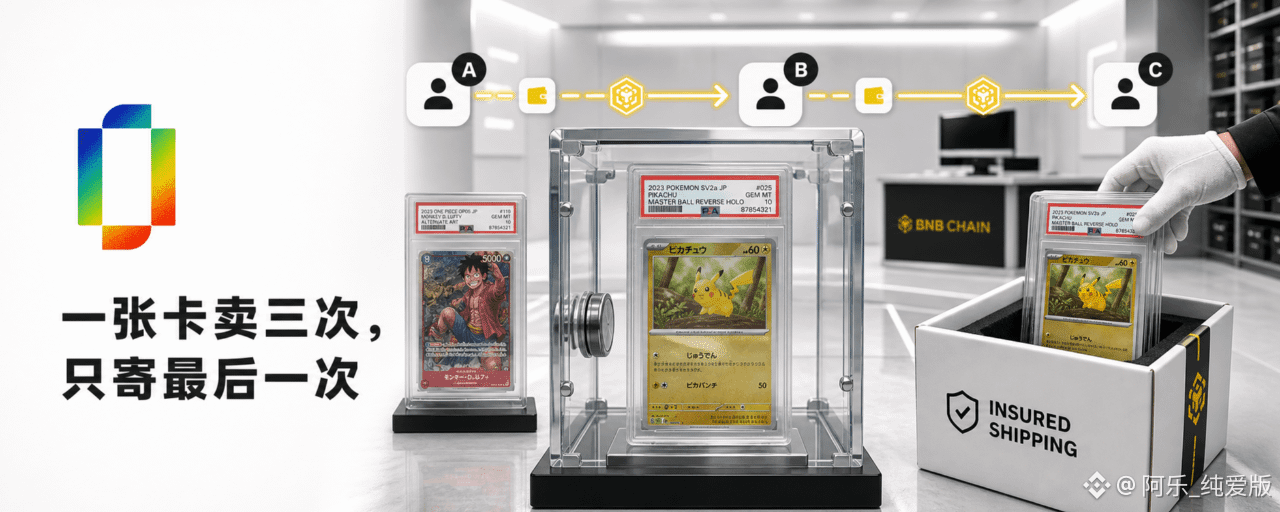
After experiencing the Renaiss Protocol ( @renaissxyz ), I feel that its approach to RWA for tangible collectibles is very straightforward: it separates “ownership transfer” from “physical shipment”—“a card can be sold three times, but only the last one is shipped.”
This logic perfectly matches Renaiss’s core product features and reflects its real value to the ecosystem.
1. Separate “ownership” from “shipping”: traditional model vs on-chain custody
Suppose a Pokémon grading card changes hands three times in a short period:
Traditional physical model: Sell once, ship once. Each time the card changes hands, it must be packed and sent by courier, wait for customs clearance, and then unboxed for inspection. If the transaction happens three times, you have to go through logistics three times. Courier fees and customs duties alone are a substantial expense, and the process can take weeks.
Renaiss on-chain custody model: The card is first stored in a partner physical vault. After PSA authenticity verification, high-definition photography, and on-chain attestation, the next three buy-sell transactions are all completed on-chain. The card stays in the vault and doesn’t move; what changes is only the card’s ownership. Ownership can be transferred instantly on-chain (and gas fees are also very cheap). Only when the final buyer wants to take the card into their hands to put into their display cabinet is a real physical shipment initiated.
Three sales, shipped only once. There’s no logistical wear and tear in between, and no need to wait around like a fool.
2. Product features that support this scenario
To achieve “multiple trades, only one shipment,” you need a coordinated on-chain and off-chain mechanism behind it:
RenaissOS (Verifying Hosted Infrastructure): When the card is first placed into the vault, the node signs on the BNB Chain to confirm, creating an on-chain record that includes the PSA’s real certificate number, high-definition detail images, and the vault location. Buyers don’t need to worry about the question of whether the card is really “in the vault.”
P2P Marketplace and Buyback (market and fast repurchase): Ownership can be transferred directly on-chain. If a seller urgently needs funds, they can also call the Buyback feature provided by the market-making vault to exit with quick monetization at a price calculated by an algorithm.
Renaiss Layer (physical fulfillment layer): When the last buyer chooses Physical Redeem, the Renaiss Layer takes over order fulfillment, insurance coverage, and international shipping, synchronizing the tracking number to the chain to complete the physical delivery.
3. What benefits does it bring to everyone in the ecosystem?
“Sell three times, ship once” not only removes the hassle of logistics, but also brings benefits to everyone across the real-world collectibles ecosystem:
For players and traders: It eliminates pointless shipping costs, customs duties, and the risk of card wear and tear. It also cuts down what would normally take weeks of logistics waiting into on-chain confirmations that take only seconds—so capital turnover becomes much faster.
For local card shops and vaults: Card shops and vaults are no longer just passive storage facilities—they become validation nodes on the chain. They can earn custody fees and node service fees, and they can also showcase their offline inventory to global Web3 buyers.
For the BNB Chain ecosystem: Behind this is $1:1$ real-world assets that actually exist, certified by authoritative institutions such as PSA/BGS. It brings the massive community of card players and capital from the real world onto the chain, providing the market with assets backed by real physical items.
4. Summary
The significance of RWA (real-world assets) collectibles isn’t about repeatedly shuffling every card back and forth in shipping boxes; it’s about using blockchain to eliminate unnecessary transportation.
Buy and sell multiple times, ship only once—this straightforwardly demonstrates Renaiss’s practical value. It gives physical collectibles transaction speeds like digital tokens, while also preserving the safety of being able to pick up the real item at any time.