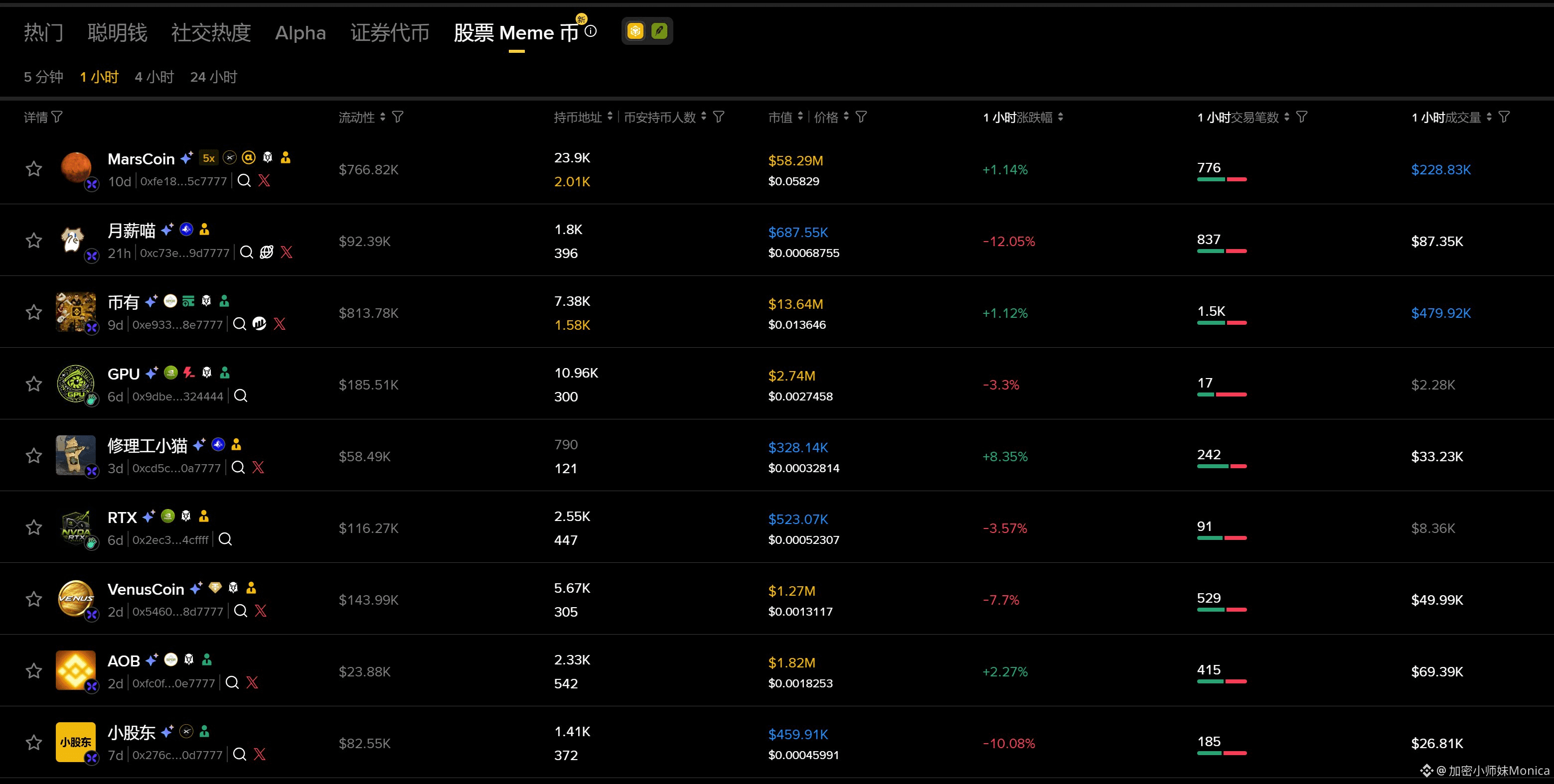
Recently spotted a pretty interesting new玩法 on BSC: stock Memes.
At the end of July, Four Meme launched the Stock Meme feature, allowing projects to use tokenized bStocks assets as trading pools. The first supported asset was Nvidia-related NVDAb.
After that, Binance Wallet launched a “Stock Meme Heat Ranking,” starting to track related projects on BNB Chain and Robinhood Chain. A set of corresponding tokens also appeared in the market:
MarsCoin ($MarsCoin ): pairs with the SpaceX narrative, with the trading pool using SPCXB
GPU ($GPU): pairs with the Nvidia and AI narrative, using NVDAb
JACKET ($JACKET): uses NVDAb as well
BIYOU ($BIYOU): pairs with the S&P 500 narrative, using SPYB
So that’s why they’re called “stock Memes.” The name has stocks, but there are no stocks in the wallet.
How do they make money? Some people profit from the coin price going up, while others profit from trading tax dividends.
For example, there’s a 3% tax on buys and sells. The project team uses the tax revenue to buy another token, then distributes it to holders. The more trades there are, the more tax is collected, making the dividends look higher.
But I think the easiest thing to misunderstand here is this:
Dividends usually don’t come from the company’s operating profits. Instead, they come from the transaction fees/taxes generated by on-chain trading. The higher the trading volume, the larger the tax source; once the trading volume disappears, dividends quickly shrink.
My understanding is that in the short term, these projects can indeed be quite “hot,” because they stack Meme, US stocks, AI, RWA, and the Binance ecosystem together, with high propagation efficiency.
However, their risks are also more complicated than ordinary Memes:
High buy/sell taxes can eat away at returns;
So-called dividends are not stable and essentially depend on trading volume;
Whether the stock tokens have sufficient reserves, redemption rights, and holder rights needs to be confirmed point by point;
but Meme tokens themselves do not represent company equity;
Contract permissions and tax-rate changes can both affect holders’ interests.
If I were to participate, I wouldn’t first look at how high the APY is. I’d first confirm three things:
Whether the contract address comes from the official entry point, and whether the contract permissions and tax rate can be checked— and whether they can be changed;
Whether normal buying and selling are possible;
Whether the dividends have genuine on-chain records.
The biggest fear for projects like this isn’t falling prices—it’s the loss of trading heat. Once attention leaves, the flywheel can quickly turn into a reverse cycle.
#BSC #股票MEME #美股超话
At the end of July, Four Meme launched the Stock Meme feature, allowing projects to use tokenized bStocks assets as trading pools. The first supported asset was Nvidia-related NVDAb.
After that, Binance Wallet launched a “Stock Meme Heat Ranking,” starting to track related projects on BNB Chain and Robinhood Chain. A set of corresponding tokens also appeared in the market:
MarsCoin ($MarsCoin ): pairs with the SpaceX narrative, with the trading pool using SPCXB
GPU ($GPU): pairs with the Nvidia and AI narrative, using NVDAb
JACKET ($JACKET): uses NVDAb as well
BIYOU ($BIYOU): pairs with the S&P 500 narrative, using SPYB
So that’s why they’re called “stock Memes.” The name has stocks, but there are no stocks in the wallet.
How do they make money? Some people profit from the coin price going up, while others profit from trading tax dividends.
For example, there’s a 3% tax on buys and sells. The project team uses the tax revenue to buy another token, then distributes it to holders. The more trades there are, the more tax is collected, making the dividends look higher.
But I think the easiest thing to misunderstand here is this:
Dividends usually don’t come from the company’s operating profits. Instead, they come from the transaction fees/taxes generated by on-chain trading. The higher the trading volume, the larger the tax source; once the trading volume disappears, dividends quickly shrink.
My understanding is that in the short term, these projects can indeed be quite “hot,” because they stack Meme, US stocks, AI, RWA, and the Binance ecosystem together, with high propagation efficiency.
However, their risks are also more complicated than ordinary Memes:
High buy/sell taxes can eat away at returns;
So-called dividends are not stable and essentially depend on trading volume;
Whether the stock tokens have sufficient reserves, redemption rights, and holder rights needs to be confirmed point by point;
but Meme tokens themselves do not represent company equity;
Contract permissions and tax-rate changes can both affect holders’ interests.
If I were to participate, I wouldn’t first look at how high the APY is. I’d first confirm three things:
Whether the contract address comes from the official entry point, and whether the contract permissions and tax rate can be checked— and whether they can be changed;
Whether normal buying and selling are possible;
Whether the dividends have genuine on-chain records.
The biggest fear for projects like this isn’t falling prices—it’s the loss of trading heat. Once attention leaves, the flywheel can quickly turn into a reverse cycle.
#BSC #股票MEME #美股超话