

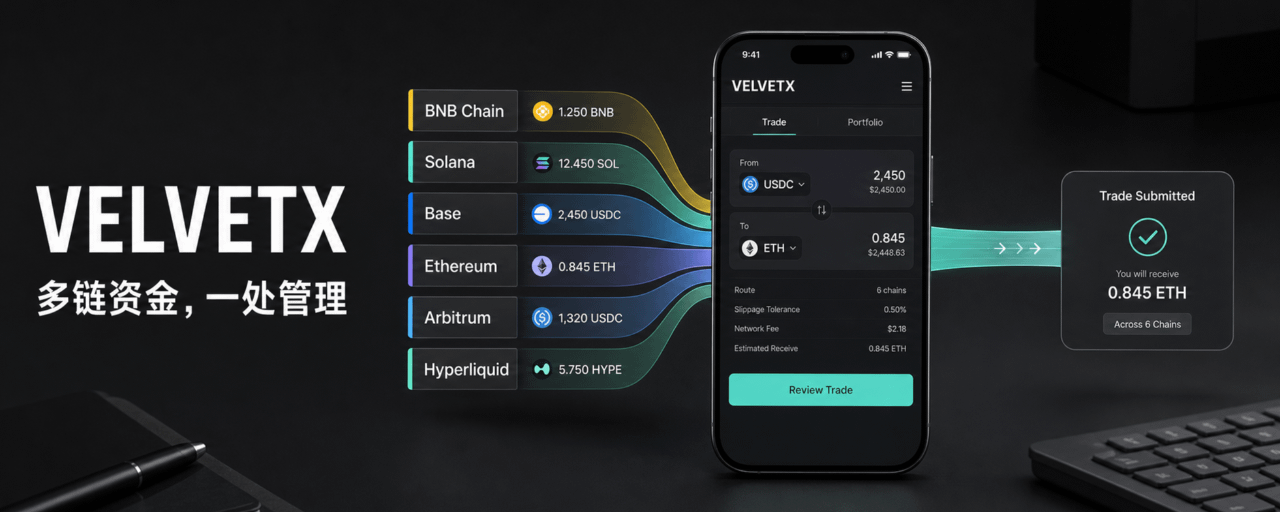

People who often play on-chain usually end up leaving a bunch of scattered assets in their wallets.
Keep some on BNB Chain, some on Base, and also prepare funds and Gas separately for Solana. When you truly run into a trading moment, the money is often on the wrong chain.
For example, when you see a coin on Arbitrum that you’re ready to buy, but your funds are on the BNB Chain. A normal operation is to first find a cross-chain bridge, verify the networks and addresses on both sides, wait for the funds to arrive, and then open the trading page to exchange the coins. When the amount isn’t that big, the cross-chain fee, Gas, and slippage add up pretty noticeably.
If the market moves quickly, by the time the money arrives, the buy price may already have changed.
@Velvet_Capital addresses this issue in a pretty straightforward way.
It currently supports networks such as BNB Chain, Solana, Base, Ethereum, Arbitrum, and Hyperliquid. During a trade, you select the asset you hold and the token you plan to buy, and the system will handle the cross-chain and swap routing in the background.
Users don’t need to prepare a separate amount of funds on every chain in advance, and they don’t have to repeatedly open wallets, cross-chain bridges, and different trading pages just to buy a single coin.
Personally, I’d rather keep most of my funds on the chains I use regularly. When I need to participate in other ecosystems, I can temporarily move funds over.
There are two benefits to doing this:
First, funds won’t be scattered across different networks for the long term. In the past, after bridging, there would be only a few dozen dollars left. Since the amount was too small, I couldn’t be bothered to transfer it back. After a long time, my wallet would be full of fragmented balances.
Second, when there’s a short-term opportunity, take fewer steps. With on-chain trading, the difference is often only a dozen minutes. The more complex the operation, the easier it is to miss the price when switching networks, requesting authorizations, and waiting for funds to arrive.
Now spot trading on Arbitrum has also been added to VelvetX. After buying spot, if the underlying has a corresponding perpetual contract on Hyperliquid, you can also open part of a short position to hedge based on your own position.
For example, if you plan to hold for a while but you’re worried about short-term market pullbacks, you can keep spot while using a small position to reduce volatility. Spot and contracts can be viewed in the same terminal, so at least you don’t have to keep switching between a few apps just to verify your positions.
However, the interface makes the operations simpler. The fees and risks of cross-chain bridging itself still exist.
When I took this new path for the first time, I generally used a small amount to test first, focusing on three things:
the page quote and the final quantity actually received
How much total do cross-chain, swapping, and network fees add up to?
How long does it take from confirming the transaction to the assets arriving?
Once you confirm you can accept all three, then decide whether to increase the amount. For smaller coins with worse liquidity, you also need to check slippage separately—don’t just place a big order directly because the operation is convenient.
For people who trade only on a single chain, these tools may not seem that useful. But if you usually look for opportunities between BNB Chain, Solana, Base, and Arbitrum, VelvetX can definitely save you some of the hassle of moving funds around.
The biggest help this cross-chain trading experience from @velvet_capital gives me is that I don’t need to place small amounts of money in five or six chains in advance for every potential opportunity that might come up.
Move over when needed, and then reorganize your positions again afterward. Your funds will be more concentrated and easier to manage.
Cross-chain transactions may be affected by network congestion, liquidity, and slippage. If using perpetual contracts, you also need to factor in funding rates and liquidation risk. For the first time, it’s recommended to start with a small amount to get familiar with the process.