

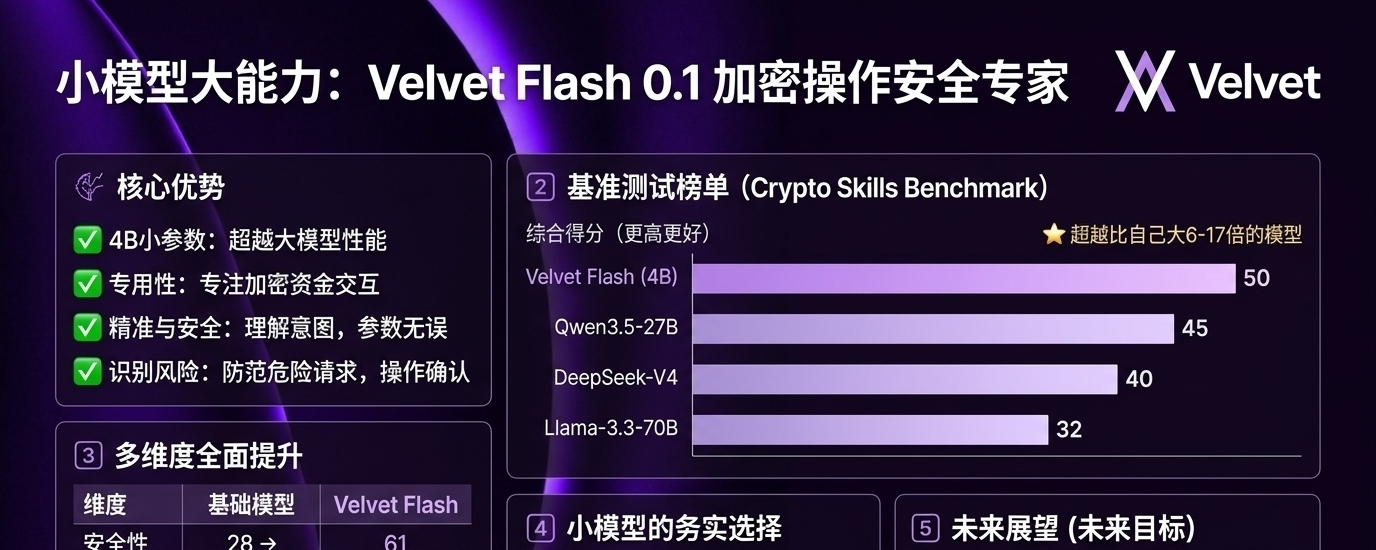

Yesterday, @Velvet_Capital officially released Velvet Flash 0.1. This is a 4-billion-parameter model designed specifically for cryptocurrency operations. Its goal is clear and straightforward: when interactions involving funds are involved, it achieves both precision and security.
General-purpose large models often fall short when handling crypto scenarios. They may misunderstand user intent, select the wrong platform commands, extract parameters incorrectly, or respond slowly to high-risk requests.
\Velvet Flash was created specifically to address these pain points. It needs to accurately understand the user’s intent, choose the correct commands, extract key parameters such as amounts, tokens, chains, and addresses, identify dangerous requests, and perform confirmations before executing any fund-related operations.
In a set of encrypted skills benchmark tests, Velvet Flash ranked first with a total score of 50. Next were Qwen3.5-27B (45 points), DeepSeek-V4 (40 points), and Llama-3.3-70B (32 points), while the scores of the other models were lower. Notably, its parameter count is only 4B, yet it outperforms models that are 6 to 17 times larger.
The training results are similarly clear. An untrained base model scores only 23, but after training it jumps directly to 50. Improvements across five dimensions are all significant: safety rises from 28 to 61, robustness from 26 to 53, clarity and user experience from 22 to 52, routing from 30 to 47, and coverage from 12 to 34.
Safety is placed first. In financial products, models must determine when to continue, when to ask follow-up questions, when to issue warnings, and when to directly refuse. They must also correctly parse amounts, protect sensitive information, and identify suspicious requests—never using funds before confirmation.
Some large models perform better on certain platforms. For example, Qwen and Llama score higher on Minara, and Qwen is also stronger on Binance spot. But overall, small models have more practical advantages: lower service costs, less latency, fewer infrastructure requirements, and they run entirely on their own servers—making iteration and control more flexible.
The benchmark covers core platforms such as Minara, Binance spot, OKX DEX, Uniswap, GMX, and MetaMask. Broader testing also includes 31 centralized exchanges, wallets, DEXs, and DeFi tools. All models use the same inputs and evaluation standards, with safety thresholds in place. Behaviors such as transferring funds without confirmation or making amount-parsing errors are penalized directly.
Velvet Flash 0.1 is only the first version. The team will continue expanding platform coverage, refining edge cases, strengthening safety behaviors, and improving the ability to handle complex multi-step workflows. The long-term goal is to build an internal capability and continuously develop专用 models that are safer, faster, cheaper, and more aligned with product needs.
In vertical scenarios, a small model that has been specifically trained is often more effective than blindly stacking parameters. Especially when it comes to fund safety, this focused approach is truly convincing. @EchoHunt_ai