


Main topics of the post:
The crypto market saw historical records, such as Bitcoin reaching $125,000, growth of stablecoins, regulatory advances, and integration with traditional payment methods, but also faced strong corrections exceeding 40% at the end of the year.
Last year confirmed that cryptocurrencies are not just an experiment, but a practical solution integrated into the global economy, with volatility still present due to rapid technological evolution and macroeconomic cycles.
An acceleration in the use of crypto for everyday payments is expected, with greater adoption of stablecoins, integration with traditional systems (such as Pix in Brazil), and the use of the Binance Card to facilitate purchases with cryptocurrencies.
Tokenization is expected to explode in 2026, allowing real assets such as real estate and bonds to be fractionalized and traded digitally, with greater security, liquidity, and accessibility, driven by technological and regulatory advances.
After a 2025 marked by historic advances, records, new regulations, and also deep corrections, the cryptocurrency market enters 2026 more mature, more observed, and more integrated into the global economy.
The previous year brought the confirmation that crypto is not an experiment: it is infrastructure and reality. And, for being all of this, it is also a solution to real problems, not just something for enthusiasts.
In any case, 2025 also clearly reminded us that volatility remains an essential part of this market, especially when technology, global liquidity, and macroeconomic cycles coexist in a rapidly evolving environment.
All of this happened just in 2025: Bitcoin hitting an ATH of $125,000, accelerated growth of stablecoins, regulatory milestones in major economies, advances in integration with traditional payment methods, consolidation of institutional products (such as ETFs), and… at the end of the year, strong corrections that accumulated declines of over 40% in certain assets.
Entering 2026 with attention to the crypto universe means seeing and recognizing this scenario as it really is: a market that combines technological innovation, institutional maturity, and large price movements, both up and down.
In this article, we will start to present you, in a direct, accessible, and structured way, what can shape 2026. And why do we say that 'we will start to present it to you'? Stay until the end and you will understand.
How the year 2025 ends: between records and corrections
Throughout 2025, Bitcoin touched, for the first time, the region of $125,000, reflecting positive flows that occurred in ETFs, optimism about the regulatory scenario (which had various advances), high institutional demand, and the change in pricing after the settling of expectations post-halving.
But this euphoria did not last the entire year. Between October and December, the market experienced one of the most significant corrections since 2021. Bitcoin returned more than 40% of the upward movement, dragging down altcoins, meme coins, infrastructure tokens, and much of the DeFi sector.
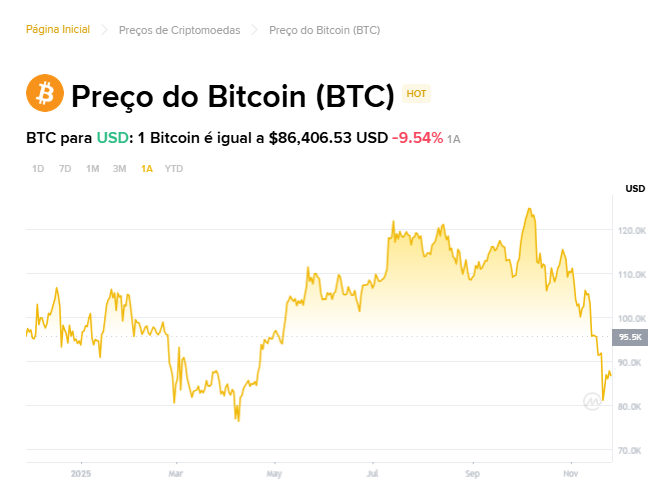
This movement has important significance for 2026: it was not a structural reversal, but a typical phase of profit-taking and adjustment of expectations after months of appreciation. The fundamentals that supported growth remain solid, but the market showed that it still operates with intense cycles.
A very important point to be remembered at this moment is that, despite a sharp correction observed in the last quarter of 2025, in broader windows, Bitcoin continues to be one of the fastest-growing financial assets.
Along with the advances in market maturity that have been verified in recent years, this indicates that there will be increasing robustness of fundamentals in this asset from now on.
Digital payments and the crypto-real world integration
If 2025 marked the consolidation of this type of movement, in 2026 we will tend to see the year of practical integration happen. What was development and discussion of ideas in previous periods will now tend to be reality in people's lives.
The expectation for 2026 is significant acceleration in the use of cryptocurrencies in everyday payments, driven by the increasingly natural integration between traditional systems and blockchain infrastructure. After years of being seen only as investment assets, cryptocurrencies are beginning to function as efficient, predictable, and widely accepted payment methods.
This transition is supported by technologies that are already implemented or expanding - some of which, it is worth emphasizing, Binance has brought over time.
Among the main vectors of adoption are:
Payments using crypto directly connected to national systems and global acceptance networks;
Instant conversion of digital balance into local currency at the time of purchase;
Growing use of stablecoins for recurring payments, subscriptions, and digital services;
Integration of Web3 wallets with transport, delivery, and e-commerce platforms;
Expansion of tokenized loyalty programs, converting engagement into digital rewards.
In Brazil, one of the main drivers of this evolution is the possibility of paying with crypto through Pix. The combination of Binance Pay and the national instant system creates a seamless experience for the user, who uses their cryptocurrencies and receives in reais with the same agility as a conventional transaction.
In Latin American countries, such as Argentina, the use of QR Code as a payment standard also facilitates adoption. The ability to use crypto as a source of balance for payments via QR Code broadens the reach of this integration and brings the digital ecosystem even closer to the real needs of people and merchants.
It is worth pointing out that this adoption combines the useful with the pleasant, since, in addition to allowing people to access a more direct way to make their payments, it also helps to reduce the effects of inflation in their daily lives - which, in Latin America, is always very welcome.
The Binance Card, available in Brazil and other countries in Latin America, adds another layer to this journey. It allows users to make purchases at millions of establishments that accept the Mastercard brand, while using cryptocurrencies as a payment source, always with automatic and instantaneous conversion to the local currency.
This bridge between crypto and point-of-sale acquisition reinforces that the experience does not require changes in habits and does not depend on in-depth technical knowledge - and shows how the distance between good ideas and practical use is increasingly smaller, which reinforces the thesis of how 2026 tends to be a year of many advances in this direction.
The central trend is clear: in 2026, paying with crypto should become as natural as using a physical card or an instant payment system. The integration between blockchain technologies and traditional payment methods transforms the crypto economy into a daily resource, accessible and increasingly present in people's lives.
The role of stablecoins in the real economy
Stablecoins - especially those with regulatory transparency - will continue to grow as instruments of liquidity, payments, and protection against volatility.
They represent an even more direct advancement in the connection between the crypto universe and the real world, because in addition to being related to strong currencies that people already know, they also allow this proximity to happen with assets that do not have high aggregate volatility. Or, in more direct terms: with something that 'follows the dollar', it becomes easier to take new steps in the crypto trajectory.
Three movements should accelerate in 2026 related to stablecoins: part of the financial flows of the crypto universe should be directed to these projects, the use by small businesses (for better cash management and reduction of inflationary impacts) should increase, and, in the end, the expansion of stablecoins should serve as a bridge between traditional payment methods and the set of innovations brought by blockchain technology.
Tokenization of real-world assets: the market that is set to explode in 2026
Tokenization - referred to as RWA (Real World Assets) - was one of the most discussed topics in 2025, but is still in the initial phase.
In 2026, everything indicates that it will be one of the most transformative segments of the ecosystem. And this happens both because large institutions have already positioned themselves regarding this point and also because the available technological structure already allows such advances to occur.
Tokenizing, in practice, means representing a real asset on the blockchain. It is transforming something that exists in the physical or financial world - such as a public bond, a property, or an account receivable - into digital units that can be registered, traded, and transferred securely, transparently, and with traceability.
If you have been familiar with the crypto universe long enough, you already know that one of the major innovations of projects in this field relates to blockchain networks, where records remain immutable. This type of security is increasingly desired in the real world because, in addition to being an additional means of verifiability, it also represents a reduction in bureaucratic costs (since something that is there in immutable record does not require so many external confirmations).
Tokenization creates important advantages for the market as a whole, such as increasing liquidity (because it allows previously 'locked' assets to be traded in real-time), reducing operational costs, facilitating the fractionalization of an asset, instantaneous settlement in immutable records, and, in the end, still allows audit and governance processes to be more efficient.
Traditional financial institutions tested these models in 2025 - and, again, that is why you have been hearing about it more often. The trend for 2026 is that many of these pilots will become stable, regulated products available to the general public, with infrastructure built on high-performance blockchains.
A practical example: imagine an apartment valued at R$1 million. Instead of selling the entire unit at once and relying on a buyer with high purchasing power, the property can be tokenized into a thousand parts of a thousand reais each. Each fraction then exists as a token registered on the blockchain.
This allows different people to buy small portions of the property, for the asset to generate continuous liquidity, and for the entire ownership history to be recorded in a transparent and auditable manner. The technology also facilitates processes such as revenue distribution, proportional rent, and governance over the use of that property.
Before you think that this is something out of the ordinary, remember that there has been a fully operational model of this for decades in a traditional way: the model of condo-hotels and apartment shares in resorts is based on this. The difference is that now, with the tools of the crypto universe, the record, access, and distribution of this property will all be conducted in a more direct and verifiable manner.
This type of operation, previously restricted to highly specialized markets, is now beginning to approach the average user. And, with that, we will take another very important step in the democratization of the crypto universe in terms of access to services and financial products in the real world.
Tokenization transforms complex assets into accessible, digital instruments integrated into the broader financial ecosystem. Reducing costs and increasing security at the same time means that many more deals will be closed with support in this technological field that is spreading.
Why RWAs gain scale now
The tokenization of real-world assets (RWAs) ceases to be theory and begins to gain real scale in 2026. This occurs because a combination of structural factors finally creates the right environment for mass adoption.
The first factor is technological maturity. First and second layer blockchains have significantly advanced in security, speed, and cost efficiency. This advancement reduces operational risks and allows financial institutions to use blockchain in a way that is compatible with their governance and compliance standards.
The second element is regulatory advancement. Strategic countries have already established guidelines for the issuance, custody, and trading of tokenized assets. This legal clarity reduces internal barriers within institutions that previously treated the subject with caution. With a clear framework in place, banks, asset managers, and brokers can create products aimed at both institutional investors and retail.
Another point of emphasis is the growing demand for accessible products. High-value assets, such as real estate, debentures, or fund shares, have historically been restricted to investors with large capital. Tokenization allows for the fractionalization of these assets into smaller parts, expanding the possible audience without altering their legal nature.
Moreover, Web3 wallets are more intuitive and integrated into daily life. Users can custody and trade RWAs with the same ease as they move cryptocurrencies or stablecoins. This aspect reduces friction and brings the traditional market closer to blockchain infrastructure in a concrete way.
When combined, these factors create the ideal scenario for RWAs to grow in scale: more secure infrastructure, predictable regulatory framework, greater democratization of access, and integration with digital tools that the public already uses.
But there is much more coming in 2026
Here we tell you about what happened in 2025 and part of the potential that this new year can unfold. Want to know what else will have positive potential in 2026? We will tell you in the next article!