

Binance News
394.6k Posts

Binance News
 Binance Officially Verified Account
Report
Follow Binance News to stay on top of industry trends & news
9 Following
2.3M+ Followers
2.8M+ Liked
Top
Replies
Videos
·
--
Article
Bitcoin News | CME Futures Listing Sends Bitcoin Cash Soaring While Bitcoin Meets Resistance AgainBitcoin Cash jumped 28% to nearly $349 after CME Group said it will list BCH and Uniswap futures from October 19, the biggest move among major tokens. Bitcoin, meanwhile, matched Monday's high near $87,300 for a second time and was sold into it again, slipping to a session low of $85,500 as rising Treasury yields and a firmer dollar pressured risk assets.
Bitcoin Was Rejected Near $87,300 for a Second Straight Session
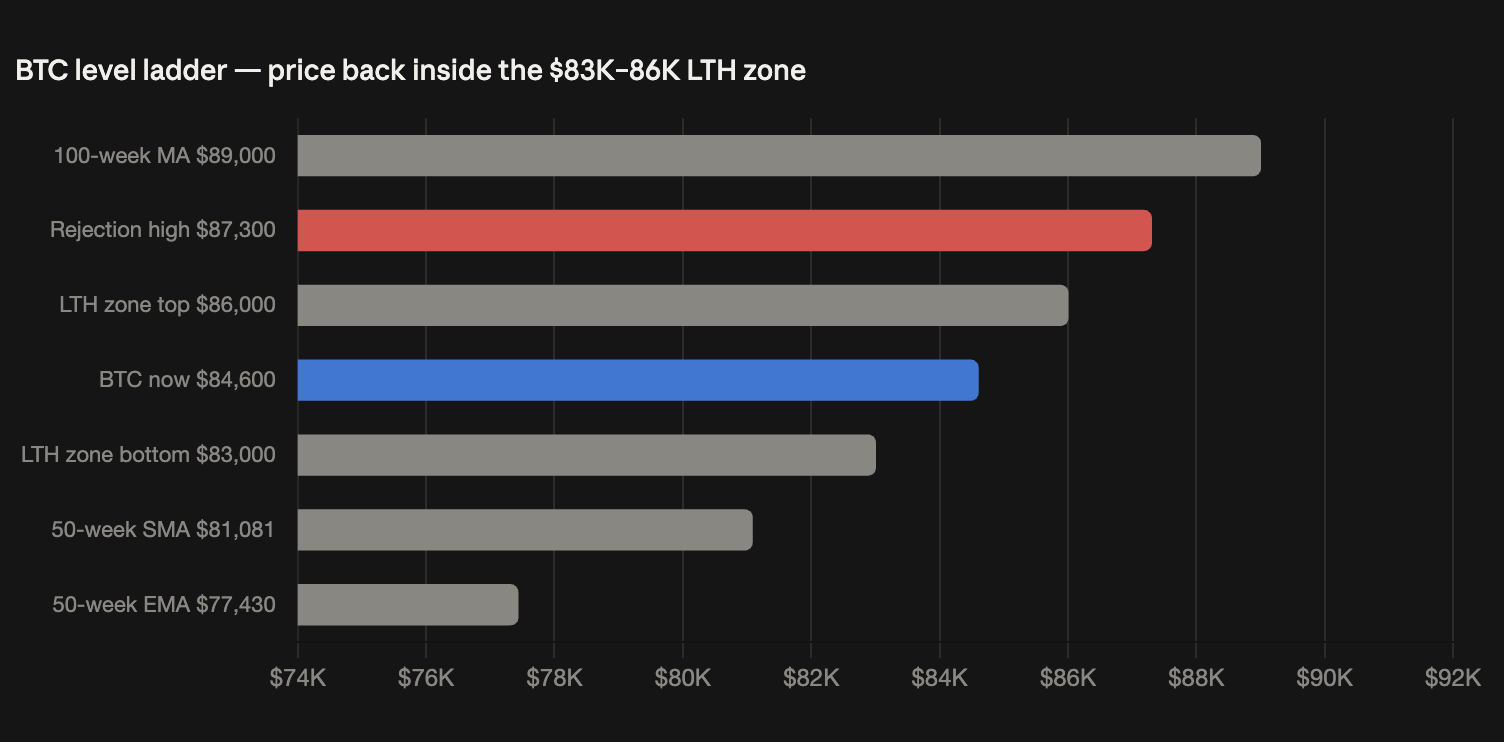
Bitcoin trades around $84,800, down just under 1% over 24 hours. The double rejection at ~$87,300 marks it as near-term resistance below the 100-week moving average around $89,000 — the next major technical hurdle. Support sits at the top of the long-term holder supply zone at $83,000–$86,000, which Bitcoin cleared earlier this week, with the 50-week SMA at $81,081 below that. Friday's ~$14 billion Deribit options expiry, with a call cluster at $85,000, adds a gravitational pull around current levels.
Rate Pressure Is Back as Oil Reverses Higher
WTI crude swung from a loss to a 0.5% gain at $90.93 after rallying more than $2 from session lows, amid a WSJ report that US oil executives are no longer confident the Trump administration will hold off on a diesel export ban following the president's comments at the UN General Assembly. The oil move helped push the US two-year Treasury yield to a new cycle high of 4.79%, with futures markets now pricing a more than 53% chance of another Fed hike in October — consistent with last week's dot plot signaling one more 2026 hike after the September move to 3.75%–4.00%. Higher short-end yields and a stronger dollar are the classic headwind combination for Bitcoin.
A 600 BTC Wallet Dormant Since 2012 Moved $51.9 Million
A wallet holding 600 BTC untouched since July 2012 transferred its coins — worth about $51.9 million — to a new address on Monday, per on-chain data flagged by Galaxy Research. The holding was acquired when Bitcoin traded near $8, making the original stake worth roughly $4,800 (derived). The transfer pattern — legacy address to Native SegWit, with no known exchange destination — points to a wallet migration or consolidation rather than a sale, echoing other recent Satoshi-era wallet movements that avoided exchanges and thus limited evidence of selling pressure.
CME Access Explains the Size of the Bitcoin Cash Move
Regulated US futures let institutions barred from custodying crypto take BCH exposure, and give market makers a hedging venue that typically tightens spot pricing — the mechanism behind outsized listing reactions. Context matters, though: even after the surge, BCH has only recovered to levels last seen in the second half of May, having reversed from near $660 in early January to a $190 low. A sustained bid would bring $450 into range, a zone where buyers were active between October 2025 and this May. Elsewhere, ZEC rose 9% to just above $1,646 — extending its record run — XRP gained 3% to nearly $1.59, and TRX fell 2%.
Analysts Read the Rotation as a Pause for Bitcoin, Not a Reversal
FxPro senior analyst Alex Kuptsikevich told CoinDesk that speculative capital parked in Bitcoin as the most liquid crypto asset is temporarily rotating into altcoins in search of higher returns. He noted that in past episodes of this pattern, Bitcoin slowed rather than reversed, with pullbacks drawing in new buyers who had previously kept their money out of crypto. That framing aligns with Glassnode's altseason signal flip this week and Bitcoin dominance easing to roughly 57% (derived). What to watch: Thursday's US jobless claims and new home sales, Friday's Deribit expiry, and whether the two-year yield holds above 4.79%.
Bitcoin News | CME Futures Listing Sends Bitcoin Cash Soaring While Bitcoin Meets Resistance Again
Bitcoin Cash jumped 28% to nearly $349 after CME Group said it will list BCH and Uniswap futures from October 19, the biggest move among major tokens. Bitcoin, meanwhile, matched Monday's high near $87,300 for a second time and was sold into it again, slipping to a session low of $85,500 as rising Treasury yields and a firmer dollar pressured risk assets.
Bitcoin Was Rejected Near $87,300 for a Second Straight Session
Bitcoin trades around $84,800, down just under 1% over 24 hours. The double rejection at ~$87,300 marks it as near-term resistance below the 100-week moving average around $89,000 — the next major technical hurdle. Support sits at the top of the long-term holder supply zone at $83,000–$86,000, which Bitcoin cleared earlier this week, with the 50-week SMA at $81,081 below that. Friday's ~$14 billion Deribit options expiry, with a call cluster at $85,000, adds a gravitational pull around current levels.
Rate Pressure Is Back as Oil Reverses Higher
WTI crude swung from a loss to a 0.5% gain at $90.93 after rallying more than $2 from session lows, amid a WSJ report that US oil executives are no longer confident the Trump administration will hold off on a diesel export ban following the president's comments at the UN General Assembly. The oil move helped push the US two-year Treasury yield to a new cycle high of 4.79%, with futures markets now pricing a more than 53% chance of another Fed hike in October — consistent with last week's dot plot signaling one more 2026 hike after the September move to 3.75%–4.00%. Higher short-end yields and a stronger dollar are the classic headwind combination for Bitcoin.
A 600 BTC Wallet Dormant Since 2012 Moved $51.9 Million
A wallet holding 600 BTC untouched since July 2012 transferred its coins — worth about $51.9 million — to a new address on Monday, per on-chain data flagged by Galaxy Research. The holding was acquired when Bitcoin traded near $8, making the original stake worth roughly $4,800 (derived). The transfer pattern — legacy address to Native SegWit, with no known exchange destination — points to a wallet migration or consolidation rather than a sale, echoing other recent Satoshi-era wallet movements that avoided exchanges and thus limited evidence of selling pressure.
CME Access Explains the Size of the Bitcoin Cash Move
Regulated US futures let institutions barred from custodying crypto take BCH exposure, and give market makers a hedging venue that typically tightens spot pricing — the mechanism behind outsized listing reactions. Context matters, though: even after the surge, BCH has only recovered to levels last seen in the second half of May, having reversed from near $660 in early January to a $190 low. A sustained bid would bring $450 into range, a zone where buyers were active between October 2025 and this May. Elsewhere, ZEC rose 9% to just above $1,646 — extending its record run — XRP gained 3% to nearly $1.59, and TRX fell 2%.
Analysts Read the Rotation as a Pause for Bitcoin, Not a Reversal
FxPro senior analyst Alex Kuptsikevich told CoinDesk that speculative capital parked in Bitcoin as the most liquid crypto asset is temporarily rotating into altcoins in search of higher returns. He noted that in past episodes of this pattern, Bitcoin slowed rather than reversed, with pullbacks drawing in new buyers who had previously kept their money out of crypto. That framing aligns with Glassnode's altseason signal flip this week and Bitcoin dominance easing to roughly 57% (derived). What to watch: Thursday's US jobless claims and new home sales, Friday's Deribit expiry, and whether the two-year yield holds above 4.79%.
Bitcoin Was Rejected Near $87,300 for a Second Straight Session
Bitcoin trades around $84,800, down just under 1% over 24 hours. The double rejection at ~$87,300 marks it as near-term resistance below the 100-week moving average around $89,000 — the next major technical hurdle. Support sits at the top of the long-term holder supply zone at $83,000–$86,000, which Bitcoin cleared earlier this week, with the 50-week SMA at $81,081 below that. Friday's ~$14 billion Deribit options expiry, with a call cluster at $85,000, adds a gravitational pull around current levels.
Rate Pressure Is Back as Oil Reverses Higher
WTI crude swung from a loss to a 0.5% gain at $90.93 after rallying more than $2 from session lows, amid a WSJ report that US oil executives are no longer confident the Trump administration will hold off on a diesel export ban following the president's comments at the UN General Assembly. The oil move helped push the US two-year Treasury yield to a new cycle high of 4.79%, with futures markets now pricing a more than 53% chance of another Fed hike in October — consistent with last week's dot plot signaling one more 2026 hike after the September move to 3.75%–4.00%. Higher short-end yields and a stronger dollar are the classic headwind combination for Bitcoin.
A 600 BTC Wallet Dormant Since 2012 Moved $51.9 Million
A wallet holding 600 BTC untouched since July 2012 transferred its coins — worth about $51.9 million — to a new address on Monday, per on-chain data flagged by Galaxy Research. The holding was acquired when Bitcoin traded near $8, making the original stake worth roughly $4,800 (derived). The transfer pattern — legacy address to Native SegWit, with no known exchange destination — points to a wallet migration or consolidation rather than a sale, echoing other recent Satoshi-era wallet movements that avoided exchanges and thus limited evidence of selling pressure.
CME Access Explains the Size of the Bitcoin Cash Move
Regulated US futures let institutions barred from custodying crypto take BCH exposure, and give market makers a hedging venue that typically tightens spot pricing — the mechanism behind outsized listing reactions. Context matters, though: even after the surge, BCH has only recovered to levels last seen in the second half of May, having reversed from near $660 in early January to a $190 low. A sustained bid would bring $450 into range, a zone where buyers were active between October 2025 and this May. Elsewhere, ZEC rose 9% to just above $1,646 — extending its record run — XRP gained 3% to nearly $1.59, and TRX fell 2%.
Analysts Read the Rotation as a Pause for Bitcoin, Not a Reversal
FxPro senior analyst Alex Kuptsikevich told CoinDesk that speculative capital parked in Bitcoin as the most liquid crypto asset is temporarily rotating into altcoins in search of higher returns. He noted that in past episodes of this pattern, Bitcoin slowed rather than reversed, with pullbacks drawing in new buyers who had previously kept their money out of crypto. That framing aligns with Glassnode's altseason signal flip this week and Bitcoin dominance easing to roughly 57% (derived). What to watch: Thursday's US jobless claims and new home sales, Friday's Deribit expiry, and whether the two-year yield holds above 4.79%.
18
6
72
88.4k
·
--
ETH Faces $1.283 Billion Short Liquidation Risk Above $2,794, Coinglass Data ShowsCoinglass data shows that if ETH breaks above $2,794, cumulative short liquidation intensity across major centralized exchanges would reach $1.283 billion. According to ChainCatcher, if ETH falls below $2,536, cumulative long liquidation intensity across major centralized exchanges would reach $469 million.
ETH Faces $1.283 Billion Short Liquidation Risk Above $2,794, Coinglass Data Shows
Coinglass data shows that if ETH breaks above $2,794, cumulative short liquidation intensity across major centralized exchanges would reach $1.283 billion. According to ChainCatcher, if ETH falls below $2,536, cumulative long liquidation intensity across major centralized exchanges would reach $469 million.
3
1
20
16.3k
·
--
Article
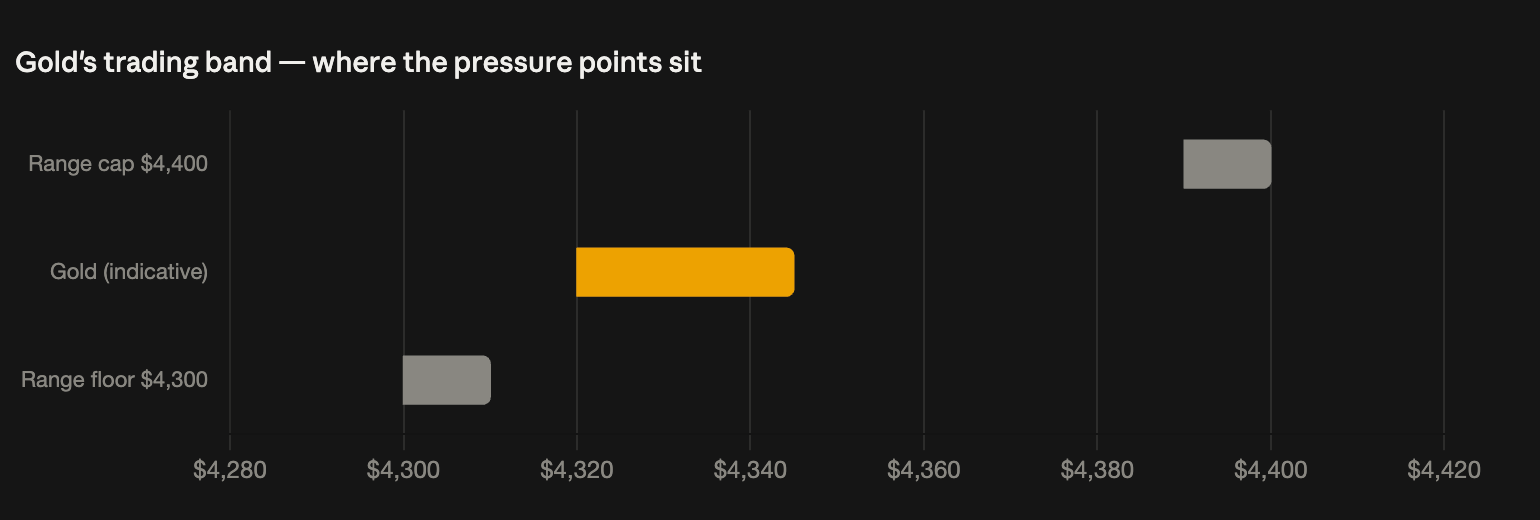
Market News | A Two-Month Dollar High Squeezes Gold as Fed Speakers Talk Up More HikesGold drifted lower inside its established $4,300–$4,400 range as a strengthening dollar and hawkish Federal Reserve commentary hardened expectations of further tightening. The dollar's rise to a two-month high makes dollar-priced gold more expensive for foreign buyers — the same currency pressure that has helped push Bitcoin from $87,300 to around $84,600 this week.The Dollar's Two-Month High Is Doing the DamageThe mechanical link is simple: a stronger dollar raises gold's cost for investors holding other currencies, dampening demand at the margin. The dollar's advance is rate-driven — the US two-year yield hit a 4.79% cycle high this week, futures markets price better-than-even odds (>53%) of an October hike, and the BOJ's move to a 31-year-high policy rate has still left USD/JPY near 157.8. Saxo Bank's Ole Hansen said Fed officials' remarks and their effect on rates, yields and the dollar — plus oil price swings — are the main directional cues for short-term gold traders within the $4,300–$4,400 band.Barkin Argues the Threat of Hikes Can Do the WorkRichmond Fed President Barkin said Tuesday that rate hikes and the threat of further increases could dampen businesses' inflation expectations and cool price rises without actually weighing on economic activity — a soft-landing case for staying hawkish. His comments stack onto Governor Barr's remarks the same day that further hikes may be needed to return inflation to 2% in a timely manner. Two hawkish speakers in one day, against WTI near $91 and supply risk from a potential US diesel export ban, keeps the October decision live.Gold's Rangebound Drift Mirrors Crypto's Macro SqueezeGold and Bitcoin are absorbing the same inputs: rising real yields lift the opportunity cost of holding non-yielding assets, and dollar strength compounds it. Bitcoin sits back inside its $83,000–$86,000 long-term holder zone, while gold holds its range — neither breaking down, both capped. The resolution likely comes from data, not speeches: Thursday's jobless claims (consensus 201K), Friday's durable goods and ~$14 billion Deribit options expiry, then the October 2 jobs report and October 14 CPI ahead of the Fed's October meeting. A downside inflation surprise would ease the dollar and lift both; hot data pointing to a confirmed October hike would test gold's $4,300 floor and Bitcoin's $83,000 zone bottom.
Market News | A Two-Month Dollar High Squeezes Gold as Fed Speakers Talk Up More Hikes
Gold drifted lower inside its established $4,300–$4,400 range as a strengthening dollar and hawkish Federal Reserve commentary hardened expectations of further tightening. The dollar's rise to a two-month high makes dollar-priced gold more expensive for foreign buyers — the same currency pressure that has helped push Bitcoin from $87,300 to around $84,600 this week.The Dollar's Two-Month High Is Doing the DamageThe mechanical link is simple: a stronger dollar raises gold's cost for investors holding other currencies, dampening demand at the margin. The dollar's advance is rate-driven — the US two-year yield hit a 4.79% cycle high this week, futures markets price better-than-even odds (>53%) of an October hike, and the BOJ's move to a 31-year-high policy rate has still left USD/JPY near 157.8. Saxo Bank's Ole Hansen said Fed officials' remarks and their effect on rates, yields and the dollar — plus oil price swings — are the main directional cues for short-term gold traders within the $4,300–$4,400 band.Barkin Argues the Threat of Hikes Can Do the WorkRichmond Fed President Barkin said Tuesday that rate hikes and the threat of further increases could dampen businesses' inflation expectations and cool price rises without actually weighing on economic activity — a soft-landing case for staying hawkish. His comments stack onto Governor Barr's remarks the same day that further hikes may be needed to return inflation to 2% in a timely manner. Two hawkish speakers in one day, against WTI near $91 and supply risk from a potential US diesel export ban, keeps the October decision live.Gold's Rangebound Drift Mirrors Crypto's Macro SqueezeGold and Bitcoin are absorbing the same inputs: rising real yields lift the opportunity cost of holding non-yielding assets, and dollar strength compounds it. Bitcoin sits back inside its $83,000–$86,000 long-term holder zone, while gold holds its range — neither breaking down, both capped. The resolution likely comes from data, not speeches: Thursday's jobless claims (consensus 201K), Friday's durable goods and ~$14 billion Deribit options expiry, then the October 2 jobs report and October 14 CPI ahead of the Fed's October meeting. A downside inflation surprise would ease the dollar and lift both; hot data pointing to a confirmed October hike would test gold's $4,300 floor and Bitcoin's $83,000 zone bottom.
1
1
26
19.9k
·
--
Polygon Foundation CEO Says 100 Million POL Burn Contract Is ReadyPolygon Foundation CEO Sandeep Nailwal said a contract to burn 100 million POL, or about 1% of total supply, is ready and can be executed by any member of the community. According to Foresight News, he said the community could carry out a burn once every quarter in the future.
Nailwal also said POL has been in a deflationary state since the start of this year. He previously said 100 million POL were ready to be permanently burned, with the related contract deployed on testnet and set to go live on mainnet after final approval from the security committee.
Polygon Foundation CEO Says 100 Million POL Burn Contract Is Ready
Polygon Foundation CEO Sandeep Nailwal said a contract to burn 100 million POL, or about 1% of total supply, is ready and can be executed by any member of the community. According to Foresight News, he said the community could carry out a burn once every quarter in the future.
Nailwal also said POL has been in a deflationary state since the start of this year. He previously said 100 million POL were ready to be permanently burned, with the related contract deployed on testnet and set to go live on mainnet after final approval from the security committee.
Nailwal also said POL has been in a deflationary state since the start of this year. He previously said 100 million POL were ready to be permanently burned, with the related contract deployed on testnet and set to go live on mainnet after final approval from the security committee.
1
17
14.2k
·
--
Binance to Suspend Injective Network Deposits and Withdrawals for Upgrade and Hard ForkAccording to the announcement from Binance, deposits and withdrawals of token(s) on the Injective (INJ) network will be suspended starting at approximately 2026-09-24 14:00 (UTC) to support a network upgrade and hard fork. The upgrade and hard fork are scheduled to take place at block height 184,394,000, or approximately at 2026-09-24 15:00 (UTC). Binance said trading of token(s) on the Injective network will not be impacted during the process, and it will handle the technical requirements for all users. The suspension is intended to support the network change and maintain user experience while the upgrade is carried out.
Deposits and withdrawals for token(s) on the Injective network will reopen once the upgraded network is deemed stable. Binance said no further announcement will be posted regarding the reopening. The notice also stated that products and services mentioned in the announcement may not be available in all regions. The announcement did not indicate any change to trading activity on the network, only to deposit and withdrawal services during the upgrade window.
Binance to Suspend Injective Network Deposits and Withdrawals for Upgrade and Hard Fork
According to the announcement from Binance, deposits and withdrawals of token(s) on the Injective (INJ) network will be suspended starting at approximately 2026-09-24 14:00 (UTC) to support a network upgrade and hard fork. The upgrade and hard fork are scheduled to take place at block height 184,394,000, or approximately at 2026-09-24 15:00 (UTC). Binance said trading of token(s) on the Injective network will not be impacted during the process, and it will handle the technical requirements for all users. The suspension is intended to support the network change and maintain user experience while the upgrade is carried out.
Deposits and withdrawals for token(s) on the Injective network will reopen once the upgraded network is deemed stable. Binance said no further announcement will be posted regarding the reopening. The notice also stated that products and services mentioned in the announcement may not be available in all regions. The announcement did not indicate any change to trading activity on the network, only to deposit and withdrawal services during the upgrade window.
Deposits and withdrawals for token(s) on the Injective network will reopen once the upgraded network is deemed stable. Binance said no further announcement will be posted regarding the reopening. The notice also stated that products and services mentioned in the announcement may not be available in all regions. The announcement did not indicate any change to trading activity on the network, only to deposit and withdrawal services during the upgrade window.
1
1
6
7.8k
·
--
Binance to Launch RLUSD Airdrop Campaign With $800,000 in XRP RewardsAccording to the announcement from Binance, the platform will launch an airdrop campaign from 2026-09-25 00:00 (UTC) for eligible users who hold Ripple USD (RLUSD). The campaign will distribute rewards from a grand prize pool of $800,000 in XRP, with XRP paid as weekly rewards to RLUSD holders every Friday. The campaign period runs from 2026-09-25 00:00 (UTC) to 2026-10-23 00:00 (UTC), and rewards will be airdropped directly to eligible users’ Spot Accounts of their Binance master accounts. Binance said the weekly reward amount will be based on qualifying RLUSD balances, with rewards starting to accrue from 2026-09-25 00:00 (UTC). The first distribution is scheduled for 2026-10-02, followed by weekly distributions on 2026-10-09, 2026-10-16, and 2026-10-23. The announcement also states that users must hold RLUSD in supported account categories, including Spot Account, Funding Account, Earn Account in RLUSD Flexible Savings, and Margin Account in RLUSD Cross Margin, Isolated Margin, or Portfolio Margin. Users must maintain at least 0.01 RLUSD in their Earn or Margin Accounts to qualify, and RLUSD acquired through borrowing other stablecoins in Margin will receive a haircut of 60% after liabilities are accounted for.
Binance said the campaign will use hourly balance snapshots to determine each user’s daily qualifying balance, with the lowest RLUSD balance captured during those snapshots on each day used for reward calculations. The weekly rewards will be calculated using the 7-day average of the qualifying balance, the effective APR on the distribution day, and a 7-day period in the formula provided in the announcement. The effective APR will be updated after each weekly distribution. Binance also said there is no individual cap on rewards, and that rewards depend on each user’s qualifying balance relative to the total qualifying balance of all eligible users and other factors. Sub-account balances will be aggregated at the master account level, while broker accounts will receive rewards in virtual sub-accounts. The announcement further states that users must complete account verification and be from an eligible jurisdiction to participate, and that users residing in listed excluded countries or regions will not be able to join the campaign.
Binance to Launch RLUSD Airdrop Campaign With $800,000 in XRP Rewards
According to the announcement from Binance, the platform will launch an airdrop campaign from 2026-09-25 00:00 (UTC) for eligible users who hold Ripple USD (RLUSD). The campaign will distribute rewards from a grand prize pool of $800,000 in XRP, with XRP paid as weekly rewards to RLUSD holders every Friday. The campaign period runs from 2026-09-25 00:00 (UTC) to 2026-10-23 00:00 (UTC), and rewards will be airdropped directly to eligible users’ Spot Accounts of their Binance master accounts. Binance said the weekly reward amount will be based on qualifying RLUSD balances, with rewards starting to accrue from 2026-09-25 00:00 (UTC). The first distribution is scheduled for 2026-10-02, followed by weekly distributions on 2026-10-09, 2026-10-16, and 2026-10-23. The announcement also states that users must hold RLUSD in supported account categories, including Spot Account, Funding Account, Earn Account in RLUSD Flexible Savings, and Margin Account in RLUSD Cross Margin, Isolated Margin, or Portfolio Margin. Users must maintain at least 0.01 RLUSD in their Earn or Margin Accounts to qualify, and RLUSD acquired through borrowing other stablecoins in Margin will receive a haircut of 60% after liabilities are accounted for.
Binance said the campaign will use hourly balance snapshots to determine each user’s daily qualifying balance, with the lowest RLUSD balance captured during those snapshots on each day used for reward calculations. The weekly rewards will be calculated using the 7-day average of the qualifying balance, the effective APR on the distribution day, and a 7-day period in the formula provided in the announcement. The effective APR will be updated after each weekly distribution. Binance also said there is no individual cap on rewards, and that rewards depend on each user’s qualifying balance relative to the total qualifying balance of all eligible users and other factors. Sub-account balances will be aggregated at the master account level, while broker accounts will receive rewards in virtual sub-accounts. The announcement further states that users must complete account verification and be from an eligible jurisdiction to participate, and that users residing in listed excluded countries or regions will not be able to join the campaign.
Binance said the campaign will use hourly balance snapshots to determine each user’s daily qualifying balance, with the lowest RLUSD balance captured during those snapshots on each day used for reward calculations. The weekly rewards will be calculated using the 7-day average of the qualifying balance, the effective APR on the distribution day, and a 7-day period in the formula provided in the announcement. The effective APR will be updated after each weekly distribution. Binance also said there is no individual cap on rewards, and that rewards depend on each user’s qualifying balance relative to the total qualifying balance of all eligible users and other factors. Sub-account balances will be aggregated at the master account level, while broker accounts will receive rewards in virtual sub-accounts. The announcement further states that users must complete account verification and be from an eligible jurisdiction to participate, and that users residing in listed excluded countries or regions will not be able to join the campaign.
4
2
16
9.5k
·
--

Article
US Weighs Initiative to Promote Dollar-Backed Stablecoins AbroadThe Trump administration is considering an initiative to promote the use of dollar-denominated stablecoins overseas in a bid to reinforce the greenback's status as the world's reserve asset, people familiar with the plans told Bloomberg. Stablecoin projects are among the areas the US government is weighing support for by creating joint ventures with private-sector firms, aiming to maintain the dollar's preeminence and boost demand for US Treasuries, the people said, asking not to be named discussing private information. Stablecoin issuers typically hold the reserves backing their tokens in cash and short-term government debt.
The effort could stretch across multiple federal agencies, including the Treasury Department and the State Department, some of the people said, and the US International Development Finance Corp. could also be involved. The Treasury Department and the White House did not respond to requests for comment, while representatives for the State Department and the DFC declined to comment. The DFC, which partners with private-sector entities to advance US foreign-policy objectives, is overseen by Ben Black, son of Apollo Global Management co-founder Leon Black.
Stablecoins, digital assets typically tied to traditional currencies, have grown in popularity as financial firms embrace them, and the vast majority in circulation are pegged to the dollar. The Genius Act, signed into law by President Donald Trump last year, established a federal framework requiring issuers to hold reserves including dollars and short-term Treasuries, and Treasury Secretary Scott Bessent has said their growth could strengthen the dollar's reserve-currency role. Meanwhile, other economies are building their own digital-payments infrastructure, such as Project mBridge, which uses China's digital yuan, while the European Central Bank presses ahead with a digital euro and this week launched a project linking blockchain markets with the region's existing payments systems.
US Weighs Initiative to Promote Dollar-Backed Stablecoins Abroad
The Trump administration is considering an initiative to promote the use of dollar-denominated stablecoins overseas in a bid to reinforce the greenback's status as the world's reserve asset, people familiar with the plans told Bloomberg. Stablecoin projects are among the areas the US government is weighing support for by creating joint ventures with private-sector firms, aiming to maintain the dollar's preeminence and boost demand for US Treasuries, the people said, asking not to be named discussing private information. Stablecoin issuers typically hold the reserves backing their tokens in cash and short-term government debt.
The effort could stretch across multiple federal agencies, including the Treasury Department and the State Department, some of the people said, and the US International Development Finance Corp. could also be involved. The Treasury Department and the White House did not respond to requests for comment, while representatives for the State Department and the DFC declined to comment. The DFC, which partners with private-sector entities to advance US foreign-policy objectives, is overseen by Ben Black, son of Apollo Global Management co-founder Leon Black.
Stablecoins, digital assets typically tied to traditional currencies, have grown in popularity as financial firms embrace them, and the vast majority in circulation are pegged to the dollar. The Genius Act, signed into law by President Donald Trump last year, established a federal framework requiring issuers to hold reserves including dollars and short-term Treasuries, and Treasury Secretary Scott Bessent has said their growth could strengthen the dollar's reserve-currency role. Meanwhile, other economies are building their own digital-payments infrastructure, such as Project mBridge, which uses China's digital yuan, while the European Central Bank presses ahead with a digital euro and this week launched a project linking blockchain markets with the region's existing payments systems.
The effort could stretch across multiple federal agencies, including the Treasury Department and the State Department, some of the people said, and the US International Development Finance Corp. could also be involved. The Treasury Department and the White House did not respond to requests for comment, while representatives for the State Department and the DFC declined to comment. The DFC, which partners with private-sector entities to advance US foreign-policy objectives, is overseen by Ben Black, son of Apollo Global Management co-founder Leon Black.
Stablecoins, digital assets typically tied to traditional currencies, have grown in popularity as financial firms embrace them, and the vast majority in circulation are pegged to the dollar. The Genius Act, signed into law by President Donald Trump last year, established a federal framework requiring issuers to hold reserves including dollars and short-term Treasuries, and Treasury Secretary Scott Bessent has said their growth could strengthen the dollar's reserve-currency role. Meanwhile, other economies are building their own digital-payments infrastructure, such as Project mBridge, which uses China's digital yuan, while the European Central Bank presses ahead with a digital euro and this week launched a project linking blockchain markets with the region's existing payments systems.
5
3.8k
·
--
Fortitude Raises Credit Line to $50 Million for Zcash Mining ExpansionZcash miner Fortitude has amended its credit agreement with parent company Digital Currency Group (DCG), increasing its existing credit line from $26 million to $50 million. According to Foresight News, Fortitude now has about $31 million in available borrowing capacity, including roughly $7 million remaining from its original unused balance, and expects the funds to be issued entirely in ZEC.
After receiving ZEC, Fortitude may sell it in the market and use the proceeds to pay for 9,000 Zcash ASIC miners and capital expenditures for new and acquired data centers and power infrastructure.
Fortitude Raises Credit Line to $50 Million for Zcash Mining Expansion
Zcash miner Fortitude has amended its credit agreement with parent company Digital Currency Group (DCG), increasing its existing credit line from $26 million to $50 million. According to Foresight News, Fortitude now has about $31 million in available borrowing capacity, including roughly $7 million remaining from its original unused balance, and expects the funds to be issued entirely in ZEC.
After receiving ZEC, Fortitude may sell it in the market and use the proceeds to pay for 9,000 Zcash ASIC miners and capital expenditures for new and acquired data centers and power infrastructure.
After receiving ZEC, Fortitude may sell it in the market and use the proceeds to pay for 9,000 Zcash ASIC miners and capital expenditures for new and acquired data centers and power infrastructure.
1
4
4.8k
·
--
Crypto News | Bitcoin Rejected at $87,300 Twice as Dollar Hits 101 and October Hike Odds Cross 50% — BCH Surges 28% on CME Futures ListingBitcoin failed at $87,300 for a second straight session and slipped back to $84,600 as the DXY hit 101 for the first time since July 30, the 2-year yield reached a cycle high of 4.79%, and October hike odds crossed 53% after Fed Governor Barr endorsed further tightening. Bitcoin Cash jumped 28% on CME's announcement of BCH and Uniswap futures from October 19. Glassnode says the four-year cycle playbook is failing — this cycle's drawdown is less than half the historical average, driven by structural changes including spot ETFs and slowing LTH distribution. Wall Street earnings revisions turned net negative for the first time in 23 weeks. Friday's $14B Deribit options expiry is the immediate test.CME Futures Listing Sends Bitcoin Cash Soaring While Bitcoin Meets Resistance AgainBitcoin failed at $87,300 for a second straight session and slipped back to $84,600 as the DXY hit 101 for the first time since July 30, the 2-year yield reached a cycle high of 4.79%, and October hike odds crossed 53% after Fed Governor Barr endorsed further tightening. Bitcoin Cash jumped 28% on CME's announcement of BCH and Uniswap futures from October 19. Glassnode says the four-year cycle playbook is failing — this cycle's drawdown is less than half the historical average, driven by structural changes including spot ETFs and slowing LTH distribution. Wall Street earnings revisions turned net negative for the first time in 23 weeks. Friday's $14B Deribit options expiry is the immediate test.The Dollar Reclaims 101 and Every Risk Asset Feels the SqueezeThe DXY touched 101 on September 23 — its highest since July 30 — gaining 0.47% as hawkish Fed commentary, a 4.79% 2-year yield, and better-than-even October hike odds tightened conditions across all dollar-priced assets. Bitcoin rejected twice near $87,300 and slipped back inside the $83,000-$86,000 LTH zone; gold drifted toward its $4,300 floor. The yen amplifies the move: despite the BOJ's hike to a 31-year-high policy rate, USD/JPY holds near 157.8, keeping DXY's yen-weighted component under dollar pressure. Historically, sustained DXY uptrends coincide with crypto consolidation; sharp reversals have marked several major crypto bottoms. The next catalysts that decide whether 101 is a checkpoint or a ceiling: Thursday's jobless claims (consensus 201K), Friday's durable goods (-0.3% forecast) and Deribit expiry, October 2 jobs report, October 14 CPI.Barr Joins the Hawkish Chorus as Markets Lean Toward an October HikeFed Governor Barr said further rate hikes may be needed if inflation doesn't return to 2% in a timely manner — endorsing the September 16 hike to 3.75%-4.00% and keeping October on the table. The 2-year yield hit a new cycle high of 4.79%, and futures markets now price 53%+ odds of an October move. The dot plot median already signals one more hike in 2026; Barr's remarks validate that path and add pressure. Bitcoin slipped from $87,300 to $84,600 on the same session — back inside the $83,000-$86,000 LTH supply zone — as higher short-end yields raise the opportunity cost of non-yielding assets and strengthen the dollar. Richmond Fed's Barkin also leaned hawkish this week, making the chorus of post-September-hike commentary notably unified in tone.Glassnode Says the Four-Year Cycle Playbook Is Failing — and That's BullishGlassnode notes this cycle's drawdown — roughly 30% from the all-time high — is less than half the depth of the past three bear markets, each of which erased 77%-85% from peak to trough. The four-year calendar template would still have weeks remaining before the cycle low; instead Bitcoin has already reclaimed $80,000-$82,000, the 50-week SMA at $81,081, and pushed to $87,300. Three structural changes explain the shallower drawdown: spot ETFs providing a persistent institutional bid ($1B inflow in a single Monday session), LTH distribution slowing 80% in three weeks, and a maturing derivatives market at ~$160B in perpetual OI. The caveat cuts both ways: if the four-year template no longer governs downside, it also doesn't govern upside timing — parabolic blow-off tops on a fixed calendar become less reliable. A macro shock (October hike above 53% odds) could still force a deeper flush.Wall Street's Earnings Optimism Cracks Just as Crypto Fights the Same Macro CurrentsCitigroup's earnings revisions index flipped net negative for the first time in 23 weeks — ending the longest run of positive analyst estimate upgrades since September 2021 — as rising inflation and rates threaten corporate margins. Morgan Stanley's Michael Wilson flagged a conditional 7% S&P 500 downside scenario if valuations keep falling while energy costs force further tightening. Both equity and crypto weakness trace to the same variable: the cost of money. Higher yields compress equity valuations and corporate margins while raising the opportunity cost of Bitcoin, which slipped from $87,300 to $84,600 this week. The caveat: the AI trade has rebounded — Philadelphia Semi Index up five straight sessions, AMD above $1T — and FxPro frames the Bitcoin pullback as rotation, not exit. October 2 jobs and October 14 CPI are the next catalysts for both asset classes.
Crypto News | Bitcoin Rejected at $87,300 Twice as Dollar Hits 101 and October Hike Odds Cross 50% — BCH Surges 28% on CME Futures Listing
Bitcoin failed at $87,300 for a second straight session and slipped back to $84,600 as the DXY hit 101 for the first time since July 30, the 2-year yield reached a cycle high of 4.79%, and October hike odds crossed 53% after Fed Governor Barr endorsed further tightening. Bitcoin Cash jumped 28% on CME's announcement of BCH and Uniswap futures from October 19. Glassnode says the four-year cycle playbook is failing — this cycle's drawdown is less than half the historical average, driven by structural changes including spot ETFs and slowing LTH distribution. Wall Street earnings revisions turned net negative for the first time in 23 weeks. Friday's $14B Deribit options expiry is the immediate test.CME Futures Listing Sends Bitcoin Cash Soaring While Bitcoin Meets Resistance AgainBitcoin failed at $87,300 for a second straight session and slipped back to $84,600 as the DXY hit 101 for the first time since July 30, the 2-year yield reached a cycle high of 4.79%, and October hike odds crossed 53% after Fed Governor Barr endorsed further tightening. Bitcoin Cash jumped 28% on CME's announcement of BCH and Uniswap futures from October 19. Glassnode says the four-year cycle playbook is failing — this cycle's drawdown is less than half the historical average, driven by structural changes including spot ETFs and slowing LTH distribution. Wall Street earnings revisions turned net negative for the first time in 23 weeks. Friday's $14B Deribit options expiry is the immediate test.The Dollar Reclaims 101 and Every Risk Asset Feels the SqueezeThe DXY touched 101 on September 23 — its highest since July 30 — gaining 0.47% as hawkish Fed commentary, a 4.79% 2-year yield, and better-than-even October hike odds tightened conditions across all dollar-priced assets. Bitcoin rejected twice near $87,300 and slipped back inside the $83,000-$86,000 LTH zone; gold drifted toward its $4,300 floor. The yen amplifies the move: despite the BOJ's hike to a 31-year-high policy rate, USD/JPY holds near 157.8, keeping DXY's yen-weighted component under dollar pressure. Historically, sustained DXY uptrends coincide with crypto consolidation; sharp reversals have marked several major crypto bottoms. The next catalysts that decide whether 101 is a checkpoint or a ceiling: Thursday's jobless claims (consensus 201K), Friday's durable goods (-0.3% forecast) and Deribit expiry, October 2 jobs report, October 14 CPI.Barr Joins the Hawkish Chorus as Markets Lean Toward an October HikeFed Governor Barr said further rate hikes may be needed if inflation doesn't return to 2% in a timely manner — endorsing the September 16 hike to 3.75%-4.00% and keeping October on the table. The 2-year yield hit a new cycle high of 4.79%, and futures markets now price 53%+ odds of an October move. The dot plot median already signals one more hike in 2026; Barr's remarks validate that path and add pressure. Bitcoin slipped from $87,300 to $84,600 on the same session — back inside the $83,000-$86,000 LTH supply zone — as higher short-end yields raise the opportunity cost of non-yielding assets and strengthen the dollar. Richmond Fed's Barkin also leaned hawkish this week, making the chorus of post-September-hike commentary notably unified in tone.Glassnode Says the Four-Year Cycle Playbook Is Failing — and That's BullishGlassnode notes this cycle's drawdown — roughly 30% from the all-time high — is less than half the depth of the past three bear markets, each of which erased 77%-85% from peak to trough. The four-year calendar template would still have weeks remaining before the cycle low; instead Bitcoin has already reclaimed $80,000-$82,000, the 50-week SMA at $81,081, and pushed to $87,300. Three structural changes explain the shallower drawdown: spot ETFs providing a persistent institutional bid ($1B inflow in a single Monday session), LTH distribution slowing 80% in three weeks, and a maturing derivatives market at ~$160B in perpetual OI. The caveat cuts both ways: if the four-year template no longer governs downside, it also doesn't govern upside timing — parabolic blow-off tops on a fixed calendar become less reliable. A macro shock (October hike above 53% odds) could still force a deeper flush.Wall Street's Earnings Optimism Cracks Just as Crypto Fights the Same Macro CurrentsCitigroup's earnings revisions index flipped net negative for the first time in 23 weeks — ending the longest run of positive analyst estimate upgrades since September 2021 — as rising inflation and rates threaten corporate margins. Morgan Stanley's Michael Wilson flagged a conditional 7% S&P 500 downside scenario if valuations keep falling while energy costs force further tightening. Both equity and crypto weakness trace to the same variable: the cost of money. Higher yields compress equity valuations and corporate margins while raising the opportunity cost of Bitcoin, which slipped from $87,300 to $84,600 this week. The caveat: the AI trade has rebounded — Philadelphia Semi Index up five straight sessions, AMD above $1T — and FxPro frames the Bitcoin pullback as rotation, not exit. October 2 jobs and October 14 CPI are the next catalysts for both asset classes.
41
7
135
16.1k
·
--
US MARKET CLOSE | Nasdaq Falls Over 1% as Treasury Yields Surge on Inflation FearsU.S. stocks fell on Wednesday as inflation concerns drove Treasury yields sharply higher, with investors worried the Federal Reserve may raise rates further, according to Sina Finance. The Dow dropped 352.10 points, or 0.68%, to 51,511.59; the S&P 500 lost 58.61 points, or 0.75%, to 7,706.03; and the Nasdaq fell 308.24 points, or 1.13%, to 26,936.03. Utilities and consumer discretionary shares led the decline, both falling more than 1%. Most optical communications and memory chip stocks fell, with SanDisk, Corning, Coherent and SK Hynix down more than 3% and Micron Technology off more than 2%, while Western Digital rose about 2%. Gold mining stocks broadly declined, with Pan American Silver and Harmony Gold down more than 5%. McDonald's fell nearly 5%, its largest single-day drop since April 2025. Among the "Magnificent Seven," Meta rose more than 1%, Microsoft and Tesla closed slightly higher, Google fell more than 3%, Amazon dropped more than 2%, Nvidia declined more than 1%, and Apple edged lower. Rising Treasury yields pressured equities after a hot reading of the latest Purchasing Managers' Index pushed yields higher. The 10-year Treasury yield touched 5.135%, its highest level since July 2007, marking its largest single-day gain since April 7, 2025. The 2-year Treasury yield reached 4.947%, its highest since May 2024. The move intensified bets that the Fed will raise rates at least once more this year, particularly after Fed Governor Michael Barr called for "further policy adjustment" to bring down inflation. Barr said Wednesday that "further policy adjustment may be needed" to bring inflation under control, adding that economic growth was strong and the labor market solid, but inflation remained above the 2% target without moving toward it in a timely manner. According to the CME FedWatch tool, the probability of a 25-basis-point rate hike in October rose above 66% following the developments, up from 55.4% the prior day and just 8.8% a month earlier. West Texas Intermediate crude for November delivery rose $1.64 to settle at $92.16 a barrel, up 1.81%, while November Brent crude gained $3.83 to close at $103.08 a barrel, up 3.86%.
US MARKET CLOSE | Nasdaq Falls Over 1% as Treasury Yields Surge on Inflation Fears
U.S. stocks fell on Wednesday as inflation concerns drove Treasury yields sharply higher, with investors worried the Federal Reserve may raise rates further, according to Sina Finance. The Dow dropped 352.10 points, or 0.68%, to 51,511.59; the S&P 500 lost 58.61 points, or 0.75%, to 7,706.03; and the Nasdaq fell 308.24 points, or 1.13%, to 26,936.03. Utilities and consumer discretionary shares led the decline, both falling more than 1%. Most optical communications and memory chip stocks fell, with SanDisk, Corning, Coherent and SK Hynix down more than 3% and Micron Technology off more than 2%, while Western Digital rose about 2%. Gold mining stocks broadly declined, with Pan American Silver and Harmony Gold down more than 5%. McDonald's fell nearly 5%, its largest single-day drop since April 2025. Among the "Magnificent Seven," Meta rose more than 1%, Microsoft and Tesla closed slightly higher, Google fell more than 3%, Amazon dropped more than 2%, Nvidia declined more than 1%, and Apple edged lower. Rising Treasury yields pressured equities after a hot reading of the latest Purchasing Managers' Index pushed yields higher. The 10-year Treasury yield touched 5.135%, its highest level since July 2007, marking its largest single-day gain since April 7, 2025. The 2-year Treasury yield reached 4.947%, its highest since May 2024. The move intensified bets that the Fed will raise rates at least once more this year, particularly after Fed Governor Michael Barr called for "further policy adjustment" to bring down inflation. Barr said Wednesday that "further policy adjustment may be needed" to bring inflation under control, adding that economic growth was strong and the labor market solid, but inflation remained above the 2% target without moving toward it in a timely manner. According to the CME FedWatch tool, the probability of a 25-basis-point rate hike in October rose above 66% following the developments, up from 55.4% the prior day and just 8.8% a month earlier. West Texas Intermediate crude for November delivery rose $1.64 to settle at $92.16 a barrel, up 1.81%, while November Brent crude gained $3.83 to close at $103.08 a barrel, up 3.86%.
2
2.4k
·
--
ETH Breaks Above 2,700 USDT as 24-Hour Decline Narrows to 2.49%ETH rose above 2,700 USDT and was last quoted at 2,700.09 USDT. According to Odaily, its 24-hour decline narrowed to 2.49%.
ETH Breaks Above 2,700 USDT as 24-Hour Decline Narrows to 2.49%
ETH rose above 2,700 USDT and was last quoted at 2,700.09 USDT. According to Odaily, its 24-hour decline narrowed to 2.49%.
3
1.8k
·
--
XRP Drained From 6,678 Hardware Wallets Across Six Waves, DCENT Investigates Key ExposureNearly $20 million in XRP was drained from 6,678 hardware wallets across six waves. According to NS3.AI, XRPL.to traced 11.75 million XRP leaving the wallets between Sept. 15 and Sept. 20.
DCENT is investigating how signing keys were exposed and is urging affected users to move their assets. No completed freeze or recovery has been announced.
XRP Drained From 6,678 Hardware Wallets Across Six Waves, DCENT Investigates Key Exposure
Nearly $20 million in XRP was drained from 6,678 hardware wallets across six waves. According to NS3.AI, XRPL.to traced 11.75 million XRP leaving the wallets between Sept. 15 and Sept. 20.
DCENT is investigating how signing keys were exposed and is urging affected users to move their assets. No completed freeze or recovery has been announced.
DCENT is investigating how signing keys were exposed and is urging affected users to move their assets. No completed freeze or recovery has been announced.
3
1
25
52.4k
·
--
White House Crypto Chief Says Democrats Politicized CLARITY Act FailureWhite House crypto council director Patrick Witt said at the Financial Markets Quality conference at Georgetown University that the CLARITY Act failed because Democrats politicized it. He said Democrats did not apply similar government ethics scrutiny to a recent major housing bill, calling that approach hypocritical. According to Foresight News, Witt said President Donald Trump agreed to two unprecedented ethics provisions.
Witt also accused banking lobby groups of influencing the bill's outcome by arguing that stablecoin yields would compete with interest-bearing bank deposits. He said large banks started the issue and it spread to community banks, adding that if the bill truly threatened the community banking system, he expected those banks to return to Capitol Hill and push for its passage.
White House Crypto Chief Says Democrats Politicized CLARITY Act Failure
White House crypto council director Patrick Witt said at the Financial Markets Quality conference at Georgetown University that the CLARITY Act failed because Democrats politicized it. He said Democrats did not apply similar government ethics scrutiny to a recent major housing bill, calling that approach hypocritical. According to Foresight News, Witt said President Donald Trump agreed to two unprecedented ethics provisions.
Witt also accused banking lobby groups of influencing the bill's outcome by arguing that stablecoin yields would compete with interest-bearing bank deposits. He said large banks started the issue and it spread to community banks, adding that if the bill truly threatened the community banking system, he expected those banks to return to Capitol Hill and push for its passage.
Witt also accused banking lobby groups of influencing the bill's outcome by arguing that stablecoin yields would compete with interest-bearing bank deposits. He said large banks started the issue and it spread to community banks, adding that if the bill truly threatened the community banking system, he expected those banks to return to Capitol Hill and push for its passage.
1
2
3.3k
·
--
21Shares Lists Europe’s First Zcash ETP on Euronext Paris and Amsterdam21Shares has listed Europe’s first Zcash exchange-traded product on Euronext Paris and Amsterdam under the ticker ZCASH, with an annual management fee of 2.5%. According to ChainCatcher, the product holds ZEC directly and uses BitGo as custodian.
ZCASH trades in euros in Paris and in U.S. dollars in Amsterdam. The product issued 5,000 units on its first day, with a net asset value of $20.04 per unit and assets under management of about $100,000. Grayscale’s Zcash ETF, ZCSH, has assets of nearly $890 million and is scheduled to complete a 1-for-3 share split on September 30.
21Shares Lists Europe’s First Zcash ETP on Euronext Paris and Amsterdam
21Shares has listed Europe’s first Zcash exchange-traded product on Euronext Paris and Amsterdam under the ticker ZCASH, with an annual management fee of 2.5%. According to ChainCatcher, the product holds ZEC directly and uses BitGo as custodian.
ZCASH trades in euros in Paris and in U.S. dollars in Amsterdam. The product issued 5,000 units on its first day, with a net asset value of $20.04 per unit and assets under management of about $100,000. Grayscale’s Zcash ETF, ZCSH, has assets of nearly $890 million and is scheduled to complete a 1-for-3 share split on September 30.
ZCASH trades in euros in Paris and in U.S. dollars in Amsterdam. The product issued 5,000 units on its first day, with a net asset value of $20.04 per unit and assets under management of about $100,000. Grayscale’s Zcash ETF, ZCSH, has assets of nearly $890 million and is scheduled to complete a 1-for-3 share split on September 30.
2
2
4.4k
·
--
Bitcoin Rises 13% After Fed Hike As Wall Street Funds ReturnBitcoin is up about 13% since the Federal Reserve raised rates on September 16, with Wall Street funds doing most of the buying. according to BeInCrypto, the rebound came as the bad news was already priced in, higher rates stopped scaring buyers and the chart showed room to rise.
Spot Bitcoin ETFs took in $2.31 billion across September 17, 18, 21 and 22, while Bitcoin (BTC) gained 5.9% on September 18 and 6.7% on September 21. The move pushed BTC out of an inverse head and shoulders pattern, with resistance at $86,935 and a measured target of $117,247.
Bitcoin Rises 13% After Fed Hike As Wall Street Funds Return
Bitcoin is up about 13% since the Federal Reserve raised rates on September 16, with Wall Street funds doing most of the buying. according to BeInCrypto, the rebound came as the bad news was already priced in, higher rates stopped scaring buyers and the chart showed room to rise.
Spot Bitcoin ETFs took in $2.31 billion across September 17, 18, 21 and 22, while Bitcoin (BTC) gained 5.9% on September 18 and 6.7% on September 21. The move pushed BTC out of an inverse head and shoulders pattern, with resistance at $86,935 and a measured target of $117,247.
Spot Bitcoin ETFs took in $2.31 billion across September 17, 18, 21 and 22, while Bitcoin (BTC) gained 5.9% on September 18 and 6.7% on September 21. The move pushed BTC out of an inverse head and shoulders pattern, with resistance at $86,935 and a measured target of $117,247.
3
10.1k
·
--
Binance Alpha Announces Third Wave of Cysic (CYS) Airdrop RewardsBinance Wallet announced on X that Binance Alpha's third wave of Cysic (CYS) airdrop rewards is now available. Users with at least 250 Binance Alpha Points can claim 180 CYS tokens on a first-come, first-served basis. If the reward pool is not fully distributed, the score threshold will automatically decrease by 5 points every 5 minutes. Claiming the airdrop will consume 15 Binance Alpha Points. Users must confirm their claim on the Alpha Events page within 24 hours, or the claim will be considered abandoned.
Binance Alpha Announces Third Wave of Cysic (CYS) Airdrop Rewards
Binance Wallet announced on X that Binance Alpha's third wave of Cysic (CYS) airdrop rewards is now available. Users with at least 250 Binance Alpha Points can claim 180 CYS tokens on a first-come, first-served basis. If the reward pool is not fully distributed, the score threshold will automatically decrease by 5 points every 5 minutes. Claiming the airdrop will consume 15 Binance Alpha Points. Users must confirm their claim on the Alpha Events page within 24 hours, or the claim will be considered abandoned.
1
6
7.4k
·
--
Peter Brandt Says Ethereum Could Rise to $8,674.50 If It Breaks $5,000Veteran trader Peter Brandt said his long-term ETH chart shows Ethereum could eventually rise to $8,600 if it breaks $5,000, with the chart marking a higher target of $8,674.50. According to Odaily, Brandt said publishing a chart or giving a price view is not the same as actually trading, and anyone claiming to have completed a trade should provide proof. He said his commodities trading career began in 1976 and that he founded Factor Trading Co. in 1980.
Peter Brandt Says Ethereum Could Rise to $8,674.50 If It Breaks $5,000
Veteran trader Peter Brandt said his long-term ETH chart shows Ethereum could eventually rise to $8,600 if it breaks $5,000, with the chart marking a higher target of $8,674.50. According to Odaily, Brandt said publishing a chart or giving a price view is not the same as actually trading, and anyone claiming to have completed a trade should provide proof. He said his commodities trading career began in 1976 and that he founded Factor Trading Co. in 1980.
2
12
26.3k
·
--
XRP Spot ETFs Record $18.04 Million in Net Inflows on September 23XRP spot ETFs recorded total net inflows of $18.04 million on September 23, U.S. Eastern Time, according to SoSoValue data. According to Odaily, Bitwise XRP ETF (XRP) led the group with $11.54 million in net inflows, bringing its cumulative net inflows to $649 million.
Franklin XRP ETF (XRPZ) followed with $6.50 million in net inflows, and its cumulative net inflows reached $492 million. As of press time, XRP spot ETFs had total net assets of $1.65 billion, a net asset ratio of 1.77%, and cumulative net inflows of $1.748 billion.
XRP Spot ETFs Record $18.04 Million in Net Inflows on September 23
XRP spot ETFs recorded total net inflows of $18.04 million on September 23, U.S. Eastern Time, according to SoSoValue data. According to Odaily, Bitwise XRP ETF (XRP) led the group with $11.54 million in net inflows, bringing its cumulative net inflows to $649 million.
Franklin XRP ETF (XRPZ) followed with $6.50 million in net inflows, and its cumulative net inflows reached $492 million. As of press time, XRP spot ETFs had total net assets of $1.65 billion, a net asset ratio of 1.77%, and cumulative net inflows of $1.748 billion.
Franklin XRP ETF (XRPZ) followed with $6.50 million in net inflows, and its cumulative net inflows reached $492 million. As of press time, XRP spot ETFs had total net assets of $1.65 billion, a net asset ratio of 1.77%, and cumulative net inflows of $1.748 billion.
1
11
7.1k
·
--
BNB Surpasses 770 USDT with a Narrowed 2.55% Decrease in 24 HoursOn Sep 24, 2026, 02:38 AM(UTC). According to Binance Market Data, BNB has crossed the 770 USDT benchmark and is now trading at 770.599976 USDT, with a narrowed narrowed 2.55% decrease in 24 hours.
BNB Surpasses 770 USDT with a Narrowed 2.55% Decrease in 24 Hours
On Sep 24, 2026, 02:38 AM(UTC). According to Binance Market Data, BNB has crossed the 770 USDT benchmark and is now trading at 770.599976 USDT, with a narrowed narrowed 2.55% decrease in 24 hours.
4
1.5k
·
--
EU Central Banks Recommend Replacing MiCA Bank-Deposit Rule With Short-Term Reserve PercentagesEuropean central banks have recommended changing MiCA’s reserve rules for stablecoins issued by electronic-money institutions. According to NS3.AI, the proposal would replace the compulsory share of bank deposits with reserve percentages held in assets maturing within one and five working days.
Under current EU rules, at least 30% of reserves must be kept in commercial-bank deposits for stablecoins issued by electronic-money institutions. The requirement increases to 60% for significant tokens.
EU Central Banks Recommend Replacing MiCA Bank-Deposit Rule With Short-Term Reserve Percentages
European central banks have recommended changing MiCA’s reserve rules for stablecoins issued by electronic-money institutions. According to NS3.AI, the proposal would replace the compulsory share of bank deposits with reserve percentages held in assets maturing within one and five working days.
Under current EU rules, at least 30% of reserves must be kept in commercial-bank deposits for stablecoins issued by electronic-money institutions. The requirement increases to 60% for significant tokens.
Under current EU rules, at least 30% of reserves must be kept in commercial-bank deposits for stablecoins issued by electronic-money institutions. The requirement increases to 60% for significant tokens.
1
1
8
13k
·
--
Mark Yusko Says Bitcoin May Fall Into Low $60,000s Before Moving Toward $100,000Mark Yusko said Bitcoin may drop into the low $60,000s before advancing toward $100,000. According to NS3.AI, Bitcoin gained around 13% over the past week. Yusko also said everyone should hold 5%, 8%, or 10% in Bitcoin.
Mark Yusko Says Bitcoin May Fall Into Low $60,000s Before Moving Toward $100,000
Mark Yusko said Bitcoin may drop into the low $60,000s before advancing toward $100,000. According to NS3.AI, Bitcoin gained around 13% over the past week. Yusko also said everyone should hold 5%, 8%, or 10% in Bitcoin.
10
29.1k
·
--
Article
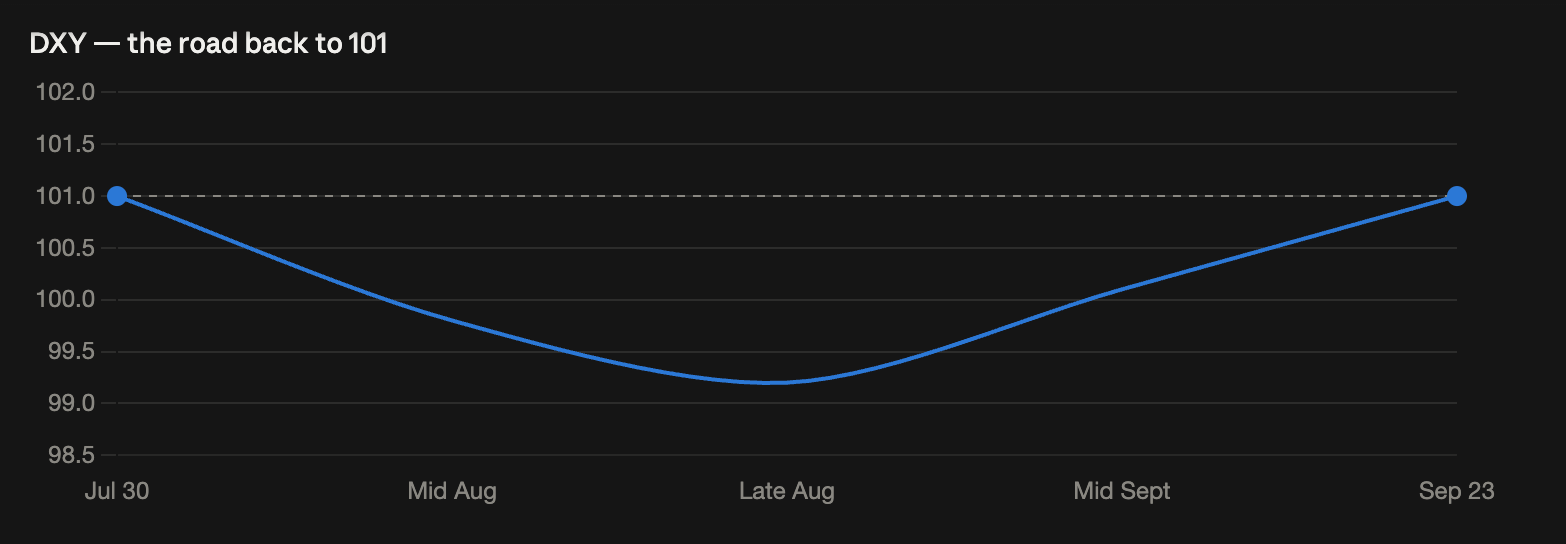
Market News | The Dollar Reclaims 101 and Every Risk Asset Feels the SqueezeThe US dollar index (DXY) touched 101 on September 23 for the first time since July 30, gaining 0.47% on the day. The milestone caps a week in which hawkish Fed commentary, a 4.79% cycle high in two-year yields and better-than-even October hike odds have pressured everything priced in dollars — Bitcoin down to $84,600, gold drifting toward its $4,300 range floor.Rate Differentials Are Powering the Dollar's AdvanceThe move is textbook rate-driven strength. The Fed hiked on September 16 to 3.75%–4.00% with the dot plot signaling one more 2026 increase, and Governor Barr and Richmond Fed President Barkin both leaned hawkish this week. Futures now imply over 53% odds of an October hike, while the two-year yield's push to 4.79% widens the dollar's carry advantage. The yen side amplifies it: even after the BOJ's hike to a 31-year-high policy rate, USD/JPY holds near 157.8, and yen weakness carries significant weight in the DXY basket.A Stronger Dollar Tightens Financial Conditions for CryptoDollar strength operates on Bitcoin through two channels: it raises the effective price of BTC for non-dollar buyers, and it typically accompanies the rising real yields that lift the opportunity cost of non-yielding assets. This week's price action fits the pattern — Bitcoin rejected twice near $87,300 and slipped back inside the $83,000–$86,000 long-term holder zone, while gold pulled back within its $4,300–$4,400 band. Historically, sustained DXY uptrends have coincided with crypto consolidation or drawdown phases; sharp DXY reversals have marked several major crypto bottoms.The 101 Level Is a Checkpoint, Not a CeilingWhether DXY extends depends on the data run into the October Fed meeting: Thursday's jobless claims (consensus 201K), Friday's durable goods (consensus -0.3%), the October 2 jobs report and October 14 CPI. Hot prints that cement an October hike would likely push the index beyond 101 and test Bitcoin's $83,000 floor; soft data would relieve pressure across gold, crypto and equities simultaneously. Friday's ~$14 billion Deribit options expiry adds a crypto-specific wildcard to the same window.
Market News | The Dollar Reclaims 101 and Every Risk Asset Feels the Squeeze
The US dollar index (DXY) touched 101 on September 23 for the first time since July 30, gaining 0.47% on the day. The milestone caps a week in which hawkish Fed commentary, a 4.79% cycle high in two-year yields and better-than-even October hike odds have pressured everything priced in dollars — Bitcoin down to $84,600, gold drifting toward its $4,300 range floor.Rate Differentials Are Powering the Dollar's AdvanceThe move is textbook rate-driven strength. The Fed hiked on September 16 to 3.75%–4.00% with the dot plot signaling one more 2026 increase, and Governor Barr and Richmond Fed President Barkin both leaned hawkish this week. Futures now imply over 53% odds of an October hike, while the two-year yield's push to 4.79% widens the dollar's carry advantage. The yen side amplifies it: even after the BOJ's hike to a 31-year-high policy rate, USD/JPY holds near 157.8, and yen weakness carries significant weight in the DXY basket.A Stronger Dollar Tightens Financial Conditions for CryptoDollar strength operates on Bitcoin through two channels: it raises the effective price of BTC for non-dollar buyers, and it typically accompanies the rising real yields that lift the opportunity cost of non-yielding assets. This week's price action fits the pattern — Bitcoin rejected twice near $87,300 and slipped back inside the $83,000–$86,000 long-term holder zone, while gold pulled back within its $4,300–$4,400 band. Historically, sustained DXY uptrends have coincided with crypto consolidation or drawdown phases; sharp DXY reversals have marked several major crypto bottoms.The 101 Level Is a Checkpoint, Not a CeilingWhether DXY extends depends on the data run into the October Fed meeting: Thursday's jobless claims (consensus 201K), Friday's durable goods (consensus -0.3%), the October 2 jobs report and October 14 CPI. Hot prints that cement an October hike would likely push the index beyond 101 and test Bitcoin's $83,000 floor; soft data would relieve pressure across gold, crypto and equities simultaneously. Friday's ~$14 billion Deribit options expiry adds a crypto-specific wildcard to the same window.
1
1
15
14.4k
·
--
BitMine Shares Fall More Than 4% as Ethereum Drops 2.9%BitMine shares fell more than 4% Wednesday as Ethereum declined. According to NS3.AI, Ethereum traded at $2,661.43 after falling 2.9% over the past 24 hours.
Investors pulled back from higher-risk assets, while broader markets also weakened. The Nasdaq fell 0.94%, and the S&P 500 declined 0.72%.
BitMine Shares Fall More Than 4% as Ethereum Drops 2.9%
BitMine shares fell more than 4% Wednesday as Ethereum declined. According to NS3.AI, Ethereum traded at $2,661.43 after falling 2.9% over the past 24 hours.
Investors pulled back from higher-risk assets, while broader markets also weakened. The Nasdaq fell 0.94%, and the S&P 500 declined 0.72%.
Investors pulled back from higher-risk assets, while broader markets also weakened. The Nasdaq fell 0.94%, and the S&P 500 declined 0.72%.
4
6.2k
·
--
Meme Coins Fall as Crypto Market Pulls BackOld meme coins fell broadly as the crypto market saw a short-term pullback. According to Odaily, MUBARAK dropped more than 19% in 24 hours, BROCCOLI714 fell more than 13%, WIF declined more than 11%, RUMP and PEPE each lost more than 7%, and TST fell more than 6%.
MUBARAK's market value fell to $52.37 million, BROCCOLI714's to $22 million, WIF's to $230 million, RUMP's to $1.477 billion, PEPE's to $1.874 billion, and TST's to $16 million.
Meme Coins Fall as Crypto Market Pulls Back
Old meme coins fell broadly as the crypto market saw a short-term pullback. According to Odaily, MUBARAK dropped more than 19% in 24 hours, BROCCOLI714 fell more than 13%, WIF declined more than 11%, RUMP and PEPE each lost more than 7%, and TST fell more than 6%.
MUBARAK's market value fell to $52.37 million, BROCCOLI714's to $22 million, WIF's to $230 million, RUMP's to $1.477 billion, PEPE's to $1.874 billion, and TST's to $16 million.
MUBARAK's market value fell to $52.37 million, BROCCOLI714's to $22 million, WIF's to $230 million, RUMP's to $1.477 billion, PEPE's to $1.874 billion, and TST's to $16 million.
5
9.6k
·
--
BNB Drops Below 780 USDT with a 1.00% Decrease in 24 HoursOn Sep 23, 2026, 12:04 PM(UTC). According to Binance Market Data, BNB has dropped below 780 USDT and is now trading at 779.039978 USDT, with a narrowed 1.00% decrease in 24 hours.
BNB Drops Below 780 USDT with a 1.00% Decrease in 24 Hours
On Sep 23, 2026, 12:04 PM(UTC). According to Binance Market Data, BNB has dropped below 780 USDT and is now trading at 779.039978 USDT, with a narrowed 1.00% decrease in 24 hours.
5
7k
·
--
Neutron Governance Proposal Manipulated, Leading to $4.4 Million TheftAn emergency governance proposal in the Cosmos ecosystem protocol Neutron was manipulated by an attacker, who bought NTRN with about 20,199 USDC and staked 31.6 million NTRN about 12 minutes before voting ended. According to ChainCatcher, the proposal ultimately passed with 82% support, after which control of 11 contracts was transferred to the attacker and migrated to malicious code, resulting in the theft of about $4.4 million in assets.
To recover the funds, Cosmos Hub validators coordinated a chain halt that lasted nearly 24 hours and 48 minutes. During the restart process, about 1.23 million ATOM were moved from the attacker’s wallet to a new address, with plans to return them to the original holders later.
Neutron Governance Proposal Manipulated, Leading to $4.4 Million Theft
An emergency governance proposal in the Cosmos ecosystem protocol Neutron was manipulated by an attacker, who bought NTRN with about 20,199 USDC and staked 31.6 million NTRN about 12 minutes before voting ended. According to ChainCatcher, the proposal ultimately passed with 82% support, after which control of 11 contracts was transferred to the attacker and migrated to malicious code, resulting in the theft of about $4.4 million in assets.
To recover the funds, Cosmos Hub validators coordinated a chain halt that lasted nearly 24 hours and 48 minutes. During the restart process, about 1.23 million ATOM were moved from the attacker’s wallet to a new address, with plans to return them to the original holders later.
To recover the funds, Cosmos Hub validators coordinated a chain halt that lasted nearly 24 hours and 48 minutes. During the restart process, about 1.23 million ATOM were moved from the attacker’s wallet to a new address, with plans to return them to the original holders later.
2
2.3k
·
--
CryptoQuant Says Onchain Signals Confirm Bitcoin's Next Bull MarketCryptoQuant analysts said onchain signals have confirmed Bitcoin's next bull market and described the path from $86,000 as largely clear. According to NS3.AI, the firm expects profit-taking to emerge near $90,000 and sees no return to bear-market conditions.
US spot Bitcoin exchange-traded funds also recorded $1.7 billion in net inflows during the first two days of the week, according to the report.
CryptoQuant Says Onchain Signals Confirm Bitcoin's Next Bull Market
CryptoQuant analysts said onchain signals have confirmed Bitcoin's next bull market and described the path from $86,000 as largely clear. According to NS3.AI, the firm expects profit-taking to emerge near $90,000 and sees no return to bear-market conditions.
US spot Bitcoin exchange-traded funds also recorded $1.7 billion in net inflows during the first two days of the week, according to the report.
US spot Bitcoin exchange-traded funds also recorded $1.7 billion in net inflows during the first two days of the week, according to the report.
8
16.7k
·
--
Travala and AVA Foundation Launch AVA Buyback MechanismTravala and the AVA Foundation have launched an AVA token buyback mechanism. According to Foresight News, Travala will independently conduct equal monthly buybacks and transfer the repurchased AVA to a multisig-custodied Travala AVA strategic reserve wallet, with Travala pledging not to sell or transfer any AVA in the reserve.
The two mechanisms together raise monthly open-market buybacks to twice the amount of member rewards distributed. Travala said AVA held in the reserve will be removed from official circulating supply, and the wallet address will be submitted to CoinMarketCap and CoinGecko for treatment as non-circulating supply.
The first buyback has been completed, with the AVA Foundation and Travala each repurchasing 369,881.04 AVA, for a total of 739,762.08 AVA. Previously, the AVA Foundation bought back an amount equal to the AVA rewards distributed to AVA Smart members in the prior month and returned the tokens to an ecosystem incentive wallet, bringing cumulative buybacks to 4,824,722 AVA.
Travala and AVA Foundation Launch AVA Buyback Mechanism
Travala and the AVA Foundation have launched an AVA token buyback mechanism. According to Foresight News, Travala will independently conduct equal monthly buybacks and transfer the repurchased AVA to a multisig-custodied Travala AVA strategic reserve wallet, with Travala pledging not to sell or transfer any AVA in the reserve.
The two mechanisms together raise monthly open-market buybacks to twice the amount of member rewards distributed. Travala said AVA held in the reserve will be removed from official circulating supply, and the wallet address will be submitted to CoinMarketCap and CoinGecko for treatment as non-circulating supply.
The first buyback has been completed, with the AVA Foundation and Travala each repurchasing 369,881.04 AVA, for a total of 739,762.08 AVA. Previously, the AVA Foundation bought back an amount equal to the AVA rewards distributed to AVA Smart members in the prior month and returned the tokens to an ecosystem incentive wallet, bringing cumulative buybacks to 4,824,722 AVA.
The two mechanisms together raise monthly open-market buybacks to twice the amount of member rewards distributed. Travala said AVA held in the reserve will be removed from official circulating supply, and the wallet address will be submitted to CoinMarketCap and CoinGecko for treatment as non-circulating supply.
The first buyback has been completed, with the AVA Foundation and Travala each repurchasing 369,881.04 AVA, for a total of 739,762.08 AVA. Previously, the AVA Foundation bought back an amount equal to the AVA rewards distributed to AVA Smart members in the prior month and returned the tokens to an ecosystem incentive wallet, bringing cumulative buybacks to 4,824,722 AVA.
1
7
4.7k
·
--
Four New Addresses Accumulate 31,979 ETH After Market PullbackFour new addresses accumulated 31,979 ETH after the broader market pulled back last night, according to on-chain analyst Ai Yi (@ai_9684xtpa). According to BlockBeats On-chain Detection, the addresses withdrew ETH from a centralized exchange between 11:31 p.m. and 11:38 p.m. last night.
The four addresses are suspected to belong to the same whale or entity. They withdrew ETH worth $85.68 million from a centralized exchange at an average price of $2,679.31.
Four New Addresses Accumulate 31,979 ETH After Market Pullback
Four new addresses accumulated 31,979 ETH after the broader market pulled back last night, according to on-chain analyst Ai Yi (@ai_9684xtpa). According to BlockBeats On-chain Detection, the addresses withdrew ETH from a centralized exchange between 11:31 p.m. and 11:38 p.m. last night.
The four addresses are suspected to belong to the same whale or entity. They withdrew ETH worth $85.68 million from a centralized exchange at an average price of $2,679.31.
The four addresses are suspected to belong to the same whale or entity. They withdrew ETH worth $85.68 million from a centralized exchange at an average price of $2,679.31.
1
4.2k
·
--
Ledger Adds Private Zcash Balances In Desktop WalletLedger now lets Zcash (ZEC) holders keep private, shielded balances inside its Ledger Wallet desktop app, while transparent balances remain public. According to BeInCrypto, the update means one account can now hold both, but private funds only appear if they sit in Ironwood, Zcash’s new privacy pool launched in July. Ledger CTO Charles Guillemet said the scanning and transaction building happen locally on the user’s machine, and the older Zondax app will be pulled on November 5.
Ledger Adds Private Zcash Balances In Desktop Wallet
Ledger now lets Zcash (ZEC) holders keep private, shielded balances inside its Ledger Wallet desktop app, while transparent balances remain public. According to BeInCrypto, the update means one account can now hold both, but private funds only appear if they sit in Ironwood, Zcash’s new privacy pool launched in July. Ledger CTO Charles Guillemet said the scanning and transaction building happen locally on the user’s machine, and the older Zondax app will be pulled on November 5.
1
7
6.3k
·
--
BNB Drops Below 770 USDT with a 3.08% Decrease in 24 HoursOn Sep 23, 2026, 14:13 PM(UTC). According to Binance Market Data, BNB has dropped below 770 USDT and is now trading at 766.609985 USDT, with a narrowed 3.08% decrease in 24 hours.
BNB Drops Below 770 USDT with a 3.08% Decrease in 24 Hours
On Sep 23, 2026, 14:13 PM(UTC). According to Binance Market Data, BNB has dropped below 770 USDT and is now trading at 766.609985 USDT, with a narrowed 3.08% decrease in 24 hours.
1
3.5k
·
--
Bessent Says Oil Prices Will Fall After Supply RecoversAccording to Jin10, U.S. Treasury Secretary Bessent said in a Fox News interview that oil prices will fall once supply disruptions ease, while discussing inflation and the impact of the conflict with Iran on the economy. He said the Iran conflict triggered an energy supply shock, highlighted that the U.S. private sector created more than 1 million jobs and that real wages increased, and said he expects the economy to keep growing.
Bessent Says Oil Prices Will Fall After Supply Recovers
According to Jin10, U.S. Treasury Secretary Bessent said in a Fox News interview that oil prices will fall once supply disruptions ease, while discussing inflation and the impact of the conflict with Iran on the economy. He said the Iran conflict triggered an energy supply shock, highlighted that the U.S. private sector created more than 1 million jobs and that real wages increased, and said he expects the economy to keep growing.
1
6
5k
·
--
Britain's Biggest Banks Complete First Interbank Transactions Using Tokenised DepositsBritain's biggest banks have completed the world's first interbank transactions using tokenised deposits. According to NS3.AI, Lloyds, NatWest and Barclays carried out two mortgage transactions, while a separate trio of banks including HSBC simulated a person-to-person online marketplace purchase.
The transactions were presented as a test of how tokenised deposits could be used across banks for mortgage payments and retail-style purchases. The article did not provide additional details on timing, transaction size, or settlement mechanics.
Britain's Biggest Banks Complete First Interbank Transactions Using Tokenised Deposits
Britain's biggest banks have completed the world's first interbank transactions using tokenised deposits. According to NS3.AI, Lloyds, NatWest and Barclays carried out two mortgage transactions, while a separate trio of banks including HSBC simulated a person-to-person online marketplace purchase.
The transactions were presented as a test of how tokenised deposits could be used across banks for mortgage payments and retail-style purchases. The article did not provide additional details on timing, transaction size, or settlement mechanics.
The transactions were presented as a test of how tokenised deposits could be used across banks for mortgage payments and retail-style purchases. The article did not provide additional details on timing, transaction size, or settlement mechanics.
1
3
4.4k
·
--
BTC Rises $10,000 in Four Days as Implied Volatility Stays at 35%Greeks.live researcher Adam said on X that BTC rose $10,000 in four days while implied volatility remained at 35%. According to Odaily, Adam made the comment in a post on X.
BTC Rises $10,000 in Four Days as Implied Volatility Stays at 35%
Greeks.live researcher Adam said on X that BTC rose $10,000 in four days while implied volatility remained at 35%. According to Odaily, Adam made the comment in a post on X.
2
5.7k
·
--
Arkham Monitors Wallet Consolidating Nearly 57,258 ETH After Receiving 45,000 ETH From Galaxy Digital OTCOn September 24, Arkham monitored a wallet that received 45,000 ETH from Galaxy Digital OTC at an estimated value of about $119.67 million, with an average withdrawal price of roughly $2,659. According to BlockBeats On-chain Detection, the address later combined part of its existing holdings with the newly received funds through intermediary wallets and transferred a total of about 54,990 ETH into the same wallet.
As of press time, the consolidation wallet held about 57,257.78 ETH and had not recorded any active outgoing transfers. The consolidation address is 0x0ff2c6e74e97c4c229bf156ab1ed8dd97bc84c9f.
Arkham Monitors Wallet Consolidating Nearly 57,258 ETH After Receiving 45,000 ETH From Galaxy Digital OTC
On September 24, Arkham monitored a wallet that received 45,000 ETH from Galaxy Digital OTC at an estimated value of about $119.67 million, with an average withdrawal price of roughly $2,659. According to BlockBeats On-chain Detection, the address later combined part of its existing holdings with the newly received funds through intermediary wallets and transferred a total of about 54,990 ETH into the same wallet.
As of press time, the consolidation wallet held about 57,257.78 ETH and had not recorded any active outgoing transfers. The consolidation address is 0x0ff2c6e74e97c4c229bf156ab1ed8dd97bc84c9f.
As of press time, the consolidation wallet held about 57,257.78 ETH and had not recorded any active outgoing transfers. The consolidation address is 0x0ff2c6e74e97c4c229bf156ab1ed8dd97bc84c9f.
1
2.7k
·
--
Aave V4 Deposits Top $1 Billion After Doubling in a MonthAave v4 deposits have surpassed $1 billion, according to Token Terminal monitoring. According to ChainCatcher, the protocol’s deposits doubled over the past month, while active loans currently stand at $300 million.
Aave V4 Deposits Top $1 Billion After Doubling in a Month
Aave v4 deposits have surpassed $1 billion, according to Token Terminal monitoring. According to ChainCatcher, the protocol’s deposits doubled over the past month, while active loans currently stand at $300 million.
4.9k
·
--
Galaxy Allocates $100 Million in sUSDS to Sky Vault and Buys SKY TokensGalaxy announced that it has allocated $100 million worth of sUSDS to a Sky vault and also purchased SKY tokens. According to Odaily, the transaction further deepens the two sides' cooperation in lending services.
Galaxy Allocates $100 Million in sUSDS to Sky Vault and Buys SKY Tokens
Galaxy announced that it has allocated $100 million worth of sUSDS to a Sky vault and also purchased SKY tokens. According to Odaily, the transaction further deepens the two sides' cooperation in lending services.
2
4.5k
·
--
Polygon Launches Stablecoin Subscription Service on Open Money StackPolygon said its stablecoin subscription service has gone live on Open Money Stack (OMS). According to Foresight News, users can approve the amount, scope, and billing cycle once, and a non-custodial wallet will automatically deduct payments on schedule without requiring monthly repeated signatures.
Merchants can offer subscriptions, memberships, or account plans inside their apps without directing users to a separate payment flow. Users can revoke authorization, and protocols can set a maximum amount, allowed contracts or actions, billing period, and expiration time.
Polygon Launches Stablecoin Subscription Service on Open Money Stack
Polygon said its stablecoin subscription service has gone live on Open Money Stack (OMS). According to Foresight News, users can approve the amount, scope, and billing cycle once, and a non-custodial wallet will automatically deduct payments on schedule without requiring monthly repeated signatures.
Merchants can offer subscriptions, memberships, or account plans inside their apps without directing users to a separate payment flow. Users can revoke authorization, and protocols can set a maximum amount, allowed contracts or actions, billing period, and expiration time.
Merchants can offer subscriptions, memberships, or account plans inside their apps without directing users to a separate payment flow. Users can revoke authorization, and protocols can set a maximum amount, allowed contracts or actions, billing period, and expiration time.
1k
·
--
XRP Shows Three Bullish Signals as It Trades Near $1.50XRP is showing three bullish signals across holder, derivatives, and ETF data. According to NS3.AI, XRP traded near $1.50 and fell about 6.3% over 24 hours.
XRP remained up over 15.6% on the week. CryptoRank data shows XRP has closed October lower in eight of 13 years.
XRP Shows Three Bullish Signals as It Trades Near $1.50
XRP is showing three bullish signals across holder, derivatives, and ETF data. According to NS3.AI, XRP traded near $1.50 and fell about 6.3% over 24 hours.
XRP remained up over 15.6% on the week. CryptoRank data shows XRP has closed October lower in eight of 13 years.
XRP remained up over 15.6% on the week. CryptoRank data shows XRP has closed October lower in eight of 13 years.
1
5
3.7k
·
--
Crypto News | Glassnode Says the Four-Year Cycle Playbook Is Failing — and That's BullishBitcoin's famed four-year cycle has not shown up in this bear market, on-chain analytics firm Glassnode said on X. Where the past three cycles each saw drawdowns more than twice as deep as today's roughly 30% retracement from the all-time high, this cycle's decline has stayed shallow — and with price recovering to around $84,600, Glassnode argues a past-style deep correction looks increasingly unlikely.This Cycle's Drawdown Is Less Than Half of Historical Bear MarketsGlassnode's data shows drawdowns in each of the past three cycles exceeded twice the current cycle's roughly 30% pullback — historically, Bitcoin bear markets in 2015, 2018 and 2022 erased between roughly 77% and 85% of value from peak to trough (general market history, not from the Glassnode post). By the four-year calendar template, several weeks would still remain before the cycle low arrives; instead, Bitcoin has already reclaimed the $80,000–$82,000 supply band, the 50-week SMA at $81,081, and pushed as high as $87,300 this week before settling back inside the $83,000–$86,000 long-term holder zone.Structural Changes Explain Why This Cycle Behaves DifferentlyThe shallower drawdown has identifiable mechanics. Spot Bitcoin ETFs provide a persistent institutional bid — Monday's ~$1 billion inflow was the largest since October 2025 — that didn't exist in prior bears. Long-term holder behavior has also shifted: 30-day LTH distribution slowed from -105,900 BTC on August 30 to -21,700 BTC by September 20, meaning the selling pressure that historically deepened corrections is drying up rather than accelerating. The halving's diminishing supply impact and a maturing derivatives market (~$160 billion in perpetual open interest) further weaken the old cycle logic.A Broken Cycle Cuts Both Ways for TradersIf the four-year template no longer governs downside, it likely no longer governs upside timing either — parabolic blow-off tops on a fixed calendar become less reliable too. Glassnode's conclusion is probabilistic, not a guarantee: a macro shock — another Fed hike is priced above 53% for October, and the two-year yield sits at a 4.79% cycle high — could still force a deeper flush. Near-term tests: Friday's ~$14 billion Deribit options expiry, the $83,000 zone floor holding, and whether Bitcoin can clear $87,300 and the ~$89,000 100-week moving average. This is Glassnode's second structural-shift call this week, following Monday's altseason signal flip.
Crypto News | Glassnode Says the Four-Year Cycle Playbook Is Failing — and That's Bullish
Bitcoin's famed four-year cycle has not shown up in this bear market, on-chain analytics firm Glassnode said on X. Where the past three cycles each saw drawdowns more than twice as deep as today's roughly 30% retracement from the all-time high, this cycle's decline has stayed shallow — and with price recovering to around $84,600, Glassnode argues a past-style deep correction looks increasingly unlikely.This Cycle's Drawdown Is Less Than Half of Historical Bear MarketsGlassnode's data shows drawdowns in each of the past three cycles exceeded twice the current cycle's roughly 30% pullback — historically, Bitcoin bear markets in 2015, 2018 and 2022 erased between roughly 77% and 85% of value from peak to trough (general market history, not from the Glassnode post). By the four-year calendar template, several weeks would still remain before the cycle low arrives; instead, Bitcoin has already reclaimed the $80,000–$82,000 supply band, the 50-week SMA at $81,081, and pushed as high as $87,300 this week before settling back inside the $83,000–$86,000 long-term holder zone.Structural Changes Explain Why This Cycle Behaves DifferentlyThe shallower drawdown has identifiable mechanics. Spot Bitcoin ETFs provide a persistent institutional bid — Monday's ~$1 billion inflow was the largest since October 2025 — that didn't exist in prior bears. Long-term holder behavior has also shifted: 30-day LTH distribution slowed from -105,900 BTC on August 30 to -21,700 BTC by September 20, meaning the selling pressure that historically deepened corrections is drying up rather than accelerating. The halving's diminishing supply impact and a maturing derivatives market (~$160 billion in perpetual open interest) further weaken the old cycle logic.A Broken Cycle Cuts Both Ways for TradersIf the four-year template no longer governs downside, it likely no longer governs upside timing either — parabolic blow-off tops on a fixed calendar become less reliable too. Glassnode's conclusion is probabilistic, not a guarantee: a macro shock — another Fed hike is priced above 53% for October, and the two-year yield sits at a 4.79% cycle high — could still force a deeper flush. Near-term tests: Friday's ~$14 billion Deribit options expiry, the $83,000 zone floor holding, and whether Bitcoin can clear $87,300 and the ~$89,000 100-week moving average. This is Glassnode's second structural-shift call this week, following Monday's altseason signal flip.
2
8
8.8k
Join global crypto users on Binance Square
⚡️ Get latest and useful information about crypto.
💬 Trusted by the world’s largest crypto exchange.
👍 Discover real insights from verified creators.
Email / Phone number
Trending Topics
FortitudeRaisesCreditLineTo$50M
264 views
40 Discussing
#FortitudeRaisesCreditLineTo$50M
A momentous occasion for the team at Fortitude Capital! 📈 We're thrilled to announce the successful expansion of our credit line to a staggering $50 million. This significant milestone, marked by a celebratory signing ceremony on the exchange floor, is a testament to the hard work and strategic vision of everyone involved.
This increased capital will empower us to pursue new investment opportunities, fuel further growth, and better serve our clients. We're incredibly grateful for the support of our partners and stakeholders who have made this achievement possible.
As we look towards the future with renewed confidence, we're excited to continue driving innovation and delivering exceptional results. Here's to a secured future and continued success!
#FortitudeRaisesCreditLineTo$50M #FortitudeCapital #Growth #Expansion #CapitalRaise
Added Three Tradeable Coins (Illustrative):
To further commemorate this achievement and align with the modern financial landscape, we've symbolically integrated three tradeable coins:
$FTDR.US (Fortitude Token): A hypothetical coin representing a stake in the future success of Fortitude Capital, potentially offering exclusive benefits or investment opportunities.
$USDC (USD Coin): A widely recognized stablecoin, representing the tangible USD value of the credit line increase and ensuring liquidity.
$ETH (Ethereum): A leading cryptocurrency platform, symbolizing our commitment to innovation and the future of finance.
Please note that these coins are included for illustrative and symbolic purposes and do not constitute financial advice. Investment decisions should always be made based on thorough research and individual circumstances.
#market #US #ETH
Axiom AlphA
·0 Likes
·12 views
USWeighsPromotingDollarStablecoinsAbroad
6,598 views
454 Discussing
US10YTreasuryYieldHits19YearHigh
5,651 views
363 Discussing