



Author: Ignas | DeFi Research
Translated by: Shen Chao TechFlow
Shen Chao's guide: DeFi researcher Ignas continues last year's 'Truth and Lies' series, analyzing the 2026 crypto market using Peter Thiel's thinking framework.
Key points: The US stock market bubble has hijacked crypto assets, BTC is completing the narrative switch from risk asset to safe-haven asset, and the 4-year cycle may have already failed. The article covers multiple main lines, including RWA, privacy, regulation, DAT, etc., with a very high information density.
The text is as follows:
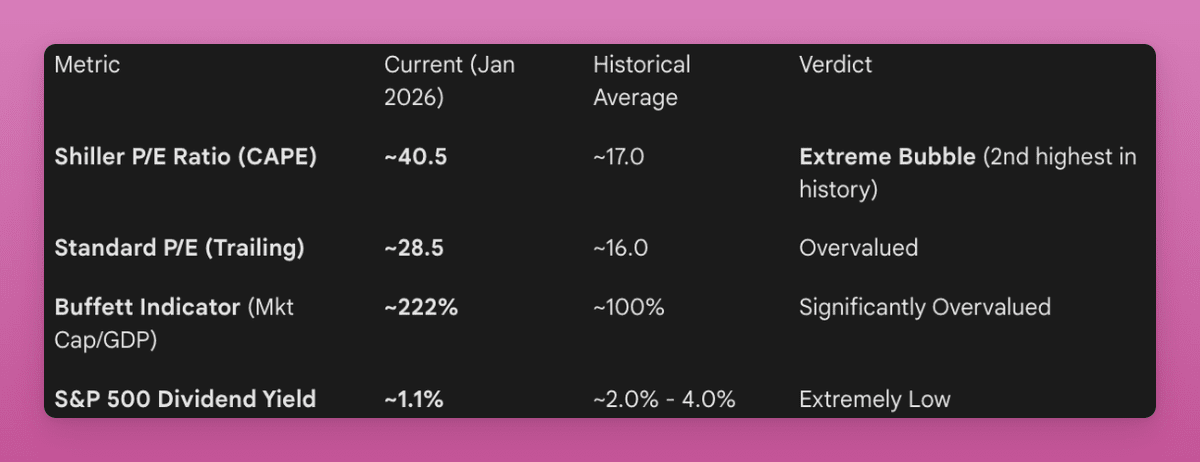
The US stock market is currently in the 'bubble' range, with valuation levels comparable to the peak of the 1999 internet bubble.
Caption: Source Gemini, data for reference only.
Currently, the price-to-earnings ratio has reached 40.5 times, higher than the 32 times before the 1929 crash.
And Buffett's 'best single indicator of valuation' — the total market cap to GDP ratio — is now 230%, 77% higher than the long-term trend. Before the 1929 crash, this ratio was 130%.
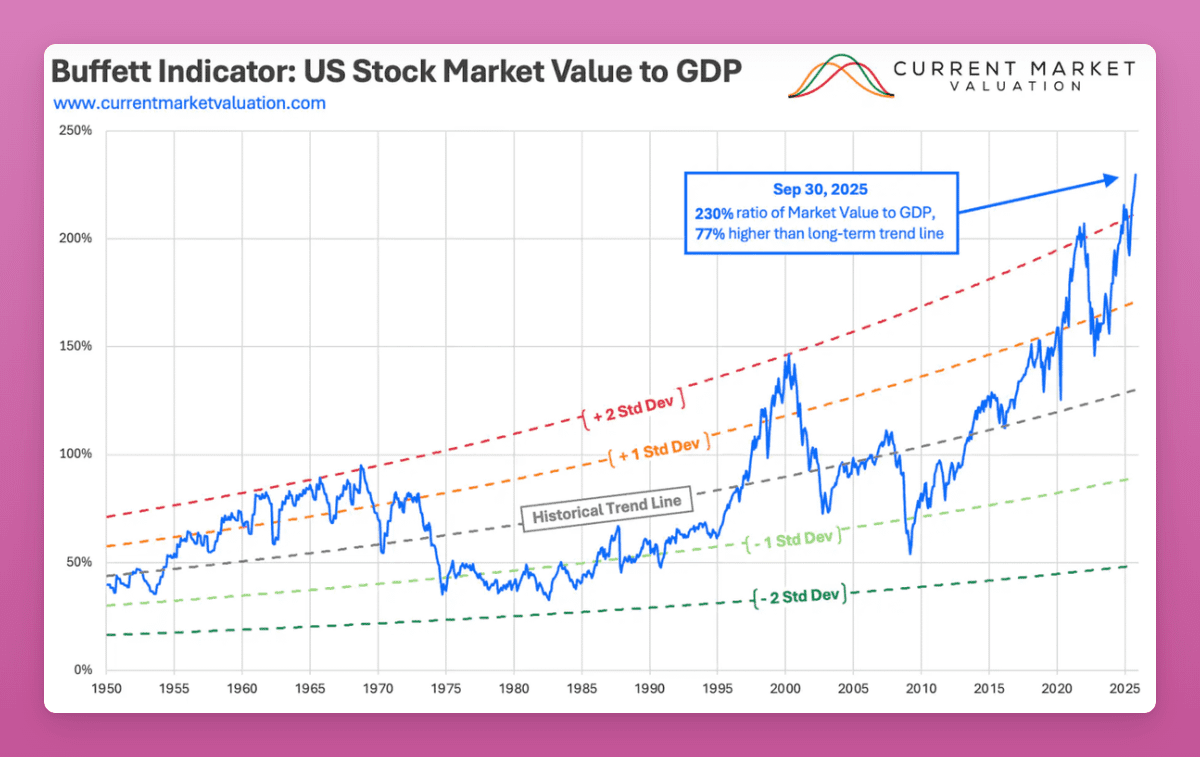
Caption: Source link.
Of course, this time it might be different. You could say this is a 'currency devaluation trade' — the purchasing power of the dollar is declining, and the world needs to digest debt through inflation.
But the statement 'currency devaluation trading is real' may be a 'non-obvious lie.'
If this is the case, the line in the chart below should be flat.
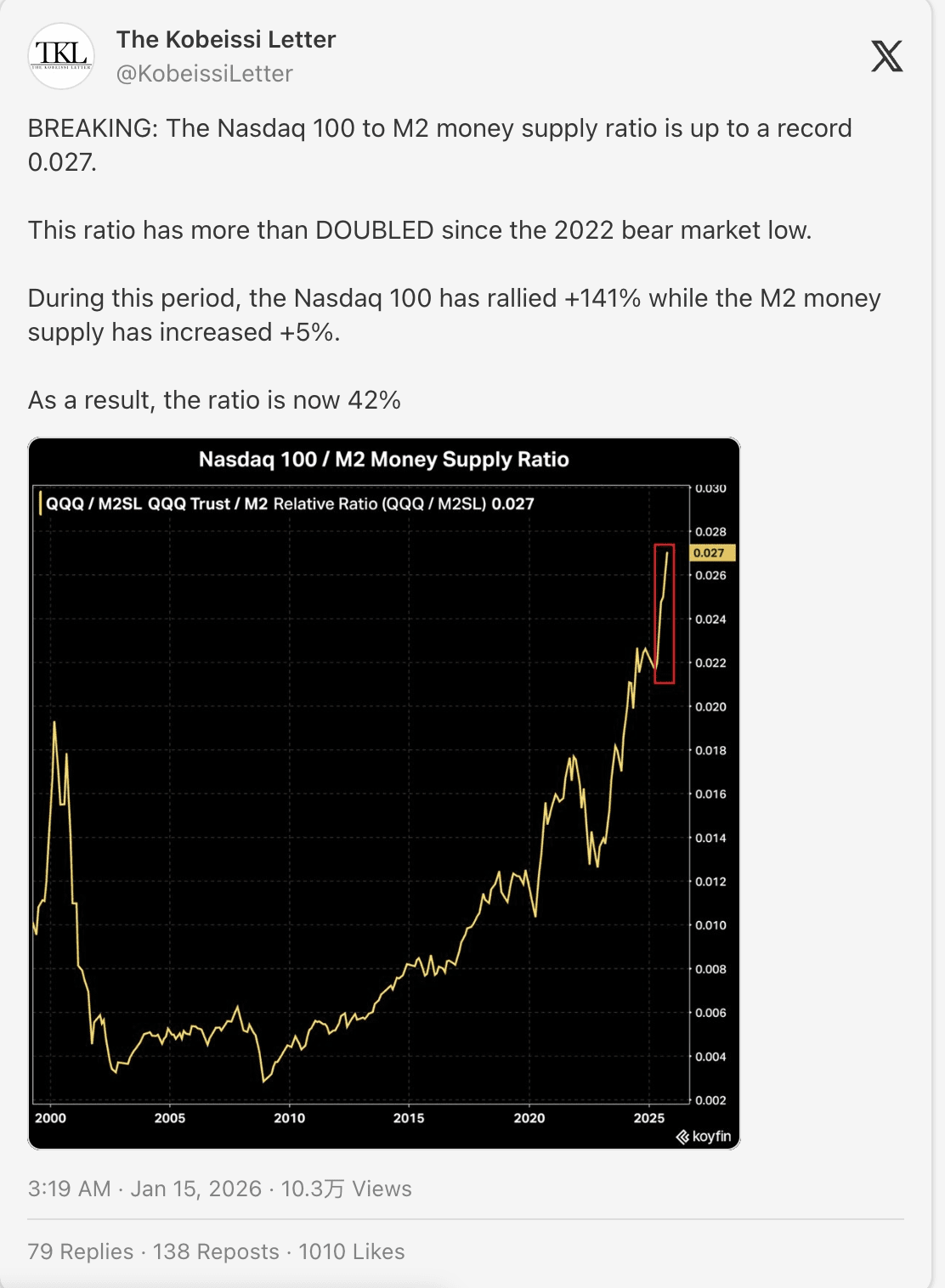
If the money supply doubles → stocks double → the ratio stays the same.
But in reality, this line is vertically upward.
This indicates that the speed of stock price increases is 28 times the speed of currency creation.
Or, perhaps AI really is transformative, and traditional indicators no longer apply.
Combined with macro uncertainty, inflation, and escalating wars, people are naturally worried.
As Ollie wrote, people live in 'universal economic anxiety.'
'You don't need to be a prophet to know that for most people, the desire of this era is stability, ownership, and exposure to the upside. We are still children of capitalism, and our desires are inherently capitalist.'
'So for most people, the clearest answer is to hold stocks and equities, then endure 12 months of Trump waving his fists and boasting of genius performances.'
Naturally, fewer people are willing to take a 100% position to bet on altcoins now.
But the outlook for BTC might be different.
I view BTC as a safe-haven asset: hedging against macro uncertainty, the collapse of international order, and currency devaluation (even though devaluation may not occur).
This is a 'non-obvious truth' I shared in my blog last year.
Too many still view BTC as a risk asset, thinking it will only rise in macro stability and NASDAQ surges.
It is precisely this narrative conflict that is suppressing prices. Fearful holders need to surrender to buyers who view BTC as digital gold.
I hope the 'big rotation' can happen this year, solidifying BTC's position as a safe-haven asset.
But there is a huge risk: the stock market could crash along with all assets... and crypto would follow.
Thus, considering this macro bubble context, I want to focus on those mid-term trends that I think will shape the crypto market in 2026.
There is no better entry point than extracting the truth and lies of 2026.
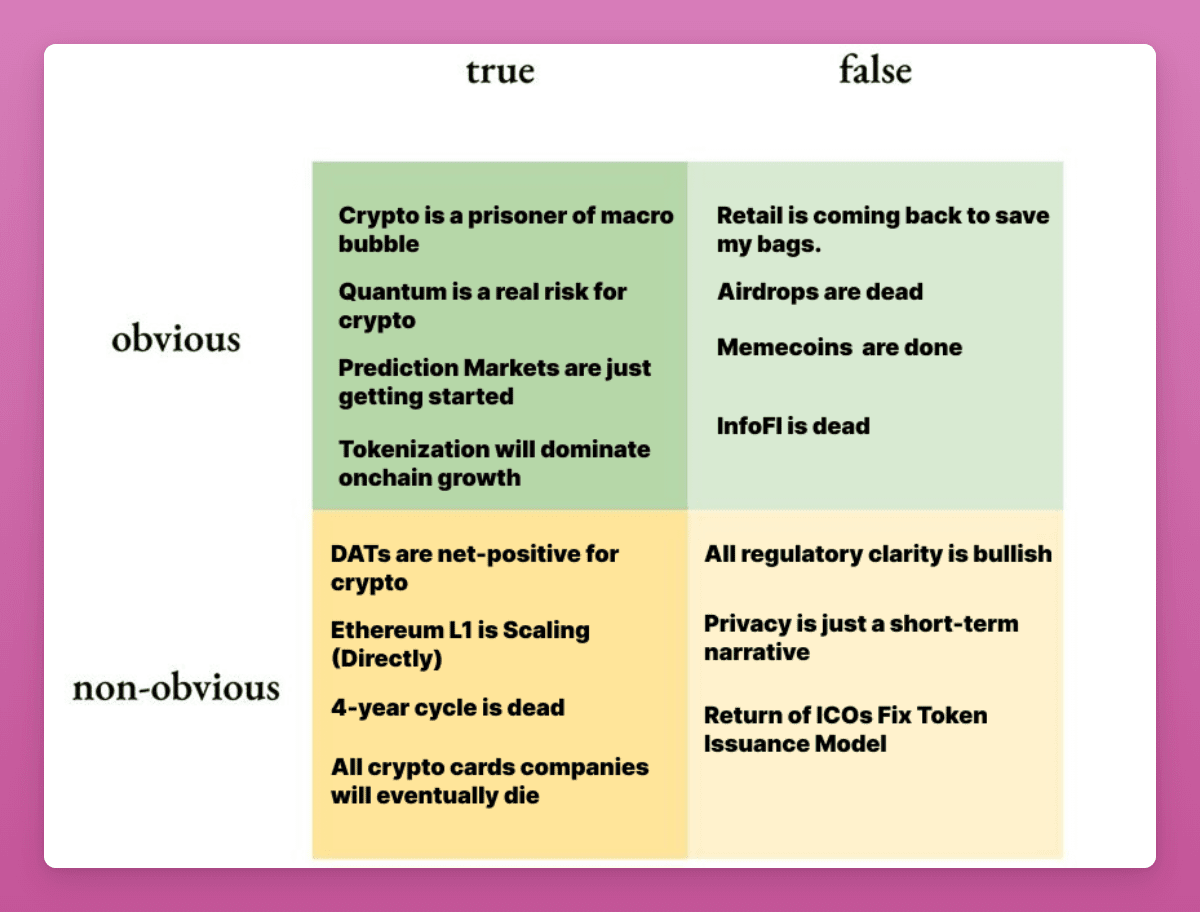
First, crypto is a prisoner of this macro bubble.
Like last year, I continue to use the thinking framework originally proposed by Peter Thiel and later adapted for the crypto space by Matti of Zee Prime Capital.
'If you listen to the current discussions and narratives, what do you think is the obvious truth, and what is the obvious lie? What is the non-obvious truth, and what is the non-obvious lie?' — Matti
Non-obvious truths and lies are harder to detect, but they reveal things that will soon be clear to everyone. These are the best trading opportunities.
This is a puzzle. I challenge you to come up with your own non-obvious truths/lies. I dare bet it’s harder than you think. As Matti wrote:
'If your insights are only in the obvious realms — you probably don't have anything unique to offer and will just compete with many others.'
Obvious truths and lies.
Lie: Retail will come back to pick up the pieces.
CT seems to still be waiting for 'little white' to return.
But retail investors have been battered, and in the current macro environment, they are more worried than ever. They have been harvested in waves by ICOs (2017), NFTs (2021), Memecoins (2024). Each trend is value extraction, with retail acting as exit liquidity.
Thus, the next wave of funding will likely come from institutions.
This is the viewpoint of Zach from Chainlink, which I think makes a lot of sense.

Unlike retail, institutions won't buy air coins. They don't buy those protocols with zero revenue.
They will buy tokens with 'dividend-like' properties (fee switches, real yields), projects with clear PMF (stablecoin issuers, prediction markets), and targets with clear regulations.
In fact, Tiger Research predicts 'utility-oriented token economics has failed. Governance voting rights have not attracted investors.' They predict that projects unable to generate sustainable income will exit the industry.
But I have one concern for 2026.
If tokens cannot provide this value, institutions will bypass tokens and directly purchase equity in development companies (just like Coinbase acquiring the Axelar team but not the tokens).
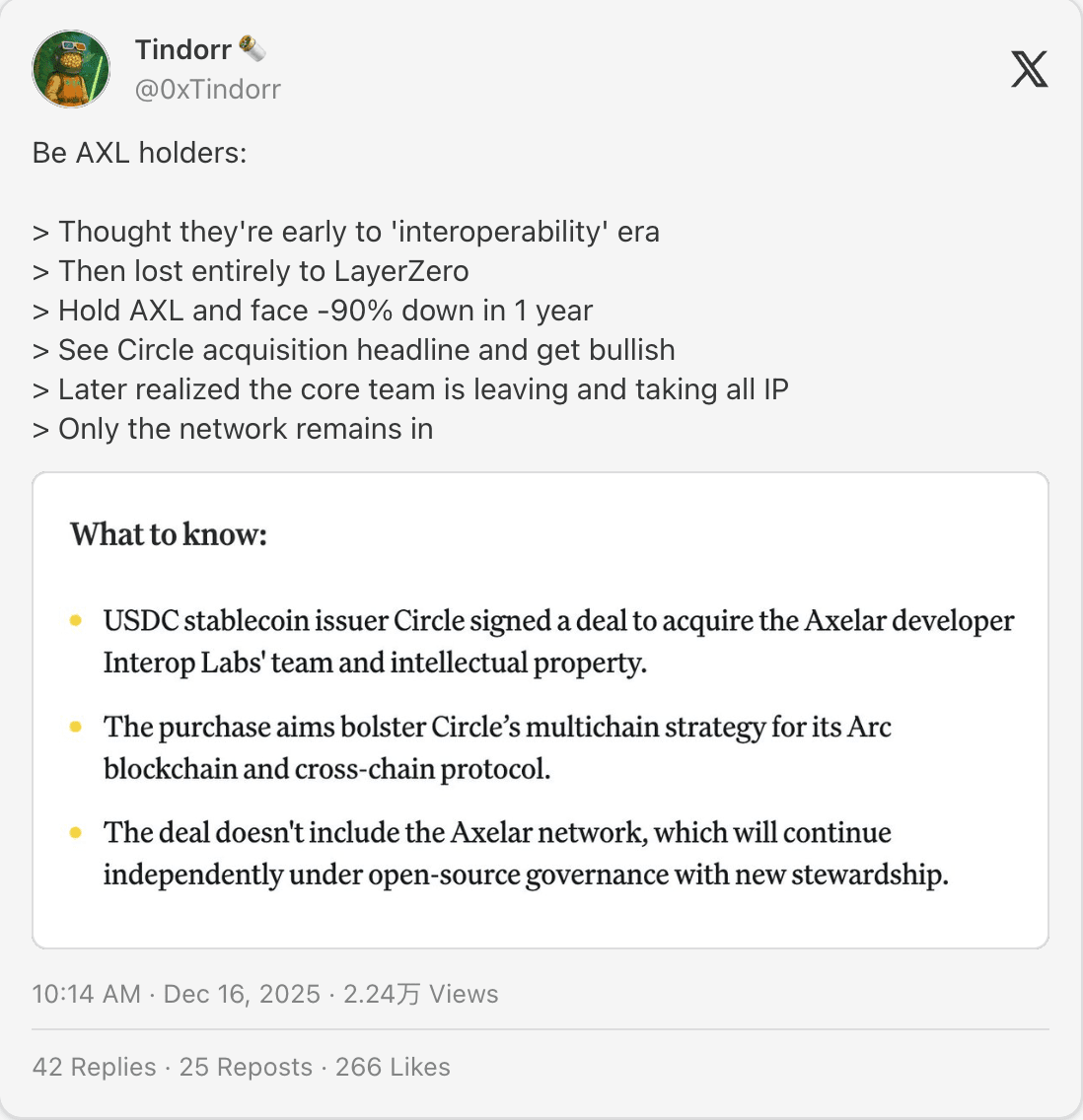
We have already seen conflicts of interest between token holders and equity holders (Aave Labs vs DAO).
If we don't address this issue, eventually smart money will own equity (real value), and retail will own tokens (exit liquidity).
For crypto to succeed, value must flow to tokens, not Labs companies. Otherwise, we are just reconstructing the same traditional financial system.
This will be a big issue to watch closely in the coming year.
Truth: Quantum risk is real.
There are two layers of risk here:
The real risk of quantum computers 'cracking blockchain' or wallets relying on non-quantum-resistant technology.
The perception of quantum risk as real among investors.
Because 1) very few truly understand quantum technology, 2) the crypto market is dominated by narratives, sentiment, and momentum, making it susceptible to FUD attacks.
What I mean is that until these risks are fully addressed, quantum risk will continue to suppress crypto prices.
We don't need quantum computers to really drain Satoshi's wallet to see BTC drop by 50%. We just need Google or IBM to issue a news headline about a 'quantum breakthrough' to trigger mass panic.
In this case, I foresee a rotation towards quantum-resistant chains, especially Ethereum.
Ethereum is already preparing for quantum resistance in its roadmap (The Splurge). Vitalik has also clearly expressed this need.
Bitcoin may erupt into civil war due to the hard fork upgrade of the signature algorithm (from ECDSA to quantum-resistant schemes).
New L1s may launch with 'post-quantum cryptography' (PQC) as a main selling point (don't be fooled).
But if BTC fails to prepare and erupts into a civil war, it will drag down all crypto assets, as market makers, hedge funds, etc., will rebalance their portfolios.
Truth: Prediction markets are just getting started.
There are few opportunities in crypto as obvious as prediction markets.
This viewpoint comes from Andy Hall, a research advisor at a16z crypto, too accurate to ignore.
Prediction markets will have entered the mainstream by 2024. But by 2026, they will become larger, broader, and smarter.
Andy says prediction markets are moving beyond questions like 'Who will win the US election?' to ultra-specific outcomes.
More contracts: Real-time odds for everything. Geopolitics, supply chains, and perhaps even 'Will Ignas issue a token?'
AI integration: AI agents will scan the internet for signals to trade these markets, making them more efficient than any human analyst.
The biggest trading opportunity is: Who gets to decide the truth? As market sizes grow, adjudicating bets become issues. We saw this in the Venezuelan invasion (?) and the Zelensky market. Existing solutions (UMA) failed to capture nuances, leading to disputes and 'scam' accusations.
Thus, we need a decentralized truth. Andy predicts a move towards decentralized governance and LLM (AI) oracles to resolve disputes.
Maybe the POLY token will play a role in this? Where are your trading opportunities?
Lie: Airdrops are dead.
I have to add this point.
Airdrops have been, and still are, the easiest way to make money in crypto. Many believe airdrops are dead because 1) it's harder to get large rewards, 2) witch detection has improved.
But if you are a real user, trying new applications every day and using them, I believe the returns are worth it.
Neofinance airdrops should start in 2025, but the real printing opportunity lies with Polymarket, Base, Opensea, Metamask...
If CT thinks airdrops are dead, that’s even better. Fewer farmers, less competition.
Lie: Memecoin is finished.
To be honest, I don't like memecoins. But sometimes I still trade them.
Winning money on memecoins is intellectually interesting 😉, where will perceived sentiment shift? The volatility is stimulating, requiring no study of token economics, revenue streams, etc. That’s the allure of memecoins.
Institution-grade L1s, revenue-sharing, or governance tokens cannot provide that kind of stimulus. 4-year unlocks are boring. In terms of revenue, utility tokens are actually less attractive than memecoins driven purely by sentiment.
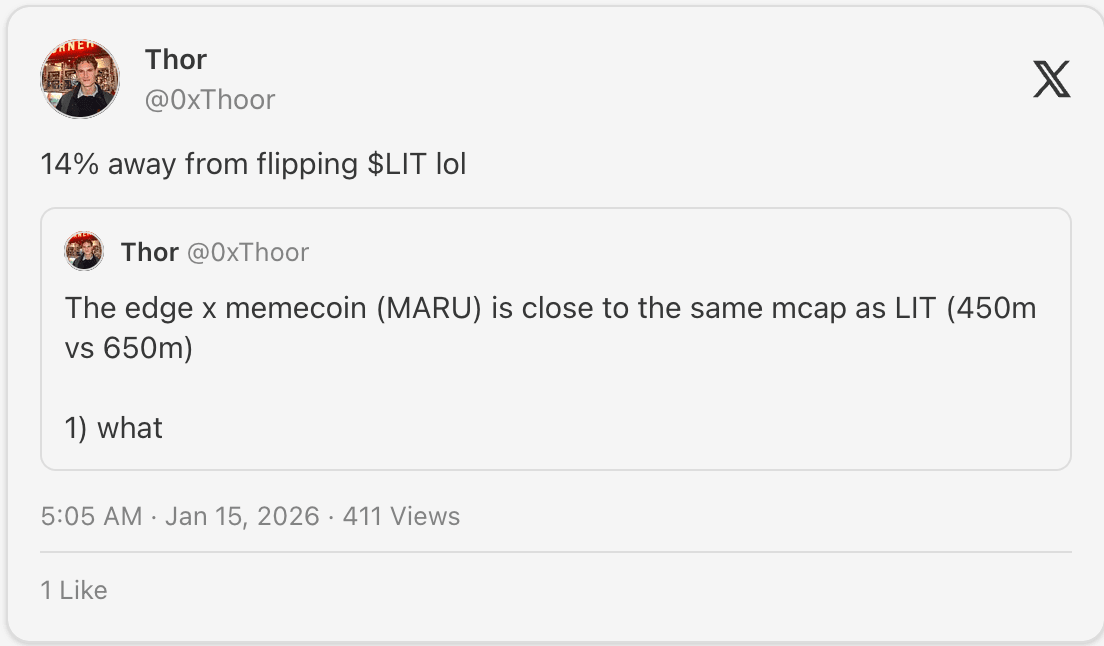
And financial nihilism will not disappear on January 1st. Regulation will not ban them.
When the crypto market turns bullish, memecoins will reappear. The incentives for KOLs to shout out are too high. Retail is too eager for 1000x victories.
If degen trading is your thing, keep an open mind (and wallet).
Truth: Tokenization/RWA will dominate crypto growth.
Few charts for 2025 are on an upward trajectory.
But the growth of RWA and tokenized assets is one of them.
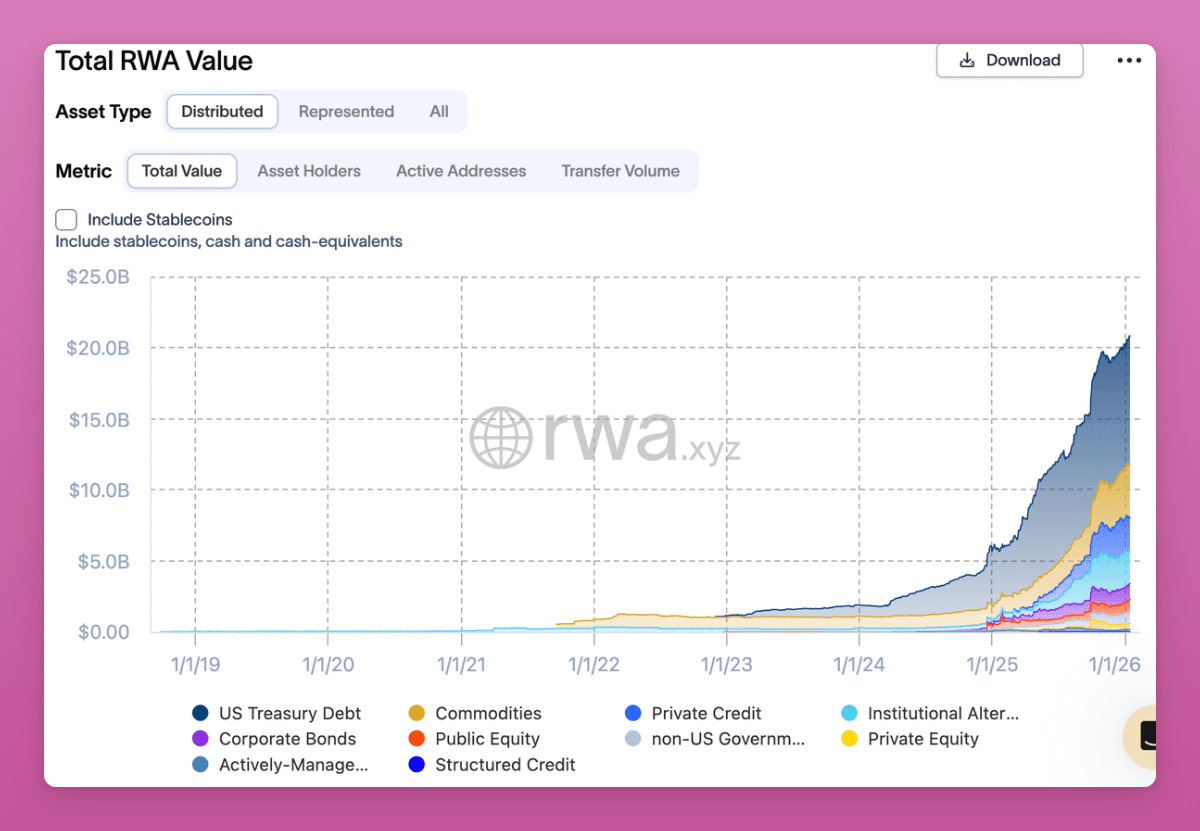
RWA is very different from cyclical DeFi, NFTs, prediction markets, or perpetual contracts. RWA is not speculative hype. It is a long-term transformation driven by institutional capital finding product-market fit.
They have vastly different predictions for 2030:
McKinsey (conservative): $2-4 trillion.
Citigroup: $4-5 trillion.
BCG + ADDX: $16 trillion.
Ripple + BCG: $18.9 trillion by 2033.
Standard Chartered (optimistic): $30 trillion.
Optimistic predictions suggest that RWA will exceed the total market capitalization of the entire crypto industry (currently $3.3 trillion).
BlackRock and Larry Fink are strongly pushing RWA. In his 2025 annual letter, he likened the current moment to 'the internet in 1996' — when Amazon was still a bookstore and Google had not yet been founded.
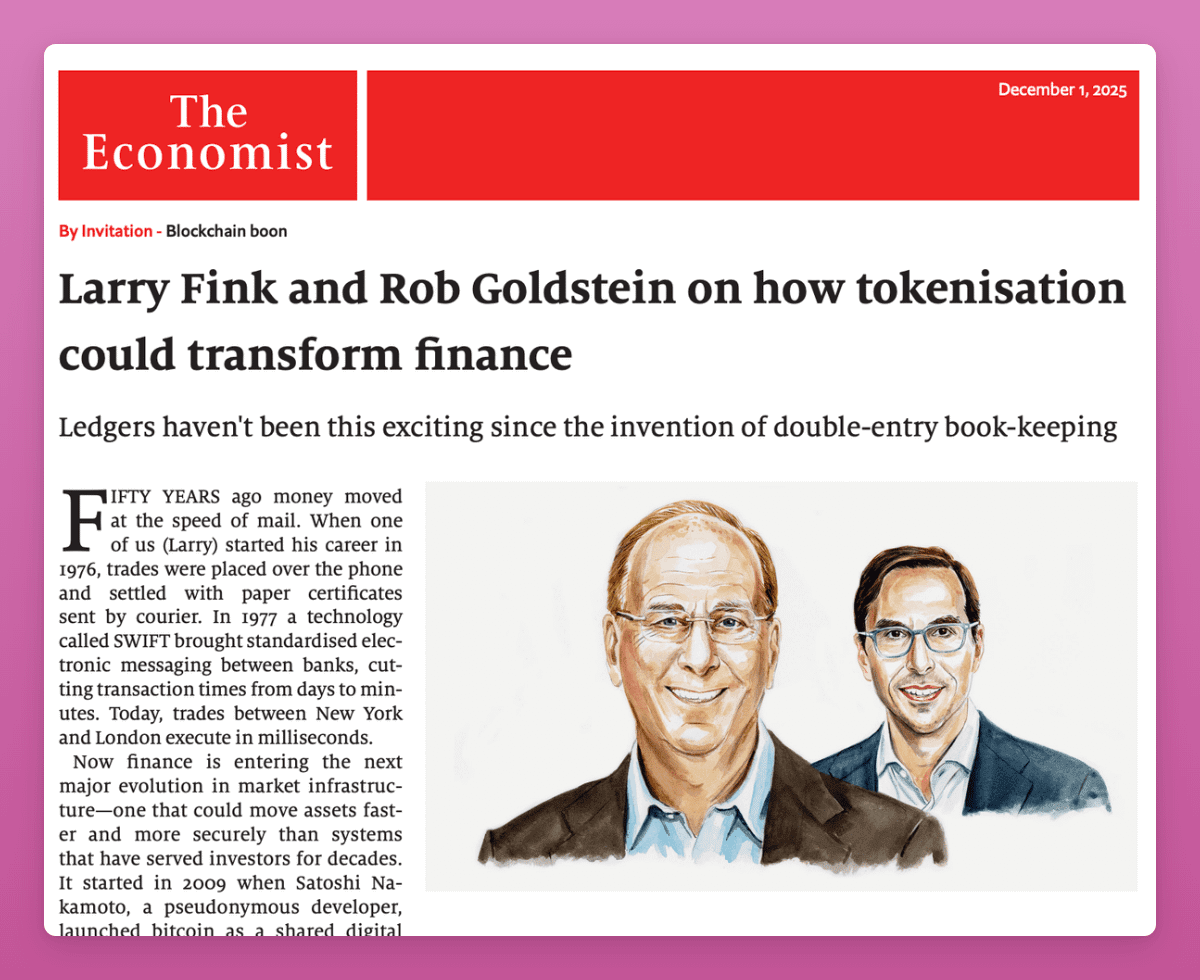
Caption: Source Economist (free reading link).
His argument:
'Every stock, every bond, every fund — every asset — can be tokenized. If realized, it will fundamentally change investing.'
The benefits of RWA are obvious to crypto natives, but traditional finance is still learning. We're early:
Collateral availability.
DeFi composability.
24/7 settlement.
Programmable compliance.
As crypto natives, how can we profit from this growth?
Thinking of a few trading opportunities:
LINK: Huge share of the oracle market. UBS, Swift, and DTCC have all integrated Chainlink for tokenized pricing. If RWA scales, LINK occupies the data layer.
PENDLE: Can they attract institutional capital? Allow degen speculation on yields, offering fixed income to long-term holders. Worth keeping an eye on.
Lending platforms: Fluid, Aave, Morpho, Euler... Will institutions use these DeFi platforms? Will retail? Key questions.
RWA issuers: Ondo, Backed finance, Securitize, etc. are RWA issuers and the entry point for retail into RWA.
ETH: 65-70% of on-chain RWA value is on Ethereum. BlackRock, Franklin Templeton, and JPMorgan are all on Ethereum. Institutional settlement layer. That's why Ethereum must provide institutional-level privacy, or new L1s may eat into ETH's market cap.
Stablecoin yield arbitrage: Borrowing at 4-6% on Aave, depositing Pendle's PT-USD class tokens to earn 8-12%.
Also, consider adding Maple finance for private credit exposure, as well as Centrifuge (although I lost on that). Is there anything I missed?
This will be the trading mainline for 2026 (and beyond).
Tiger Research predicts 'companies may establish their own chains to maintain market leadership. RWA projects lacking independent asset supply will lose competitive advantages and get eliminated.'
If you only focus on one thing, pay attention to where new RWA assets are issued: on Ethereum, Solana, or some new L1s where you have no exposure.
Non-obvious truth: Ethereum L1 is scaling (directly).
Most people think Ethereum L1 is still stuck in 2020: slow, expensive, funneling all value to L2.
But Ethereum L1 is quietly scaling, and the market hasn't priced it in yet.
When Vitalik says 'the blockchain trilemma has been solved on Ethereum,' it doesn't sound like his usual style.
@VitalikButerin tweeted:
'Now ZK-EVM is in the alpha stage (production-level performance, remaining work is security), PeerDAS has gone live on the mainnet, it's time to talk more about what this combination means for Ethereum.'
These are not small improvements; they are transforming Ethereum into...
After last year's Fusaka upgrade, the gas limit reached 60 million (up from 30 million). By mid-2026, the gas limit could reach 80 million and then exceed 100 million.
Through ZK-EVM, Ethereum L1 pushes towards thousands of TPS while remaining fully decentralized.
'No longer does each validator re-execute each transaction; rather, a single proof verifies an entire batch, reducing computational demands. This allows developers to increase transaction quantities or complexities without excluding smaller participants. Buterin stated that these virtual machines have achieved 'production-level performance,' with 'security' as the remaining focus.' — DLnews
More activity on L1 = higher fee burn = stronger deflationary pressure. The ultrasonic money narrative is not dead. Well, it might have died for a few years, but it may reappear in the future.
L2 will still dominate super cheap things (perpetual DEX), but the narrative that 'everything must migrate to L2 forever' will become outdated.
Oh, the quantum resistance promoted by the Ethereum Foundation and Vitalik makes ETH an attractive bet, especially if Bitcoin's core developers mess up.
I think this is a non-obvious truth because the rollout is gradual, with no single hype moment.
Non-obvious lie: All clear regulations are positive.
Did the CLARITY Act pass? Positive. Is the GENIUS Act implemented? Positive. European MiCA? Positive…?
When I read Coinbase's celebratory post about regulation, I wonder if this is really a positive for you and me?
Of course, it may be beneficial for Coinbase, but it complicates things for the entire crypto industry.
Firstly, the GENIUS Act explicitly prohibits interest-bearing stablecoins.
But I think this is actually a positive for DeFi.
When stablecoin issuers can't pay yields directly, where do stablecoin holders go? To DeFi protocols like Aave to earn yields themselves.
DeFi lending will reach over $50 billion in TVL by 2025, with stablecoin annualized yields of 4-14%. Crypto collateralized lending will grow 27% in Q2 2025, reaching $53 billion.
So the yield ban won't kill yields, it just shifts them on-chain. Stablecoin inflows to protocols generate fees, and tokens capture value from those fees. The entire DeFi ecosystem benefits.
So on this specific issue of stablecoins, regulation may actually accelerate DeFi adoption.
But I worry that regulation will further stifle crypto innovation. Our degen era is over.
In the EU, MiCA has already banned USDT on all major exchanges. I can't trade with USDT anymore, which is really unfortunate.
Apart from stablecoins, the compliance costs of MiCA are very high for startups: small companies face €250,000 to €500,000 annually, and over €540 million in fines have been issued since implementation. 75% of European crypto service providers face the risk of losing registration due to compliance costs.
The result is market consolidation, beneficial for already mature companies. Even if Coinbase does not support the current CLARITY Act, they will push for regulations that benefit them.
I saw this firsthand when I worked in Korea: only 4 exchanges were allowed to have KRW deposits. They push for regulation, but just to kill competition.
The US is not purely positive either (The Block's article explains that DeFi platforms will need to share private information).
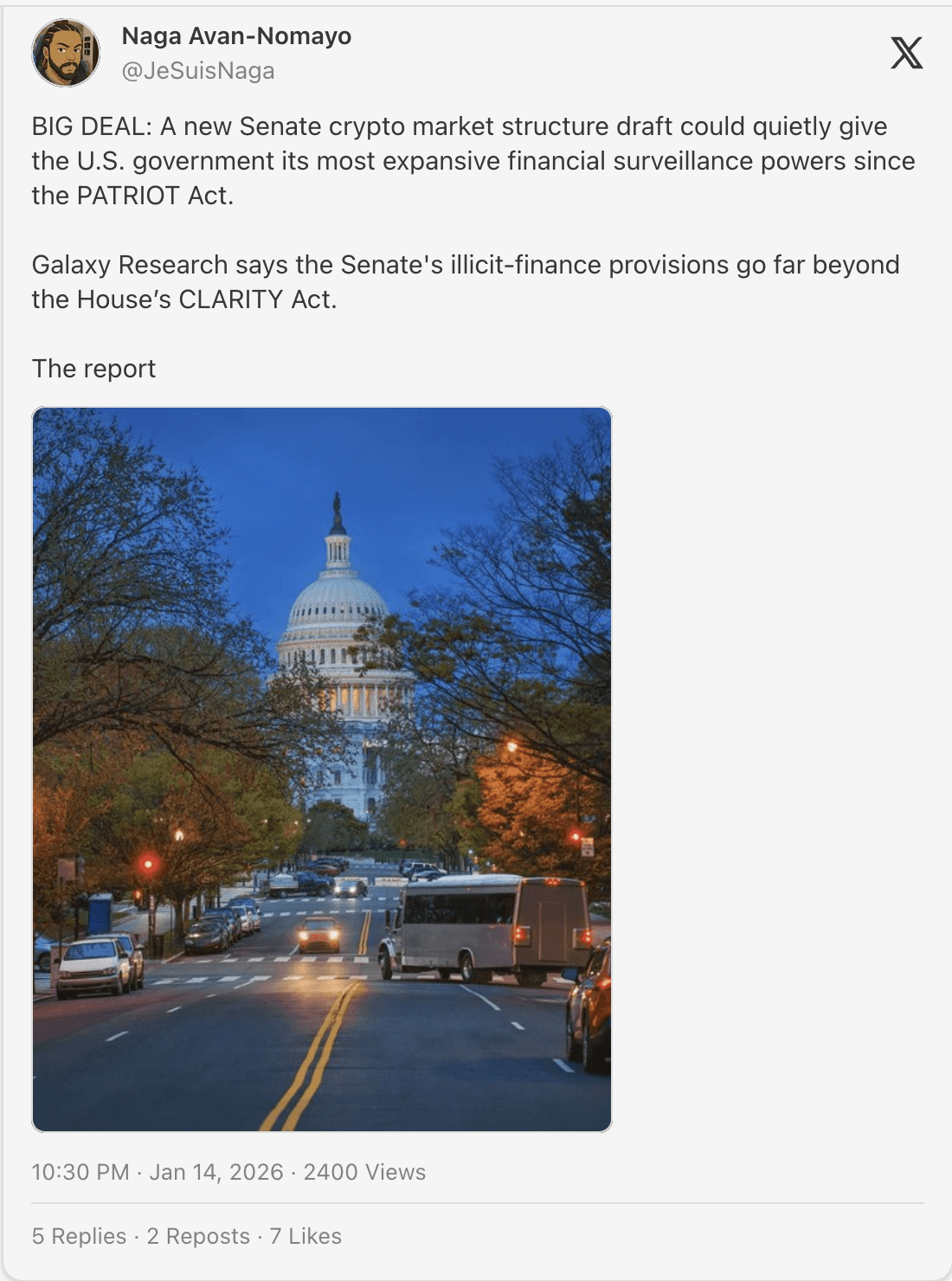
Banks are also lobbying to extend restrictions on stablecoins to non-interest-bearing rewards. As of writing, it’s uncertain if this will pass with the CLARITY Act.
So don't automatically believe the narrative that 'regulation = positive.' Some are clearly good, but some will limit what made crypto great in the first place.
Throw the documents into Claude/Gemini and ask what that legislation means.
Non-obvious lie: Privacy is just a short-term narrative.
CT is excited about the rise of Monero and Zcash. The narrative is 'privacy coins are back.'
My non-obvious truth: The real privacy opportunity lies in providing privacy infrastructure for institutions.
Privacy coins are banned everywhere:
Dubai's DFSA has just banned privacy tokens.
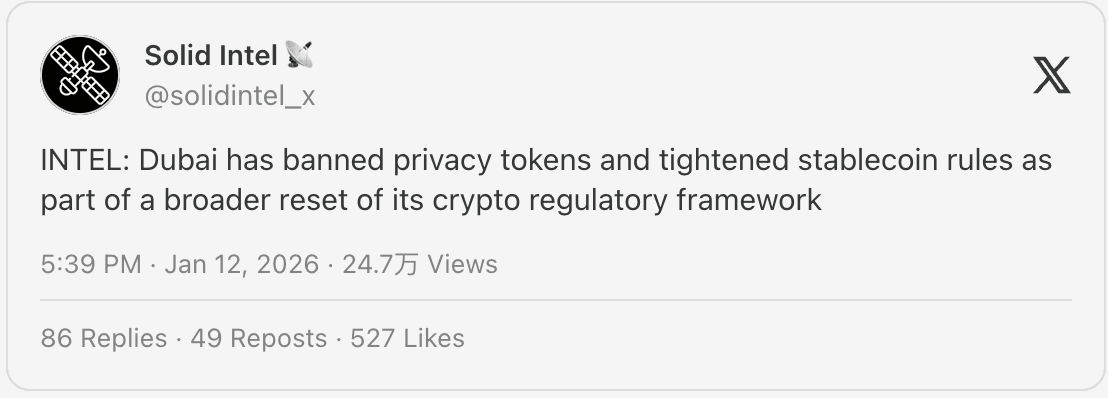
The EU explicitly prohibits 'cryptocurrency accounts that allow transactions to be anonymized' and 'accounts using anonymous-enhancing coins,' effective July 2027. According to the EU crypto initiative, this regulation is the 'final version.'
Japan and South Korea banned privacy coins years ago.
Binance and Kraken delisted privacy tokens (Monero).
If you are an EU citizen, depositing ZEC from a blocked address to a regulated CEX will cause issues with proof of funds reports. I'm currently doing a forensic report, so trust me.
If funds are not traceable, CEX cannot verify the source, users get stuck.
But institutions urgently need privacy.
Look at Tiger Research's chart: The US stock market share has changed from approximately 70% within exchanges in 2010 to nearly a 50-50 split with outside exchanges by 2025. Bloomberg reports that most US stock trades now happen 'in the dark.'
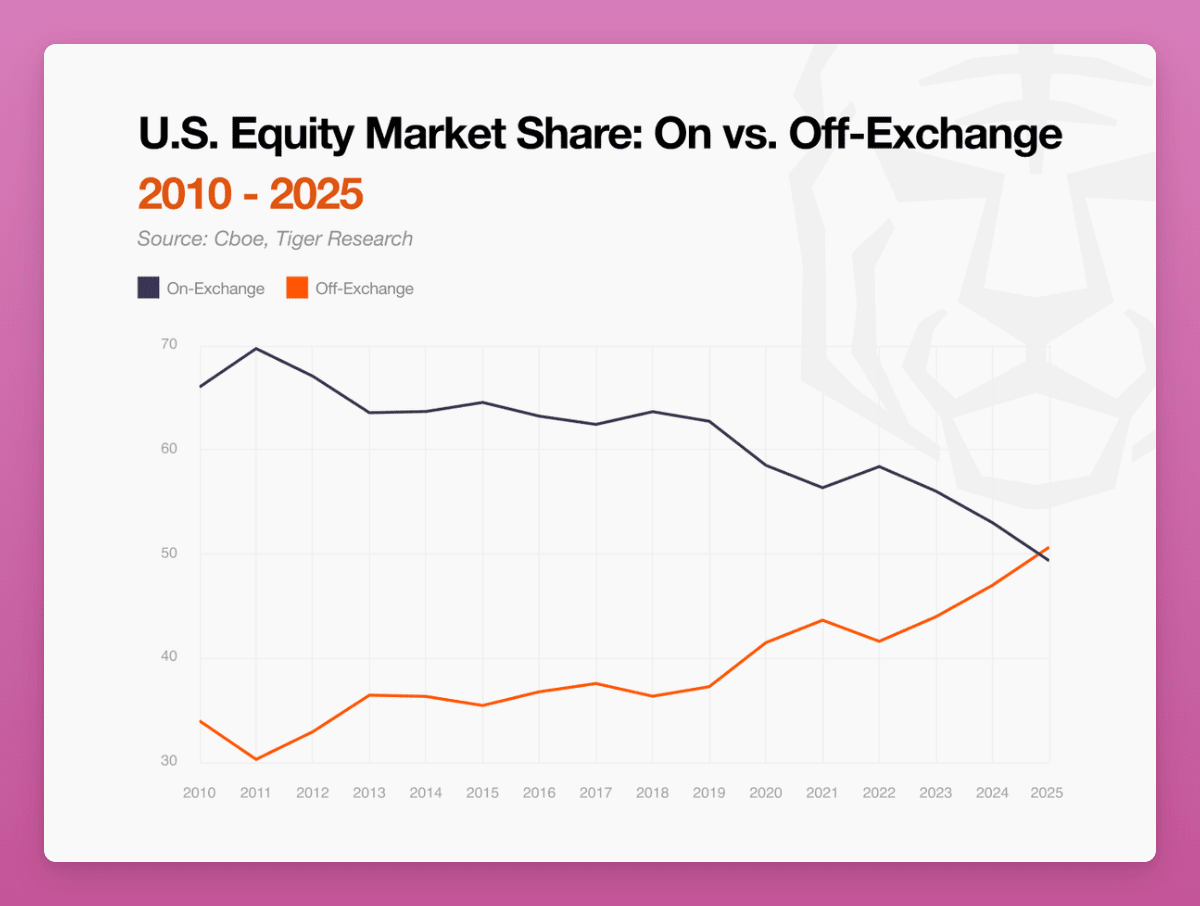
Caption: Source Tiger Research.
Why? Because on-chain transparency exposes their trading plans.
Maybe not the best example, but when James Wynn's leveraged position of 949 BTC on Hyperliquid along with the liquidation price was visible on-chain... perhaps his claims of being targeted with psychological tactics weren't wrong :)
'Professional trading firms and institutions are reluctant to deploy complex strategies on public blockchains because every step may be visible, replicable, or countered.'
In this context, I see more and more people talking about Canton. A market cap of $5.4 billion, quietly sitting at 33rd place.
DTCC announced they will begin tokenizing US Treasuries on Canton starting in Q2 2026. DTCC. This agency handled $37 trillion in securities transactions in 2024.
Canton is the first open blockchain built specifically for institutional finance that supports privacy. Participants control which counterparties can see specific transaction information: not everything is broadcast like on public chains.
As TRM Labs explains:
'Many blockchain architectures are developed for open, permissionless environments where transaction data is widely visible. While this model has advantages in certain cases, it is inconsistent with the requirements of regulated financial markets. Institutions cannot publicly expose their positions, trading counterparties, or liquidity changes.'
Supporters of Canton are all traditional financial giants: BlackRock, Blackstone, Nasdaq, S&P Global, Goldman Sachs, Citadel Securities, HSBC, BNP Paribas, Euroclear...
So yes, privacy is absolutely crucial.
If my ETH and SOL positions are heavy, I would be very nervous facing competition from alt L1s.
But Ethereum is also advancing towards privacy.
First, Vitalik is clearly aware that privacy is one of the 'known flaws' in the current Ethereum architecture layer.
Vitalik Buterin shared a privacy roadmap that includes 9 steps to improve L1 privacy: integrating privacy pools and tools like Railgun directly into wallets, making 'one address per application' the default setting, and implementing TEE-based RPC privacy.
At EDCON 2025, the roadmap outlined by Vitalik includes:
'Efforts to read privacy include trusted execution environments, private information retrieval technologies, false queries that obfuscate access patterns, and displaying only necessary data on partial state nodes. These measures aim to reduce information leakage on both ends of user interactions.'
Ethereum needs to shift from 'do no harm' to 'cannot do harm.' Using cryptography to secure the system, even if individual participants are malicious.
Another redemption is L2: Aztec Network has launched Ignition Chain on Ethereum's mainnet. The first fully decentralized privacy-preserving L2. Supported by $170 million from a16z, Aztec achieves 'programmable privacy,' allowing users to control what is public and what is private.
Aztec co-founder Zac Williamson said:
'2025-2035 will be the era of privacy rotation.'
Non-obvious truth: The 4-year cycle no longer applies.
Oh my, I hope I'm not wrong on this point.
But I believe BTC and crypto have changed enough to escape the 4-year cycle. It is precisely the reason that crypto, especially BTC, has become a macro prisoner, which is also why the previous pattern has been broken.
This is one of the viewpoints from Messari's 2026 paper.
'As BTC is increasingly viewed as a macro asset, the importance of traditional frameworks like the 4-year cycle is not what it used to be. BTC's performance will be shaped by broader macro forces.'
We are now trading a different asset class.
Miners are no longer important: Daily issuance of about 450 BTC ($42 million). BlackRock ETF can absorb these in just 15 minutes of trading volume. The supply shock narrative is dead because miners no longer control circulation.
ETFs suppress volatility: As mentioned in the 'macro prisoner's dilemma' section. Additionally, institutions and pension funds do not trade like retail; they have rebalancing obligations that offset the previous cycles of retail-dominated sell-offs.
Liquidity is more important than halving: Overlay the charts with global M2 money supply, matching very well. After the sell-off from BTC veterans and 4-year cycle panic sellers, we briefly deviated from this relationship.
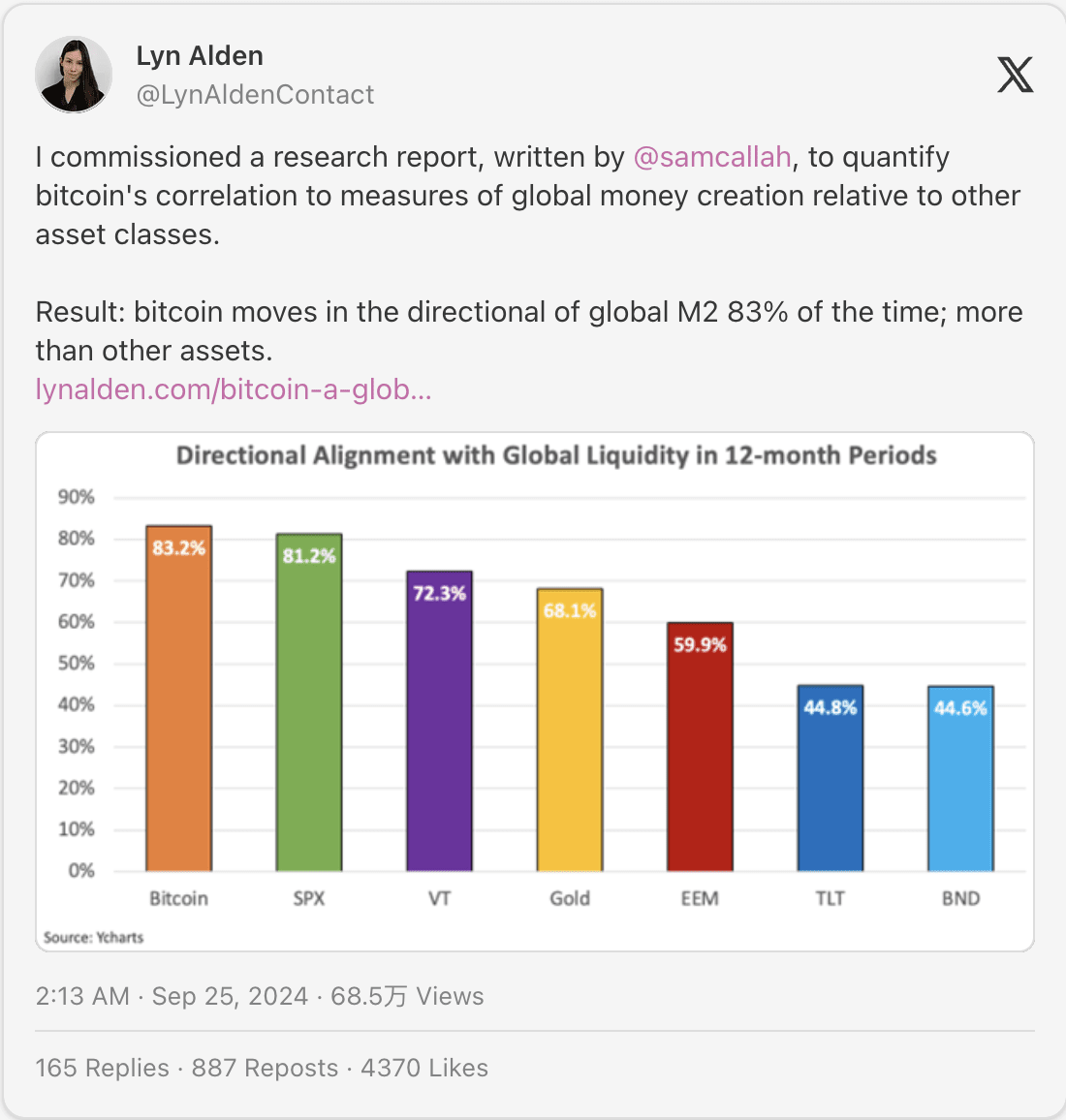
BTC lags behind gold: Historically, gold leads Bitcoin by 60-150 days. While many expect Bitcoin to follow, I believe this catching-up trade and rotation into BTC will be stronger than the 4-year cycle.
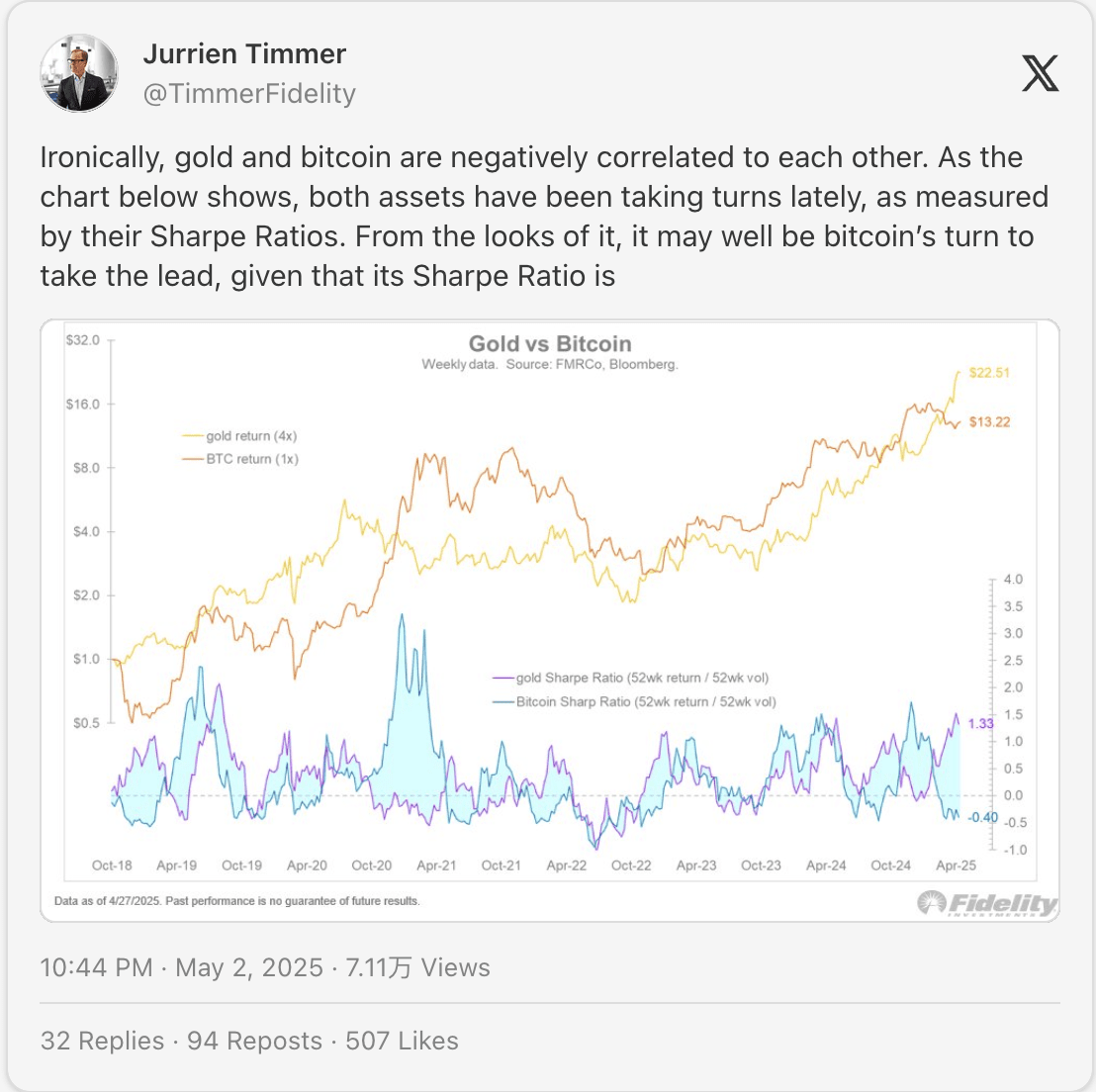
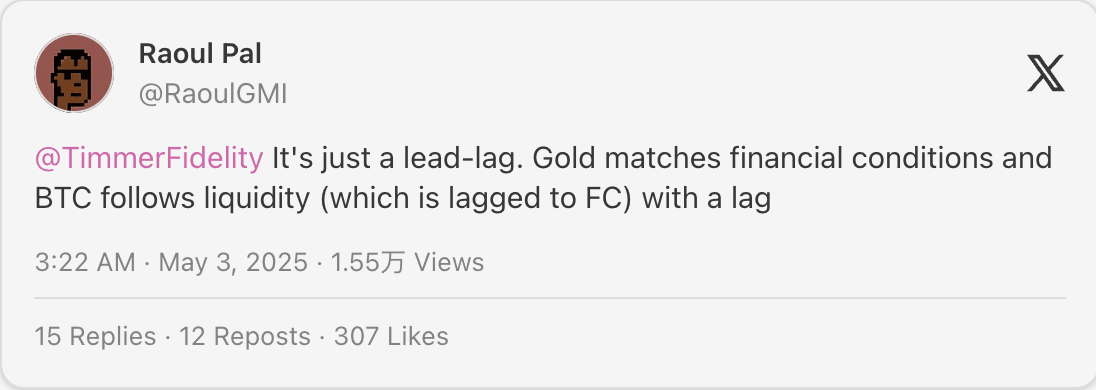
In the same Messari 2026 paper, they believe Bitcoin will remain strong by absorbing the monetary premium and value storage role of gold.
Polymarket prices Bitcoin will outperform gold and the S&P 500 in 2026. But the gap is small.
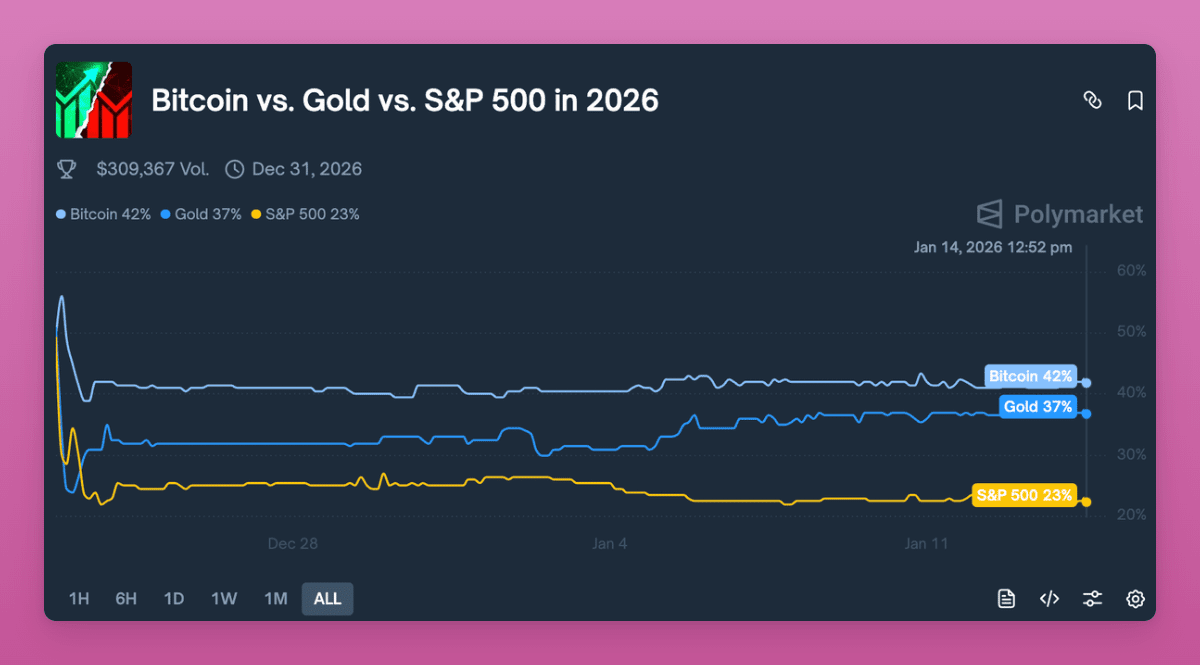
So this is not an obvious truth.
Non-obvious truth: DAT is net positive for crypto.
Standard Chartered's G. Kendrick (head of crypto research) has lowered the 2026 Bitcoin target from $300,000 to $150,000 due to DAT depletion:
'...The Bitcoin Digital Asset Treasury Company's (DAT) purchases may have ended because valuations... no longer support further DAT expansion. We expect consolidation rather than a complete sell-off, but DAT purchases are unlikely to provide further support.'
'Therefore, we now believe that the future rise in Bitcoin prices is actually driven by just one leg' — he added.
Grayscale also shares similar views in its 2026 outlook report:
'Despite high media attention, we believe DAT will not become a major volatility factor in the digital asset market in 2026.'
'There will be extensive discussions around these topics, but we believe they are not at the core of market prospects.'
DAT holds 3.7% of BTC supply, 4.6% of ETH, and 2.5% of SOL.
Demand has fallen back from its peak in mid-2025: The largest DAT now trades at nearly 1.0 mNAV (see chart below).
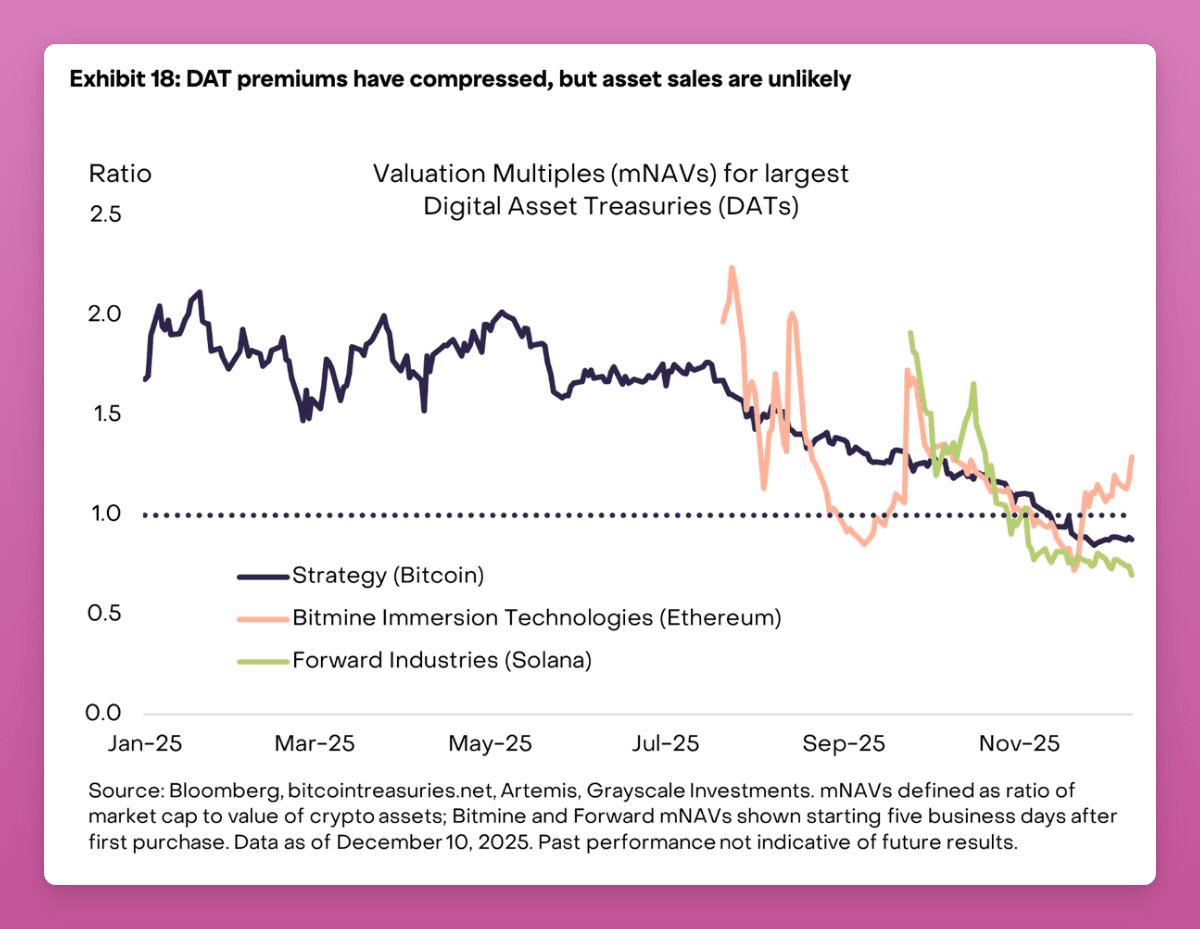
Caption: Source Grayscale.
However, most DAT are not overly leveraged (or not leveraged at all), so they may not be forced to liquidate assets during downturns.
The largest DAT Strategy by market cap recently raised a dollar reserve fund to continue paying preferred stock dividends even if Bitcoin prices drop.
Grayscale expects most DAT to trade like closed-end funds at premiums and discounts, with little asset liquidation. DAT may become a permanent feature of crypto, but is unlikely to be the main source of new demand or major sell pressure in 2026.
To be honest, DAT scares me. If they become 'non-news' in 2026, I would be happy.
But they do matter.
For ETH, DAT has already surpassed ETFs.
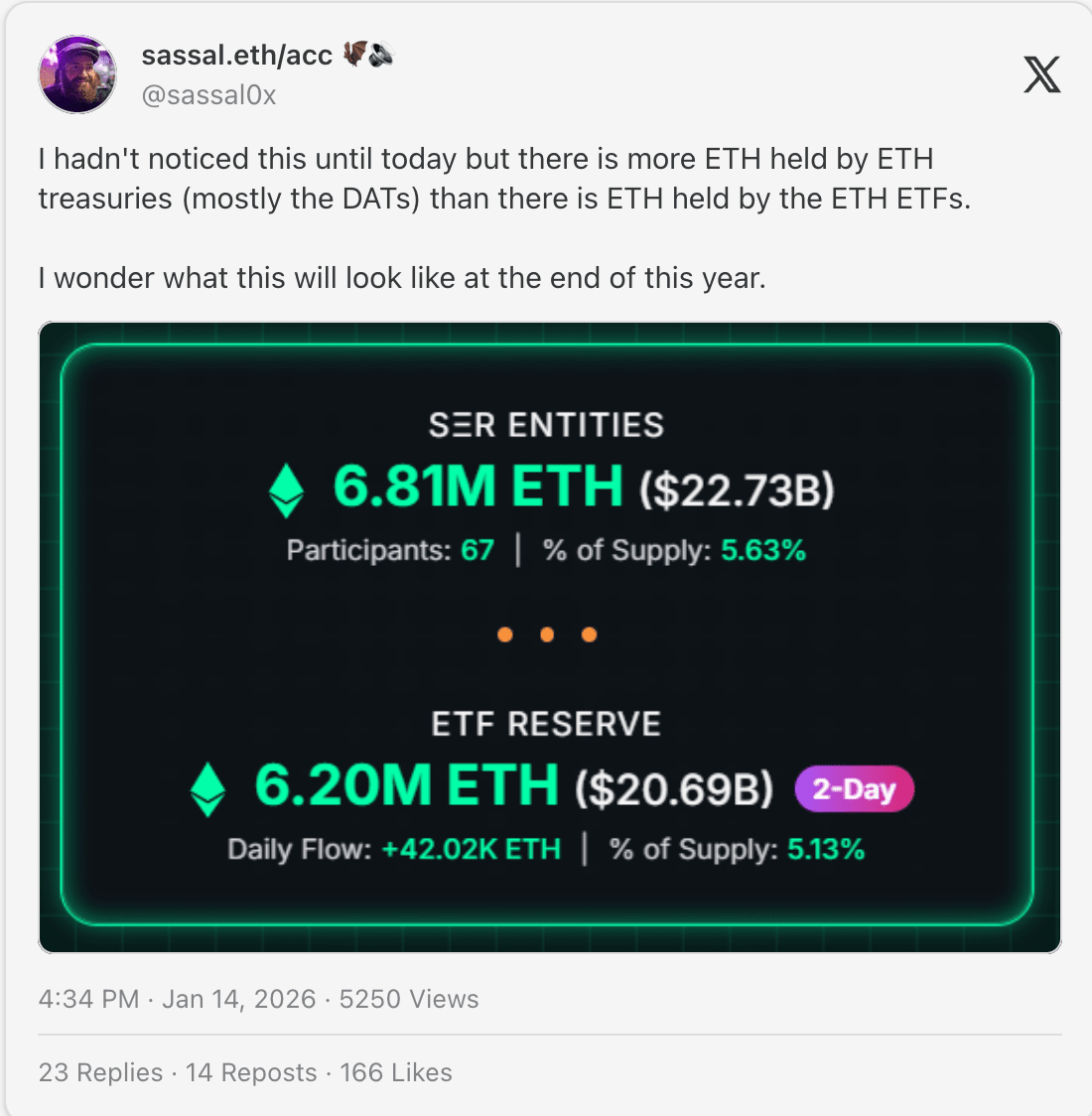
Unlike BTC DAT, ETH treasuries use their holdings. BitMine staked 74,880 ETH ($219 million) to earn a 3% yield. SharpLink Gaming has earned 1,326 ETH (about $6 million) through staking rewards since June 2025.
BitMine is developing the 'Made in America Validator Network' (MAVAN), aiming to earn $363-$485 million in staking rewards annually by operating its own validators. They also invested in MrBeast. It’s confusing, but I love experimentation.
BTC does not generate yields. But ETH DAT is transforming the treasury into productive infrastructure for validators, liquid staking, and DeFi yield farming.
This is another important reason I am bullish on $ETH for 2026. Quantum resistance roadmap + L1 scaling + more sustainable DAT.
BTC, SOL, and ETH have ETFs competing with DAT.
But most altcoins are still too risky, too illiquid, or legally too complex to do ETFs.
This makes DAT the 'IPO moment' for altcoins. It's a simple way for institutions to gain compliant exposure.
I believe these DAT can focus attention and determine which altcoins are worth buying.
Because there are thousands of altcoins, only a few can create DAT structures. Therefore, this focuses user attention and capital inflow on a few assets that can be lifted.
But I worry about insider trading in DAT. Last year, the SEC and FINRA investigated over 200 DAT companies because stocks surged days before DAT announcements.
Additionally, retail hates it when VCs exit through DAT instead of selling on the spot market.
Overall, if:
BTC's DAT will become non-news by 2026.
ETH DAT continues to be staked in PoS and DeFi protocols.
Altcoin DAT expands high-quality assets.
So I think DAT will be net positive for crypto in 2026.
But during downturns, DAT will exacerbate sell-offs. But that's nothing new; retail and institutions are both sellers.
Non-obvious lie: The return of ICOs has fixed the token issuance model.
ICOs are back.
MegaETH raised $450 million in one of the most meticulously designed models.
Echo was acquired by Coinbase for $375 million.
Kraken is partnering with Legion for 'fair' sales.
MetaDAO pioneered ownership token sales.
The narrative is beautiful: Retail finally has access opportunities like VCs. Fair launches. Equal terms and democratized participation.
Indeed, returning to ICOs is necessary because airdrops with low circulation and high FDV are unsustainable.
We really want to go back to the early ETH ICO era for a 450x return.
Thus, the ICO 2.0 platform promises to solve this issue. Legion uses 'merit scores' based on on-chain, social, or development activity. Echo allows retail to invest 'on equal terms with VCs.'
I love it! Because my X account allows me to get the best trades, like the $50,000 quota for MegaETH sales.
But ICOs did not democratize token issuance:
All need KYC (excluding most people in the world). As an EU citizen, I can't buy Monad sales on COINBASE?!
Reputation scores (beneficial for existing insiders, KOLs)
Quota limits are not something VCs have, or smart whales bypass them through multiple wallets.
Token printing mechanisms are always changing. From BTC forks (Litecoin), then ICOs became IDOs. IDOs turned into airdrops. Airdrops became points farming. Points turned into quota scores.
However, value flow always tends to those who 1) already control project flow and 2) know the rules of the game. I've written about this in previous posts.
The good side is that ICOs demonstrated the real demand for tokens. Because inflated numbers used for airdrop farming masked the actual demand for tokens.
But if/when the market heats up, retail entry prices may be 10-50 times worse than seed investors, with unlock schedules releasing into selling pressure. On those projects where most of the upside has already been captured privately.
Again, I love the ICO meta-narrative because I can get the best trades. But what about most of you?
Non-obvious truth: 'All crypto card companies will eventually die.'
This perspective comes from Pavel Paramonov:
The main reasons he thinks crypto cards will die:
They run on Visa/Mastercard, so there's no real disruption.
Easily replicable: Most just brand on shared infrastructure (Rain raised $250 million at a $2 billion valuation).
Centralized + KYC, contrary to the goals of crypto.
Users long-term will not tolerate additional fees/taxes.
Once adopted, wallet-to-wallet payments will replace them.
These are all great points, and I agree that most crypto cards will close down. Generally, most startups fail, so it's easy to make this judgment :)
There is already evidence that stablecoins can enable direct P2P payments. Interactive Brokers adding USDC deposits is a huge positive for crypto.
But I believe two types of 'crypto card companies' will survive:
Provide loans collateralized by crypto like Etherfi. Even CeFi platforms like Nexo, Bybit, Crypto.com also offer cards, and that won't change.
More importantly, crypto card companies are becoming new banking applications, 1) providing banking services, 2) building their own payment networks.
For example, Payy is building a privacy-first but regulatory-compliant payment L2. Their card is just the first use case of the network. If their network succeeds, their own success (achieving P2P transactions) will make the card obsolete.
Base has bet heavily on this and created Base applications.
But the probability of this happening is very low. Imagine replacing Paypal, Alipay, or other players deeply rooted in their fields.
What is more likely is that Revolut starts direct stablecoin payments, leading to the death of most crypto-native payment solutions...
The fact is that crypto cards will still be big business in the coming years because 1) banks are unwilling to accept deposits from crypto exchanges, and 2) using crypto cards to avoid taxes is a significant PMF.
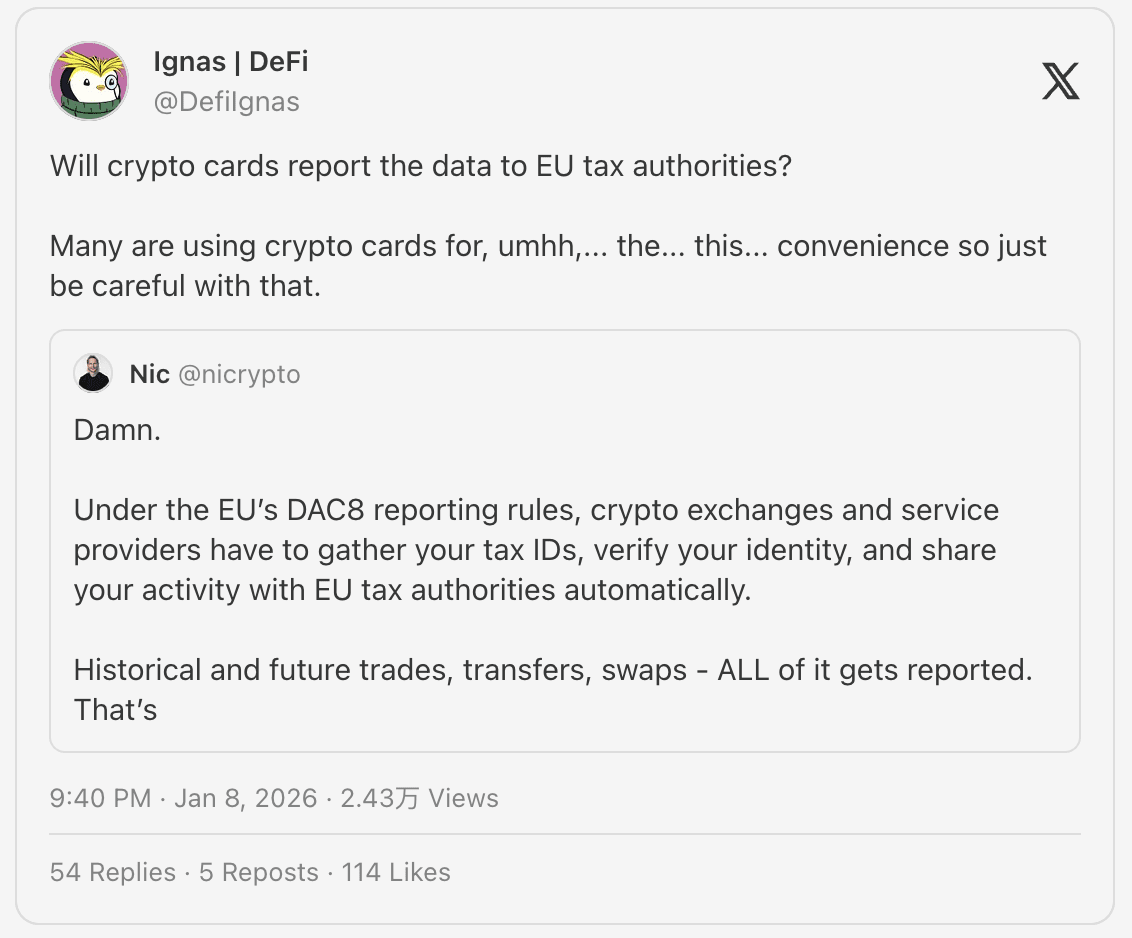
But regulation will ultimately catch up with crypto card companies or their users.
Successful cases of stablecoins compete directly with crypto card companies. If stablecoin payments take off, cards will be unnecessary.
It is very likely that current crypto card payments will turn into new banks, trying to compete with new financial applications like Revolut. So yes, crypto cards that do not transform into new banks will die.
If they win, the upside potential is huge!