



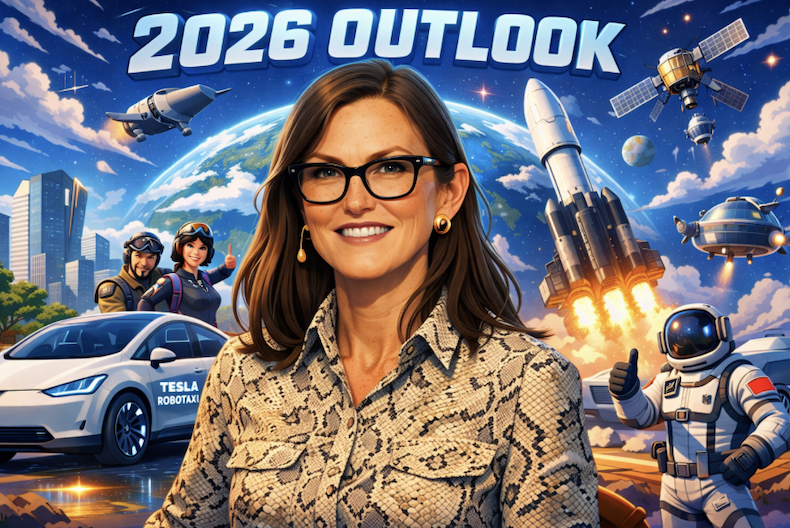
ARK Invest founder Cathie Wood, in a recent interview, discussed her outlook for Tesla and SpaceX in 2026, emphasizing that the market is reinterpreting the nature of technology companies. She believes that Tesla's key is no longer just selling cars, but whether it can successfully transform into a self-driving service platform; in the space industry, she pointed out that SpaceX has the opportunity to become the first space company in the world to exceed a market value of 1 trillion dollars. These changes will profoundly affect how the market evaluates technology companies after 2026.
Electric vehicles are under pressure, Tesla shifts to self-driving service mode
Cathie Wood pointed out that the electric vehicle market is currently facing sales pressure, and Tesla's growth momentum at the vehicle delivery end is not as strong as it was initially. However, the market's focus has gradually shifted from quarterly sales to Tesla's potential in self-driving services.
She stated that traditional automobiles belong to the hardware industry, with a gross margin of about 15%; if Tesla successfully develops a self-driving taxi (Robotaxi) platform, the revenue structure and business model will be closer to the SaaS industry, and the gross margin could potentially increase to 70% to 80%.
Analysts are re-evaluating Tesla from a technology company perspective, no longer just viewing it as an automaker.
Wood revealed that there have been more and more analysts recently, even researchers originally focused on the automotive industry, starting to raise their ratings for Tesla. The reason is that they are gradually understanding that Tesla is no longer just a traditional automaker but is transforming into a technology platform centered around software and self-driving services.
Once the analytical model officially incorporates Robotaxi revenue, Tesla's potential scale will no longer be limited to the manufacturing mindset of 'selling millions of vehicles per year', but will be seen as a service-oriented enterprise with high gross margins and repeatable charging characteristics.
The expansion speed of Robotaxi may exceed market expectations.
Regarding the progress of Robotaxi's rollout, Wood stated that based on the expansion of Tesla's self-driving system service range, the actual speed has already exceeded the expectations of many market participants.
She also mentioned that competitors like Waymo, especially in the Texas region of the United States, are in fierce competition with Tesla. She believes that such competition will not slow down industry development but rather help accelerate the popularization of self-driving taxis.
She further pointed out that if a unified federal-level regulation can be established in the future, rather than each state acting independently, the expansion speed of Robotaxi around 2026 may significantly exceed current market expectations.
To enable the Optimus robot to operate stably, it remains a high-difficulty challenge in the short term.
Talking about Tesla's humanoid robot Optimus, Wood's attitude is relatively cautious. She relayed internal research results from Ark that indicated the technical difficulty of enabling a robot with human flexibility to operate stably is about 200,000 times that of self-driving taxis.
This means that Optimus will gradually improve through generational updates, but it will still take a considerable amount of time to reach a stage close to human capabilities. However, Wood also pointed out that single-function robots in warehousing, logistics, handling, and picking have already begun to see practical applications, and these experiences will help accumulate Tesla's technological foundation in the robotics field in the future.
The market is optimistic about the space industry, and SpaceX's valuation is approaching the trillion-dollar threshold.
In the latter part of the interview, Wood also talked about the space industry. She stated that the latest round of private market valuations for space companies has reached around $800 billion, almost doubling in scale.
She pointed out that the market generally believes that SpaceX has the opportunity to become the world's first space company with a market value exceeding $1 trillion. Especially as new application scenarios emerge, such as developing data centers in space orbits to avoid ground energy, land, and safety constraints, the economic value of space infrastructure is rapidly increasing.
(2026 Space Race Heats Up, Three Musk SpaceX Space Concept Stocks at Once)
This article Cathie Wood 2026 Outlook: Robotaxi Reshaping Tesla's Valuation, SpaceX Expected to Break the Trillion Dollar Market Cap First Appeared in Chain News ABMedia.