
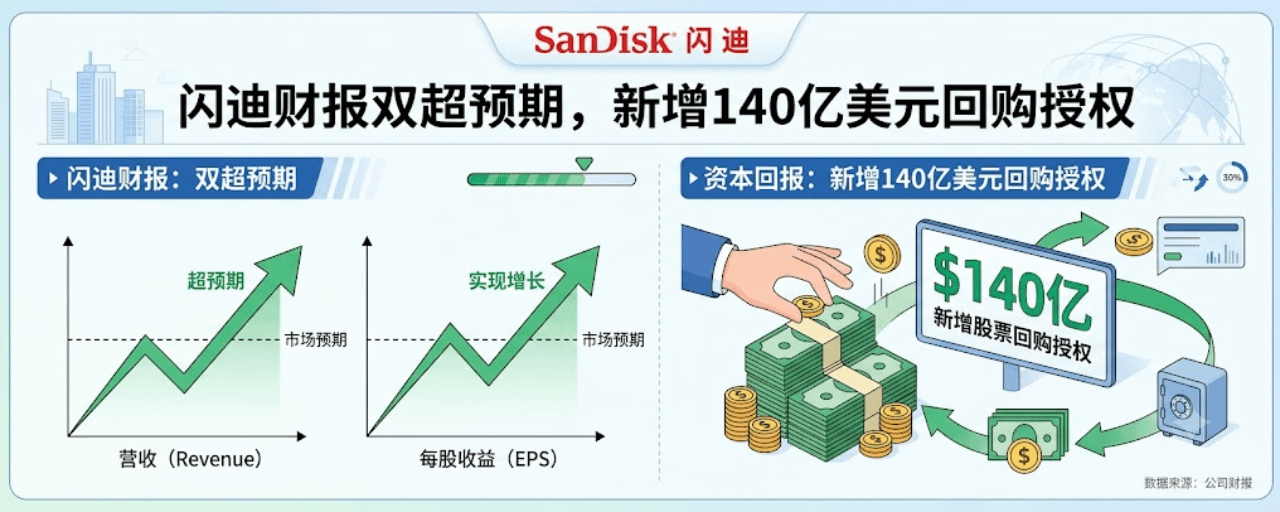

Last night, SanDisk released its Q4 earnings report: revenue was $8.97 billion, up 372% year over year. Adjusted EPS was $39.25, compared with $0.29 a year earlier—up 135x. Gross margin was 84.6%, versus 26.2% a year ago—tripled.
The board waved it through: an additional $14 billion share repurchase, bringing the remaining repurchase authorization total to $15.5 billion.
“This earnings report is insane—buy it!”
After waking up from a sleep, SanDisk’s stock was down 8% in after-hours trading.
She was completely stunned again.
“No, wait—such great performance. Why?”
Why? Because you’re still looking at this market with outdated perspectives.
On the night of August 5, after the U.S. market closed, SanDisk and Western Digital both released earnings reports—making a fortune.
SanDisk’s data center business: revenue of $2.98 billion, up 1,298% year over year. You read that right—1,298%, not 12.98%.
Edge computing: $5.43 billion, up 392% year over year. Full-year revenue was $20.25 billion, up 175%.
Eight NBM long-term agreements: $93.9 billion in guaranteed revenue, and $16.5 billion in customer default protection. More than half of capacity for fiscal 2027 is locked in early, and two-thirds of fiscal 2028 has already been arranged.
In the earnings call, the CEO said: “The growth rate of AI storage demand has already exceeded our supply capacity. After our largest customer signed, orders kept getting added.”
All capacity is sold out, yet customers are still chasing after additional orders.
In any normal market, wouldn’t this stock price fly to the sky?
But the market doesn’t think that way.
SanDisk expects next quarter’s revenue to be $10.3 billion to $10.8 billion, with a midpoint of $10.55 billion—about 5.5% lower than analysts’ forecast of $11.16 billion.
EPS guidance of $44 to $46. The market expected $45.58—right at the lower edge of expectations.
Gross margin guidance of 83% to 85%, versus 84.6% this quarter—basically flat, with signs of a peak.
The market only recognizes one logic: you were great in the past—but can you be even better in the future?
And SanDisk’s answer was: Yes, but not as great as you think.
After the stock price surged 468%, even results that beat expectations aren’t enough anymore.
Since the start of this year, SanDisk’s stock price has risen nearly 5x, while the S&P 500 is up only 13%.
A 468% jump has already priced in the story of an “AI storage demand explosion.”
Now what the market wants isn’t “how much you’ve earned.” — It wants “how much you can still earn.”
The guidance was off by a tiny bit, and the stock price showed you how it crashes.
Western Digital posted its earnings the same day—revenue of $3.75 billion beat expectations, EPS of 3.56 beat expectations, and guidance also beat expectations.
So what happened? It fell 11% after hours.
Both companies crashed.
What does this mean?
It shows this isn’t just a problem with SanDisk—it's the entire storage sector, and the market is repricing it.
A bunch of institutions at Goldman Sachs and JPMorgan gave “strong buy” ratings, with an average target price of $2,400. But the stock is already down 40% from its June high.
Expectations were set far too high—so high that even results that beat expectations couldn’t fill the gap.
The market isn’t trading what you did.
It’s about what you can still do.
SanDisk gave everything it could: explosive performance, a $14 billion buyback, eight long-term contract agreements locking in the future four years, and $93.9 billion in guaranteed revenue.
But the market only focuses on that one line: the guidance is off by a tiny bit next quarter.
So 8% is gone.
This isn’t SanDisk’s fault. It’s the one cut that all AI-story stocks will have to face sooner or later.
Is the market just being too harsh, or is the valuation truly too expensive?