
Source|Duozhi
Author|Wang Shang
On August 5, Duolingo (NASDAQ: DUOL) released its 2026 Q2 financial results. According to the report, Duolingo’s 2026 Q2 revenue was $298.5 million, up 18.3% year over year. Second-quarter net profit was $33.2 million, with a profit margin of 11.1%. Paid users were 12.7 million, up 17% year over year, which was below analysts’ expectations. Duolingo’s share price fell by more than 11% after hours.
In the second quarter, Duolingo’s bookings and profitability remained healthy, meeting expectations. Daily active users (DAU) were 58.7 million, up 23% year over year; the growth rate improved versus the first quarter and exceeded expectations.
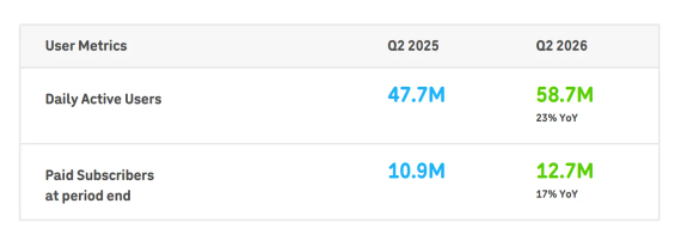
In the second quarter, Duolingo users continued to grow. Duolingo co-founder and CEO Luis von Ahn said that the acceleration in user growth comes from three factors: product improvements, marketing effectiveness, and a one-time “Streak Revival” activity that restores consecutive learning days. Since two of these factors are ongoing, the year-over-year DAU growth rate for the rest of the year is expected to remain above 20%, consistent with prior guidance.
Luis revealed that, currently, Duolingo is ramping up its monetization investments again, but on the condition that it does not harm user growth. Duolingo continuously improves its app through a process called the “Green Machine.” The team tests hundreds of product changes, measures the results, and increases investment in changes that work. Most of these changes, when viewed individually, have minimal impact, but cumulatively they can lead to meaningful product improvements.
Duolingo mainly uses “Green Machine” to optimize three areas: user retention, learning outcomes, and monetization. This year’s strategy is to prioritize the first two while exploring monetization approaches that do not run counter to user growth.
Thanks to the “Green Machine,” the current user retention rate (CURR) has reached a historical high of 84%, up by about 1 percentage point compared with last year.
This seemingly small improvement has a significant compounding effect, driving substantial cumulative growth in daily active users over the long term. The goal is still to reach 100 million DAUs by 2028.
At the earnings call, CFO Gilian Munson said that besides the standout highlight of accelerated daily active user growth, the company’s revenue performance was in line with expectations, while profitability came in slightly above plan.
After the sharp drop in the cost of video calls, the feature is gradually being rolled out from Max to Super, and in the future it may be opened up to all Super subscribers as well as existing subscribers.
At the more macro level of AI strategy, Luis expressed a strong preference for open-source models. He believes that, from the company’s interests, migrating as much as possible to open-source models is the best option, because the costs are significantly lower than closed-source alternatives.
The following are the main contents of the analyst conference call (compiled and edited by Duozhi):
01? Retention hits a historic high; the user acquisition funnel improves across the board
Luis revealed that nearly all user retention metrics are at historical highs. Current user retention (CURR) has improved by about one percentage point over the past year.
User growth improvements have very broad impact. Whether in mature or emerging markets, whether for new users or returning users, the retention curves are rising in sync.
Luis attributes this to stronger overall product stickiness. Duolingo maintains a high-frequency iteration cadence of releasing new versions every week, with each version including around 350 changes. While it is difficult to pinpoint the impact of any single feature, the overall product experience is clearly getting better over time.
On the customer acquisition side, Gilian Munson pointed out that in virtually all regions this quarter, the growth rate at the top of the funnel improved sequentially, which is an important result of the team’s long-term deep cultivation.
Luis further broke down the diversification trend in growth sources: word-of-mouth remains the cornerstone. Duolingo’s own social media accounts still generate more than 1 billion impressions each quarter. At the same time, influencer marketing and performance marketing are becoming strong supplements. Especially in markets such as China, Indonesia, and India, influencer marketing shows a very high input-output ratio—about two-thirds of social media impression volume comes from creator content. These creators reach audience segments that are completely different from those reached by official accounts, bringing a large number of genuinely new users.
The US market also saw a noticeable acceleration this quarter. Asia remained the fastest-growing region, but growth is accelerating across all regions worldwide.
In June this year, Duolingo ran a special activity—“Streak Revival.” It allows eligible learners to restore their longest streak by choosing to participate and completing three lessons.

The results from this activity were: 15.4 million learners restored their streaks, including nearly 8 million users who had no active streak at the start of the event. Luis said, “This became one of our most successful activities. It shows how important streaks are to our learners, and it also demonstrates the huge opportunity to bring past learners back to Duolingo.”
02? Rebalancing Monetization: Unlocking Value Without Damaging Growth
Analysts have noticed a subtle but important shift in Duolingo’s monetization strategy. Luis candidly admitted that earlier this year the company did exercise restraint in monetization, guided by the principle that “any monetization approach that runs counter to DAU growth is paused.” But as the company deepened its understanding of various monetization levers, it now has more confidence in increasing commercialization levels without harming the user experience.
Extending the free trial period is a typical example of this thinking. Duolingo is gradually extending its traditional 7-day free trial to one month.
This seemingly simple adjustment brings double benefits: a longer trial period makes more users willing to try the product, thereby improving the paid conversion rate; at the same time, turning off energy limits and ads during the trial actually enhances the product experience, further boosting daily active users.
Another direction being tested is “Super Lite,” a low-priced tier priced at about half of the standard Super package. It includes ads and doubles energy rather than offering unlimited energy, targeting potential users who are certain they will not buy Super. Luis emphasized that this is still at an early testing stage, so the final form is not yet certain; however, the logic is clear. If users are unwilling to buy Super, offering a cheaper option is better than letting them stay entirely outside the paid ecosystem.
Advertising is another reactivated growth point. Compared with top apps of similar scale, Duolingo’s ad revenue is significantly lower, which means there is substantial room for improvement.
In the past few years, Duolingo’s company spending on advertising was extremely low, at times with only half a person responsible for it. Now it has assembled a more professional team.
Luis expects that over the next few quarters, the Duolingo advertising business will see a significant improvement. The core idea is to deliver a higher-quality ad experience within the product while increasing ad revenue. He emphasized that Duolingo will still be subscription-led for the foreseeable future, but ads will become an increasingly important complement.
03? Lower video call costs; AI open-source models reshape product boundaries
Progress at the technology level has brought profound structural implications for Duolingo’s business model, and the most representative of these is the cost revolution behind the video call feature.
Luis recalled that when video calls first launched, the AI cost per call was about $0.30, which forced the company to place it behind the most expensive Max tier. But after sustained technical breakthroughs, the team—by shifting at scale to open-source models—has reduced the cost per call to less than $0.01, without observing any loss in quality.
A sharp drop in costs has allowed video calls to be opened up to a broader range of subscription tiers. Currently, most new Super subscribers can already enjoy this feature, and it is expected to roll out to all existing Super subscribers in the coming months.

This change has also sparked discussion about the future of the Max plan. Luis said the company is evaluating several possibilities: Super users could receive a limited number of video calls, while Max users would receive unlimited ones; or, if video calls become the standard feature of Super and the company can find other differentiating value propositions, the Max tier might even be eliminated.
No matter which path the company ultimately chooses, Luis believes the core objective is the same: without sacrificing revenue, help as many users as possible practice speaking—because this not only improves learning outcomes, but also feeds user growth back through word of mouth.
At the more macro level of AI strategy, Luis expressed a strong preference for open-source models. He believes that, from the company’s interests, migrating as much as possible to open-source models is the best option, because the costs are significantly lower than closed-source alternatives.
Of course, this does not mean completely giving up on the cutting-edge models from OpenAI and Anthropic. Internally, Duolingo actually maintains a “model portfolio.” For scenarios that require the highest quality, it will choose proprietary models; for a large number of basic application scenarios — such as conversation practice around everyday topics like cooking eggs — the quality difference between open-source models and frontier models is hardly noticeable, while the cost savings from switching are very significant.
Chief Financial Officer Gilian Munson added that it is precisely these structural AI cost reductions that allow the company to roll out voice features broadly while still raising its full-year profit margin guidance.
The China market is a special case. Due to regulatory requirements, all of Duolingo’s AI features in China run on local models. Luis said that China is already the company’s second-largest DAU market, and it is expected to surpass the United States to become the largest within one to two years, with a monetization level comparable to France.
04? Math, Music, and Attention: The Boundaries and Focus of Product Experiments
Beyond the core battleground of language learning, Duolingo’s exploration in math and music has also attracted analysts’ attention.
Luis’s attitude toward the two shows a clear temperature difference. The math product has already undergone an important strategic adjustment. Initially, the team tried to make ordinary adults addicted to math, but quickly found that this path would not work. So it refocused its target users on the K12 student segment that truly needs to learn math. This shift brought significant progress, but math is still a-to-C, and the company does not intend to sell it directly to schools.
The music product is still at a very early stage. The team is investing heavily, but it is still one to two quarters away from a mature disclosure.
Luis also acknowledged that for now, the DAU of the math and music products are both in the millions. Compared with the overall DAU base of over 60 million, even with 50% growth, their contribution to the whole would be relatively limited, and they should not be expected to become the main engine of DAU growth in the short term.
Another noteworthy product challenge is the ongoing decline in global attention. Social media apps are slicing users’ usage habits into fragments measured in 10-second units, while Duolingo’s lessons naturally require about 2 minutes of sustained focus.
Luis revealed that the team is internally testing approaches to shorten the minimum session length, but the key is finding the right balance. If single sessions are shorter, the company must ensure users return frequently enough each day to produce a positive compounding effect. These experiments are still ongoing and have not yet been officially released.
05? “Still focusing on achieving 100 million DAUs by 2028”
A core narrative running throughout the entire earnings call is Duolingo’s explanation of its long-term goals.
Luis repeatedly emphasized that the company would not abruptly switch from “pursuing user growth” to “focusing on making money” at some point in time; these two goals are not in conflict within Duolingo’s framework.
As a mission-driven company, Duolingo’s core belief is this: every additional active user means there is one more person in the world receiving high-quality education, and the expansion of the user base itself naturally creates greater commercial value and monetization potential.
From the “win-win” design of extending free trials, to the sharp cost drop and tier downscaling of the video call feature, and then to the specialized restart of the ad business, Duolingo is carefully looking for monetization approaches that do not conflict with user growth. As these pieces of the puzzle fall into place, the path to its 100 million DAU target by 2028 is becoming clearer.
As Gilian Munson put it in the wrap-up, Duolingo’s user momentum is strong, its business model continues to generate substantial cash flow, and the team executed well in an important investment year. And the path to 100 million DAUs will create a company value for shareholders that is significantly higher.
06? Performance exceeds expectations; full-year profit margin guidance raised
Management was satisfied with Duolingo’s performance in the second quarter of 2026. Revenue was $298.5 million, up 18.3% year over year; net profit was $33.2 million, with a profit margin of 11.1%.
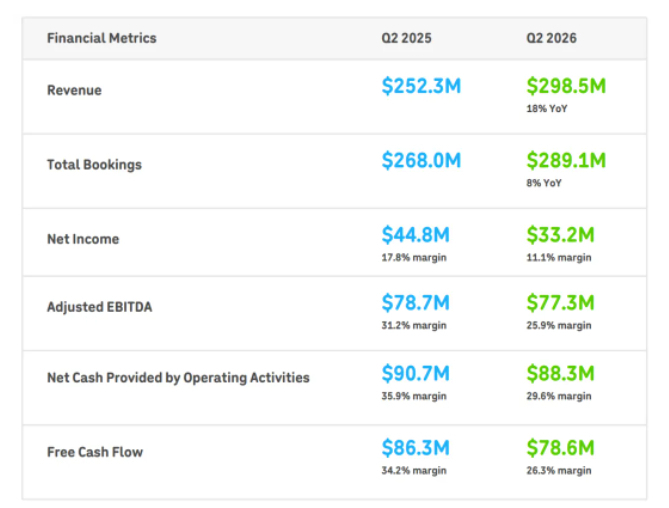
Management’s confidence in the full-year profitability outlook has clearly increased. The adjusted EBITDA profit margin guidance was raised from the 25% set at the beginning of the year to 26.5%. Adjusted EBITDA for the full year is expected to reach about $320 million, and free cash flow is likely to exceed $375 million.
Gross margin was also raised, from the initial expectation of 69% to nearly 70%. The driving force behind this is not simply cost control, but structural cost savings brought by AI technology—even if the company incorporates more AI content into its products, overall costs continue to decline.
Looking at the full-year guidance, Duolingo maintains the target ranges for reservation volume growth of 10% to 12% and revenue growth of 15% to 18%. Within that, reservation volume is expected to grow by about 11% for the full year, and revenue is expected to grow by about 16%.
Using fixed exchange rates, the reservation volume growth rate is about 0.5 percentage points higher than the previous exchange-rate level. For the third quarter, the company expects reservation volume of about $307 million, up 9% year over year; revenue of $302 million, up 11% year over year; gross margin up to 71%; adjusted EBITDA of about $76 million; and a profit margin of 25.2%.
The balance sheet also remained strong. Cash and investments at quarter-end were $1.3 billion. The company generated $79 million in free cash flow this quarter and completed about $44 million in stock repurchases, bringing cumulative repurchases to $72 million.
It needs to be specifically noted that the company has a bonus incentive plan tied to DAU growth. If the year-over-year DAU growth rate in the fourth quarter reaches 25% or higher, the company will pay an approximately $10 million cash bonus in the first quarter of next year, and the amount may increase further depending on the magnitude of the growth. Since it is currently unclear whether the threshold can be reached, this potential expense has not been included in the 2026 guidance.