

Western Digital (WDC.US), which together with SanDisk and Seagate ranks among the United States’ top three storage-product powerhouses, reported its quarterly results and outlook after the U.S. market close on Wednesday (U.S. Eastern Time; i.e., the early hours of Thursday Beijing time). The announcement once again highlighted how global technology companies are facing an almost “endless” burst in demand for high-capacity nearline HDDs, driving this storage giant’s quarterly performance and guidance to exceed Wall Street analysts’ expectations across the board. After Samsung and SK hynix—two major memory-chip original equipment manufacturers—as well as Seagate, another HDD storage heavyweight, released exceptionally strong performance data, Western Digital’s similarly strong results that beat expectations across the board have further strengthened the narrative of a “storage supercycle” in which storage product leaders are powering robust growth.
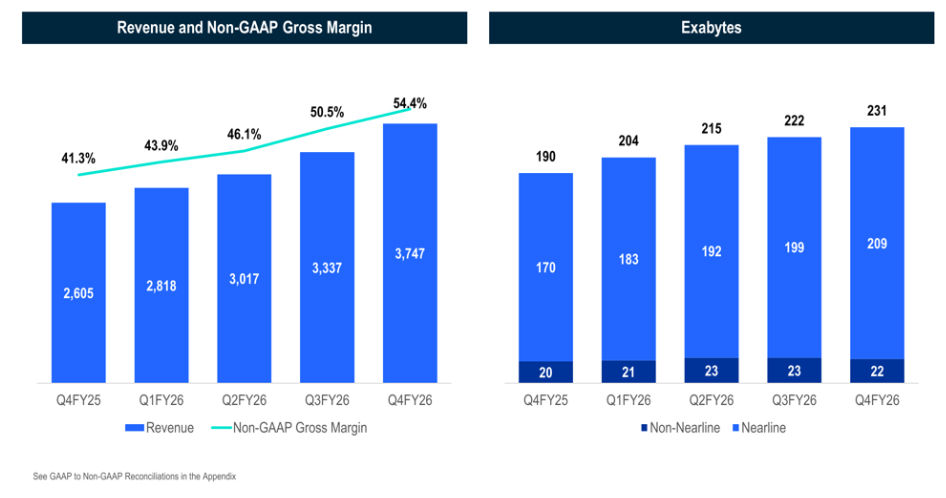
As of fiscal 2026 fourth-quarter performance through July 3, Western Digital’s quarterly revenue was $3.747 billion, up 44% year over year and up 12% quarter over quarter. Cash flow and deleveraging are also very encouraging. The company’s management provided strong guidance for next quarter as well. However, before the earnings release, Western Digital’s year-to-date stock increase had reached about 201%. The market had already priced in and traded the expectation of HDD shortages. Although Western Digital’s outlook exceeded analysts’ benchmarks, it did not release more aggressive forward supply, order locking, and profitability expectations like Seagate did. Therefore, in relative comparison it appears more cautious.
This “expectations cliff” is also partly behind the more than 10% after-hours plunge in Western Digital’s share price following the company’s earnings release. An “expectations cliff” means that earnings and guidance exceed the market’s broadly shared consensus, but do not clear the higher hurdle required by extremely crowded positioning. If results come slightly short of expectations (even if they are still growing), confidence collapses and asset prices can fall off a cliff. The after-hours rout looks more like an unwind driven by expectations and positioning than a collapse in fundamentals.
The company’s earnings call also reinforced the logic around order visibility and pricing power. Western Digital management expects EB-level demand growth to remain above 25% over the coming years, and customer discussions have extended to 2029–2031. Here, “orders booked out to 2031” needs to be stated more rigorously as long-term agreement (i.e., LTA) negotiations and extended demand-planning visibility out to 2031. Existing LTAs mainly lock in capacity and pricing frameworks, and they are not necessarily all irrevocable take-or-pay contracts.
Western Digital’s operating logic is to deliver more EB, lower cost per TB, and expand gross margin by scaling capacity with higher-density products such as 40TB-class ePMR, subsequent HAMR, and even higher areal density—without simply increasing the number of drives in proportion. The company’s latest official roadmap points to ePMR reaching 60TB and HAMR reaching 100TB in 2029. High Bandwidth Drives and a dual-executor (dual-pivot technology) architecture also aim to expand HDD use cases beyond pure capacity into higher-throughput AI workloads.
Management emphasizes that HDD demand is no longer just a one-off equipment cycle following data center build-outs, but is driven by continuous data production after AI compute infrastructure is put into use. Even if GPU/TPU or cloud hyperscalers’ deployment pace of custom AI ASICs slows temporarily, the already deployed “AI factories” will keep generating data that needs to be stored, accessed, and reused.
Western Digital’s 54% gross margin and strong cash flow validate the AI storage bull market, but the after-hours plunge reveals an “expectations cliff”
Western Digital’s August 5 reported fiscal 2026 fourth-quarter results are, in essence, a high-quality earnings report that strengthens revenue, margins, cash flow, and the balance sheet simultaneously. Quarterly revenue was $3.747 billion, up 44% year over year and up 12% quarter over quarter. Non-GAAP gross margin was 54.4%, expanding 1,310 basis points year over year and 390 basis points quarter over quarter. Non-GAAP operating profit was $1.655 billion, up 126%, and operating margin rose to 44.2%. Non-GAAP net profit was $1.382 billion, up 130%. Under non-GAAP, adjusted EPS was $3.56, up 109% year over year and up 31% quarter over quarter.
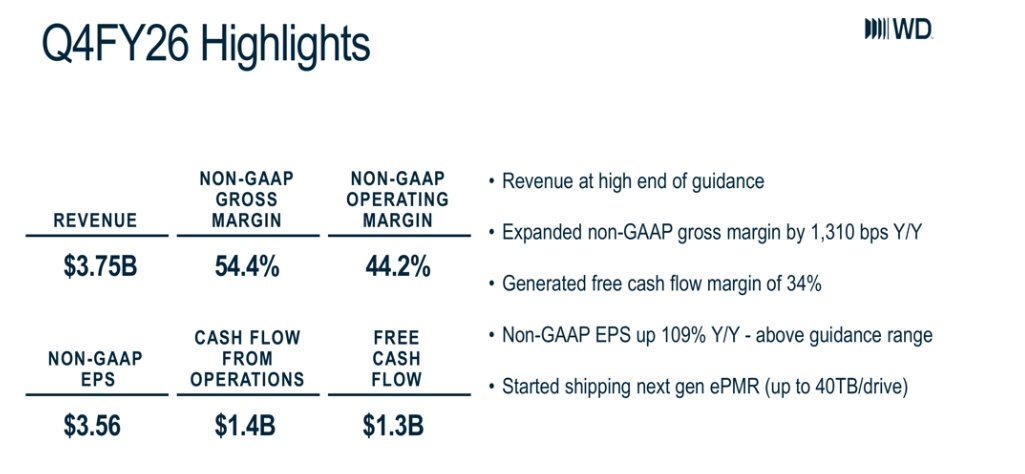
Western Digital’s quarterly revenue and adjusted EPS beat Wall Street analysts’ average expectations of $3.7 billion and $3.31, respectively. Compared with the company’s prior guidance of $3.65 billion revenue, a 51.5% gross margin, and a midpoint EPS guidance of $3.25, the actual results came in 2.7% higher on revenue, 290 basis points higher on gross margin, and 9.5% higher on EPS. Under GAAP, EPS was as high as $8.21, but it includes an estimated $2.05 billion Sandisk (Flash) remaining equity revaluation gain, so the core earnings power should be judged by non-GAAP EPS of $3.56.
After Western Digital spun off its flash business into Sandisk (i.e., “SanDisk”) in February 2025, the company’s financial reporting no longer consolidates NAND flash or eSSD. Western Digital’s long-covered “enterprise data center SSD (eSSD) super line of business” has fully migrated to the NAND storage giant Sandisk (formerly WDC Flash). The Sandisk spun out of Western Digital has been publicly traded on the US stock market since February 2025. As a listed entity, Western Digital can arguably be described as the most pure-play HDD stock amid a once-in-a-lifetime AI wave.
Cash flow and the deleveraging process are also major fundamental positives. Western Digital’s quarterly operating cash flow was $1.389 billion, up 86% year over year. After deducting $108 million in capital expenditures, free cash flow was approximately $1.281 billion, up about 90% year over year and up 31% quarter over quarter. For fiscal year 2026, full-year revenue was $12.919 billion, up 36%; non-GAAP EPS was $10.22, up 104%. Full-year free cash flow was about $3.511 billion, up about 174% from roughly $1.284 billion in the prior fiscal year.
Meanwhile, over the past year the company reduced total debt from about $4.711 billion to $1.052 billion, with cash of $1.579 billion at period end. It has effectively shifted to a net cash position of about $527 million, and it repurchased $672 million of stock in the current quarter. In other words, this unprecedented AI-driven storage boom cycle is reflected not only in accounting profits, but also has already converted into real free cash flow and capital return capability.
In terms of the earnings outlook that the market is focused on, Western Digital expects fiscal 2027 first-quarter revenue of $4.0–$4.2 billion, with a midpoint of $4.1 billion—up 9.4% from the current quarter and up about 45.5% from the prior-year quarter’s $2.818 billion. It also forecasts non-GAAP gross margin above the analysts’ expected midpoint of 55.5% at 110 basis points higher sequentially and 1,160 basis points higher year over year. Midpoint EPS is $4.00, up 12.4% sequentially and up about 125% from the prior-year quarter’s $1.78, above analysts’ expected $3.77. These outlooks indicate that revenue, profit margins, and EPS are still in a synchronized accelerating range, absolutely not a top signal for the HDD and storage cycles. However, market expectations no longer satisfy themselves with “slightly above consensus.” Although Western Digital’s guidance beats analysts’ benchmarks, it has not released a more aggressive forward supply increase, order locking, and earnings outlook like Seagate did. As a result, compared with peers it appears somewhat cautious.
For Western Digital’s stock price, the latest earnings and outlook are not an immediate positive catalyst for the share price—especially since the outlook for future quarters does not substantially beat the market’s widely agreed expectations. Before the earnings release, Western Digital’s stock had surged an astonishing 201% year-to-date, meaning the market already priced in and traded the HDD shortage, price increases, margin expansion, and multi-year order lock-in from AI data centers. On August 5 during regular trading, the stock fell 5.4% first, then dropped another roughly 10%–11% after the report to around $465.96.
Goldman’s trading desk data shows that after the extreme deleveraging selloff in July, US stocks recorded the largest net buying since November 2020 last week. Tech hardware has become a key focus for rebuilding positions, and WDC (Western Digital) and STX (Seagate) were explicitly listed as key directions for AI trade short-covering. At the same time, S&P 500 (SPX) bullish call options saw daily volume surpass 4 million contracts, pushing the market into a FOMO positive feedback loop of “the higher it goes, the more people buy.” Because much of the incremental buying comes from short-covering, options leverage, and chasing, rather than low-cost long-term allocations, earnings must provide guidance far above consensus to keep squeezing shorts. If it is merely “excellent but not the next step,” high valuation, high volatility, and crowded positioning can quickly convert into profit-taking and options deleveraging. The after-hours selloff looks more like an unwind tied to expectations and positioning, not a fundamental collapse.
AI data torrent awakens “sleeping hard drives”—the HDD duopoly captures the full “AI infrastructure upside”!
Western Digital and Seagate—the two major HDD oligopolies—have benefited greatly from the near “endless” storage demand driven by the global, unprecedented AI compute flood. The main logic is that mega-scale AI data centers such as the “Stargate” create explosive expansion needs for Western Digital and Seagate’s nearline HDDs at data-center-class levels (i.e., nearline high-capacity HDDs for WDC, and nearline equivalents for Seagate) as well as Seagate’s high-performance eSSDs.
AI training/inference processes not only consume compute, but also create data that must be preserved at an exponential pace. AI training/inference scales the chain of “data generation—cleaning—versioning—replay—archiving” to an exponential level. Data centers need storage that balances both cost and scale at the Exabyte level. At this level, nearline HDD remains one of the best solutions for “cost per TB per watt.” Therefore, as cloud providers and enterprises expand AI infrastructure, they allocate large budgets to high-capacity nearline drives to handle data lake/object storage, cold–warm tiering, and long-term retention requirements.
Global progress on AI infrastructure construction cannot avoid high-capacity nearline HDDs as a storage tier. GPUs and HBM handle matrix computations; DRAM and high-performance SSDs handle hot data, cache, and high-frequency random access. But training corpora, raw video and sensor data, model checkpoints, vector and embedding snapshots, inference logs, synthetic data, model outputs, backup copies, and compliant archiving will continue to accumulate as PB- and even EB-level “warm and cold data.” These data require access within seconds, even sub-second latency. Tape is too slow, while using NAND for every TB’s cost and power consumption is hard to bear. Therefore, HDDs—long ignored by the market—are being transformed from a low-speed traditional storage solution into an optimal “capacity, energy efficiency, and total cost of ownership” choice for the AI data layer.
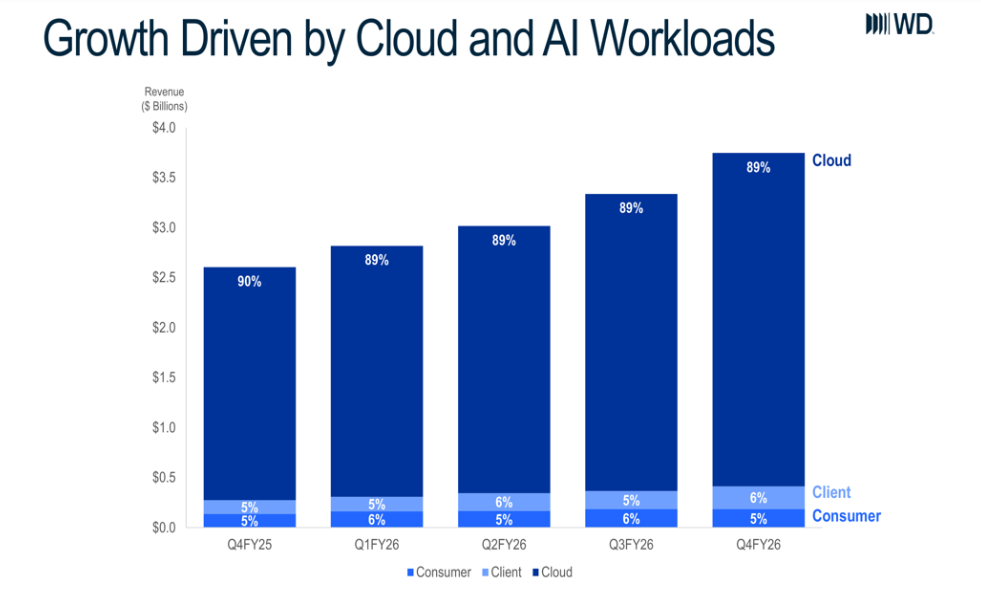
Western Digital said that NAND flash has a long-term cost premium of about 6–10x versus HDD. In the quarter that disclosed complete operating data, the company’s cloud revenue was about $3.0 billion, accounting for 89% of total revenue, up 48% year over year. Total shipments were 222 EB, up 34%. Of this, shipments of the company’s latest-generation ePMR drives exceeded 4.1 million units with capacity of 118 EB, directly reflecting that hyperscale cloud vendors are converting AI data lake demand into nearline HDD purchases.
The most important incremental contribution from the earnings call is not the next-quarter $4.1 billion revenue guide, but rather management’s redefinition of the AI-driven storage demand function. Compute resources can be repeatedly scheduled across different training and inference tasks, but model inputs, outputs, checkpoints, inference logs, agent workflow contexts, and synthetic data will continue to accumulate and compound. Even if GPU/TPU or cloud hyperscalers’ deployment pace of custom AI ASICs slows temporarily, the already deployed “AI factories” will keep generating data that needs to be stored, accessed, and reused. This effect is further amplified by autonomous driving, robotics, and industrial automation: insufficient real-world data forces enterprises to generate large amounts of synthetic video and simulation data, making “physical AI” the next new round of capacity black hole after training and inference.
The conference call also strengthened the logic around order visibility and pricing power. Western Digital management expects EB-level demand growth of at least 25% over the coming years, and customer discussions have extended to 2029–2031. Management said that given restrained supply, WDC does not need to massively increase the number of drives produced; instead, it will raise per-drive capacity, lower cost per TB, and improve customers’ total cost of ownership value through 40TB UltraSMR ePMR, HAMR ramping in 2027, and higher areal density. The official roadmap points to ePMR 60TB and HAMR reaching 100TB by 2029, while high bandwidth drives and a Dual Pivot architecture aim to expand HDD applicability from pure capacity into higher-throughput AI workloads.
Western Digital’s exclusive 40TB UltraSMR ePMR drives have already been certified by two hyperscale customers, with plans for mass production in the second half of 2026. The ePMR roadmap will extend to 60TB, with HAMR planned to ramp in 2027 and reach 100TB by 2029. High Bandwidth Drive and the Dual Pivot architecture improve throughput via multi-head parallel read/write and two independent actuators, respectively; combined, they can raise sequential I/O by about 4x. Power-optimized HDDs target a 20% reduction in power consumption, allowing data centers to expand storage capacity without increasing the scale of racks, power, or SSD purchases.
HDD cycle: shifting from the traditional inventory cycle to a data-compounding-driven structural capacity cycle
Western Digital’s latest earnings report and forward guidance clearly significantly strengthen its long-term fundamentals rather than serving as a short-term trading catalyst. It shows that this round of earnings expansion is not merely the result of temporary shortages, but rather the combined effect of AI data volume growth, upgrades to high-capacity products, long-term customer collaboration, and industry supply discipline. Whether the stock can be immediately repaired, however, still depends on how quickly gross margin catches up relative to Seagate, the ramp-up pace of 40TB products, and whether LTA can translate into actual EB shipments and continued price increases.
The after-hours decline reflects the unwinding of high valuations and extreme expectations. What the conference call will reveal is that the HDD cycle is moving from the traditional inventory cycle to a structural capacity cycle driven by data compounding led by AI data centers. The focus going forward is whether gross margin can sustainably hold around 55%, cloud EB shipment growth, certification and mass production ramp of 40TB products, HAMR progress, and capex from hyperscale customers—rather than inferring that the AI storage cycle has reversed solely from the size of the after-hours drop.
On the eve of the earnings release, Melius Research technology analyst Ben Reitzes set a $1,050 price target for Western Digital with a “Buy” rating. Western Digital’s regular trading close on August 5 was $519.17, so $1,050 implies about 102.2% potential upside. Based on the current market cap of about $178.9 billion and assuming existing common equity stays static, if the stock reaches $1,050, the company’s market cap would be roughly $362.0 billion.
Reitzes’ core view is that HDD is not a traditional cycle hardware being replaced by flash; rather, it is a capacity-layer asset whose long-term strategic value in AI data infrastructure has been severely underestimated. Reitzes said generative AI—especially video models—will expand the size of training corpora, inference outputs, logs, checkpoints, and content archiving. “Physical AI” such as autonomous driving, robotics, and industrial automation will also generate real-world video, sensor data, and synthetic training data around the clock, shifting storage demand from one-time data center build-outs to sustained compounded growth. Reitzes at Melius therefore considers the prior stock pullback of more than 20% from the highs to be an opportunity for AI infrastructure longs to re-enter.
The deeper profit logic is that Western Digital does not need to expand HDD headcount and capacity build-outs in the same proportion. Instead, it can deliver more EB capacity with roughly similar unit production by leveraging 40TB-class ePMR, HAMR, and higher areal density products. Industry demand growth has continued to outpace supply growth, plus multi-year customer agreements, which is favorable for rising average selling prices per TB. At the same time, capacity upgrades lower manufacturing cost per TB, creating a threefold operating lever: “EB shipment growth + price improvement + unit cost reduction.” Management expects EB demand growth to exceed 25% over the coming years, and the conference call indicates customers’ long-term plans are extending to 2029–2031.