



1. Overview of the report content
Grayscale is one of the world's leading digital asset investment management companies and an important reference point for many institutional investors and market participants. The report '2026 Digital Asset Outlook: Dawn of the Institutional Era' outlines a blueprint for the future of the digital asset market, particularly how digital assets will become more deeply integrated into the mainstream financial system with the advent of the institutional era.
The report primarily revolves around the following themes:
Macroeconomic demand drives alternative value storage: As fiat currencies face high debt and inflation pressures, scarce digital assets like Bitcoin and Ethereum will see increased long-term allocation demand.
The improvement of regulatory transparency: In 2026, the U.S. is expected to pass bipartisan legislation on crypto market structure, providing a clear legal framework for institutional investors and promoting the deep integration of blockchain with traditional finance.
The rapid development of asset tokenization: The scale of tokenized assets in fields such as real estate, money market funds, and green energy will grow significantly, becoming new tools for institutional asset-liability management and risk control.
The accelerated application of DeFi and stablecoins: Driven by the GENIUS Act, stablecoins play a key role in cross-border payments, corporate financial management, and on-chain financial settlements, while DeFi activities and on-chain liquidity continue to expand.
The enhancement of privacy protection technologies: As the integration of blockchain and traditional finance deepens, privacy coins, privacy chains, and compliant privacy infrastructure will become necessary components of the financial system.
Based on this, Starbase will provide a detailed interpretation of the report's content, focusing on industry trends and practical market applications.
Original link: https://research.grayscale.com/reports/2026-digital-asset-outlook-dawn-of-the-institutional-era
Grayscale
2. The formal entry of digital assets into the 'institutional-led cycle'
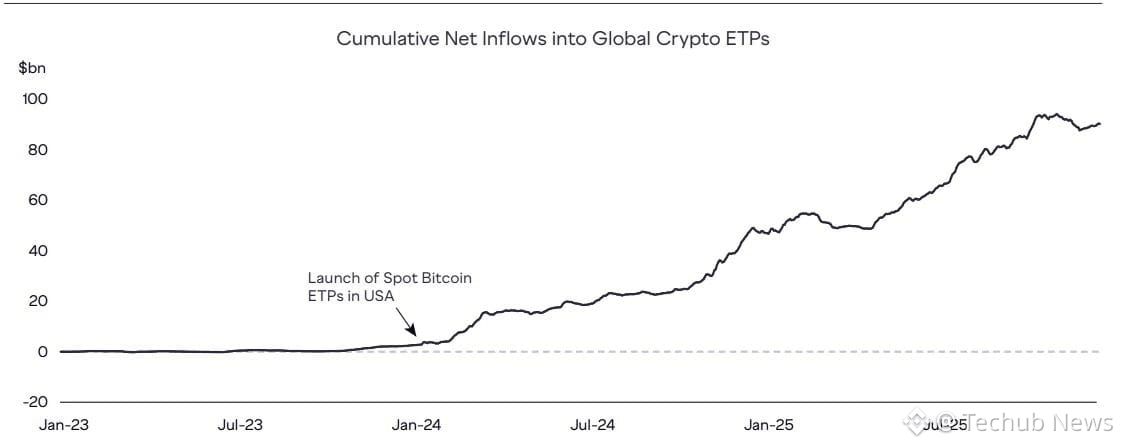
ETF approvals, the improvement of custody and audit systems, and the maturity of compliant trading channels have made it possible for digital assets to be included in the long-term allocation framework of mainstream institutions for the first time. By the end of 2025, the asset management scale of Bitcoin spot ETFs reached hundreds of billions of dollars, with a significant increase in the proportion of institutions among holders. The main source of new capital is exchange-traded products (ETPs); since the launch of Bitcoin ETP in 2024, global net inflows have reached $87 billion.
Market pricing logic is shifting from being dominated by retail sentiment and short-term liquidity to an institutional paradigm centered on compliant capital, allocation cycles, and risk budgets. Unlike previous bull markets driven by large fluctuations and retail, this round of gains under institutional leadership is more stable; for example, Bitcoin has a recent annual increase of about 240%, far below historical annual increases of over 1000%.
3. The macro environment reshapes the selection criteria for 'value storage' assets
In the context of high debt, long-term inflation expectations, and uncertainty in monetary policy, scarcity, verifiability, and cross-system transferability are becoming common characteristics of the new generation of value storage assets. The maximum supply of Bitcoin is 21 million, and the 20 millionth coin is expected to be mined by March 2026, further reinforcing its long-term value attributes. Ethereum's characteristics in deflationary mechanisms, yield generation, and on-chain economic activity enable it to gradually transition from a 'tech asset' to an 'economic infrastructure asset.'
The report points out that the risk of U.S. dollar depreciation is driving institutional and retail investors to allocate digital currencies like Bitcoin, Ethereum, and some privacy coins (such as Zcash) to hedge against potential risks in the fiat currency system.
4. Stablecoins and tokenized assets become key interfaces connecting traditional finance
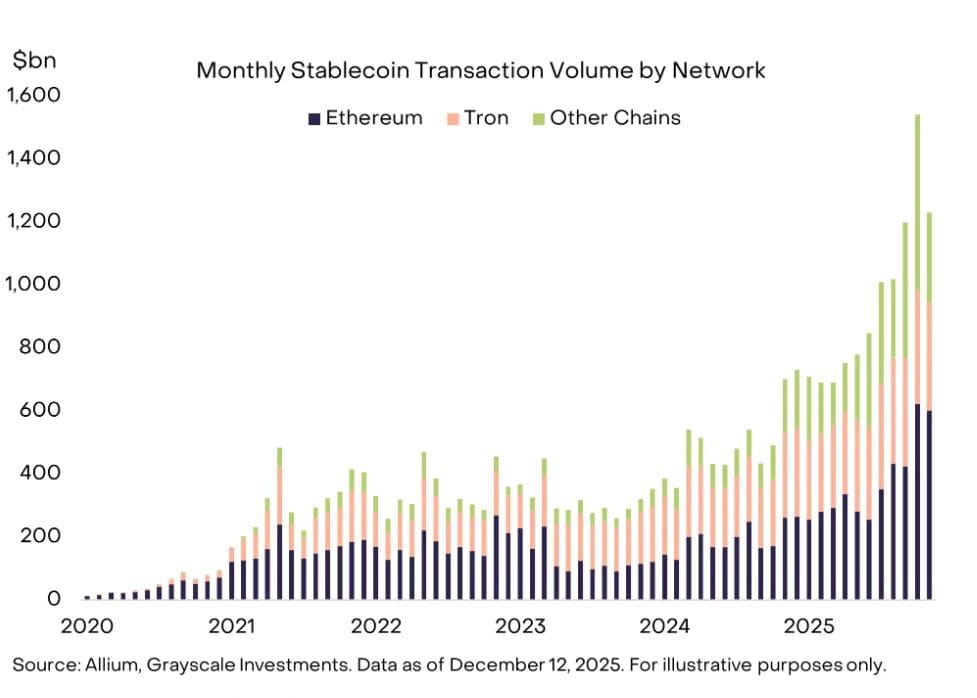
Stablecoins have evolved from a medium of exchange to the settlement and clearing infrastructure of the on-chain financial system. By 2025, the global monthly trading volume of stablecoins has reached $1.1 trillion, with a total market size of approximately $300 billion, and the penetration rates in cross-border payments, derivative trading, and corporate payments continue to rise.
RWA is seen as the core carrier for the expanded application of stablecoins. By putting real assets on-chain, institutions can obtain quantifiable, tradable, and combinable asset units, providing institutional support for upgrading financial infrastructure.
5. The accelerated development of DeFi and stablecoins
The report points out that 2026 will be a key year for the development of DeFi and stablecoins. Driven by the GENIUS Act, the use of stablecoins will be more widespread, expected to play an important role in cross-border payments, corporate finances, and consumer payments. The supply of stablecoins in the market has reached $300 billion, with monthly trading volume reaching $1.1 trillion in 2025, demonstrating its potential in the global payment system.
DeFi and stablecoins will become the pillars of the digital asset economy. Enterprises can improve asset liquidity and achieve cross-border payments and consumer application scenarios by combining RWA assets with stablecoins. As the regulatory framework becomes clearer, Web3 institutions should focus on how to utilize stablecoins and DeFi mechanisms to maximize the liquidity and efficiency of real assets while ensuring compliance and risk control.
6. RWA has moved from 'proof of concept' to the institutional landing phase
The market's weight on RWA has significantly increased. Low-volatility, cash flow-clear assets (such as government bonds, money market funds, and receivables) have become the first choice for institutions trying to go on-chain. By 2025, the scale of on-chain tokenized government bonds and cash-like assets is expected to reach hundreds of billions of dollars, showing characteristics led by top institutions with a focus on compliance structures.
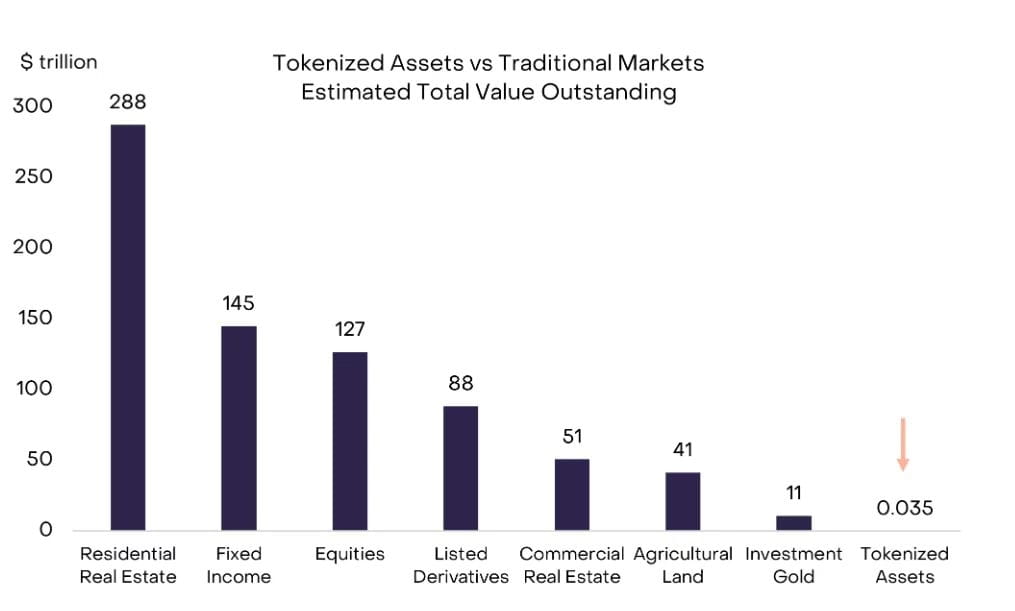
Asset tokenization currently accounts for about 0.01% of the global equity and bond market value, and it is expected to grow approximately 1000 times in the coming years. Ethereum, BNB, and Solana are the main underlying chains, while middleware like Chainlink provides support for pricing, identity, and compliance data. This indicates that RWA is transitioning from single-point project exploration to institutionalized tools that can be integrated into asset-liability management and risk control systems, and is expected to become the new norm for institutional allocation.
7. Regulatory clarity determines expansion speed, not whether it happens
The regulatory rhythm differences among jurisdictions will directly affect the landing path of RWA and stablecoins. However, the overall trend has shifted from 'whether to allow' to 'how to regulate.' In 2025, the U.S. will pass the GENIUS Act and launch a regulatory framework for stablecoins, while the SEC, Congress, and the traditional banking system will gradually provide clear guidance. In 2026, a bipartisan-supported crypto market structure bill is expected to be enacted, allowing regulated token issuance and promoting compliant trading.
In markets with high regulatory clarity, tokenized assets are viewed as part of the upgrade of financial infrastructure rather than a substitute for existing systems, providing institutional endorsement for the long-term existence of RWA.
8. In 2026, the golden age of the RWA market
According to Grayscale's report analysis, the digital asset market will usher in a golden age of institutionalization and compliance in 2026. Increased macro pressures, clarified regulatory frameworks, asset tokenization, and accelerated DeFi applications are expected to lead to an explosive period for the RWA market globally.
The on-chain integration of real assets and the deep fusion of digital assets with traditional finance will become the norm; stablecoins, privacy protection technologies, and tokenized assets will drive market structure optimization and trading efficiency improvements; institutional investors will pay more attention to the long-term value carrying capacity and compliance guarantees of assets.
In the coming years, RWA and on-chain assets will become important cornerstones of the institutionalization of digital assets, and investors, enterprises, and developers should continue to pay attention to the evolution of the underlying chains and supporting infrastructure.
Please continue to follow Starbase, as we will share more valuable research content on digital assets and RWA in the future to help readers grasp industry trends and practical opportunities.