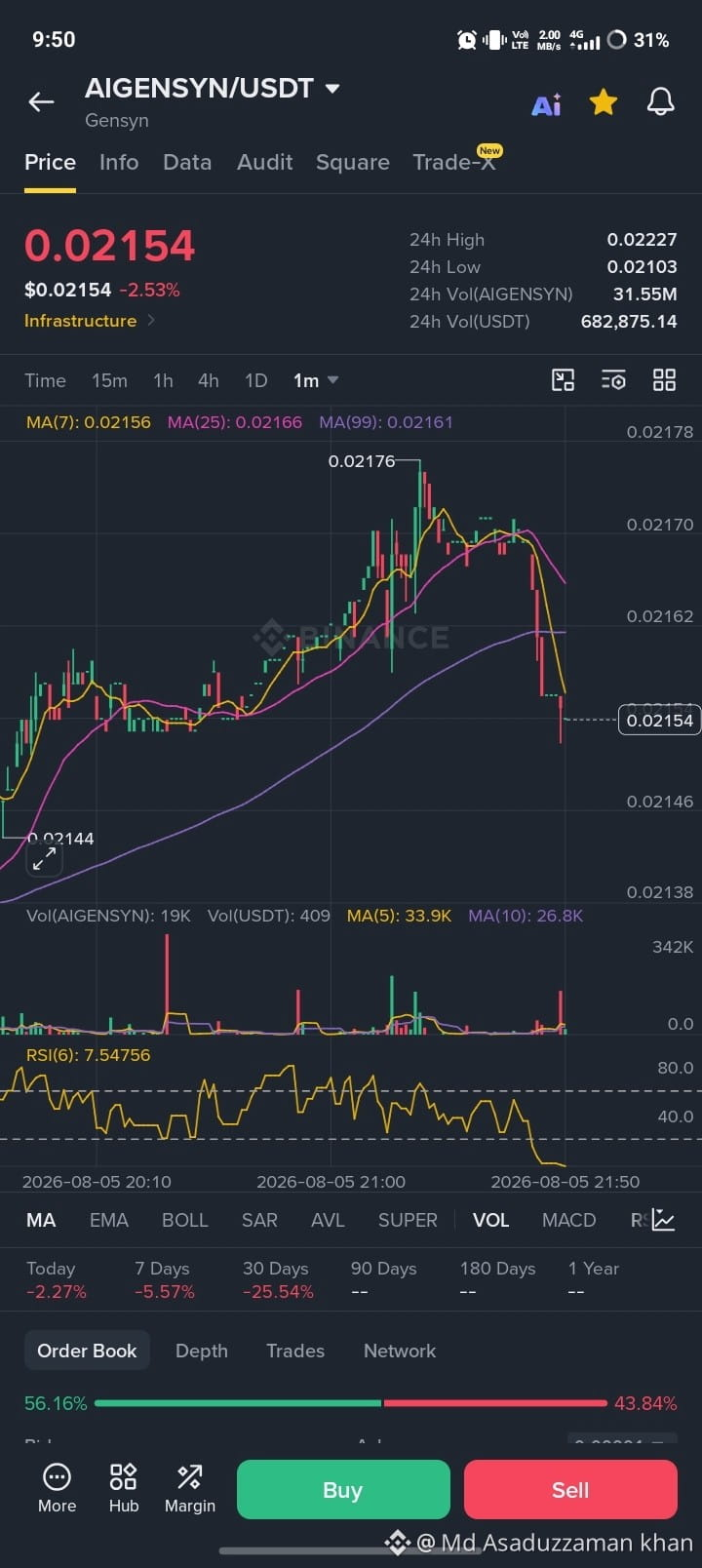
#AIGENSYN/USDT is currently trading around $0.02154, showing a 2.53% decline over the last 24 hours. The recent chart indicates that the price faced strong selling pressure after failing to hold above the $0.02170–0.02176 resistance zone. Sellers quickly pushed the price below the short-term moving averages, signaling weakening bullish momentum.
The RSI (6) has dropped to an extremely oversold level (around 7.5), suggesting that the recent sell-off may be overextended. While this could lead to a short-term relief bounce, traders should wait for confirmation before entering new positions. Low RSI alone does not guarantee an immediate reversal.
Trading volume has increased during the decline, which confirms that sellers are currently in control. The nearest support is around $0.02145–0.02150, while the first resistance lies near $0.02165–0.02175. A break above resistance could restore bullish momentum, whereas losing support may trigger another wave of selling.
Conclusion: AIGENSYN/USDT remains under short-term bearish pressure. Traders should monitor support levels closely and wait for a clear recovery signal before considering long positions. Proper risk management and stop-loss placement remain essential in the current volatile market.
The RSI (6) has dropped to an extremely oversold level (around 7.5), suggesting that the recent sell-off may be overextended. While this could lead to a short-term relief bounce, traders should wait for confirmation before entering new positions. Low RSI alone does not guarantee an immediate reversal.
Trading volume has increased during the decline, which confirms that sellers are currently in control. The nearest support is around $0.02145–0.02150, while the first resistance lies near $0.02165–0.02175. A break above resistance could restore bullish momentum, whereas losing support may trigger another wave of selling.
Conclusion: AIGENSYN/USDT remains under short-term bearish pressure. Traders should monitor support levels closely and wait for a clear recovery signal before considering long positions. Proper risk management and stop-loss placement remain essential in the current volatile market.