


Jiaoyi Lu, a reporter for 21st Century Business Herald
The hot CPU chip market is sparking yet another round of turbulence.
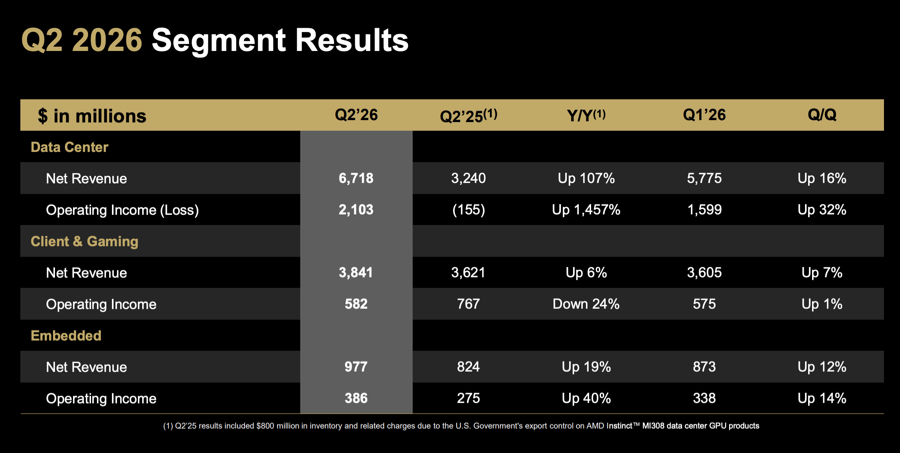
On August 4 local time, AMD delivered a high-growth performance report. In the company’s fiscal second quarter of 2026, revenue reached $11.5 billion, up 50% year over year and 13% quarter over quarter. Profitability hit a historic high. Notably, data center revenue grew by more than double year over year.
But this earnings report failed to ignite enthusiasm in the capital markets. After the close, AMD’s stock price fell by more than 9% at one point. The reason is simple: the market was expecting a “super surge,” but the actual performance fell short of some institutions’ estimates.
Such high expectations reflect the market’s broad optimism about CPU chip demand. Meanwhile, beyond AMD, the earnings updates and outlooks recently disclosed by the three major manufacturers—Intel, Qualcomm, and Arm—are collectively painting a picture of the CPU chip market like never before: supply and demand remain tight, the competitive landscape is becoming more diversified, and the growth curve has long broken the traditional cycle.
AMD’s quarterly financial report once again proves that AI infrastructure buildout is still in a period of rapid expansion.
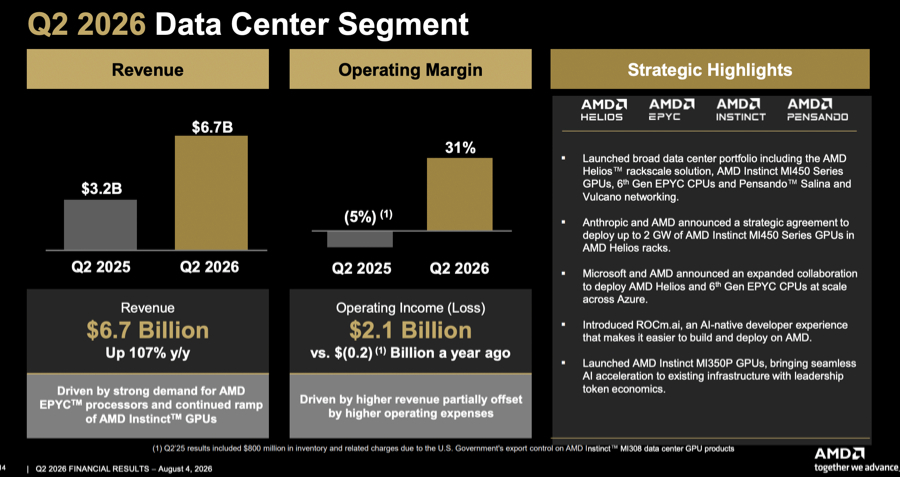
According to AMD Chairman and CEO Su Zifeng, in the second fiscal quarter, the company’s data center business revenue doubled year-on-year and its share of total company revenue rose to 58%, up from 42% in the same period last year, fully demonstrating the rapid expansion of the company’s server and AI data center business scale.
She listed a set of data to support this: data center segment revenue grew 107% year-on-year to $6.7 billion, setting a historical record high. The core driver of this growth is strong demand for EPYC server CPUs and Instinct AI accelerators. The server CPU business has refreshed revenue records for five consecutive quarters. Year-on-year sales revenue via cloud computing and enterprise on-prem deployment channels both increased by more than 70%, exceeding the performance expectations given in the previous quarter; and the company’s market share for x86 server CPU chips increased year-on-year.
Based on performance, Su Zifeng said that the year-on-year growth rate of server CPU revenue in the second half of 2026 is expected to exceed 80%, and in all of 2027, revenue is expected to grow by more than 70% year-on-year on a higher base. Combining the two major businesses, the company expects that in 2027 overall revenue for the data center segment will more than double year-on-year.
Based on AMD’s projections, over the next several years, the overall compound annual growth rate of the high-performance computing and AI compute market will be about 40%, and by 2030 the overall market size will be close to $2 trillion. Against this backdrop, the company’s revenue growth rate will continue to outperform the industry overall.
In fact, this is no longer the growth logic under traditional AI infrastructure buildout assessment standards; it is closely tied to the explosive demand for agentic (agent-based) AI.
Counterpoint Research senior analyst Parv Sharma analyzed for a reporter from the 21st Century Business Herald that agentic AI needs more CPU cores per GPU to handle tasks such as orchestration, managing multiple sub-agents, and tool calls. At the same time, hyperscalers continue to build AI data centers at massive scale and continually increase capital expenditures (CapEx), further boosting demand for server CPUs.
This can also be seen from the performance of AMD’s peers.
At a recent earnings call, Intel executives said that the current demand in the CPU chip market is very strong. Measured by shipment volumes, the ratio of CPUs to GPUs is already close to 1:1, and it may even shift further toward CPUs in the future. Judging from downstream manufacturers’ capital expenditures and long-term agreements already signed, it can be expected that the market will achieve significant growth. “The bigger challenge right now is expanding supply to meet customer demand,” the company added.
This makes it easy to understand why two giants, Qualcomm and Arm, have also entered the data center CPU chip market.
Qualcomm executives explained at a recent earnings call that agentic AI workloads are reshaping the AI economy. Efficient token generation and total cost of ownership (TCO) are crucial for scaling AI development, and this is also the opportunity for the company to re-enter the data center CPU chip market now.
Although it is still in the product-planning stage, Qualcomm is accelerating its entry from four dimensions: first, connectivity—leveraging its acquisition of Alphawave, Qualcomm strengthens its ability to provide connected optical/electrical digital signal processing for rack-level and data center-level use cases; second, custom chips—this business focuses on full-stack design based on customer needs; third, AI acceleration chips—by the second fiscal quarter of 2027, Qualcomm will launch its next-generation AI acceleration chip, the industry’s first near-memory computing accelerator; fourth, CPU chips—by the second half of 2028, Qualcomm will launch Oryon server-class computing solutions (covering IP cores/architecture). At that time, it will also release a complete CPU product matrix covering three key scenarios: agentic AI, general computing, and AI head nodes (Head Node).
Arm’s investment has already shown results. The latest quarterly report shows that in the first fiscal quarter, the company’s royalty revenue was $715 million, up 22% year-on-year. Among that, data center royalty revenue once again grew by more than double year-on-year, making it the biggest driver of royalty growth. The growth comes from ongoing adoption of Arm-architecture server chips by all major hyperscalers, as well as increased deployment of data center network chips (especially DPUs and smart NICs).
For the past two years, the market has generally believed that the core bottleneck restricting AI industry development is GPUs. But based on the latest assessments from four leading CPU vendors, as agentic AI continues to drive the evolution of AI computing architectures, CPUs are gradually turning from traditional “co-processors” into a new variable that determines the efficiency of AI infrastructure. Beyond determining the upper limit of compute power with GPUs, CPUs now start to determine how many agents the entire AI system can run, how complex the inference workflows can be, and how efficiently the resources of the entire data center are scheduled.
Against the backdrop of CPU chips becoming a “hot commodity,” a shortage and price-rising trend has naturally followed.
Since this year began, Intel and AMD have raised server CPU chip prices one after another. Parv Sharma, analyzing for a reporter from the 21st Century Business Herald, said that in 2026, CPU price increases are mainly concentrated in the server CPU market, with increases generally ranging from 10% to 20%. The price hikes are mainly driven by factors such as Intel’s wafer fabrication supply bottlenecks and TSMC’s manufacturing cost increases being passed down to downstream customers. Historically, the growth of server CPU average selling price (ASP) has typically been relatively steady, mainly driven by increases in core counts. This round of premium pricing, however, is driven more by the surge in server CPU demand brought by agentic AI, combined with supply shortages. Meanwhile, some older CPU models have also seen premium pricing, but overall supply tightness is still not as severe as in the current memory chip market.
Arm, which already has some accumulation in the CPU chip market, is also accelerating its participation in the battle for market share. According to statistics from IDC, a third-party research firm, global AI infrastructure spending reached $89.7 billion in the first quarter of 2026. One trend that should not be overlooked is that rack-scale GPU servers based on Arm architecture have surpassed x86 and become mainstream accelerated computing platforms.
Over the past few decades, the server CPU market has almost always belonged to the x86 camp. Intel has long maintained absolute dominance, while AMD has continuously eroded market share. The two companies compete around performance, process technology, energy efficiency, and pricing, forming the basic landscape of the global data center CPU market.
But with AI data centers entering a new construction cycle, this long-lasting duopoly competition pattern is now facing new variables.
At the latest round of earnings call, both Arm and Qualcomm placed data center CPUs at the core strategic position for the company in the coming years.
Not long ago, Arm, which just released physical CPU chips, disclosed new progress in an earnings call: its initial products have been delivered to multiple customers, the order value has already exceeded $2 billion, and it continues to add new customers.
For tight production capacity, Arm has already secured manufacturing capacity needed to meet the $1 billion revenue target announced earlier. In addition, it has made progress in securing extra supply, optimizing the customer mix, and improving commercial terms. According to the description, Arm’s AGI CPU will cover three major areas: traditional servers, head nodes (Head Node), and agentic applications (Agentic). In each of these areas, the company currently has customers.
Arm CEO Rene Haas said that in March this year, the company’s estimate of the total addressable market (TAM) space for CPUs was $100 billion, but current industry estimates have risen to $220 billion.
Qualcomm also discussed related revenue guidance. The company expects that it will begin generating data center-related revenue starting in December 2026, and then gradually grow throughout fiscal year 2027. Overall, it expects data center business revenue to reach $5 billion in fiscal year 2027 and $15 billion in fiscal year 2029.
However, as a latecomer, Qualcomm—facing ongoing supply-chain tightness and rising prices—may also suffer some gross margin losses in the early stages of its development.
Qualcomm said that because early revenue mainly came from its custom-chip business, its gross margin is significantly below the company’s baseline level, and to a certain extent even drags down the company’s overall gross margin.
However, this does not mean that x86 is rapidly losing its advantages.
Parv Sharma told reporters that in the race for data center CPU market share, Arm’s architecture camp still faces three major challenges: insufficient SMT (simultaneous multithreading) capability for agentic AI workloads, issues with long-tail compatibility in the software ecosystem, and the limitation that most Arm chips are only used internally by cloud vendors and have not been opened to an external ecosystem.
Another point to note is that the biggest difference in this round of CPU-chip competition is that the contest is no longer purely about the performance of a single CPU.
The leading vendors mentioned earlier all pointed to an operating logic centered on coordination across multiple product lines. This also indicates that what each company is fighting for is no longer just market share in server CPU chips, but rather influence over next-generation AI infrastructure.
This may also be a new signal: while CPU remains the starting point of competition, what ultimately decides the outcome will be how the CPU, together with GPUs, ASICs, interconnect networks, memory, and software platforms, forms a complete AI computing system.