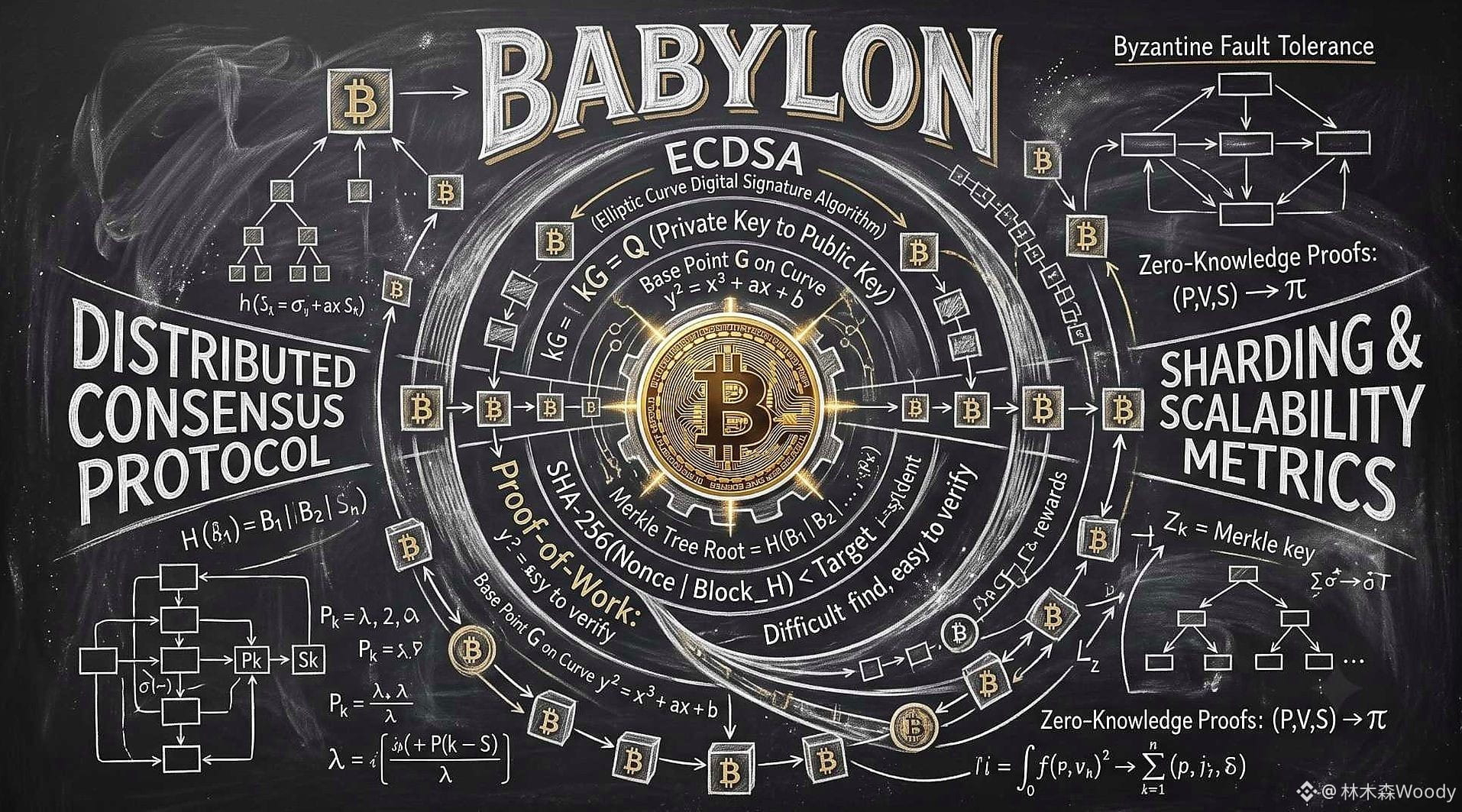
I took the @BabylonLabs_io risk framework I published myself, and went through the TBV testnet parameters line by line. The most interesting part is that one side says “the collateral lifecycle should require no permission,” while the other side explicitly lists an emergency threshold of 3-of-5 for the Security Council.
This may not be a contradiction, but it’s exactly the seam that tests the real value of “trustless.”
SCRIPT calls for six things: users retain sovereignty; disposal rules are clear; collateral cannot be re-pledged without consent; each position is isolated; third parties can’t review; and collateral status is transparent. It’s like listing the six acceptance checks for a safe: who holds the keys, under what conditions the safe can be opened, whether the contents can be re-pledged, whether the safes are mixed or not, who can block you, and whether outsiders can verify and audit what’s inside.
TBV’s approach to isolation and transparency is very clear: each user’s BTC stays in an independent Bitcoin Vault, and external applications verify the state—without pooling all coins into one custodial bucket. But the current public testnet parameters also say that the Security Council consists of 5 seats, and that 3 signatures can execute an emergency intervention similar to CouncilNoPayout.
Here we must draw a boundary: 3-of-5 is a public testnet parameter, and we cannot directly infer that the future mainnet will simply copy it. Precisely because the mainnet answer can’t be determined from this page’s parameters, we should treat the committee’s retention and permission changes as long-term observation items—not as a place to let the project’s conclusions fill in the blanks.
I recognize that an emergency brake has real value during the test phase. The new system involves Bitcoin scripts, off-chain coordination, and Ethereum smart contracts. If a severe fault is discovered, having absolutely no stop-loss button may not be safer than having one. The issue is: once a button exists, you must keep asking—who the members are, what conditions allow it to be pressed, whether the execution is publicly delayed or not, and whether users have an exit path that doesn’t rely on the committee.
This is also what governance with $BABY is truly supposed to focus on. Not assuming that “community governance” automatically means dispersed permissions, but rather checking in the future mainnet which emergency powers will remain, who can adjust the thresholds, and whether each action can be traced on-chain. #baby is not voting for an abstract vision; it’s voting for specific permission boundaries.
My stance: an emergency committee can be a safety rail during construction, but it can’t rely forever on a single claim of “for safety” to avoid scrutiny. Do the self-check first. Are you willing to trade a 3-of-5 brake for fault response, or do you think a permissionless system shouldn’t keep this master switch? Split it open in the comments and discuss.
This may not be a contradiction, but it’s exactly the seam that tests the real value of “trustless.”
SCRIPT calls for six things: users retain sovereignty; disposal rules are clear; collateral cannot be re-pledged without consent; each position is isolated; third parties can’t review; and collateral status is transparent. It’s like listing the six acceptance checks for a safe: who holds the keys, under what conditions the safe can be opened, whether the contents can be re-pledged, whether the safes are mixed or not, who can block you, and whether outsiders can verify and audit what’s inside.
TBV’s approach to isolation and transparency is very clear: each user’s BTC stays in an independent Bitcoin Vault, and external applications verify the state—without pooling all coins into one custodial bucket. But the current public testnet parameters also say that the Security Council consists of 5 seats, and that 3 signatures can execute an emergency intervention similar to CouncilNoPayout.
Here we must draw a boundary: 3-of-5 is a public testnet parameter, and we cannot directly infer that the future mainnet will simply copy it. Precisely because the mainnet answer can’t be determined from this page’s parameters, we should treat the committee’s retention and permission changes as long-term observation items—not as a place to let the project’s conclusions fill in the blanks.
I recognize that an emergency brake has real value during the test phase. The new system involves Bitcoin scripts, off-chain coordination, and Ethereum smart contracts. If a severe fault is discovered, having absolutely no stop-loss button may not be safer than having one. The issue is: once a button exists, you must keep asking—who the members are, what conditions allow it to be pressed, whether the execution is publicly delayed or not, and whether users have an exit path that doesn’t rely on the committee.
This is also what governance with $BABY is truly supposed to focus on. Not assuming that “community governance” automatically means dispersed permissions, but rather checking in the future mainnet which emergency powers will remain, who can adjust the thresholds, and whether each action can be traced on-chain. #baby is not voting for an abstract vision; it’s voting for specific permission boundaries.
My stance: an emergency committee can be a safety rail during construction, but it can’t rely forever on a single claim of “for safety” to avoid scrutiny. Do the self-check first. Are you willing to trade a 3-of-5 brake for fault response, or do you think a permissionless system shouldn’t keep this master switch? Split it open in the comments and discuss.