
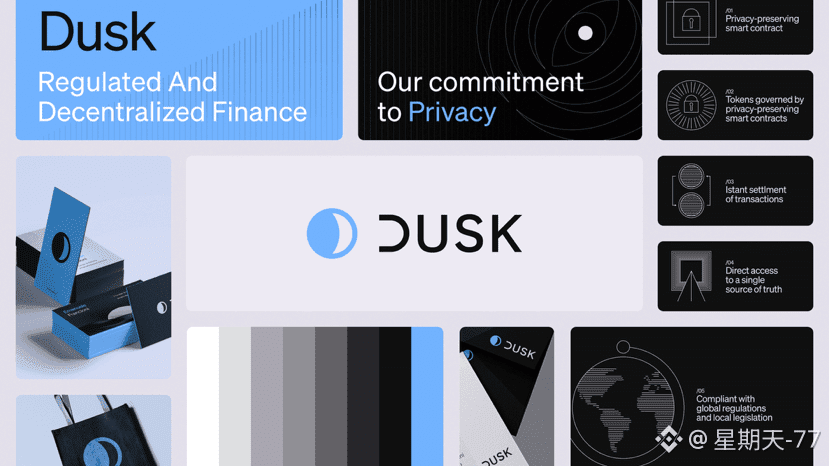

By 2026, the reality of asset (RWA) tokenization track has moved from conceptual hype to a real infrastructure competition. Many public chains have emerged, but Dusk Network, with its positioning of 'compliant and private financial infrastructure' established since 2018, has built a competitive barrier that is difficult to replicate simply. This barrier is not a single technology but a systematic capability that deeply integrates technological architecture, regulatory adaptability, and business models.
The core lies in resolving the fundamental contradictions of financial institutions. Traditional financial institutions have an inherent paradox regarding the demand for blockchain: they desire to leverage its transparency and efficient clearing capabilities while strictly protecting customer data and trading strategies as commercial secrets, all while meeting increasingly complex anti-money laundering (AML) and securities regulations. Mainstream transparent public chains cannot solve privacy issues, while purely private chains struggle to meet compliance audit requirements. Dusk, through its Hedger component, creatively utilizes zero-knowledge proofs (ZKP) and homomorphic encryption technology to achieve a balance of 'data encrypted for the public, auditable by authorized regulators.' This allows institutions not to have to choose between 'privacy' and 'compliance,' providing a ready-made, regulatory-compliant technical solution.
Secondly, there is a deep integration with the 'compliance interface' of the traditional financial system. This is reflected in its flagship partnership case, DuskTrade. The partner, the Dutch NPEX exchange, is not an ordinary crypto institution but a regulated entity holding multiple financial licenses from the EU (such as MTF and broker licenses). This means that Dusk's blockchain capabilities are built on top of an existing, legitimate financial operating framework. This cooperation model is far more efficient and reliable than the project party applying for licenses themselves or persuading individual asset issuers. It validates the full-chain compliance feasibility from asset issuance, KYC/AML to trading settlement, setting a replicable template for more traditional exchanges and asset classes to follow.
Finally, the practicality of the ecological launch strategy. Despite leading technology, Dusk also faces the common challenge of 'ecological cold start' for new public chains. Its response strategy is clear and pragmatic: first, by minimizing migration costs through a fully compatible DuskEVM, it attracts a large number of Ethereum developers and mature codebases; at the same time, it uses the initial real assets promised by DuskTrade, which exceed 300 million euros, as a core magnet to directly attract market makers and professional investors seeking compliant liquidity. This combination of 'technical usability + real asset entry' aims to bridge the critical gap from technology to ecology.
Therefore, the moat of #dusk is comprehensive. It is not just a faster virtual machine or higher TPS, but a complete protocol stack specifically designed for regulated financial scenarios, a verified compliance cooperation paradigm, and a pragmatic ecological growth strategy. For investors, this means that the long-term value of @Dusk depends not only on technological iteration but also on the breadth and depth of its acceptance as a 'compliance bridge' by traditional financial markets. With regulations like the EU MiCA fully implemented, the value of this moat may further highlight. In this competition for RWA infrastructure, $DUSK is trying to become part of the rules, not just a participant.