

Recently, on-chain data platform BirdEye released its first research report focusing on the tokenized gold market (The Onchain Gold Rush). From five dimensions—market size, trading volume, holder distribution, gold perpetual futures, and the lending market—the report provides a systematic analysis of the development of tokenized gold over the past decade. Unlike prior reports that focused more narrowly on a single product or market event, this report places greater emphasis on industry-wide development trends, and on which products have already entered the scope of long-term observation by third-party data providers.
Notably, the tokenized gold XAUm issued by Matrixdock is featured with data in multiple chapters of the report, covering aspects such as market size, number of holders, trading volume, and the lending market. This does not mean BirdEye is issuing an evaluation of a single product; rather, it indicates that XAUm has been included in BirdEye’s data statistics for the tokenized gold market.
For the RWA industry, which is still developing rapidly, the significance of third-party industry research samples like this may be worth more attention than a single standalone partnership announcement.
What does BirdEye’s report reflect? Tokenized gold is entering a new growth phase
BirdEye’s research first describes the current development status of the entire tokenized gold market.
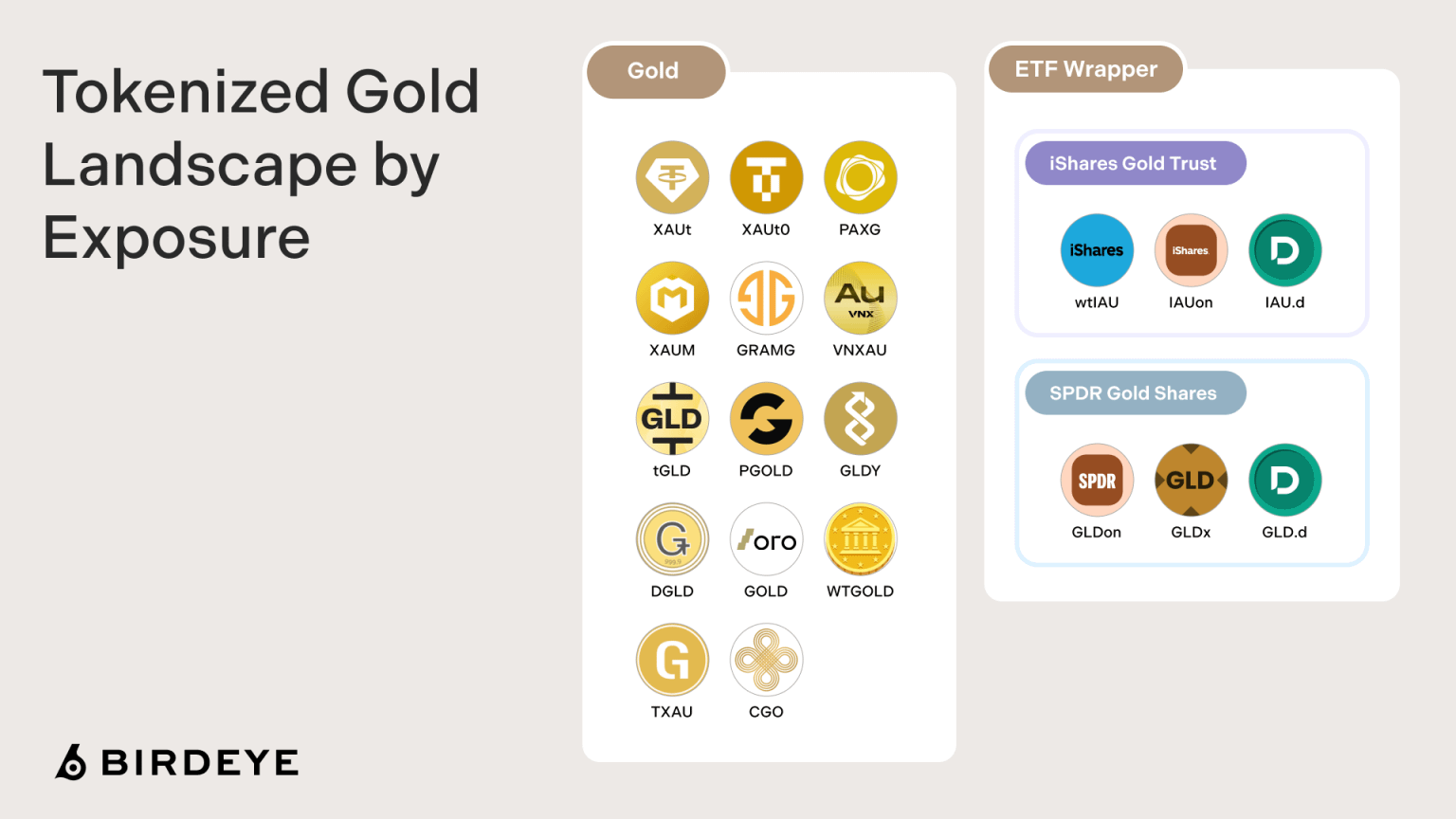
As of July 2026, the global tokenized gold market size is approximately $4.56 billion. It includes 14 types of gold tokens backed by physical gold, as well as 6 products that tokenize shares of traditional gold ETFs. Over the past year, as international gold prices rose, on-chain gold supply grew rapidly and reached a historical peak of about 1.2 million troy ounces in February 2026. After that, even though gold prices pulled back, overall supply remained stable at around 1.14 million troy ounces, with no obvious decline. BirdEye believes this indicates that the market did not see large-scale redemptions in response to the price adjustment.
Meanwhile, trading activity continues to rise. The report shows that industry quarterly trading volume increased from $13.6 billion in Q3 2025 to $48.8 billion in Q4, and reached a peak of $91.0 billion in Q1 2026, indicating that tokenized gold is gradually moving from the asset issuance stage into a more active trading stage.
However, the market landscape remains highly concentrated. The two major products, XAUt and PAXG, account for 93.1% of market share, while all other products combined account for less than 7%. BirdEye also points out that worth watching is not only the leading products, but the growing number of new products that are gradually expanding their influence across different ecosystems, driving sustained market growth.
Why does XAUm enter BirdEye’s research sample?
BirdEye did not provide a separate evaluation of XAUm; instead, it included XAUm in the overall data statistics system for the tokenized gold market.
According to the report, at the time of data collection, XAUm’s market capitalization was about $66.0 million, and it was included in BirdEye’s statistical scope for the tokenized gold market. At the same time, the number of XAUm holders recorded by BirdEye was about 66,100 addresses, second only to PAXG and higher than XAUt. Of those, about 60,600 addresses are concentrated on the Plume network. The report suggests this reflects that RWA-dedicated networks are beginning to form asset distribution capabilities that differ from traditional layer-1 public chains.
From trading data, XAUm also shows relatively rapid growth. BirdEye’s statistics show that its monthly trading volume reached $54.6 million in April 2026, up by about 7.4x from its low point in December 2025, and up by about 4.4x from March 2026, indicating that on-chain trading activity is continuously increasing.
In addition, according to the latest publicly available information on the Matrixdock website, XAUm’s current market cap is about $68.31 million, corresponding to approximately 16,331 troy ounces of physical gold. It is supported by 508 gold bars that meet LBMA standards, with the token supply maintaining an corresponding relationship with the underlying gold. Currently, XAUm has expanded to multiple blockchain networks and has been applied to on-chain financial scenarios such as trading, lending, and liquidity.

From “asset on-chain” to “asset usable,” industry evaluation criteria are changing
Compared with specific products, what is more worth关注 in BirdEye’s report is the industry changes it reflects.
If in the past the market mainly focused on whether “gold had been tokenized,” then now third-party data institutions are paying more attention to whether assets are truly circulating and being used on-chain.
In BirdEye’s statistical framework, market size is only one dimension. Trading volume, holder composition, perpetual contracts, and the lending market are also important indicators for measuring industry development.
The report shows that, as of now, the TVL in the tokenized gold lending market has reached approximately $112.6 million. Although XAUm’s current lending TVL is about $0.787 million, which still lags behind mature products such as XAUt, BirdEye’s statistics also show that new tokenized gold lending markets have already emerged across ecosystems including Sui, BNB Chain, and Solana. The application scenarios for tokenized gold are continuing to expand.
This also means that industry competition is shifting from simply focusing on asset issuance to gradually expanding into the ability to sustain the operation of assets—across multiple dimensions, including underlying reserve transparency, holder base, on-chain liquidity, and financial applications.
Behind the BirdEye report, tokenized gold is starting to enter an infrastructure competition
In the report, BirdEye mentions that although XAUt and PAXG still occupy a dominant position in the market, the market periphery continues to expand: ETF-wrapped products are growing rapidly, gold perpetual contract trading volume on Solana continues to rise, new gold lending markets are emerging in ecosystems such as Sui and BNB Chain, and XAUm’s approximately 66,000 on-chain address holders are mainly concentrated on the Plume network.
Taken together, these changes reflect that the tokenized gold market has entered a new stage of development.
The focus of future industry competition may no longer be simply who issues more gold, but who can build more comprehensive on-chain infrastructure around gold—including a continuously transparent reserve system, wider on-chain distribution, richer financial applications, and more mature ecosystem participation capabilities.
For XAUm, the significance of appearing in BirdEye’s first tokenized gold industry research report is not a one-time exposure. Rather, it is because it has entered the data-statistics sample range of third-party research institutions and is being continuously tracked across multiple dimensions, including market size, number of holders, trading activity, and multi-chain ecosystem deployment.
As more and more research institutions begin to evaluate tokenized gold from dimensions such as market size, liquidity, on-chain activity, and financial use cases, competition in this space is gradually expanding from asset issuance to on-chain infrastructure capabilities and ecosystem development.
Original link: https://birdeye.so/research/detail/the-onchain-gold-rush