

?? Original by Lin Zhibai · Author|Lin Zhibai
“Playing with abstraction” seems to have become a required course in brand marketing.
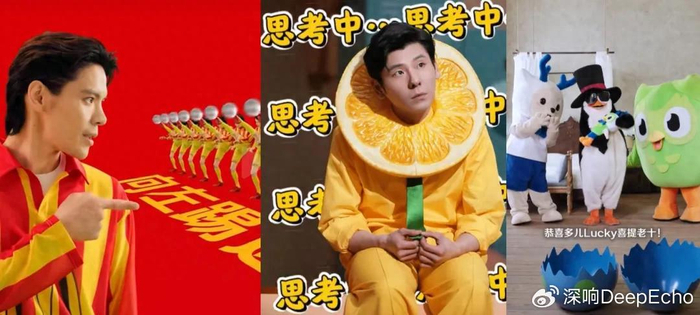
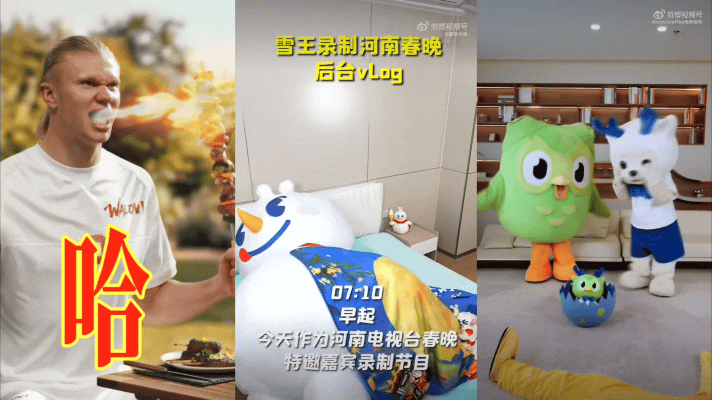
First there was a “Snow King” bus parade, announcing to the whole world that it would be at the 2026 Henan Spring Festival Gala—then it even filmed a rehearsal vlog just to show off its talents, like headstand drumming. After that, during the World Cup, the entire internet was flooded with catchy ad slogans like “Haaland Ha Wanglaoji” and “Mbappé, time to rehydrate,” turning every arena’s top killers into internet “meme kings.” Luckin Coffee and Duolingo also turned the abstract into a serialized story: from the official announcement of a “marriage,” to staging a divorce and then remarriage, even laying 11 eggs in a row—absurd bits of theater all the way…
Haaland × Wanglaoji, Mizxue Bingcheng, Luckin Coffee × Duolingo | Source: Weibo
In a time when attention is extremely scarce and the public-opinion environment is increasingly sensitive, traditional one-way communication is harder and harder to move users. Brands urgently need a communication approach that the general public can quickly understand and is willing to engage with. And “abstraction” precisely hits the shared emotional points of people today—no grandstanding morals, no stiff posture. With just a hot meme and a contrast-driven storyline, brands can align signals with users and achieve emotional synchrony.
But what must be clear is that abstract marketing is only an efficient shortcut to break out of the bubble—it is absolutely not the ultimate answer to brand building.
When every brand squeezes into the abstract marketing track, the next question worth thinking about arises: where exactly is the boundary of abstraction? After a lively marketing campaign, what else can the brand leave behind besides making consumers smile? And as the abstract marketing style keeps getting more and more abstract, can it remain compatible with the brand’s tone long-term?
Abstract marketing “three axes”:
Find comedians, ride hot memes, and create a sense of contrast
Looking back at breakout cases in recent years, it’s not hard to see that most abstract marketing follows three mainstream playstyles: (1) comedians with broad national appeal and abstract “genetics,” (2) leveraging widely trending hot memes across the entire internet, and (3) using contrast-driven storylines to create memorable moments. Each of these “three axes” has its own focus, and together they form an efficient operational template for abstract marketing.
First, collaborating with highly relatable comedians is the lowest-risk option—safest, with the most certainty.
Because comedians themselves are abstract symbols with built-in recognizability: they have a solid audience base and clear persona tags. Brands don’t need to build users’ cognition from scratch. They just need to bind the product’s characteristics with the comedian’s personal tags to quickly amplify the effect of abstraction, let audiences slip into the storyline, and fully leverage the charisma of the star.
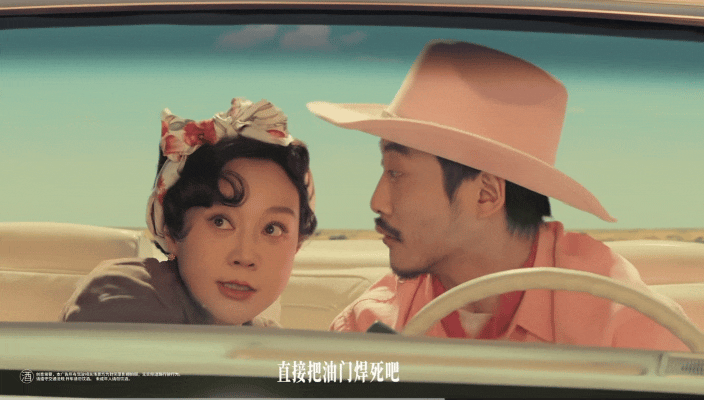
For example, this year’s RIO Spring Festival short film uses a plot line titled “The New Year Escape” and pays homage to movies (Barbie). It lets the “kidnapper” Zhang Xingchao, with “hostage” Yan Ni, dodge annoying relatives and discard everyday hassles along the way, so they can live a “free and easy Spring Festival” together. Besides capturing hearts with the theme of escaping “New Year anxiety,” Zhang Xingchao and Yan Ni’s casting also adds a lot: the former has his own niche brand of nonsense comedy, while the latter is widely recognized in the domestic entertainment industry as the “tipsy ambassador.” Their personalities align closely with RIO’s products and marketing scenarios, and netizens praised the casting as “casting perfection.”
RIO × Zhang Xingchao, Yan Ni Spring Festival short film | Source: Video account
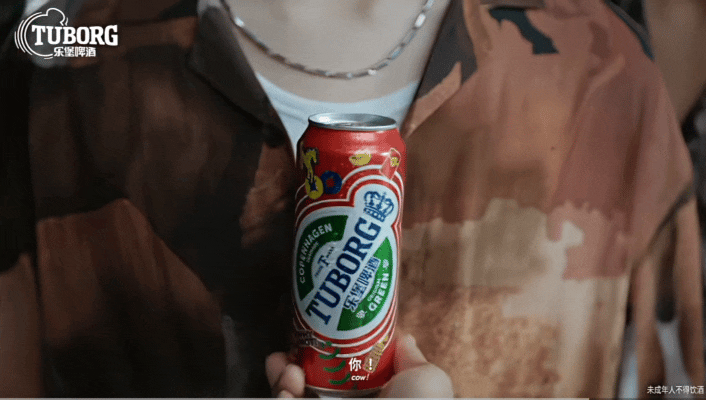
A short film co-produced by Leibao beer and Wang Mian uses the latter’s persona of “a mouthpiece for working people.” It adopts a theme of “reverse performance review,” letting Wang Mian roast the boss for drawing big promises, the relentless early mornings (every day’s 8 a.m.), constant PPT remakes, and other workplace pain points. Naturally, it also highlights Leibao beer’s selling point—relaxing and decompressing—turning the value of a comedian persona into a brand communication asset.
Comedy stars carry relatively fewer idol burdens. Their friendly, down-to-earth image naturally allows for a more tolerant public opinion. So even if they push the meme boundaries a bit and complain more sharply, most netizens will feel, “Yes, that’s exactly the kind of thing they can do,” making it less likely to trigger resentment.
Leibao × Wang Mian “Reverse Performance Review Report” | Source: Video account
Second, piggybacking on hot internet memes is also a high-efficiency approach with inherent distribution advantages—it helps brands catch a “traffic windfall ride.”
Homophonic memes, plot memes, role memes, and more—all are ready-made marketing entry points. Brands can directly reuse them. What’s more, memes themselves originate from users’ collective creation and are the most familiar shared context across the entire internet. As long as the brand integrates them appropriately, users can understand at a glance—an inexpensive shortcut to enter the “inside” of a community.
For example, the collaboration between China Mobile and Wang Yaoting pushes the role-meme concept to the extreme. Using Wang Yaoting’s “national Uncle” label, it crafts the slogan “A good ‘Uncle’ picks Mobile,” tailored to the role. The ad also blends Wang Yaoting’s signature “wobble dance,” aiming for something simple, easy to remember, and with built-in punchlines.
China Mobile × Wang Yaoting | Source: Official account on WeChat Video Channel (video account)
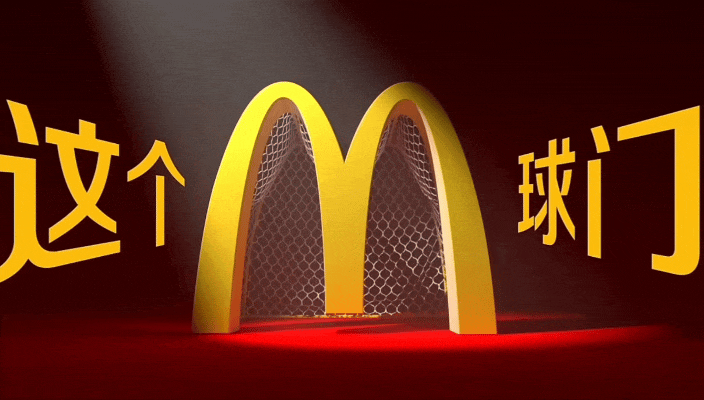
When McDonald’s collaborates with Xiang Zuo, it fully leverages the power of mashing up memes. By piggybacking on the World Cup’s trending spotlight, Xiang Zuo plays a goalkeeper guarding the “Golden Arches,” paired with the catchy lines “Kick left, kick right, kick it into the Golden Arches.” After making saves, he even adds the classic “nose-fixing” cool pose. In a single ad, homophonic memes, sports hotspots, and the actor’s personal memes are all fused together—every element hits a specific audience.
Once a brand learns to talk with users using memes they’re already familiar with, it creates a sense of closeness—“it even understands this.” It also makes it easier to spark users’ spontaneous discussions and second creations, producing an additive effect on traffic.
McDonald’s × Xiang Zuo | Source: Video account
If the key to the first two playstyles is to ride on existing momentum, then contrast-based abstraction manufactures impact through “violating expectations.”
Breaking fixed expectations is one of the most classic logics in comedy creation. It can grab viewers’ attention immediately, and it can also use the bewilderment caused by contrast to form stronger memory points. Moreover, unlike collaborations with comedians or meme-mixing that can only develop around existing resources, the forms that create contrast are more diverse and creative freedom is higher—giving brands ample room to play.
The most common approach is self-deprecating contrast: using a light, witty tone to dismantle serious topics.
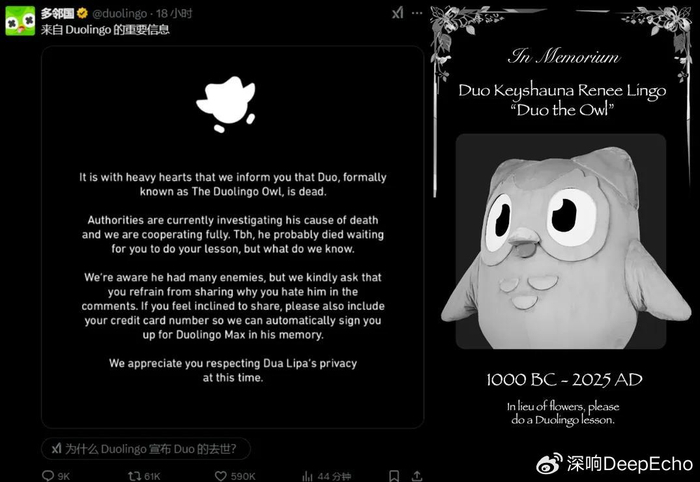
Duolingo is a veteran player in this area. Besides the Luckin “marriage” incident mentioned earlier, it also officially announced that its account “died,” and then immediately “revived on the spot.” It’s really mocking the way users often abandon their check-ins midway, and dissolves the boredom of studying with self-deprecating humor. To introduce a new logo, Duolingo also held a “grand funeral” for its old “owl” logo—no wonder fans joked that “Duolingo is always on the road to various kinds of deaths, just like me while studying.”
Duolingo holds a “funeral” for its former logo
Narrative contrast is also very common—“saying nonsense in a very serious way” always brings people unexpected surprises and emotional hits.
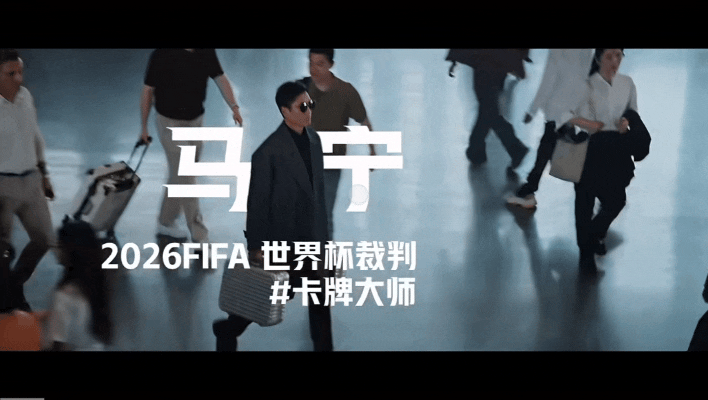
For example, the ad collaboration between Mengniu and Ning Meng (Ma Ning). By borrowing the story shell of a spy thriller and having Ma Ning set off for the World Cup with a “mysterious suitcase,” “agents” go through huge effort trying to swap the red and yellow cards inside—only to find that what’s actually in there is Mengniu’s soft milk. The contrast between a serious narrative shell and a nonsensical core, plus references to hot memes like “Ma Ning doesn’t have a soft spot” and “Card Master,” naturally leaves a deep impression.

Mengniu × Ma Ning | Source: Video account
And then there’s the cognitive contrast in personas: an old-artisan type playing with memes, a tough guy acting cute, and a radical makeover of an artsy goddess—these are all classic brand moves.
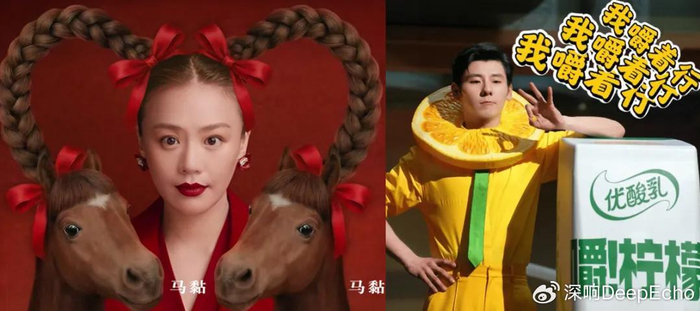
Hanshu and Ma Sichun’s Spring Festival TVC uses a magical claymation style paired with the brainwashing ad line “Ma sticks to Ma Sichun,” along with double ponytail looks—completely overturning Ma Sichun’s past artistic image. U-Style Plus, on the other hand, has Jiang Qiming—who plays the role of a “melancholic leading man”—act as a lemon and debate whether “lemon is a fruit or a seasoning,” dismantling the theme of “prejudice and labels” through seemingly abstract storytelling, while also delivering the product selling point of “eat the lemon by chewing it.”
Hanshu × Ma Sichun, U-Style Plus × Jiang Qiming | Source: Weibo
Overall, it’s not hard to see that these “three axes” of abstract marketing work because—at their root—they precisely hit the pain points in brand communication right now.
First, it dissolves the “authoritative, condescending” vibe of traditional advertising. Young people hate preaching the most. When a brand stops trying to educate users from a position of superiority and instead drops its posture to play along with users, using shared language to get closer, it can earn genuine recognition from users.
Second, it reduces the risk of trial-and-error. Comedian “ordinary viewers” appeal and meme-driven traffic have already laid the foundation for distribution. Plus, abstract marketing conveys a relaxed, easygoing atmosphere, leaving room for emotional buffering. So as the saying goes, “you don’t slap someone who’s smiling.” Even if the content quality varies a bit, users won’t be overly harsh.
Third, it naturally fits a fragmented communication environment—whether it’s exaggerated styling, highly contrast-filled plotlines, or a simple-to-remember slogan, all act as typical “memory anchors.” Users can catch the core after only a few seconds of scrolling. This fully matches today’s communication logic and users’ information-receiving habits.
After the excitement,
What else can abstract marketing leave behind?
Yet while abstract marketing comes with “tons of traffic,” fundamentally it’s still a double-edged sword where benefits and risks coexist: if played well, it becomes a masterpiece; if played badly, it could easily turn into a disaster.
Especially when the entire industry treats “doing abstraction” as the standard marketing answer, and everyone rushes into the same track, side effects like homogenized aesthetic fatigue, misjudged boundaries, and the difficulty of balancing traffic with retention start to surface all at once.
First is severe homogenized over-involution.
Once a celebrity becomes famous, a wave of brands will rush in to collaborate. Once a hot meme is popular, it gets reused again and again—these are industry norms.
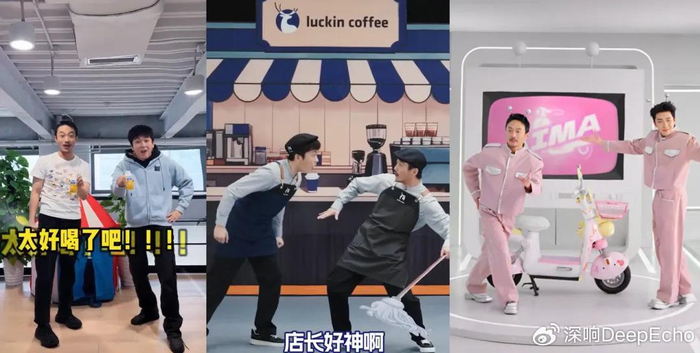
For example, after (The Wonderful Night of the Funny Ones) (shortened as (Funny Ones)) became popular, business collaborations for the show’s popular contestants surged. Zhang Xingchao and Li Ka-shing—this hot CP—appeared one after another in commercials for Luckin Coffee, Amul (Anmuxi), Aima electric vehicles, Unilever/舒肤佳 (Safeguard) and more, repeatedly paying homage to show highlights like “singing and dancing,” “bang bang bang,” and “my brain hurts so hot it’s burning.”
When similar content is mass-produced and pushed to the market within a short period of time, it not only intensifies users’ aesthetic fatigue and raises the threshold for humor, it also completely erases the memorability brought by contrast—making it increasingly hard to spark users’ enthusiasm for discussion.
Zhang Xingchao, Li Ka-shing × Amul (Anmuxi), Luckin Coffee, Aima (electric bikes) | Source: Weibo
Precisely because of this, many brands have started taking unconventional routes—constantly amplifying the content’s boundaries to chase off-corner virality. This, in turn, intensifies the problem of imbalance in those boundaries and standards.
The phenomenon of memes going wrong is increasingly common in recent years. Either they go too hard—ads and copy become overly abstract, sliding into vulgar parody; or they adopt the wrong perspective. The original intention is to please young people, but it ends up offending them.
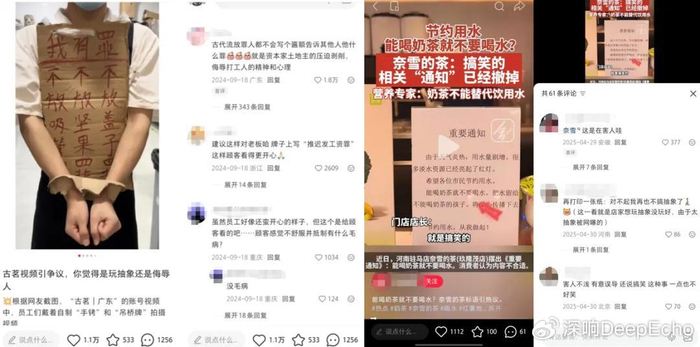
For instance, Guming had store staff wear handwritten “apology cards” around their necks, and used cup holders shaped like handcuffs to stage a skit in which they “apologize” to consumers—this precisely hit those pitfalls, got heavily criticized for “turning workers’ dignity into traffic,” and forced the brand to step in with a “real, genuine apology.” Naixue also faced mockery over its “water-saving” copy: “Given that the weather is hot and water usage increases, we hope citizens can drink milk tea instead of water.” Some netizens even complained, “The person who issued the notice must have drunk too much milk tea and messed up their brain.”
Guming’s “apology” video, Naixue’s “water-saving notice” gets mocked | Source: Xiaohongshu
The reason brands keep bouncing in and out of users’ “minefields,” at the root, is that ordinary abstract marketing has been overrun and exhausted—when conventional safe choices are no longer reliable, you can only bet on traffic with even bigger boundary pushes. That’s why tea-and-coffee brands in fierce competition crash more often.
However, abstraction isn’t an all-powerful “get-out-of-jail-free card.” Many things can’t be brushed off with just “it’s just a joke.” On the contrary, the red line of online public opinion is always changing. The emotional boundaries of different groups switch repeatedly. Testing that red line is like dancing on a tightrope.
If a brand only sees the meme’s popularity but ignores the negative meanings behind it and the boundaries of what’s acceptable, then at its core it’s still thinking in opportunistic, formula-based ways—quietly increasing the risk of backlash.
But an even more common problem than “going wrong” is that the marketing stays on the surface—earning cheers, yet failing to leave behind lasting mindshare.
From the perspective of communication studies, memes with built-in topic attributes always have more penetration than abstract content like product selling points and brand value—and they’re also easier for users to remember. This can easily lead to focus drift: after one marketing campaign, brainwashing ad slogans go viral, and the meme gets played to death by netizens—but users don’t actually remember the product’s core selling point or what the brand’s philosophy really is.
You have to know that the life cycle of internet hot memes is extremely short—many times it lasts only one or two weeks. Audiences drawn in by playing with abstraction are also mostly “just here for fun” people, making it difficult to convert them directly into a brand’s long-term users. If, after a burst of excitement in marketing, neither clear mindshare cognition is established nor long-term trust is built with users, then at its core it still escapes the traffic trap of “getting buzz but not winning hearts.”
The key to solving this problem lies in stepping out of a single-campaign mindset and turning “abstraction” from a marketing technique into a unified, complete brand personality.
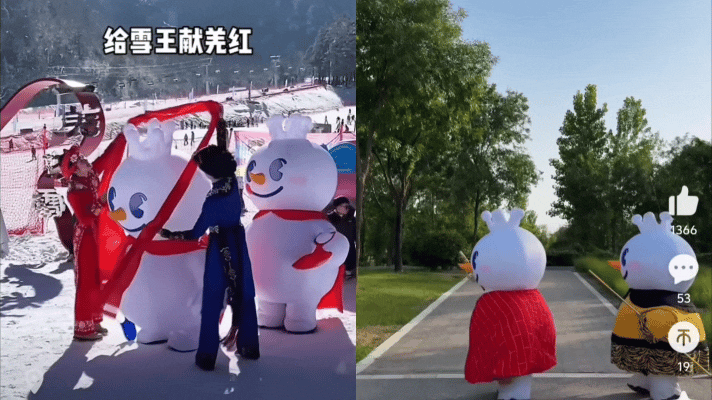
Mizxue Bingcheng is the textbook example of embedding abstraction into the bones. From the earliest creation of the “Xue Wang” IP and the release of its catchy, brainwashing theme song, to recent years’ consecutive planning of “Xue Wang Goes Down to the South of the River,” “Xue Wang Fights Xue Wang,” and even “Xue Wang Cosplays the Four Disciples of Tang Monk,” all its actions revolve around the unified abstract character persona of “Xue Wang,” consistently matching the brand’s friendly, down-to-earth tone.
Over time, what users remember is no longer some single standalone abstract scenario or a trendy meme. Instead, it’s the distinct IP “Xue Wang” (Snow King). Abstraction then becomes part of the brand’s DNA, ultimately consolidating long-term, stable mindshare assets.
Mizxue Bingcheng’s “extra content” (doing antics) | Source: Bilibili
As you can see, whether abstract marketing succeeds isn’t measured by simple buzz alone, and not every brand is suited to play with abstraction.
Abstract marketing really is a shortcut for today’s brands to quickly pry open the floodgates of attention. With a more equal stance and language closer to users, it lowers the communication barrier between brand and audience. But if you treat playing memes and doing abstraction as the entirety of marketing, then after the excitement fades, chances are you’ll be left mostly with momentary laughter—without much of lasting value.
At the end of the day, abstraction is never the goal—it’s merely a communication method. Truly valuable abstract marketing isn’t abstract for abstraction’s sake. Instead, it uses playful expression as a wrapper to convey the brand’s clear core to users. Only when the abstract visual style and the brand’s internal temperament form a unified cognition can that burst of traffic have a chance to convert into lasting mindshare.