


Original author: IGNAS
Original translation: TechFlow
Introduction
In 2024, the field of restaking has exploded and has become a major trend in the DeFi field. This article will analyze the restaking mechanism of EigenLayer and the application cases of AVS. In addition, the article will also introduce different types of AVS, such as Ethos, AltLayer, Espresso, Omni, etc., and analyze their characteristics and functions.
text
Mark my words: restaking is the fastest growing sector in 2024. Restaking is the 9th largest DeFi category with $2B TVL on EigenLayer alone.
Don’t forget liquidity re-staking, which ranks 13th and has reached $1 billion.
With the launch of the first Active Validation Service (AVS) token ALT, and EigenLayer opening deposits on February 5th, now is the time to track all the developments in this space.
I will briefly explain re-staking on EigenLayer and will introduce emerging use cases of AVS enabled by re-staking.
EigenLayer will open for deposits on February 5th. Here’s what you need to know.
They have modified their points system to encourage decentralization and decentralization by capping single deposits and LST/LRT allocations at 33%. Currently no single LST/LRT has reached the 33% cap.
Swell and EtherFi offer double points via native token airdrops. My approach is to diversify across different LST/LRTs to achieve a balanced accumulation of points and risk.
Regarding the LRT competition, I am hedging my bets on a few projects:
EtherFi: This is the leading LRT with 51% of the LRT market share. Use my referral link to get an extra 1000 EtherFi points per ETH and double points on partnered DeFi protocols.
Kelp DAO: Earn Eigenlayer points and KelpDAO miles by re-staking stETH or ETHx.
Renzo: Same as EtherFi, uses Eigenpods for native ETH re-collateralization.
Swell: You can deposit ETH to get swETH LST and stake it on EigenLayer. Or deposit rswETH LRT directly.
Eigenpie: Eigenpie has $100 million TVL, supports 6 LSTs, and provides double points in the first two weeks. These points are used for 10% EGP token airdrops and 60% EGP token IDOs with $3 million FDV to incentivize early user participation.
Re-stake: ELI 5
Back in September 2023, I wrote in detail about restaking and staking Liquid Restaked Tokens (LRT). But a lot has changed since then. There are now multiple LRT protocols on mainnet, and things are heating up with AltLayer launching a token.
Many people are still confused about re-staking and often over-complicate it.
In simple terms, it allows you to stake (bond) your ETH for various Active Validation Services (AVS) to enhance the security of your chosen protocol. This includes services such as bridges, oracles, and sidechains, with more innovative concepts on the horizon.
For example, Optimism and Arbitrum can bypass the 7-day fraud proof window and enable instant withdrawals as long as there is enough economic security (ETH in this case) to support the withdrawal.
These insured bridges guarantee full redistribution in case of validator errors. You redeposit your ETH to an insured bridge AVS, and in case of a validator error, you may lose some ETH. (As it stands, insured bridges do not protect you in case of smart contract bugs).
You can re-stake ETH directly or through liquid staking tokens such as stETH, rETH, cbETH, etc. EigenLayer has added LST sfrxETH, mETH and LsETH in this round.
Benefits of re-staking:
Multi-protocol rewards: Earn income from multiple protocols using the same ETH
Improved security: Leverage Ethereum’s security to implement new protocols
Developer freedom: No need to build new security layers, saving developers time and resources
Risks of re-staking:
Slashing Risk: Increased risk of losing staked ETH due to malicious activity
Centralization risk: If too many stakers move to EigenLayer, it may pose a systemic risk to Ethereum
Smart Contract Risk: Like Everywhere Else in DeFi
I believe the risk is limited at this point, as Eigenlayer is still in phase 2 testnet and permissionless AVS deployment is not enabled. I agree with ChainLinkGod that while the risks will mostly be ignored, at least we will be OK until 2025.
On the current Phase 2 testnet, re-stakers like you can delegate to operators. These operators validate AVS. So, you are not re-staking directly into AVS!
EigenDA (Data Availability) is the first AVS in Phase 2. Rollups can integrate it to increase throughput. Phase 2 mainnet will launch in the first half of 2024, and Phase 3 will launch later in 2024 with more AVS.
You can actually check out how operator delegation works on the Goerli testnet. Follow the guide here to get some goerliETH and exchange it for stETH. Then go to the Eigenlayer testnet page and deposit stETH. Then select an operator running EigenDA AVS.
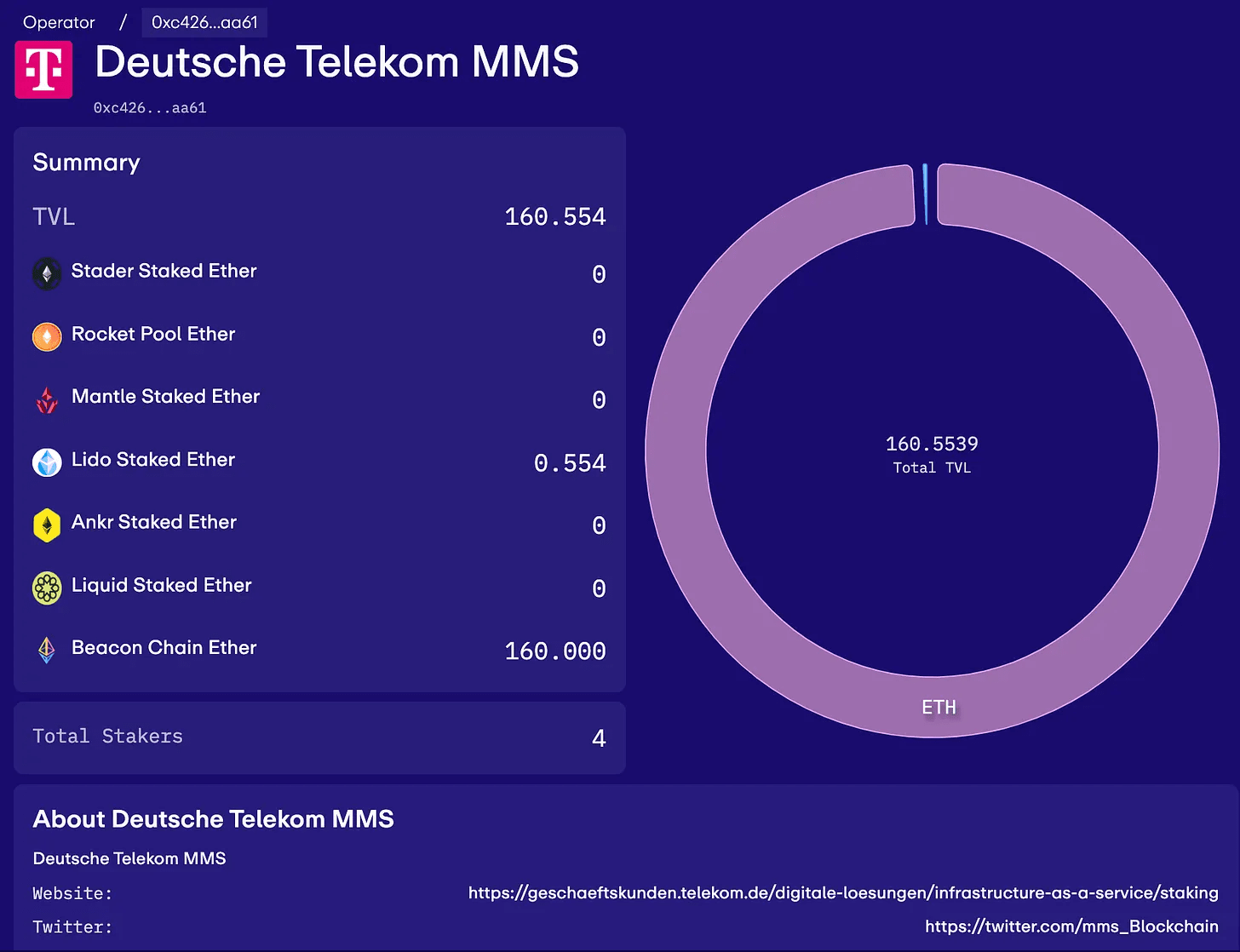
Interestingly, among the many operators, one stands out: Deutsche Telekom. It looks like Telekom will use Eigenlayer for its staking services.
Anyway, are you ready to manually select AVS and operators on mainnet yourself? Considering the high gas fees? And then collect rewards from AVS? And then sell the rewards for more ETH to compound interest? If you are not extremely wealthy, I think the gas fees here will be high.
I’m sure you can guess what I’m going to talk about next: Liquidity Re-collateralization Token (LRT). But more about LRT in the next article. For now, let’s focus on the use case of the new token that AVS will airdrop to us.
The first AVS is EigenDA, but I won’t go into detail as I doubt it will have a separate token (it’s a data availability layer for Rollups to save on data storage fees).
Active Authentication Service
Don’t be fooled by the name. AVS is a fully functional protocol that uses re-collateralized ETH to power its functionality. I mentioned the “insurance bridge” above, but the scope and impact of AVS will become more apparent soon.
I will introduce 7 AVS in very simple language in this blog. Because if we invest ETH into the Restake ecosystem, we need to understand AVS.
Ethos: Bringing ETH to the Cosmos securely
Ethos brings the economic security and liquidity of Ethereum to Cosmos.
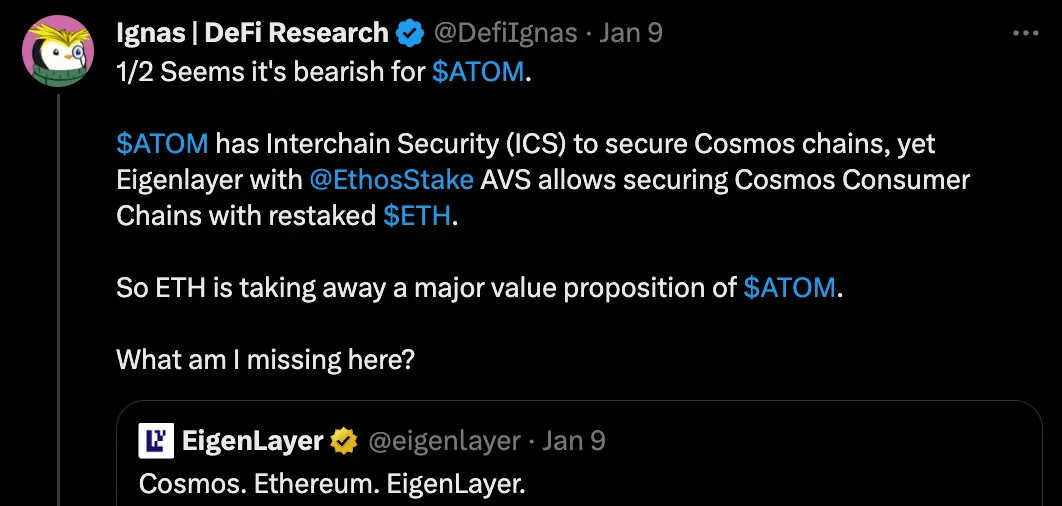
The so-called Cosmos Consumer chain typically issues its native staking token to secure the network. However, this introduces more complexity and inflationary token economics. While Cosmos ATOM stakers offer an Inter-Chain Security (ICS) solution, the Ethereum ecosystem, through Ethos and re-staking, is now expanding into Cosmos itself.
Coupled with Dymension, the ATOM fork, and now the launch of Ethos, ATOM seems to be under a lot of pressure.
Ethos is inspired by Mesh Security (allowing staked tokens from one chain to be used on another chain), thereby enhancing economic security without the need for additional nodes. More details can be found in the Ethos blog post here.
Which security solution will win out depends on its adoption. Ethos is starting off strong.
The first partner is Sommelier, an automated yield farming provider with a TVL of $60M. I understand more Consumer Chains are coming soon.
The advantage of this structure is that ETHOS may receive partner chain token airdrops (and revenue). At the same time, the ETHOS token itself will be airdropped to re-stakers of ETH on Eigenlayer as part of our harvesting of EIGEN tokens.
All you need to do is stake ETH again and claim the airdrop.
AltLayer: Re-collateralized Rollup
I just introduced AltLayer in a previous article, so I won’t go into too much detail about its functionality in this article. You can check it out here.
But what you need to know is that AltLayer introduces three AVSs, which brings
Fast finality
Decentralized sorting
Decentralized Verification
The ALT token economics model is interesting because ALT must be staked along with re-staked ETH to secure the three AVS.
If you experienced the 2020 DeFi Summer, you will understand the Ponzi effect it can produce.
Currently, only 3% of the total supply has been airdropped to the community, but more are planned for the future. Initial circulating supply is 11%. Does a $4.3 billion FDV (at the time of writing) justify a protocol that no one had heard of just a few weeks ago?
Not too sure, but this makes me more bullish on the entire re-staking ecosystem.
Furthermore, I suspect AltLayer reserves liquidity mining rewards for re-stakers. As more AVS are launched, various services will compete to attract valuable ETH deposits. After all, AVS without any deposited ETH is worthless.
Espresso: A decentralized sequencer
Espresso is focused on decentralized sorters for Layer 2. As you know, L2 has been criticized a lot for the centralization of sorters. There is a great visualization of how Espresso achieves this using their HotShot consensus, which can be viewed on their website here.
AltLayer actually integrates with Espresso, so developers can choose to use AltLayer’s decentralized authentication solution and/or the Espresso sequencer to deploy on the AltLayer stack.
Omni: The blockchain that connects all Rollups
Problem: L2 reduces transaction costs, but leads to fragmentation of the ecosystem. This makes it difficult for developers to reach a broad audience, complicates the user experience, and disperses liquidity.
Bridges are also necessary, but bridges usually issue wrapped tokens, which poses risks. If the bridge is hacked, there will not be enough underlying assets to support the bridged wrapped tokens. As a result, the wrapped tokens will lose their pegs.
Solution: Omni
Omni is a “re-collateralized L1 blockchain” that aims to unify all of Ethereum’s rollups under one roof.
Omni introduces a “unified global state layer” that is secured through the restaking of the EigenLayer. This layer centralizes the cross-domain management of applications under one roof.
Use cases include:
Cross-rollup margin accounts and leveraged trading: post margin on one domain and trade using that margin on another domain
Cross-rollup NFT minting
Cross-rollup lending: deposit collateral on one domain and borrow collateral on another domain
There’s a lot more, but does this sound familiar? That’s what LayerZero does.
LayerZero’s cross-chain messaging enables Omnichain fungible tokens (OFTs) instead of wrapped tokens. Manta’s STONE token is an ETH OFT, and LayerZero issued Lido’s wstETH OFT.
But what if there’s a vulnerability in the LayerZero messaging system? Well, Omni secures it with re-staked ETH, which can be confiscated if a validator misbehaves.
Consider a regular speculative degen who wants to use his ETH on Arbitrum to obtain a USDC loan on Optimism. The degen's transactions on Arbitrum are monitored by Omni validators who ensure the integrity of the data transmitted to Optimism. These validators are incentivized through rewards and deterred by the risk of losing their staked ETH for false reports.
LayerZero may use their token staking to secure cross-messaging, but if something goes wrong with the LayerZero contracts, the token will go down and that security is useless. ETH is an asset that is much harder to secure from outside the system.
Competition is heating up for LayerZero
Injective is partnering with Omni to make $INJ the first asset on the Omni Open Liquidity Network. Omni is issuing xERC 20 INJ tokens, bringing INJ into the Ethereum rollup ecosystem.
Omni is backed by $18 million from big-name investors like Pantera Capital, Two Sigma Ventures, and Jump Crypto. So, I’m guessing it’ll do well.
Hyperlane: Similar to Omni, but better
You think Omni is great at connecting Ethereum Rollup? But Hyperlane seems to be even better. Because Hyperlane's goal is to connect all L1 and L2.
Using Hyperlane, developers can build cross-chain applications — applications that span multiple blockchains, using cross-chain messaging, secured by its modular security stack that includes the Cross-Chain Security Module and re-staked ETH.
Judging from the documentation, Hyperlane will support Ethereum L2, Cosmos ecosystem chains, Solana, Move-based chains, etc.
Hyperlane’s permissionless interoperability is what makes it unique, as Rollups can connect to Hyperlane on their own without the need for cumbersome governance approvals etc. They are pretty proud of this, as you can see from the tweet below. However, LayerZero v2 appears to allow permissionless deployments as well.
Unfortunately, I can’t find any token information for Omni or Hyperlane at the moment.
The Blockless: Powering dApps While They’re Being Used
In ordinary dApps, we cannot directly contribute computing power, and applications are limited by specific L1 or L2 capabilities, such as latency, transaction speed, gas fees, etc.
Therefore, Blockless adopted network neutral applications (nnApp), allowing users to power applications simply by using them. It uses "nested nodes", where each user's device acts as a node, contributing its resources to the network. This means that the computing power of the application scales as the user base grows, which is a major shift from the traditional model.
In short, you run a node while using your application.
Blockless login page
For example, some dApps may choose to keep governance on Ethereum and data availability workloads on Celestia or EigenLayer. But intensive computational work for use cases like machine learning, AI interfaces, and gaming will be performed in faster, more efficient off-chain environments.
This results in the computational support for these applications scaling directly with the number of users, with more users meaning more computational power provided by the community.
This brings me to Grass, an application on Solana that sells idle internet bandwidth to train AI, although it is not part of Blockless.
Blockless uses proof of stake to secure its network, so the token is more than just a meme.
As for re-staking, Blockless will provide its network to applications built on EigenLayer to minimize accidental slashing.
other
You can see a full list of all AVS on the Eigenlayer website. Worth mentioning:
Lagrange: Another LayerZero, Omni, and Hyperlane competitor, its cross-chain infrastructure is able to create universal state proofs across all major blockchains. Recently raised $4 million in seed funding from 1kx and others.
Drosera: An “incident response protocol” for controlling vulnerabilities. When a hack occurs, Drosera’s traps detect it and take action to mitigate the attack.
Witness Chain: Uses re-staking for Proof of Diligence and to ensure the security of the rollup, and uses Proof of Location to establish physical node decentralization.