last angle i had queued up this week, and its one i think is actually important for being fair to the tradeoffs here - how does TBV compare to DLCs (discreet log contracts), since thats an older and simpler bitcoin collateral model that a lot of people already know about.
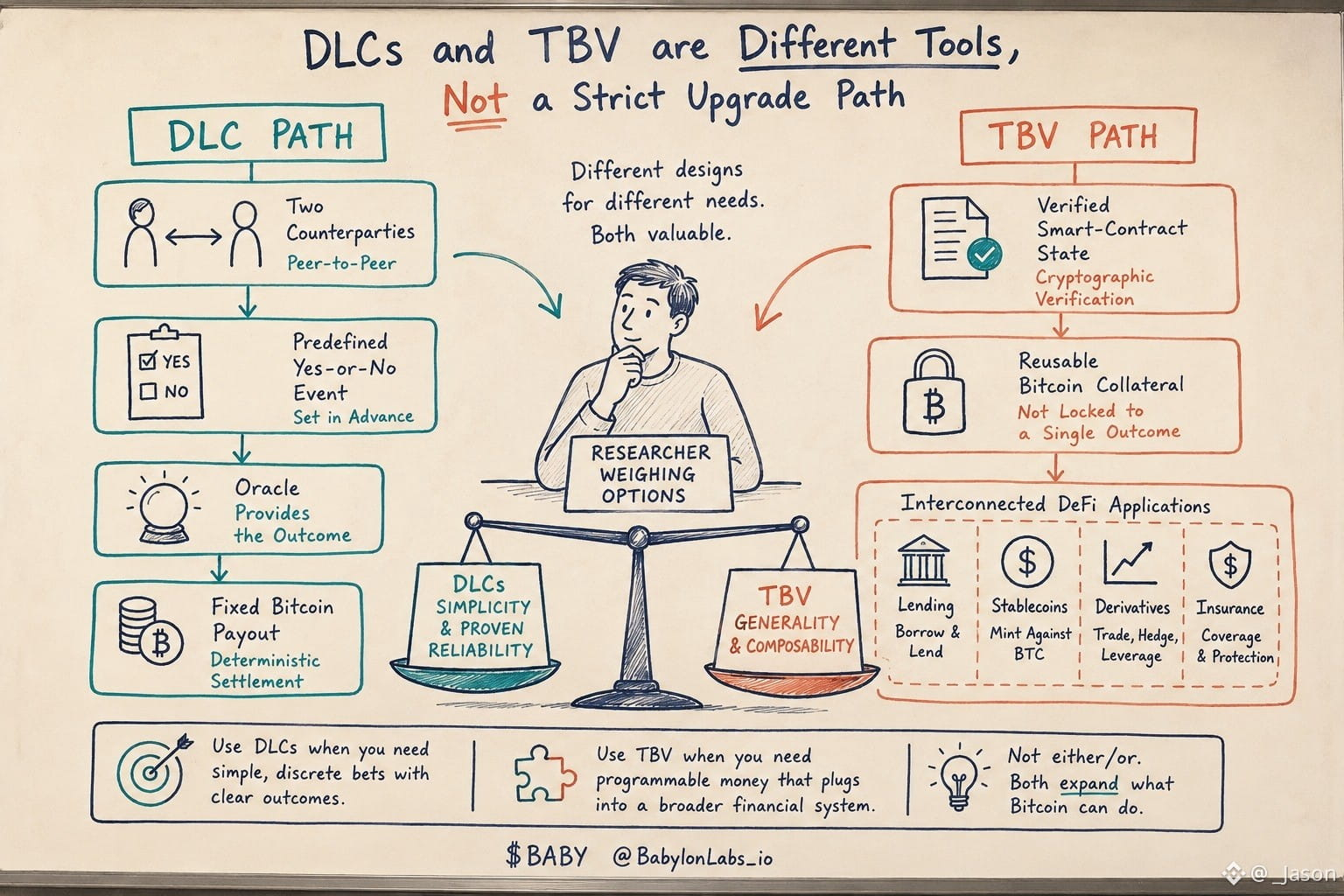
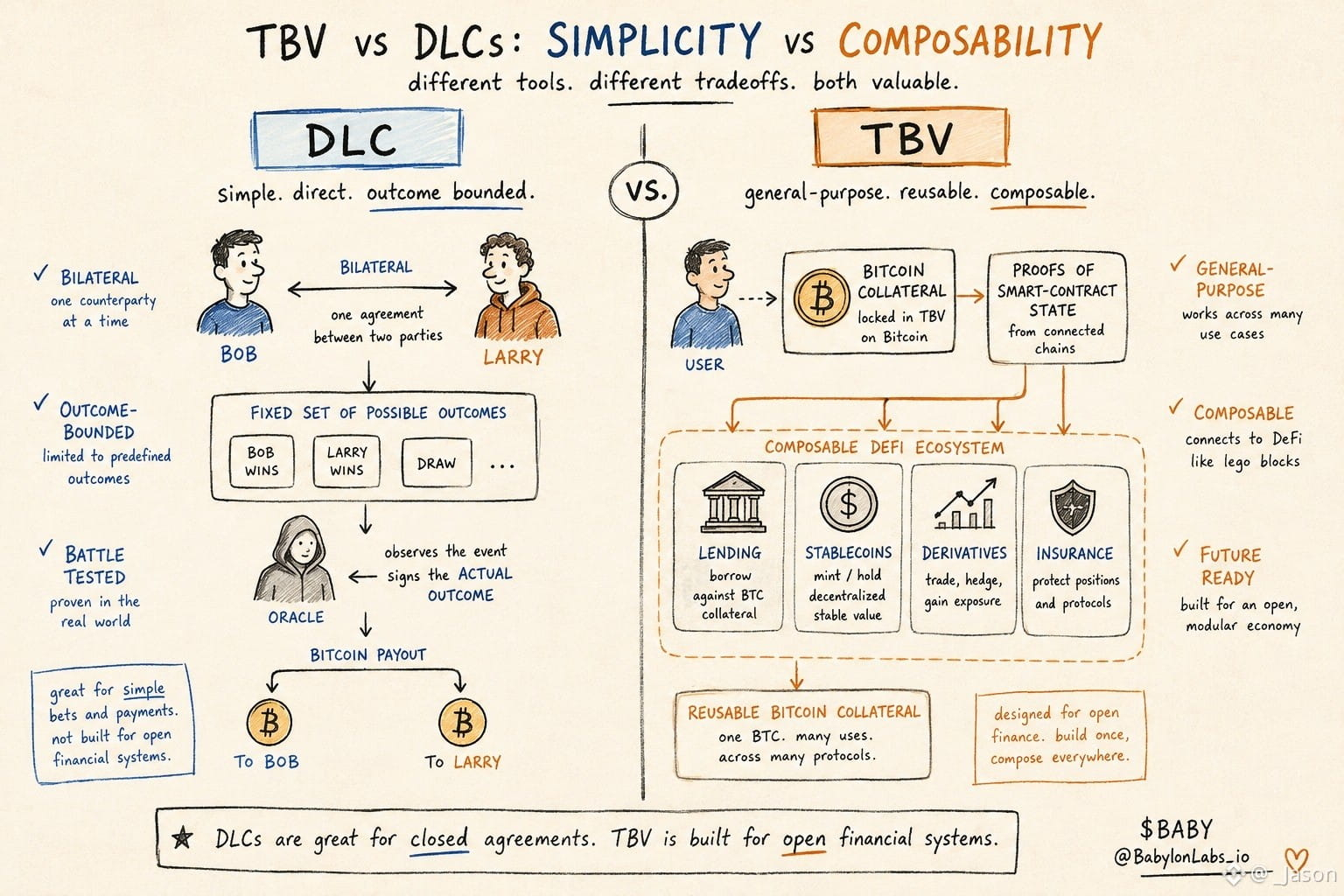
a DLC at its core is a two party contract. bob and larry agree in advance on a set of possible outcomes, an oracle later signs whichever outcome actually happened, and that signature is what determines how a pre-agreed bitcoin payout gets split between them. its been around a while, its relatively simple to reason about, and its genuinely battle tested compared to something like TBV which is still moving through testnet.
so wheres the actual difference in what each one can do. a DLC is fundamentally bilateral and outcome-bounded - its bob and larry, agreeing to a fixed set of outcomes decided upfront. it works great for things shaped like "did event X happen, yes or no, pay out accordingly." what it doesnt really do is general purpose programmability, or letting the same bitcoin serve as collateral across multiple different applications without renegotiating a brand new contract each time.
TBV is going for something structurally different - collateral thats usable across a broader defi surface (lending today, stablecoins/derivatives/insurance mentioned as future directions), verified through proofs of actual smart contract state rather then a fixed pre-agreed outcome set between two named parties.
im trying to be honest here rather then just pitching TBV as strictly better - DLCs being simpler and more proven is a real advantage, especially for something narrowly bilateral. TBV is trading some of that simplicity for generality and defi composability. different tools shaped for different problems, not a strict upgrade path from one to the other.
thats the full set of angles i had lined up from the docs and whitepaper this week.
#baby $BABY
@BabylonLabs_io
a DLC at its core is a two party contract. bob and larry agree in advance on a set of possible outcomes, an oracle later signs whichever outcome actually happened, and that signature is what determines how a pre-agreed bitcoin payout gets split between them. its been around a while, its relatively simple to reason about, and its genuinely battle tested compared to something like TBV which is still moving through testnet.
so wheres the actual difference in what each one can do. a DLC is fundamentally bilateral and outcome-bounded - its bob and larry, agreeing to a fixed set of outcomes decided upfront. it works great for things shaped like "did event X happen, yes or no, pay out accordingly." what it doesnt really do is general purpose programmability, or letting the same bitcoin serve as collateral across multiple different applications without renegotiating a brand new contract each time.
TBV is going for something structurally different - collateral thats usable across a broader defi surface (lending today, stablecoins/derivatives/insurance mentioned as future directions), verified through proofs of actual smart contract state rather then a fixed pre-agreed outcome set between two named parties.
im trying to be honest here rather then just pitching TBV as strictly better - DLCs being simpler and more proven is a real advantage, especially for something narrowly bilateral. TBV is trading some of that simplicity for generality and defi composability. different tools shaped for different problems, not a strict upgrade path from one to the other.
thats the full set of angles i had lined up from the docs and whitepaper this week.
#baby $BABY
@BabylonLabs_io