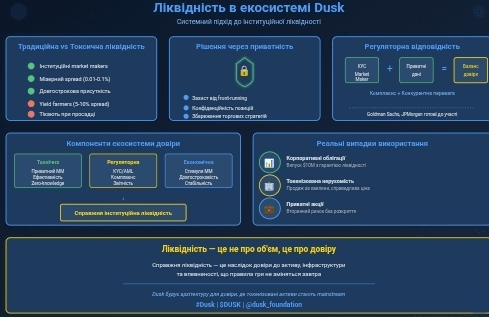
When I first started trading cryptocurrencies, I was most surprised by the spread. You buy Bitcoin — one price, you sell it a second later — already 0.1% less. And this is for the most liquid asset in crypto. Try selling some DeFi token with a market capitalization of $50 million — the spread can be 5%, or even 10%. This doesn't happen in traditional finance. Corporate bonds trade with a minimal spread, blue-chip stocks do too. Why? Because there are market makers, institutional players, regulatory guarantees. There is trust that you are not buying air and that tomorrow someone else will also want to buy it. When I started to understand how @Dusk approaches the liquidity problem for tokenized assets, I realized: they are not building an exchange, they are building a trust ecosystem that makes liquidity possible.
Most crypto projects think about liquidity primitively: "Let’s launch a pool on Uniswap, offer a high APY for farmers, and liquidity will come." And it does come, but it’s toxic liquidity — mercenaries who flee at the first dip. For tokenized real assets on $DUSK such an approach does not work. Imagine a tokenized corporate bond worth $10 million. Who will be the market maker? Yield farmers? They don’t understand the credit risk of the issuer and are not interested in fundamental analysis. They need APY, not an asset. True liquidity for such instruments can only be provided by professional participants: financial institutions that understand the asset and are willing to quote it long-term.
But here’s the paradox: institutional market makers will not operate in a system where all their positions, strategies, and volumes are visible to competitors. On public blockchains, anyone can track large transactions, attempt to front-run them, and copy the strategy. This makes market making economically unfeasible or even loss-making. #Dusk addresses this through protocol-level privacy. A market maker can quote tokenized bonds without revealing their inventory, position sizes, or trading frequency. They are protected from front-running, from copying strategies, and from alpha theft. And this is what makes institutional market making economically rational on Dusk.
There is another aspect that is rarely discussed: regulatory requirements for liquidity. In traditional finance, there are rules about who can be a market maker, what capital requirements exist, and how to report to regulators. If you want Goldman Sachs or JPMorgan to become market makers for tokenized assets, they must comply with these rules. On anonymous DEXs, this is impossible. On the Dusk Foundation, it is possible: a market maker undergoes KYC, their activities comply with regulatory standards, while their trading information remains confidential from the public. This is a balance between compliance and competitive advantage.
Think about what will happen when true institutional liquidity appears on $DUSK . A corporation will be able to issue bonds and be confident that they can be easily sold on the secondary market. An investor will be able to buy tokenized real estate and know that if they suddenly need money, they will sell at a fair price in a matter of minutes. This is not speculative liquidity from yield farmers; it is fundamental liquidity from professional participants who understand the assets and work long-term. This is the kind of liquidity that turns tokenization from a concept into reality.
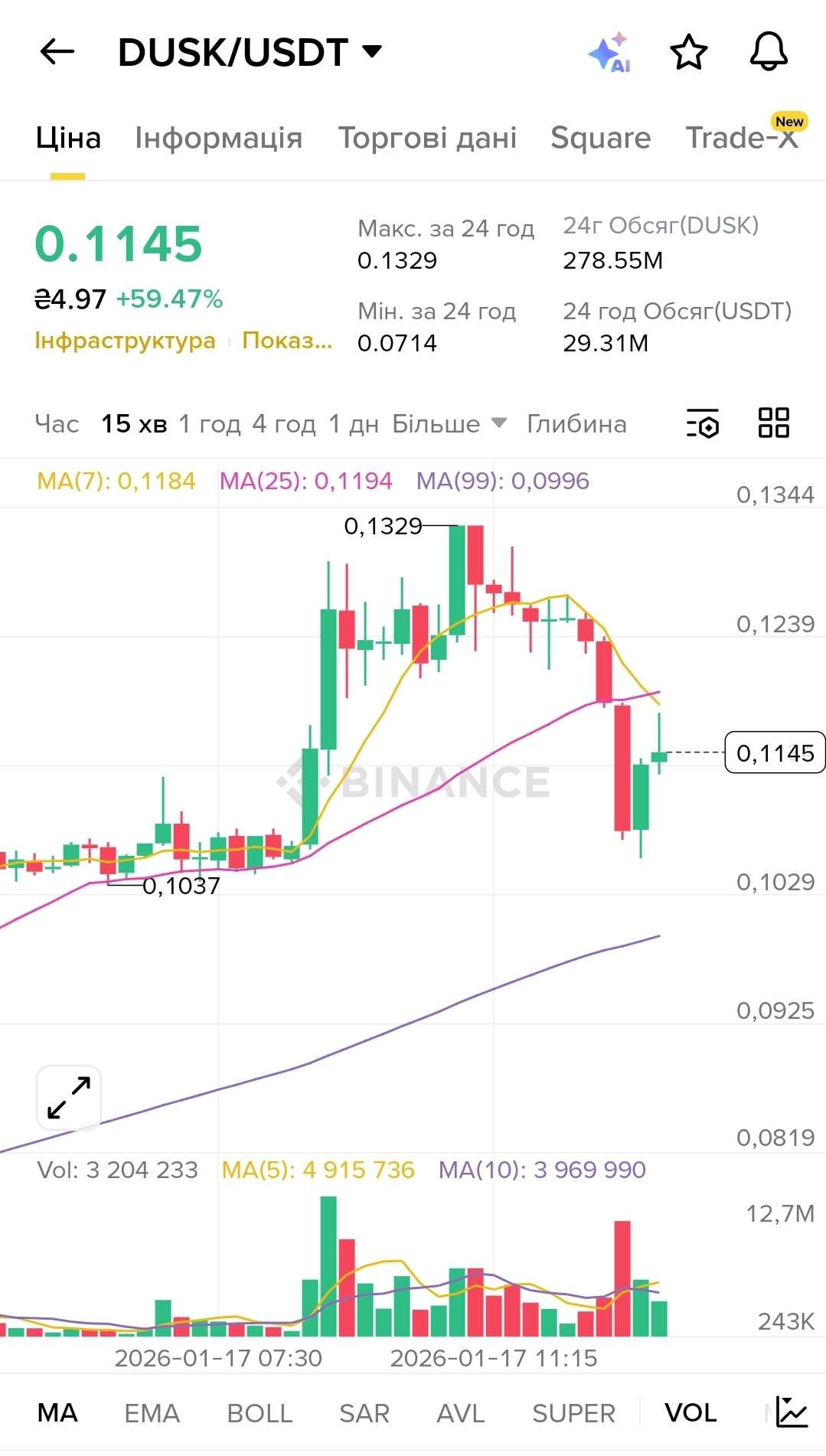
In my opinion, the biggest mistake in understanding liquidity is thinking that it appears by itself if you just create a token and a pool. True liquidity is a result of trust: trust in the asset, trust in the infrastructure, trust that the rules of the game won’t change tomorrow. Dusk builds all these components systematically: technical infrastructure for private and efficient market making, a regulatory framework for compliant participation of institutions, and economic incentives for long-term market makers. This is not a quick path; it’s the right path. And when tokenized assets become mainstream, liquidity will be where there is trust. And trust will be where there is architecture to support it.