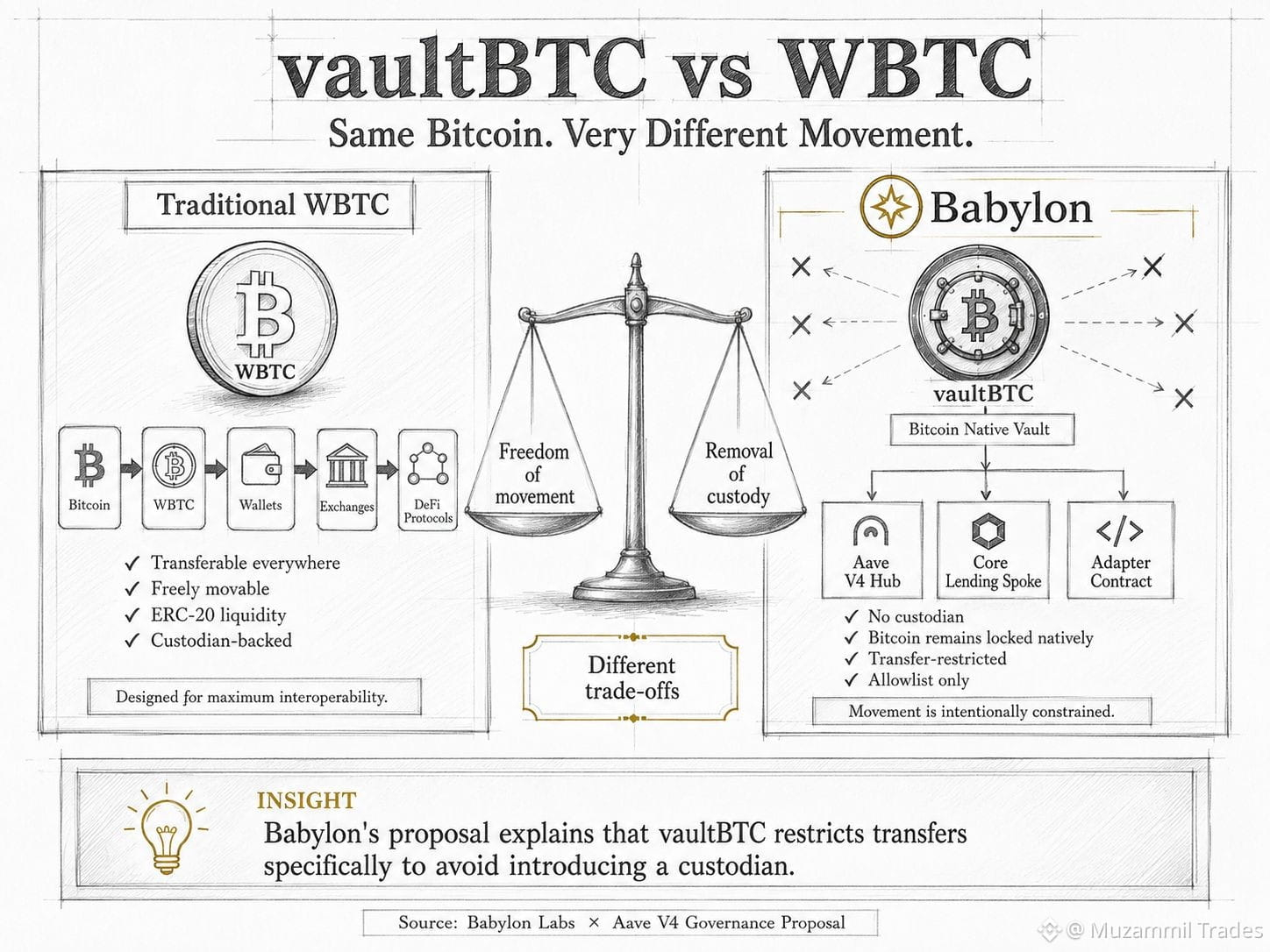
I went looking for how vaultBTC moves on-chain, expecting it to work like WBTC. It doesn't.
WBTC can move to any wallet, any exchange, any protocol.
That's part of what makes it useful, and part of what critics point to as the tradeoff: it's fungible because a custodian backs it.
@BabylonLabs_io Aave proposal describes a different token, vaultBTC, built to represent locked BTC without a custodian.
According to the proposal, vaultBTC is transfer-restricted: it can only move between three fixed destinations, the Aave V4 Hub, the Core Lending Spoke, and the integration's adapter contract.
Nowhere else.
The same proposal explains why: the restriction is what lets the vault skip a custodian in the first place. Removing the trusted third party meant constraining where the token could go instead.
One detail stood out. vaultBTC removes the custodian, but it also removes unrestricted transferability.
Does removing custody require giving up transferability?
@BabylonLabs_io #baby $BABY
WBTC can move to any wallet, any exchange, any protocol.
That's part of what makes it useful, and part of what critics point to as the tradeoff: it's fungible because a custodian backs it.
@BabylonLabs_io Aave proposal describes a different token, vaultBTC, built to represent locked BTC without a custodian.
According to the proposal, vaultBTC is transfer-restricted: it can only move between three fixed destinations, the Aave V4 Hub, the Core Lending Spoke, and the integration's adapter contract.
Nowhere else.
The same proposal explains why: the restriction is what lets the vault skip a custodian in the first place. Removing the trusted third party meant constraining where the token could go instead.
One detail stood out. vaultBTC removes the custodian, but it also removes unrestricted transferability.
Does removing custody require giving up transferability?
@BabylonLabs_io #baby $BABY