I found two lines in the a16z and Babylon announcements that looked aligned until I placed them side by side.
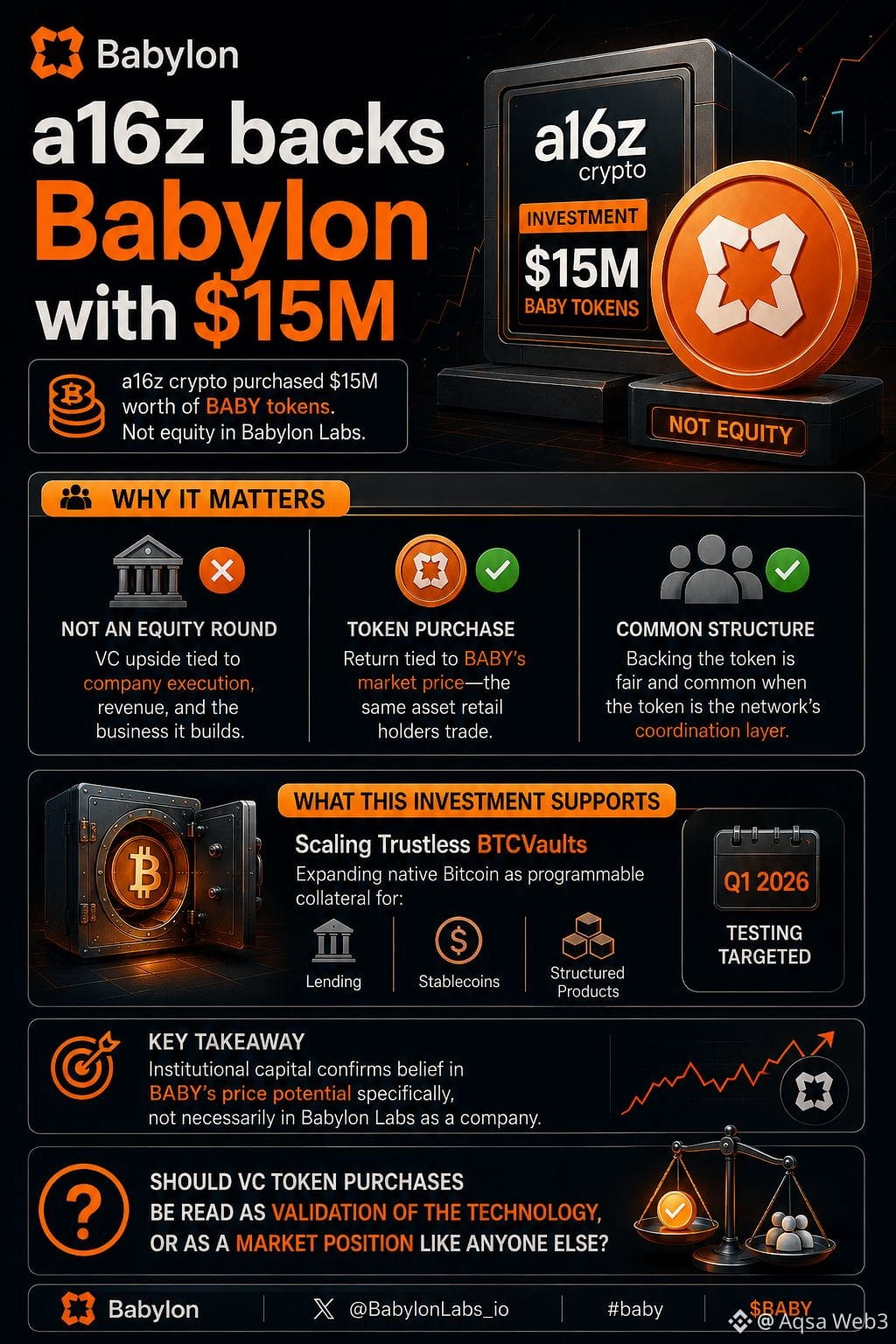
a16z crypto bought $15 million of $BABY while backing the development of @BabylonLabs_io Trustless BTCVaults.
Babylon's own framing was notable too: BTCVaults could create new utility and value capture for BABY, described as something the vault ecosystem will support going forward, not a mechanism already in place today.
That's the real tension.
Institutional capital entered the token before the mechanism linking BTCVault success to BABY value has been fully defined.
That doesn't make the investment weak. It makes it forward looking. a16z's thesis also backed Babylon's founders and broader vision for native Bitcoin collateral.
But token holders should separate two signals: a major investor believes BTCVaults can become important, versus BTCVault growth already creating measurable demand for BABY.
The investment supports the first. The second still depends on economic design that hasn't been completed yet.
Product adoption and token value don't automatically move together. The metric I'd watch isn't how many vaults launch, but what users or applications must actually do with BABY as that activity grows.
A $15 million token purchase confirms conviction.
It doesn't complete the economic link.
Should institutional backing validate today's token utility, or signal confidence that stronger value capture can be designed later?
@BabylonLabs_io #baby $BABY
a16z crypto bought $15 million of $BABY while backing the development of @BabylonLabs_io Trustless BTCVaults.
Babylon's own framing was notable too: BTCVaults could create new utility and value capture for BABY, described as something the vault ecosystem will support going forward, not a mechanism already in place today.
That's the real tension.
Institutional capital entered the token before the mechanism linking BTCVault success to BABY value has been fully defined.
That doesn't make the investment weak. It makes it forward looking. a16z's thesis also backed Babylon's founders and broader vision for native Bitcoin collateral.
But token holders should separate two signals: a major investor believes BTCVaults can become important, versus BTCVault growth already creating measurable demand for BABY.
The investment supports the first. The second still depends on economic design that hasn't been completed yet.
Product adoption and token value don't automatically move together. The metric I'd watch isn't how many vaults launch, but what users or applications must actually do with BABY as that activity grows.
A $15 million token purchase confirms conviction.
It doesn't complete the economic link.
Should institutional backing validate today's token utility, or signal confidence that stronger value capture can be designed later?
@BabylonLabs_io #baby $BABY