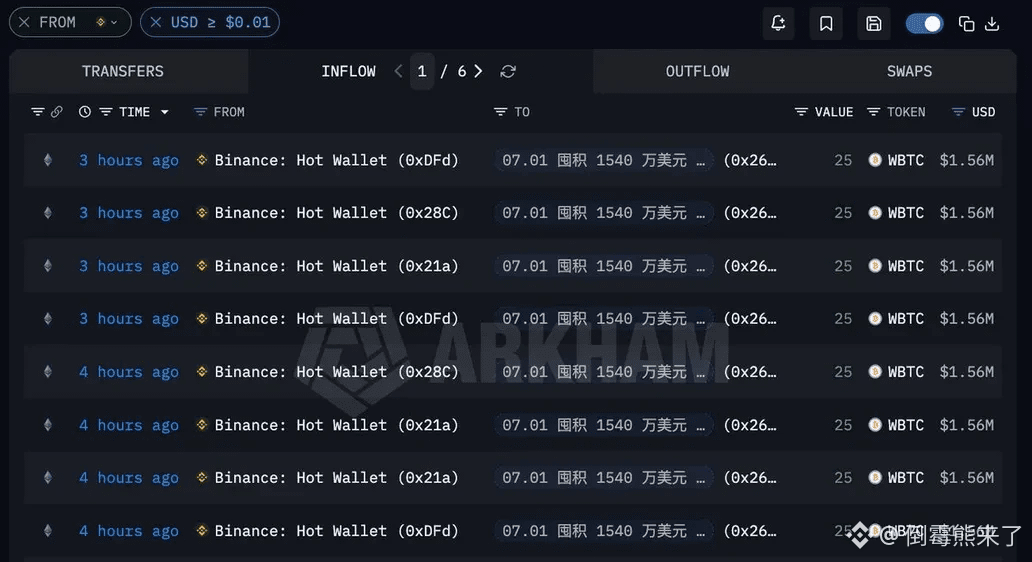
“A certain mysterious mega whale has built up positions totaling over $220 million since July in $ETH and WBTC. The same mysterious mega whale withdrew 200 coins $BTC from Binance 4 hours ago. It has now accumulated withdrawals of 74,265 ETH and 1,400 WBTC, with average costs of about $1,770 and $63,887. It is currently up by $3.8 million; ETH is in an on-chain (on the surface) state, while WBTC is in an off-chain (underwater) state.”
If anything, this whale’s operations are less about “buying the dip” and more about putting together a “crypto version of a 60/40 portfolio.”
Since July, this address has cumulatively withdrawn 74,265 units of $ETH and 1,400 units of $WBTC from exchanges, with average costs of approximately $1,770 and $63,887, respectively. Measured by cost basis, the ETH position is about $131 million, the WBTC position about $89.44 million, for a total investment of nearly $221 million.
Converted into allocation, roughly 59.5% of the funds are allocated to $ETH and 40.5% to $WBTC. It’s not a bet on a single coin; it’s betting on both Ethereum’s upside optionality and Bitcoin’s relative stability.
The latest move was withdrawing 200 units of $BTC from Binance. Estimated around the $63,000 level, the size is over $12 million—about 14.3% of the current 1,400 WBTC position. If these BTC are later wrapped into WBTC, the portfolio’s Bitcoin weighting could keep increasing.
There’s one detail that needs to be clarified: withdrawing coins is not the same as buying on the spot. The buys may have already been completed on the exchange; what can be confirmed right now is simply that the assets are leaving the trading platform and moving to on-chain wallets, self-custody, or DeFi scenarios. Compared with directly leaving coins on the exchange, this usually suggests a lower likelihood of selling in the short term.
At present, Ethereum is performing above its average cost, while $WBTC is still under pressure near the cost line. In other words, at this stage, the portfolio’s gains are mainly driven by ETH’s upside flexibility, while BTC is helping to reduce overall volatility.
Going forward, I’m mainly watching two things: whether the whale will continue extracting BTC, and whether these BTC ultimately remain on the native chain or are converted into $WBTC to be used as collateral in lending, staking, or liquidity protocols. The former would indicate continued coin-hoarding; the latter could suggest he’s preparing collateral for more complex on-chain strategies.
Just personal market observations, not investment advice—DYOR.
If anything, this whale’s operations are less about “buying the dip” and more about putting together a “crypto version of a 60/40 portfolio.”
Since July, this address has cumulatively withdrawn 74,265 units of $ETH and 1,400 units of $WBTC from exchanges, with average costs of approximately $1,770 and $63,887, respectively. Measured by cost basis, the ETH position is about $131 million, the WBTC position about $89.44 million, for a total investment of nearly $221 million.
Converted into allocation, roughly 59.5% of the funds are allocated to $ETH and 40.5% to $WBTC. It’s not a bet on a single coin; it’s betting on both Ethereum’s upside optionality and Bitcoin’s relative stability.
The latest move was withdrawing 200 units of $BTC from Binance. Estimated around the $63,000 level, the size is over $12 million—about 14.3% of the current 1,400 WBTC position. If these BTC are later wrapped into WBTC, the portfolio’s Bitcoin weighting could keep increasing.
There’s one detail that needs to be clarified: withdrawing coins is not the same as buying on the spot. The buys may have already been completed on the exchange; what can be confirmed right now is simply that the assets are leaving the trading platform and moving to on-chain wallets, self-custody, or DeFi scenarios. Compared with directly leaving coins on the exchange, this usually suggests a lower likelihood of selling in the short term.
At present, Ethereum is performing above its average cost, while $WBTC is still under pressure near the cost line. In other words, at this stage, the portfolio’s gains are mainly driven by ETH’s upside flexibility, while BTC is helping to reduce overall volatility.
Going forward, I’m mainly watching two things: whether the whale will continue extracting BTC, and whether these BTC ultimately remain on the native chain or are converted into $WBTC to be used as collateral in lending, staking, or liquidity protocols. The former would indicate continued coin-hoarding; the latter could suggest he’s preparing collateral for more complex on-chain strategies.
Just personal market observations, not investment advice—DYOR.