

XCM and Snowbridge in focus
Connectivity between blockchains has ceased to be a differential and has become a structural requirement.
However, the way this connectivity is implemented determines whether it will be a growth accelerator or a vector of systemic risk.
In recent years, the market has heavily invested in traditional bridges as a solution for interoperability. The result has been a succession of failures, billion-dollar hacks, liquidity silos, and fragile trust models. In this context, Tanssi's approach stands out not for promising 'infinite connectivity,' but for redefining how connectivity should be built from the ground up.
This article analyzes how combining XCM and Snowbridge creates a real connectivity advantage for appchains and sovereign L1s, going beyond traditional bridging solutions.
The structural problem of traditional bridges
Most classic bridges share three fundamental fragilities.
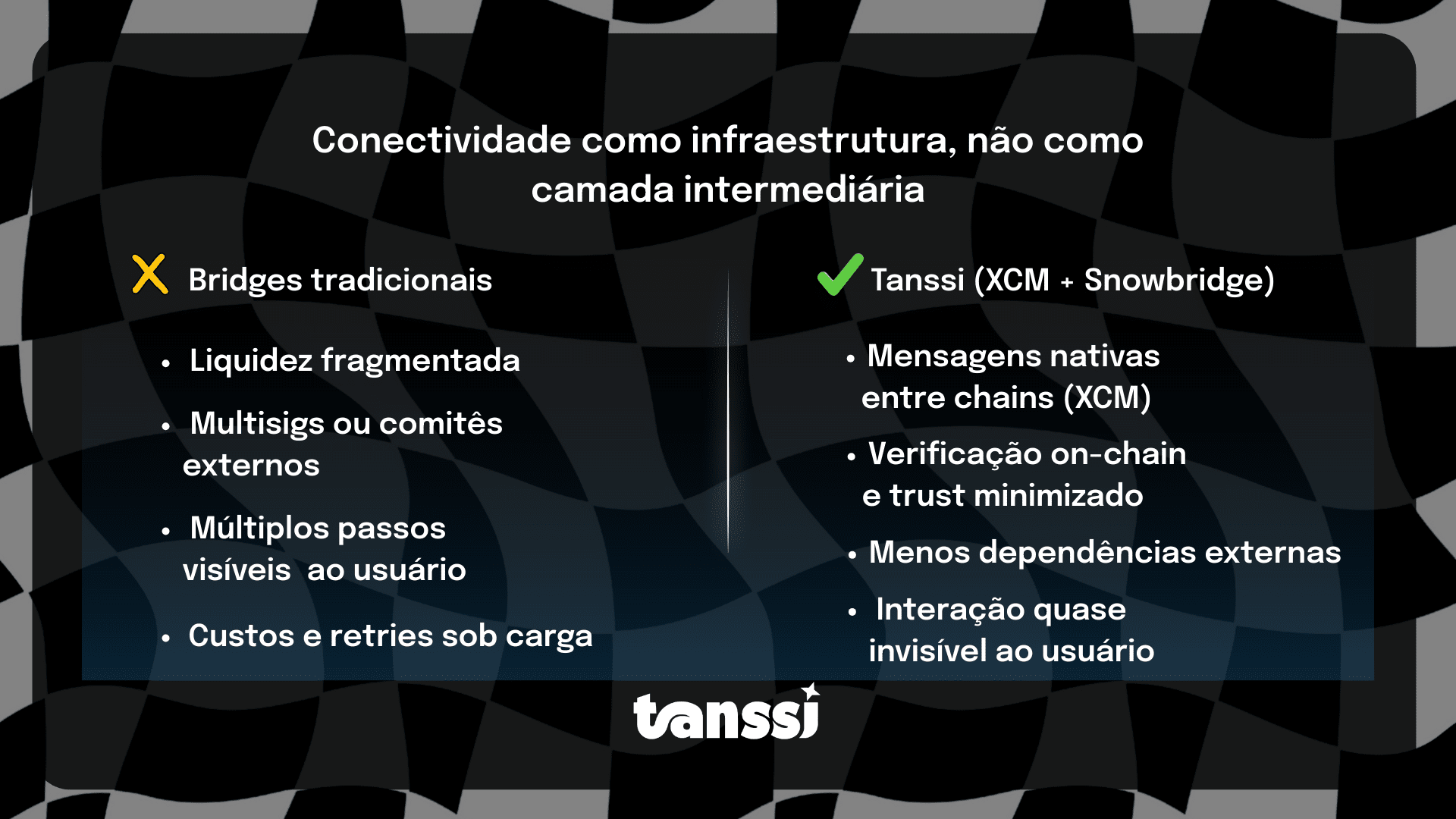
1. Single points of failure
Even when labeled as “decentralized,” many bridges rely on:
Reduced sets of validators
Concentrated multisigs
Relayers with misaligned incentives
This design creates clear attack surfaces, repeatedly exploited in recent cycles.
2. Fragmented liquidity
Each bridge creates its own “mirror” of assets. The result is:
Fragmented stablecoins
Isolated liquidity by bridge
Poor experience for users and applications
Interoperability, in this model, increases complexity instead of reducing it.
3. Security outside the domain of the chain
In traditional bridges, the security of the transfer does not automatically inherit the economic security of the source or destination chain. It relies on external layers, often less robust.
This model may solve the short term, but does not scale securely.
XCM: native interoperability, not patched
XCM (Cross-Consensus Messaging) is born from a radically different principle. Blockchains do not need to “trust” each other, they need to communicate within a coherent system.
What makes XCM structurally different?
It is not an asset bridge
It is a messaging protocol between consensuses
Does not create artificial wrappers
Operates at the protocol level, not isolated contracts
Instead of “locking” assets and issuing representations, XCM allows chains:
Execute messages
Move value
Coordinate states
All of this without leaving the security domain of the ecosystem.
Why does this matter for Tanssi?
Tanssi inherits and extends this model, allowing appchains:
Communicate natively
Avoid liquidity silos
Operate with operational predictability
Connectivity ceases to be an accessory and becomes first-class infrastructure.
Snowbridge: connecting Ethereum without compromising sovereignty
If XCM solves internal communication, Snowbridge solves the critical link with Ethereum.
And here is the key point, Snowbridge does not attempt to “simplify” Ethereum's security. It preserves it.
How does Snowbridge differ from common bridges?
Direct verification of Ethereum consensus
Use of light clients, not outsourced validators
Fewer layers of implicit trust
Fewer economic attack vectors
In practice, this means that the Ethereum ↔ Tanssi connection:
Does not depend on fragile multisigs
Does not create dependency on centralized operators
Maintains stronger cryptographic guarantees
For stablecoins and ERC-20 tokens, this represents lower systemic risk and greater predictability for applications.
Operational efficiency in the real world: the case of projects like Gotas
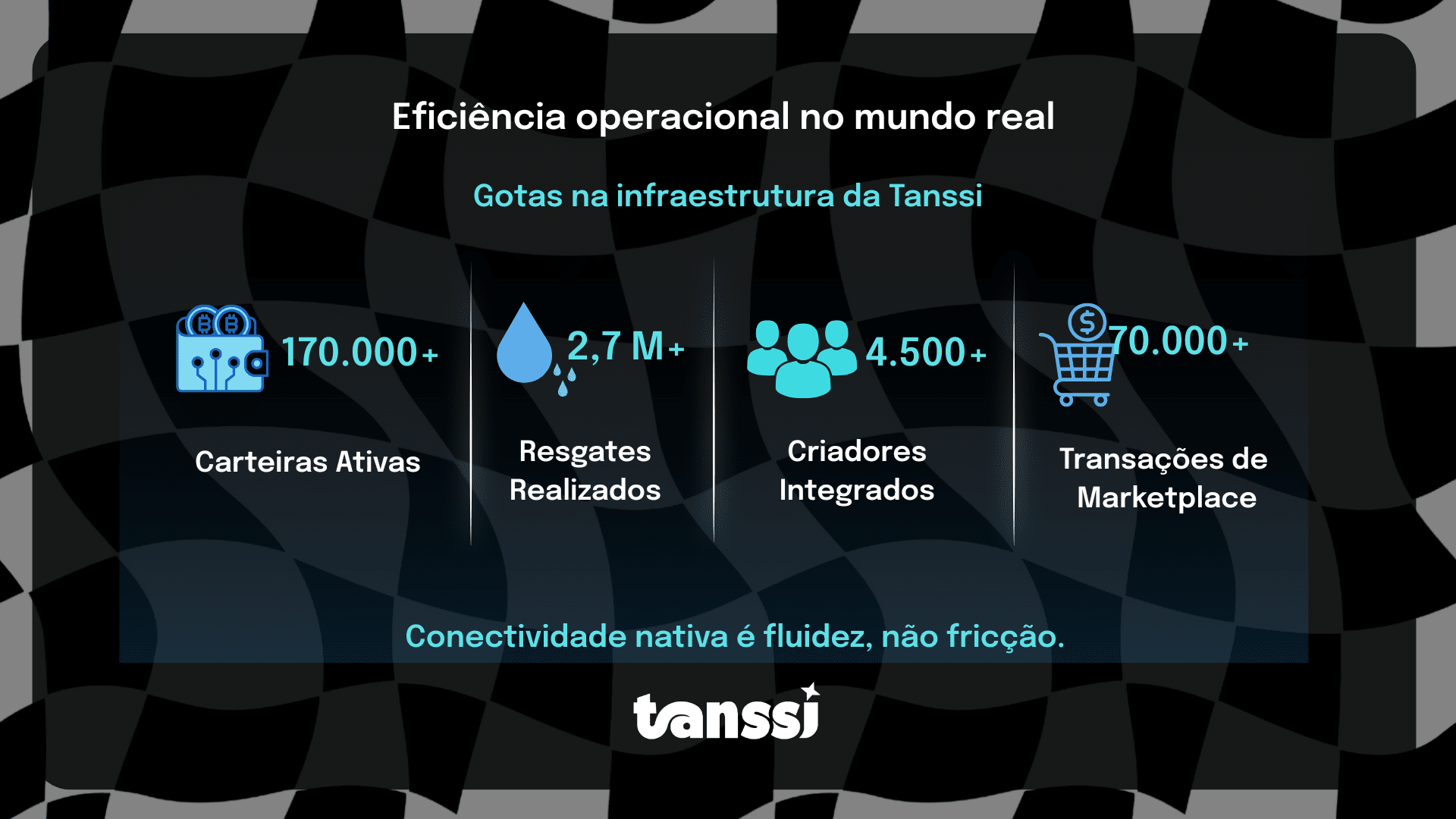
More than looking at absolute numbers, the case of Gotas is relevant for demonstrating how architectural choices behave under real load and continuous use.
When connectivity is treated as part of the infrastructure, its effects cease to appear as “extra steps” for the user and begin to be perceived as fluidity. A practical test of this is to observe projects that operate at consumer scale, such as Gotas, running on a dedicated L1 in Tanssi's infrastructure.
In public metrics, Gotas already records:
170,000+ active wallets
2.7 million redemptions made
4,500+ creators and brands integrated
70,000+ marketplace transactions
In consumer-facing products, volumes of this type tend to quickly expose operational frictions, such as retries, intermittent failures, multiple approvals, or costs that “leak” into the user experience. Sustaining this level of activity suggests that native connectivity structurally reduces operational complexity, not just cosmetically.
In this context, connectivity ceases to be an “invisible infrastructure” and becomes a concrete competitive advantage, allowing applications to focus on experience and scale without taking on additional integration risks.
Security as architecture, not as a promise
One of the biggest differentiators of Tanssi's approach is treating security as a result of architecture, not marketing.
By combining:
XCM for native communication
Snowbridge for access to Ethereum
Sovereign infrastructure for appchains
Tanssi reduces:
Fragile external dependencies
Unnecessary attack surfaces
Invisible operational complexity
This creates a model where growing does not mean taking on more risk proportionally.
Connectivity as a structural advantage
The future of interoperability is not in multiplying bridges, but in reducing the need for them.
Tanssi's approach shows that:
Connectivity can be native
Security can be inherited, not outsourced
Liquidity does not need to be fragmented
Sovereignty does not need to be sacrificed to scale
In a market increasingly aware of the hidden costs of complexity, the real advantage is not in promising more connections, but in building them the right way.
This is exactly where the @Tanssi positions itself.