

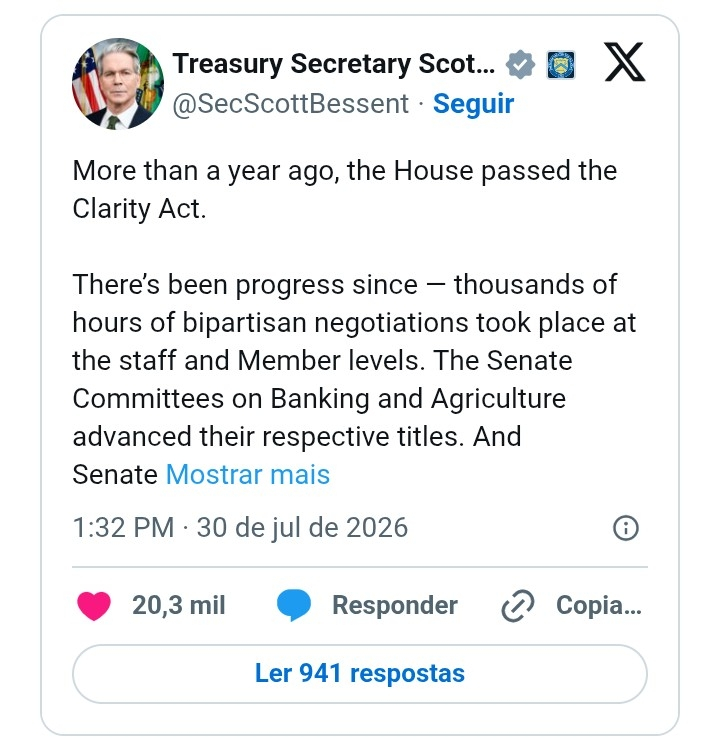
The U.S. Treasury Secretary, Scott Bessent, once again defended on Thursday (30) the approval of the Clarity Act, a bill that aims to establish rules for the cryptocurrency market in the country. According to him, the delay in the vote is due to political reasons, and this uncertainty could cause the United States to lose ground in global leadership in the digital assets sector.
In an extensive post on the social network X, Bessent stated that the House of Representatives approved the bill more than a year ago. Since then, teams from the Senate Banking and Agriculture Committees would have devoted thousands of hours to negotiating changes with the support of lawmakers from different parties. According to the secretary, the text is already ready and only awaits a floor vote.
Bessent criticized the posture of Senate Democrats, saying that postponing the vote harms the progress of legislation. In his view, the lack of a definition puts the United States’ competitiveness at risk in a market that is growing rapidly.
"It’s frustrating, though not surprising, that Senate Democrats are prioritizing political disputes just when the country could score an important win for its economic leadership," he wrote.
The secretary also questioned the decision to delay regulation of the sector, saying it would be hard to find another moment in history when Congress preferred to stay away from a growing industry instead of creating clear rules for its development. According to Bessent, if the Clarity Act is not approved, the United States’ leadership position in the digital assets market could be jeopardized.
Scott Bessent also rebutted the criticisms that the Clarity Act does not provide sufficient protection for consumers or effective mechanisms to combat financial crimes. According to the Treasury secretary, Titles II and III of the bill significantly expand compliance requirements for companies that deal with digital assets, bringing the rules closer to those already applied to traditional financial institutions.
The secretary also defended the Blockchain Regulatory Certainty Act, a section of the Clarity Act that seeks to ensure legal certainty for developers of decentralized software. According to Bessent, the measure simply formalizes an old understanding from the Treasury Department that these developers do not need to comply with the registration requirements set out in the Bank Secrecy Act. He also noted that the Fraternal Order of Police, which had previously opposed the proposal, now supports it.
In the posting, Bessent also criticized Senate Democrats, saying that many would be hesitant to face opposition from Senator Elizabeth Warren and the group he calls the "anti-crypto army." In his view, the vote will be decisive in determining whether the United States will continue to lead the global digital assets market or whether companies in the sector will move to other countries because of the lack of clear rules.
In closing his message, the secretary quoted a famous line from Satoshi Nakamoto, the creator of Bitcoin. "America will lead or it will be left behind. It’s that simple," he wrote. He then repeated Satoshi’s well-known statement: "If you don’t believe me or don’t understand, I don’t have time to try to convince you. Sorry."
The Clarity Act creates a federal regulatory framework for the digital assets market in the United States and, in practice, establishes rules for most cryptocurrency operations in the country. If approved and signed into law, the bill will split oversight of the sector between the SEC, responsible for securities markets, and the CFTC, which will oversee most crypto-asset enforcement.
The proposal has become one of the main priorities for the cryptocurrency industry in Washington. In May, Senate Republicans introduced a new version of the text with ethics clauses that would prohibit the U.S. president and other senior government officials from creating or promoting digital assets while in office.
The measure was seen as a direct response to activities linked to President Donald Trump, who, according to recent disclosures, would have earned more than $1.2 billion from businesses involving cryptocurrencies in 2025 alone.
The Democrats, however, criticized the text. Among the main points, they argue that the restrictions would apply only until 2029, that oversight would be concentrated in the Department of Justice, and that the rules would not extend to the officials’ children.
Despite the progress in discussions, the bill’s future remains uncertain. The Senate Majority Leader, John Thune, recently said he does not believe the proposal will be approved before the August parliamentary recess, since negotiations on the ethics rules are still ongoing without consensus.
Analysts assess that the August recess represents the main window for approval of the proposal this year. After that period, the expectation is that Congress will focus its efforts on the midterm legislative elections, reducing the chances of the matter moving forward.