After chewing through TBV whitepaper section 4.2, this “non-custodial vault” isn’t as amazing as they claim
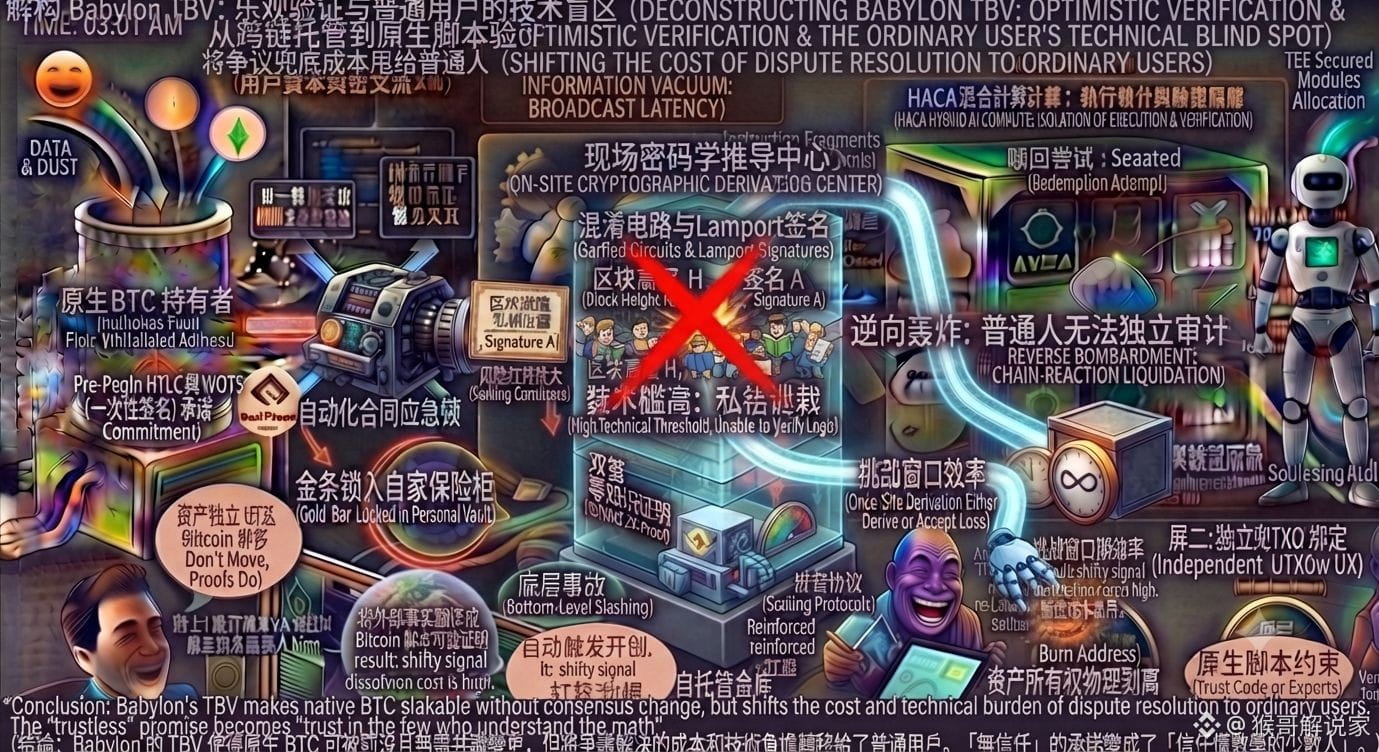
In the “Putting Them Together” part of section 4.2 of the TBV whitepaper at @BabylonLabs_io , I spent half an hour working through the combination logic that pairs an obscured circuit with a Lamport signature. I went back and forth and traced the流程 three times, and found a blind spot that everyone seems to be avoiding: this optimistic verification mechanism shifts all the cost of covering disputes onto ordinary users.
Insiders keep praising “no BTC moves on-chain, no custody, no wrapping,” as if keeping coins on Bitcoin L1 automatically equals absolute safety. No one is willing to spell it out. If liquidation goes wrong or someone proves that the data was fabricated, ordinary holders have no ability to independently run garbled-circuit verification, let alone reach the technical threshold to provide evidence.
Let’s put it plainly with a real analogy: it’s like you lock your gold bars in your home safe and agree that the vault will only be opened after you repay the loan. The key to opening the safe is a complicated mathematical proof. Everything goes smoothly during normal repayment, and the system automatically grants access. But if the system mistakenly decides you’re in default, then you have to hold a cryptography textbook on the spot and derive the proof yourself in order to open your own safe. Most people can’t even derive it, and they can’t read the proof documents either—so in the end, they just have to accept it.
The most impressive part of this design is that, truly without changing Bitcoin’s consensus, it turns native BTC into a verifiable on-chain collateral. This is more solid than most BTCfi projects out there.
However, BABY’s role within the TBV system has always been awkward. Fees, governance, and staking rewards are all the usual playbook. TBV’s core value flow happens entirely around BTC. BABY is more like a roadside toll booth—when business is booming, it can skim some road tax, but when it doesn’t take off, there’s no real core lever. Value capture and the core narrative are basically two layers of skin.
In the end, all the claims in crypto that this is “trustless” are, in essence, transferring trust from people to code. But the more complex the code is, the fewer people can understand it. “Trustless,” in the end, just means handing that trust to a small group of people who can read cryptography. If you can’t even figure out how to unlock your own assets, do you truly control your wealth?
Do you think ordinary BTC holders would really dare to use this mechanism with confidence?
#baby $BABY
In the “Putting Them Together” part of section 4.2 of the TBV whitepaper at @BabylonLabs_io , I spent half an hour working through the combination logic that pairs an obscured circuit with a Lamport signature. I went back and forth and traced the流程 three times, and found a blind spot that everyone seems to be avoiding: this optimistic verification mechanism shifts all the cost of covering disputes onto ordinary users.
Insiders keep praising “no BTC moves on-chain, no custody, no wrapping,” as if keeping coins on Bitcoin L1 automatically equals absolute safety. No one is willing to spell it out. If liquidation goes wrong or someone proves that the data was fabricated, ordinary holders have no ability to independently run garbled-circuit verification, let alone reach the technical threshold to provide evidence.
Let’s put it plainly with a real analogy: it’s like you lock your gold bars in your home safe and agree that the vault will only be opened after you repay the loan. The key to opening the safe is a complicated mathematical proof. Everything goes smoothly during normal repayment, and the system automatically grants access. But if the system mistakenly decides you’re in default, then you have to hold a cryptography textbook on the spot and derive the proof yourself in order to open your own safe. Most people can’t even derive it, and they can’t read the proof documents either—so in the end, they just have to accept it.
The most impressive part of this design is that, truly without changing Bitcoin’s consensus, it turns native BTC into a verifiable on-chain collateral. This is more solid than most BTCfi projects out there.
However, BABY’s role within the TBV system has always been awkward. Fees, governance, and staking rewards are all the usual playbook. TBV’s core value flow happens entirely around BTC. BABY is more like a roadside toll booth—when business is booming, it can skim some road tax, but when it doesn’t take off, there’s no real core lever. Value capture and the core narrative are basically two layers of skin.
In the end, all the claims in crypto that this is “trustless” are, in essence, transferring trust from people to code. But the more complex the code is, the fewer people can understand it. “Trustless,” in the end, just means handing that trust to a small group of people who can read cryptography. If you can’t even figure out how to unlock your own assets, do you truly control your wealth?
Do you think ordinary BTC holders would really dare to use this mechanism with confidence?
#baby $BABY