#baby $BABY
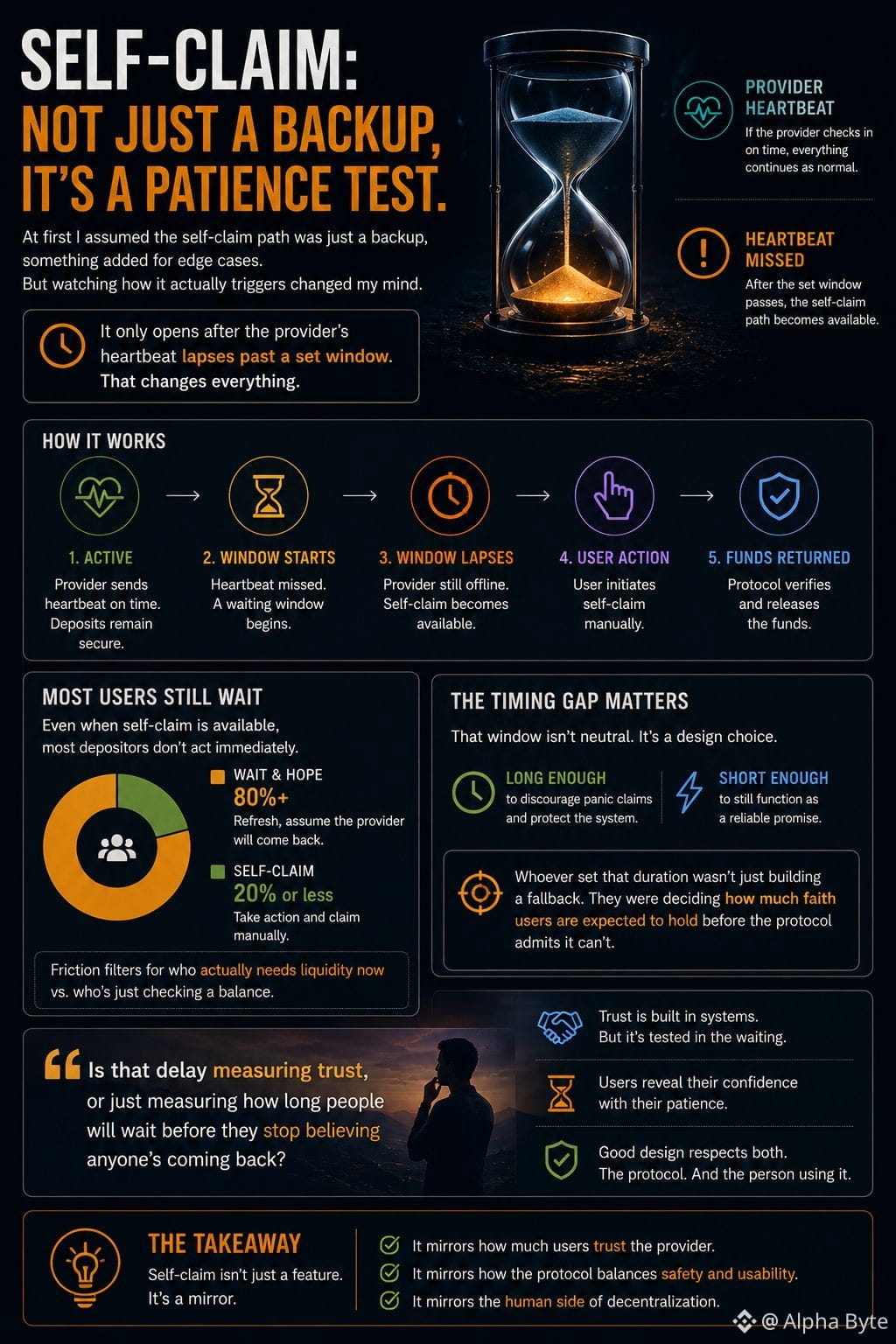
When I first learned about the self-claim mechanism, I assumed it was nothing more than a backup option. I thought it existed for unusual situations that most users would never need. After spending more time understanding how it actually works, I realized it serves a much bigger purpose.
The self-claim path only becomes available after a provider fails to send its required heartbeat for a specific period. That detail completely changed my perspective. Instead of being just an emergency feature, it feels like a carefully designed test of patience and user behavior.
What I found interesting is that many users don't immediately initiate a self-claim once it becomes available. Most people simply wait. They refresh the page, expect the provider to recover, and assume everything will return to normal without requiring any action. That behavior reveals something important about how people naturally respond to uncertainty.
The waiting period creates useful friction. It separates users who genuinely need immediate access to their funds from those who are simply monitoring their balances. In that sense, the delay isn't just a technical requirement—it quietly influences how the entire system is used.
The more I thought about it, the more I appreciated how carefully that timing must have been chosen. It is long enough to discourage unnecessary panic claims while remaining short enough to reassure users that there is still a reliable fallback if something goes wrong.
For me, the most interesting question isn't whether the self-claim mechanism works. It's whether the waiting period is actually measuring trust. At what point do users stop believing the provider will return and decide to act for themselves? Sometimes the most important part of a protocol isn't the technology—it's the way its design shapes human behavior.
@BabylonLabs_io $BABY #baby
When I first learned about the self-claim mechanism, I assumed it was nothing more than a backup option. I thought it existed for unusual situations that most users would never need. After spending more time understanding how it actually works, I realized it serves a much bigger purpose.
The self-claim path only becomes available after a provider fails to send its required heartbeat for a specific period. That detail completely changed my perspective. Instead of being just an emergency feature, it feels like a carefully designed test of patience and user behavior.
What I found interesting is that many users don't immediately initiate a self-claim once it becomes available. Most people simply wait. They refresh the page, expect the provider to recover, and assume everything will return to normal without requiring any action. That behavior reveals something important about how people naturally respond to uncertainty.
The waiting period creates useful friction. It separates users who genuinely need immediate access to their funds from those who are simply monitoring their balances. In that sense, the delay isn't just a technical requirement—it quietly influences how the entire system is used.
The more I thought about it, the more I appreciated how carefully that timing must have been chosen. It is long enough to discourage unnecessary panic claims while remaining short enough to reassure users that there is still a reliable fallback if something goes wrong.
For me, the most interesting question isn't whether the self-claim mechanism works. It's whether the waiting period is actually measuring trust. At what point do users stop believing the provider will return and decide to act for themselves? Sometimes the most important part of a protocol isn't the technology—it's the way its design shapes human behavior.
@BabylonLabs_io $BABY #baby