


I am 38 years old this year, started trading cryptocurrencies at 26, and from 2020 to 2022, my capital reached eight figures. Now my lifestyle requires me to stay in high-end hotels costing around 2000 yuan, and my suitcase and hat might bear cryptocurrency symbols. It's much more comfortable than what the older generation experienced in real industries or the post-80s in e-commerce. Today, I’m sharing a few key insights; these experiences are worth 60 million, and I hope they can help you.
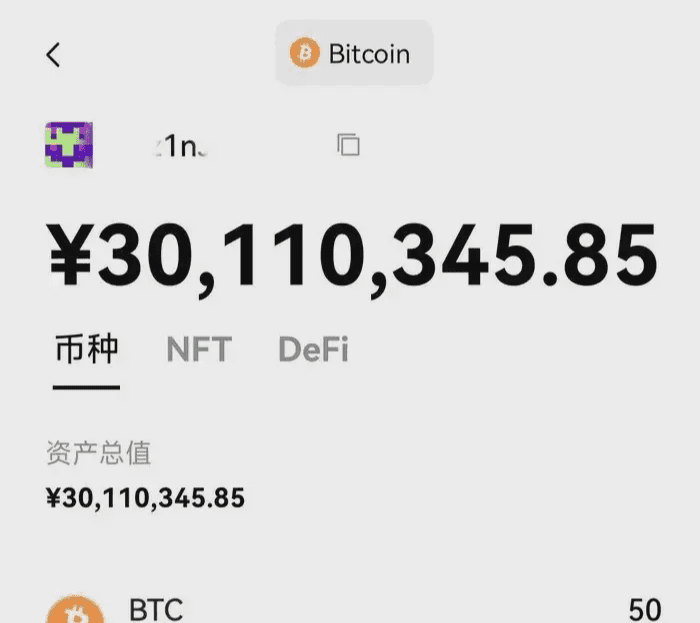 1. In most cases, Bitcoin is the leader of the fluctuations in the cryptocurrency market. Occasionally, strong altcoins may break away from Bitcoin's influence and trend independently, but altcoins generally cannot escape its impact.
2. Bitcoin and USDT move in opposite directions; if you find that USDT is rising, be alert that Bitcoin is likely to fall; when Bitcoin rises, it is a suitable time to buy USDT.
3. Between 12 AM and 1 AM, there is often a phenomenon of price manipulation, so domestic crypto friends can try to place a buy order at a low price for their desired cryptocurrency and a high selling price right before sleeping; it might just get executed while lying down.
4. Every morning from 6 to 8 AM is a timing point for judging whether to buy or sell, and also a time to judge the day's ups and downs. If from midnight to 6 AM it has been falling, it likely continues to fall, making it a buying or replenishing time. The day is generally bullish; if it has been rising from midnight to 6 AM, it likely continues to rise, making it a selling time; the day will likely be bearish.
5. 5 PM is an important focus point for rumors in the community. Due to time zone differences, American crypto friends are getting up and working, which may cause fluctuations in the price of cryptocurrencies; some significant rises or drops have indeed occurred at this time, so pay special attention.
6. There is a saying in the crypto world about 'Black Friday'; there have been a few instances of significant drops on Fridays, but there have also been significant rises or sideways movements, so it’s not particularly accurate; just pay attention to the news.
7. If a cryptocurrency with a certain trading volume drops, don't worry; if you hold on patiently, you will definitely make back your money, whether in 3 or 4 days or as long as a month. If you have spare USDT, buy in batches to lower the price, which will speed up your breakeven. If you have no spare money, just wait; you won't be disappointed unless you really bought an I coin.
8. Holding the same cryptocurrency for the long term with less trading yields greater returns than frequent trading, it just depends on whether you have the patience to hold. I bought Dogecoin at 0.1, and it has increased more than 20 times now after playing around in the crypto space.
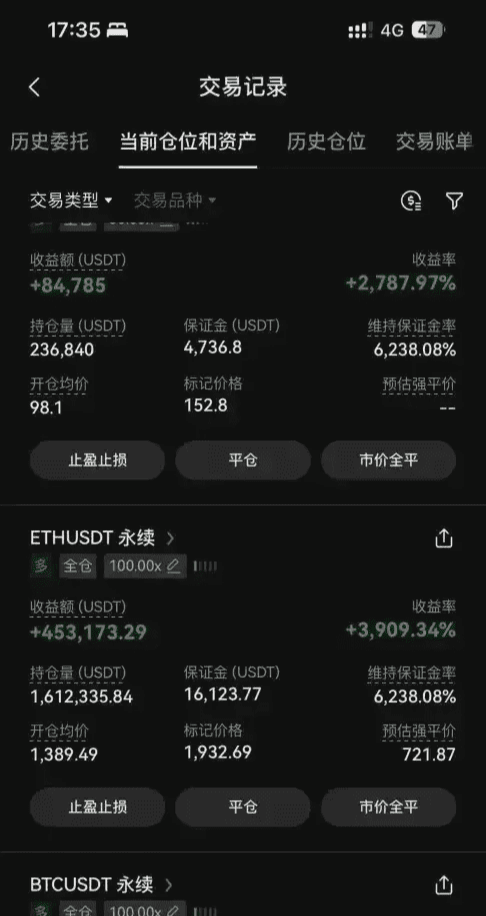
Today, I will share some valuable insights; this experience is worth 60 million and I hope it can help you.
1. Choose the right platform: Avoid 'eating customer losses.'
The top choice for black market platforms: Binance, OKX (low fees, good depth, no lag), avoid small platforms (in 2023, a certain platform maliciously manipulated prices, leading to collective liquidations of users).
Key indicators: Check 'funding volume' (over 1 billion USD), 'number of positions' (over 500,000), 'historical manipulation records' (the less, the better).
2. Position control: Use the '1% rule'.
Preserve the principal single position: each opening position should not exceed 1% of the total funds (e.g., with a principal of 100,000 yuan, a single position should not exceed 1,000 yuan in margin).
Total position limit: All contract positions' margin should not exceed 20% of total funds (to avoid simultaneous liquidation of long and short positions).
For example: With a principal of 10,000 yuan under 10 times leverage, the margin for a single position should be ≤100 yuan (corresponding to a contract value of 1,000 yuan), and the total margin for all positions should be ≤2,000 yuan.
3. Technical analysis: 3 must-see indicators to help you determine direction. MA moving average: When the 50-day moving average crosses above the 100-day moving average (golden cross), it is bullish; when it crosses down (death cross), it is bearish.
MACD: Red bars lengthen (bullish), green bars lengthen (bearish), divergence signal (price rises while volume shrinks, may signal a top).
Support and resistance levels: Check previous highs and lows (for example, Bitcoin at 32,000 is strong support, and at 40,000 is strong resistance); after breaking through, open positions along with the trend.
4. Order placing skills: Seize the 'golden opportunity' of sharp drops and rises. Going long during a sharp drop: If the cryptocurrency price drops more than 5% and touches a strong support level (e.g., Bitcoin dropping to 28,000 in May 2025 and rebounding 2% within 30 minutes), going long can earn 20%.
Shorting during a surge: If the price of the cryptocurrency rises more than 10% in a short time and reaches a resistance level (like Bitcoin hitting 45,000 and then quickly falling), open a short position to earn 15% within an hour.
Taboo: Do not open positions during sideways fluctuations (70% of the time is spent in fluctuations; frequent operations will definitely lead to losses).
5. Closing strategy: The money earned is the real money. Target completion and liquidation: Immediately take profit upon reaching preset earnings (e.g., 20%) without being greedy.
Stop loss liquidation: If it falls below the support level / rises above the resistance level, stop loss unconditionally (e.g., if the price drops below the previous low after going long, run immediately, do not bet on a rebound).
Time stop loss: If the position exceeds 4 hours without reaching expectations, forced liquidation (to avoid staying up all night watching the market; 2023 statistics indicate that users holding positions for over 12 hours have a liquidation rate that increases by 3 times).
3 core concepts every beginner must learn: Understand these 3 points to reduce losses by 80% of your principal!
1. Leverage: It is not a double-edged sword, but a 'dragon-slaying knife.' Common leverage: 10 times (low risk), 50 times (medium), 100 times (for advanced users).
Fatal misconception: 100 times leverage ≠ earn 100 times, but rather 'a 1% fluctuation means losing 100% of the principal' (e.g., with 100 times leverage, investing 10,000 yuan to buy 1 million yuan in assets, a 1% drop results in a 10,000 yuan loss, leading to immediate liquidation).
Iron law: Beginners should only use 10-20 times leverage, and veterans should not exceed 50 times (2023 statistics: 99% of users using 100 times leverage liquidated within 3 months).
2. Stop loss and take profit: The 'life-saving talisman' that is more important than making money. Stop loss: set in advance 'how much loss must run' (e.g., with a principal of 10,000, set stop loss at 5%, if the loss reaches 500 yuan, automatically close the position to avoid carrying the position to liquidation).
Take profit: Automatically cash out after reaching the target profit (e.g., expect to earn 20%, enforce a sale after making 2,000 yuan to avoid a market reversal and loss).
Real case: In 2024, Bitcoin crashed by 30%. Users who set a 10% stop loss only lost 10% of their principal, while those who did not set a stop loss went directly to liquidation.
3. Funding rates: the 'hidden mechanism' of making money from the opposing party. Principle: When long and short positions are imbalanced (e.g., 80% of users are long), the platform will require long position users to pay funding fees to short position users, and vice versa.
Practical skills: In extreme market conditions (e.g., Bitcoin breaking through key resistance levels), open a small reverse position to earn funding fees, which can yield daily returns of 0.1%-1% (data from a certain platform in 2025: long-term users earning funding fees have stable annualized returns of 15%+).
3 advanced strategies used by experts.
1. Hedging strategy: A 'winning formula' that makes money whether the market rises or falls. Operation: Simultaneously open a 10x long position and a 10x short position (each occupying 5% of the position), when the price fluctuates over 2%, close the losing position and hold the profitable one.
Case: Bitcoin fluctuates in the range of 30,000 - 40,000, using a hedging strategy to earn 5%-10% every month, with risks close to zero.
2. Ladder-style position increase: the 'bottom-fishing tool' during sharp drops. Steps: If the price drops by 10%, open a long position of 1%; if it drops again by 10%, open a long position of 2%; and so forth. Advantage: Lowers average cost, a 15% rebound can turn losses into profits (e.g., go long at 30,000, total position is 6% when it drops to 24,000, a rebound to 27,600 means breaking even).
3. Capital management: Use the 'liquidation price calculator' as a life-saving tool: Enter margin, leverage, and position size in the exchange app to automatically calculate the liquidation price (e.g., with 10 times leverage and 10,000 yuan margin, the liquidation price = opening price - opening price × 10%).
Iron law 4: Ensure the liquidation price is at least 20% away from the current market price (e.g., if Bitcoin is at 30,000, set the liquidation price at 24,000, leaving enough buffer space).
Contracts are not ATMs, but rather a battlefield for 'cognitive realization'!
1. First practice on a simulated account: Use 10,000 yuan in virtual funds to practice for 3 months. Recommended platform: Binance 'Contract Simulation Account', 1:1 replicating real trading; can be reset if lost.
Goal: Achieve 'no liquidation within 3 months, win rate over 50%' before re-entering real combat.
2. Always remember: Contracts are 'the icing on the cake,' not 'a gamble to turn things around.'
Correct mindset: Use no more than 20% of spare money to trade contracts; your main income is fundamental (for a worker earning 3000 a month, using 600 yuan to trade contracts is enough; don't bet your entire fortune).
3. Liquidation is not the end, but the beginning of growth. Every liquidation is the best teacher: record the reason for liquidation (was it due to high leverage? No stop loss set? Or emotional trading?), and form your own 'pitfall guide.'
Today, I will discuss a summary of my years of trading experience as a free share, hoping to help everyone!
Because if you want to change your destiny, you must try the crypto world; if you can't make money in this circle, ordinary people will never have a chance in their lifetime.
I believe that excellent traders must have patience to endure and guard their wealth!
Frequent small profits and exiting indicate that your ability to judge the market is limited, and you cannot accurately determine the cycles of price rises and falls. A good solution is to improve your trading ability to better judge and analyze investment targets.
Next, I will share some trading experiences, hoping to help investors in need:
1. Choose familiar cryptocurrencies, and do not focus on too many varieties. Understand the relationship of price changes to better grasp price trends, and don't focus on too many varieties, as this is also from the perspective of investors; human energy is limited, and it is impossible to profit from different varieties, so don't challenge your limits.
2. The importance of position management. If not managed properly, all principal can be lost, with no chance of recovery. Here, it is recommended that the margin for open positions accounts for about 30% of the total funds, and should not exceed 50%. Of course, when faced with favorable market conditions, you can increase your position appropriately. During trading, pay attention to two points: first, do not increase your position when in floating profit; second, do not increase your position when in floating loss. Learning to wait is a necessary lesson in trading.
3. Develop a trading plan and avoid frequent trading. Frequent trading consumes a lot of energy, and trading costs can be relatively high. Finding profitable opportunities in uncertain markets is not easy. If the results are poor, it not only consumes your principal but also affects your performance.
4. Maintain a good mindset while trading, enhance learning, summarize more, and exercise more.
5. Set take profit and stop loss, take profits quickly, and don't hold onto losing positions. The main reason for losses is often due to holding onto positions.
Technical knowledge.
1. Introduction to Bollinger Bands indicators and practical explanations 2. Dow Theory 3. Revelation of major chip distribution 4. Introduction to KDJ indicators and practical explanations 5. Elliott Wave Theory 6. What are pressure and support? 7. What is a trend and how to judge it? 8. Stochastic Index, Stochastic Index 9. How to apply Fibonacci? ……
Basic knowledge.
1. What are digital currency futures contracts?
(1) Definition of futures contracts.
(2) Types of contracts.
(3) The three elements of futures contracts.
2. What is leveraged trading in digital currencies?
(1) What is leverage?
(2) Examples of leveraged trading.
3. What is the principle of hedging and reducing risk?
(1) What is hedging?
(2) What to do if you are stuck after buying at a high in the cryptocurrency market?
(3) How to hedge in the digital currency market?
4. Key points to note in contract trading.
(1) How to allocate positions?
(2) Where should the stop-loss and take-profit levels be set?
2. Supply and demand trading method to find key intervals.
The relationship between supply and demand is the same in any market: when the supply and demand relationship starts to become unbalanced, the price will either move or reverse. The supply area is where professional traders short, and the demand area is where they buy.
The demand area generally has two forms of expression.
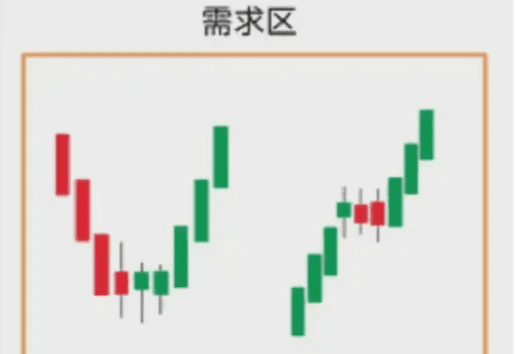
The first type: Falling, entering the area, rising.
The second type: Rising, entering the area, rising.
Similarly, the supply area also has two forms of expression.
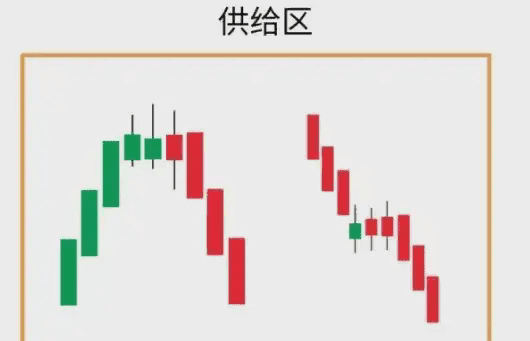
The first type: Rising, entering the area, and then falling;
The second type: Falling, entering the area, and then falling.
So when we see a demand area, what should we do?
In the market, when a demand area appears, we expect the price to rise here, and buy when it pulls back to the demand area.
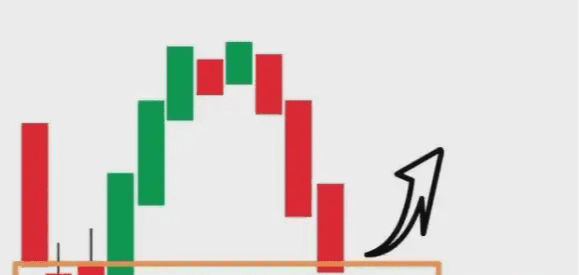
The supply area is contrary to the demand area. We expect the price to drop here and sell when it pulls back to the demand area.
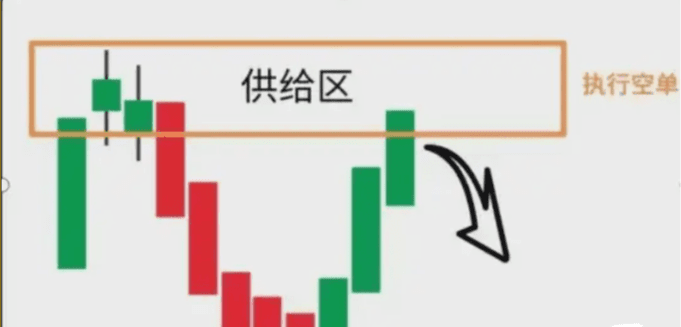
In simple terms, a rising flat requires long positions, and a falling flat requires short positions.
Let me give you an example; the most typical one is the example from the time around 519!
At that time, it was a very good entry point, and shortly after forming this demand area, the price returned to the demand area multiple times (at the time it was around 30,000 USD), so this demand area is likely to be a good trading opportunity.
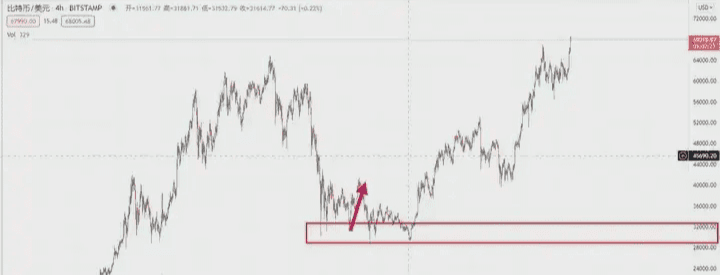
If the price continues to fall after the first pullback, we will see the price surge in the demand area. Corresponding to the market at that time, after 519, the second drop below 30,000 USD had a nice rebound. Because we just mentioned that, just like the principle of the supply area, if institutions still have unfulfilled long contracts in the demand area, they will quickly pull the price back into the area.
3. Finding positions using the Fibonacci method.
Fibonacci retracement is the most commonly used method for finding support and resistance levels in trading.
Generally speaking, we will pull from the highest price point during a certain time period to the relatively lowest price point. The 9 lines formed at this time (line segments) are the pullback levels we need to pay attention to, and each line has a certain support or resistance effect, which is related to the position of the market.
(1) Hold patiently for a breakthrough.
Short-term Fibonacci retracement lines drawn on 1-4 hour charts can be purchased at the 0.236 position, which is relatively safe, and it will definitely test the 0.382 position; at this time, you should exit to prevent a pullback!
(2) Shorting at high prices to profit.
Using Fibonacci retracement lines on daily charts can help you sell high and buy low between the 0.236-0.382 positions, capturing nice short-term profits.
(3) Be cautious when taking risks.
Be especially cautious in the 0.382-0.618 zone, as there are many possibilities for market changes; try not to apply it to small time frames.
(4) A high breakout must pull back.
The 0.618 level will definitely see a pullback, so entering at this point generally yields good profits!
Examples of Fibonacci retracement lines are not easy to illustrate, and drawing lines should not be based on one time frame; separate multiple time frames to find high and low points. However, it is worth noting that this is still relatively useful, and it can also be used for short-term trading, buying at support levels and selling at resistance levels.
That's about it, contracts are like gambling, but many people still can't resist the temptation of getting rich overnight. Of course, this doesn't mean you shouldn't trade digital currency contracts; the purpose of writing this article is to help you trade contracts reasonably. Therefore, I hope this content can be helpful to everyone! #ETH走势分析 $BTC
Follow A Xun.