


Long article, enter with caution
BNB Chain: Retail + narrative-driven, active on-chain spot/derivatives, significant RWA deployment → BNB performs best among major assets.
2026 Outlook (Key Points of the Report) 'Risk Reboot': Global monetary easing + fiscal stimulus + deregulation.
Liquidity-driven expansion → Institutional funds replace retail speculation.
Key areas: Bitcoin (strategic reserve potential), institutional adoption, stablecoins, RWA/tokenization, decentralized trading, prediction markets, etc.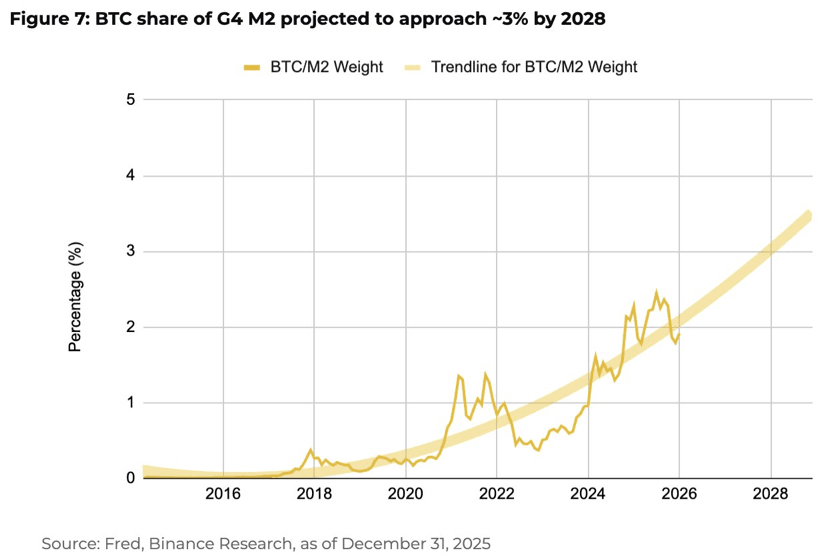
Text
1️⃣, 2025 will be a year of both milestone achievements and market performance divergence in the cryptocurrency industry. The total market cap will first exceed $40 trillion, with Bitcoin (BTC) reaching a new all-time high (ATH), reflecting ongoing institutional adoption, regulatory progress (especially regarding stablecoins), and the expansion of regulated investment products. Meanwhile, high macroeconomic uncertainty driven by monetary policy, trade tensions, and geopolitical risks will dominate market behavior, leading to sharp price fluctuations and repeated phases of risk aversion. This results in an annual trading range of approximately 76%, with total market cap fluctuating dramatically between about $2.4 trillion and about $4.2 trillion. Despite structural progress in market access and infrastructure, the crypto market will still decline by about 7.9% for the year, highlighting that price formation in 2025 is increasingly influenced by macro conditions and traditional financial cycles, rather than purely by crypto-native adoption.
2️⃣, from a macro perspective, this year is characterized by 'data fog' and volatility, with the market struggling through events such as the new U.S. government, 'Liberation Day' tariff shocks, and government shutdowns, which obscure economic signals. Although speculation around artificial intelligence (AI) and the OBBBA fiscal bill drove BTC to a new high in the early second half of the year, regulatory delays caused the crypto market to decouple from the rebound of traditional assets by the end of 2025. However, the outlook for 2026 reveals a clear 'risk reset' driven by the 'policy trifecta': global synchronized monetary easing, massive fiscal stimulus (via cash/tax refunds), and a wave of deregulation. This shift is expected to replace retail-driven speculation with institutional capital inflows, leading to liquidity-driven expansion for cryptocurrencies, supported by the potential of the U.S. Strategic BTC Reserve.
3️⃣, Bitcoin shows a clear divergence between structural market strength and base layer economic activity. BTC reached new highs during the year but closed slightly lower by year-end, underperforming gold and most major stock indices, while its market capitalization remained around $1.8 trillion, with market dominance maintained at 58–60%. Despite weak price performance, the concentration of capital towards BTC is intensifying: net inflows into U.S. spot ETFs exceeded $21 billion, and corporate holdings surpassed 1.1 million BTC, accounting for about 5.5% of total supply. Network security continues to strengthen, with hash rates exceeding 1 ZH/s and mining difficulty rising approximately 36% year-on-year, indicating sustained miner investment. However, base layer activity has slowed: active addresses decreased by about 16% year-on-year, and transaction volumes fell below previous cycle peaks, with speculative token activity only showing brief, non-sustained bursts. These combined signals indicate that Bitcoin's liquidity, price formation, and demand are increasingly flowing through off-chain financial channels and holding behaviors, while the base layer's role recedes to a secondary position, further reinforcing Bitcoin's positioning as a macro financial asset rather than a transaction-dominated network.
4️⃣, at the Layer 1 (L1) level, 2025 indicated that sheer activity volume is not a reliable indicator of economic relevance, as many networks failed to convert usage into fees, value capture, or sustained token performance. At the same time, the L1 landscape continues to concentrate around a few leading networks. Ethereum maintains dominance in developer activity, decentralized finance (DeFi) liquidity, and total value, but its base layer execution footprint and rollup-driven fee compression have hindered ETH's performance relative to BTC. In contrast, Solana has maintained high transaction volumes and daily active users, significantly expanding stablecoin supply, generating meaningful protocol revenue even after speculative activities normalized, and receiving approval for a U.S. spot ETF, further enhancing institutional accessibility. The BNB Chain, with mainstream market narratives and a strong retail trading base, has driven on-chain spot and derivatives activity, large stablecoin settlements, and real-world asset (RWA) deployments, making BNB the best-performing major crypto asset. A key signal for 2025 is that L1 differentiation increasingly depends on the ability to monetize recurring flows (transactions, payments, or institutional settlements), rather than merely maximizing raw transaction volume.
5️⃣, Ethereum's Layer 2 (L2) ecosystem executed over 90% of Ethereum-related transactions in 2025, thanks to protocol upgrades that expanded blob capacity and reduced data availability (DA) costs. As execution migrated off-chain, the key focus shifted to whether this scale could translate into sustained usage, fee generation, and economic alignment with the base layer. From this perspective, the outcome discrepancies are significant: activity, liquidity, and fee generation are concentrated in a few optimistic rollups (like Base and Arbitrum) and specific application chains with clear use cases and excellent user experiences, while many other rollups saw a sharp decline in usage after incentives waned. Zero-knowledge (ZK) rollups continue to make progress in prover efficiency and decentralization milestones but still lag behind optimistic rollups by an order of magnitude in total locked value (TVL) and fee generation. The fragmentation of over 100 rollups, diminishing incentive effects, and uneven decentralization of sequencers remain major constraints.
6️⃣, by 2025, DeFi has taken another step toward 'structured institutionalization', focusing on capital efficiency and compliance. TVL stabilized at $124.4 billion, with a significant shift in capital composition toward stablecoins and yield-bearing assets rather than inflationary tokens. A historic milestone is that RWA TVL ($17 billion) exceeded DEX, driven by the adoption of tokenized government bonds and stocks. Meanwhile, the U.S. GENIUS Act provides regulatory clarity for stablecoins, pushing their market capitalization over $30.7 billion and establishing their core position in global settlement infrastructure. Functionally, DeFi has matured into cash flow powerhouses. Protocol revenue has surged to $16.2 billion, comparable to major traditional finance (TradFi) institutions, transforming governance tokens into productive 'blue-chip' assets. On-chain execution has also dominated, with the spot DEX to CEX trading ratio peaking near 20%.
7️⃣, 2025 marks a breakthrough year for stablecoins entering the mainstream. Total market capitalization surged nearly 50%, exceeding $30.5 billion, driven by the milestone regulatory clarity of the GENIUS Act and institutional entry. Daily trading volume averaged 26% to $35.4 trillion, far surpassing Visa's $13.4 trillion, proving the superiority of stablecoins in fast, borderless payments. Momentum comes from a new wave of heavyweight players: six new stablecoins (BUIDL, PYUSD, RLUSD, USD1, USDf, and USDtB) each crossed the $1 billion market cap threshold, bringing fresh competition and real-world utility. These developments collectively lay the foundation for the ongoing expansion of stablecoins in payments, savings, and fintech use cases.
8️⃣, consumer crypto is entering a decisive era: blockchain infrastructure has matured, and the focus has decisively shifted to real-world applications and seamless execution. Leading this transformation are new banks and fintech platforms—whether Web2 giants or Web3 native projects—that are rapidly evolving into fully bank-like services built on blockchain tracks. Although enthusiasm for crypto games and social applications cooled during the year, blockchain's deep integration into global payments and fintech has laid a critical foundation for the emergence of truly native networks in these fields. As the industry shifts from infrastructure building to application-driven growth, its core mission is also evolving: from mere decentralization to deliberately designing trustworthy, verifiable systems to inspire confidence among consumers and institutions.
9️⃣, by 2025, cutting-edge technology will focus on AI agents, on-chain payments, and decentralized coordination of real-world infrastructure. The most substantial progress has been the availability of agent payments at internet scale through the HTTP native settlement standard (Revival 402 'Payment Required' path), enabling pay-per-call for APIs, data, and automated workflows; by the end of the year, this track will handle over 100 million payments, with a cumulative transaction volume exceeding $30 million, and a daily transaction volume exceeding 1 million, with agent-driven traffic accounting for over 90%. Meanwhile, decentralized physical AI (DePAI) has garnered attention as an extension of DePIN toward coordinating autonomous machines, although progress in 2025 is limited by data quality, the sim-to-real gap, capital intensity, and security and regulatory requirements. In contrast, DeFAI and DeSci remain in the exploratory stage, lacking clear evidence of persistent economic output compared to agent-native payments and early machine economy use cases.
🔟, institutional adoption is characterized by embedding crypto into core financial workflows rather than merely accessing it through price exposure. Banks are getting closer to mainstream crypto-supported lending, viewing BTC (and selectively ETH) as financial-grade collateral within custody and compliance frameworks, while regulated crypto ETFs are expanding in breadth and structure, reinforcing ETFs as the preferred institutional access path. Tokenized money market funds are emerging as credible RWA tokenization use cases, gaining traction due to faster settlements, stronger collateral liquidity, and auditability. Meanwhile, corporate digital asset treasury (DATs) scales are expanding rapidly, but 2025 highlights sustainability pressures: leveraged treasury tools are underperforming compared to simpler yield-bearing ETF alternatives, emphasizing a shift towards infrastructure and yield-driven adoption rather than mere asset accumulation.
Global crypto regulation is maturing along a differentiated but complementary path: the U.S. is advancing innovation through the GENIUS Act (July), establishing the first federal stablecoin framework; Europe is implementing strict licensed MiCA regulations; Hong Kong solidifies its hub position through stablecoin regulations and tax incentives; Singapore reinforces high standards through stricter compliance and licensing rules (June). Internationally, the commitment to the OECD crypto asset reporting framework (CARF) is accelerating, paving the way for standardized tax transparency and cross-border information exchange.
Looking ahead to 2026, we are particularly excited about several key themes and anticipate significant progress throughout the year in these areas. These themes span multiple narratives and sectors, including the macro environment and Bitcoin, institutional adoption, policy and regulation, stablecoins, tokenization, decentralized trading, and prediction markets.