

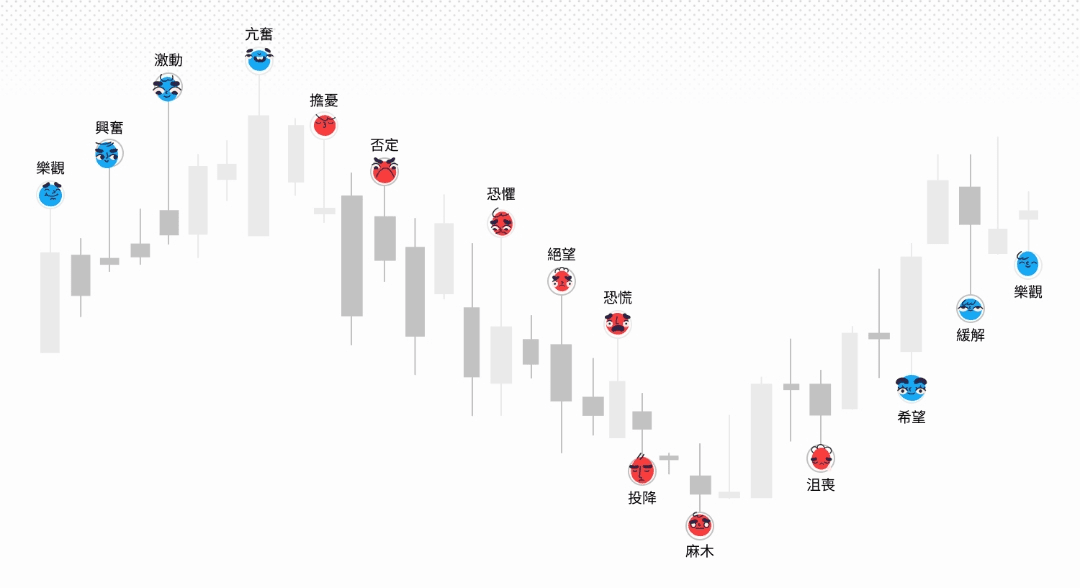
The market never cares about your feelings; your emotional fluctuations aren't due to harsh market conditions, but because you've exposed yourself to risks you shouldn't have taken.
Once emotion arises, you've already made a mistake
Many people attribute their problems to 'poor mindset'
But the truth is: emotion is not the cause, it's the result. When are people most likely to panic?
Over-leveraged position
Vague stop-loss
Logic is rejected, yet you remain in the market
If a trade's loss is entirely within your expectations, you wouldn't have any emotional reaction.
You'll calmly cut your losses, like shutting down a faulty program.
So remember one sentence:
Emotional outbursts indicate that risk control has already failed.
Two: All emotional breakdowns stem from three structural errors
Simplifying complex problems, you'll find that those who keep losing keep making the same mistakes:
Position size exceeds your understanding
Market fluctuations affect prices; you bear the volatility through your account.
Didn't calculate the worst-case scenario before entering
True fear comes from 'not knowing how much you might lose.'
Changing your logic mid-session
Once you start thinking during the session, you're already at a disadvantage.
Emotions aren't a human weakness,
Is a warning sign of incomplete trading structure.
Three: Why experts appear 'emotionless'
Many people think experts have strong mental resilience.
It's actually not at all.
They 'have no emotions'—and there's only one reason for that:
The risk of every trade is predictable and acceptable.
Fixed loss per trade
Stop-loss comes before entry
Don't make choices during the session
When wins and losses are within calculable limits,
Emotions naturally fade away.
It's not that you're not calm enough,
It's your trading approach that forces you to become emotional.
Four: True emotional management happens before placing the order
90% of emotional issues should be resolved before entering the market, not suppressed during trading.
There's only one correct sequence:
First define: what happens if this trade goes wrong?
Then reconsider: how much can I gain if I'm right?
Finally comes: whether it's worth taking action.
If you're still thinking while entering:
"Could it go up a bit more?"
"Should I wait and see?"
That means—
This trade should never have been taken.
Five: The only correct way to handle emotions when they arise
Once you realize you're starting to:
Frequent monitoring of the market
Wanting to add position to prove yourself
Continuously looking for reasons to justify the market move.
Don't review, don't argue about right or wrong.
Reduce position immediately, or even stop trading.
Any trade made during an emotional state,
The essence is always amplifying mistakes.
Truly mature traders don't rely on willpower to endure emotions,
But instead, avoid conditions that trigger emotions at the system level.