#baby $BABY Batch entering Bitcoin—at first glance, it just combines a few transactions into one; in TBV, it’s more like a test of state-management capabilities.
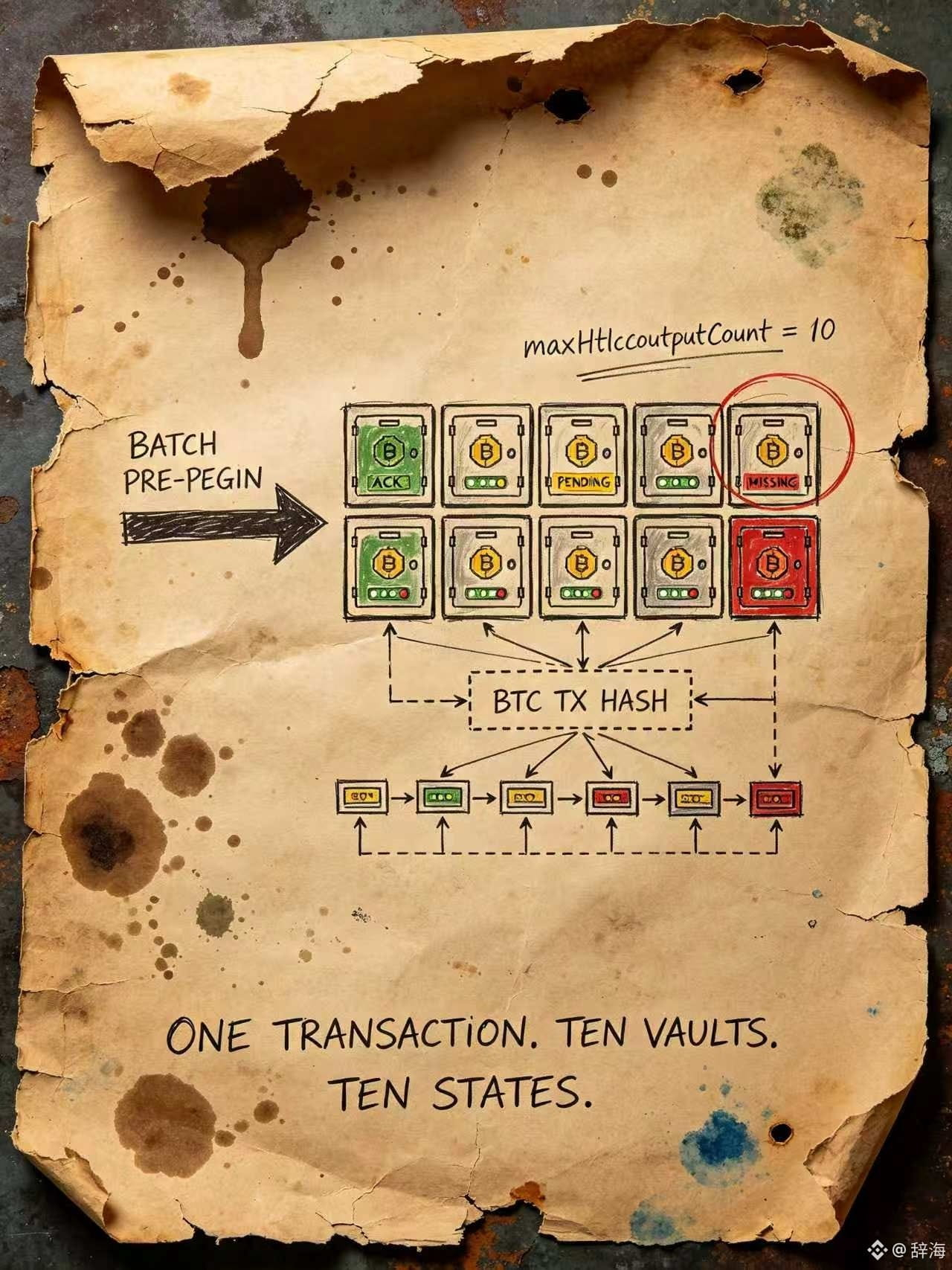
When I flipped through the parameters page and found “maxHtlcOutputCount,” I noticed that on the current public testnet, a single batch Pre-PegIn transaction can include at most 10 HTLC outputs. Multiple Vaults can share one Bitcoin transaction, but each output still keeps its own Vault state and exit conditions. For someone opening only one Vault, this limit is far away; for someone continuously creating many deposits, it directly determines entry cost and operational cadence.
Trouble comes after confirmation. Users can’t just watch a single transaction hash—they also have to separately confirm each Vault’s ACK, activation, and borrowable state. If the fee suddenly rises, or if the settings for one output aren’t completed on time, the efficiency gained from batching won’t automatically translate into a synchronized experience: the operator has to manage a set of states, while users bear the costs of waiting and making judgments. The saved transaction-organization cost may end up leaking out through the interface and customer-support steps.
This is also the part I pay closer attention to when looking at TBV’s batching design. It optimizes “how to put it in at once,” but it doesn’t remove the management differences among multiple Vaults. After @BabylonLabs_io , if we see failed retries for public batch Pre-PegIn and state changes for a single Vault, it’ll be easier to tell whether it’s actually lowering usage costs—or shifting complexity onto users. The TBV narrative after $BABY ultimately needs to hold up under this kind of detailed follow-up questioning.
When I flipped through the parameters page and found “maxHtlcOutputCount,” I noticed that on the current public testnet, a single batch Pre-PegIn transaction can include at most 10 HTLC outputs. Multiple Vaults can share one Bitcoin transaction, but each output still keeps its own Vault state and exit conditions. For someone opening only one Vault, this limit is far away; for someone continuously creating many deposits, it directly determines entry cost and operational cadence.
Trouble comes after confirmation. Users can’t just watch a single transaction hash—they also have to separately confirm each Vault’s ACK, activation, and borrowable state. If the fee suddenly rises, or if the settings for one output aren’t completed on time, the efficiency gained from batching won’t automatically translate into a synchronized experience: the operator has to manage a set of states, while users bear the costs of waiting and making judgments. The saved transaction-organization cost may end up leaking out through the interface and customer-support steps.
This is also the part I pay closer attention to when looking at TBV’s batching design. It optimizes “how to put it in at once,” but it doesn’t remove the management differences among multiple Vaults. After @BabylonLabs_io , if we see failed retries for public batch Pre-PegIn and state changes for a single Vault, it’ll be easier to tell whether it’s actually lowering usage costs—or shifting complexity onto users. The TBV narrative after $BABY ultimately needs to hold up under this kind of detailed follow-up questioning.