
We gathered genuine insights (positions) from frontline Builders, broke them down into a word cloud, and fed them into ChatGPT, Gemini, and DeepSeek.
Written by Frank, MSX Researcher at Maitong
For the same dataset, do you trust human interpretation or AI 'divination'?
It sounds like a cyberpunk joke, but in today's environment of countless opinions and high emotional intensity, what the market truly lacks are unfiltered, raw real-world samples.
After all, positions can be deceptive.
As we approach the pivotal transition point between 2025 and 2026, to get as close as possible to the truth of tokenization/Web3, we conducted an anonymous survey targeting frontline Builders at Maitong MSX, focusing on three key questions:
What are the keywords for US stocks/tokenization in your view for 2025;
What are your real positions in 2025 (not limited to US stocks/Web3);
What direction do you most want to allocate in 2026 (not limited to US stocks/Web3);
After a round of 'coercion and inducement', we managed to gather a sample size that was somewhat satisfactory, and compressed it into three cloud maps that hardly mixed subjective judgments. Considering that human interpretation inevitably involves bias, we decided to invite 'pure' ChatGPT, Gemini, and DeepSeek, under completely consistent prompt constraints, to see how they would interpret these three word cloud maps.
Perhaps, AI really understands this generation of Builders better than we do, and can piece together the fate puzzle of the US stock market, Web3, and tokenization for 2026 through these fragments.
1. What are the keywords for US stocks/tokenization in your view for 2025?
Prompt: You will see a set of keyword samples from front-line practitioners in US stock tokenization/Web3, which are used to answer the same question: 'What is your view of the US stock/tokenization field in 2025?'; do not judge right or wrong, nor introduce any external market information, only based on these keywords themselves, interpreting from the perspective of data structure and language characteristics, focusing on answering:
Which keywords have the highest/lowest/most abrupt frequencies, and what structural state might they reflect? Which keywords or semantic directions exhibit clear consensus characteristics, and are there keyword combinations with similar meanings, opposite directions, or strong tensions? What do these keywords overall suggest about the stage characteristics of the track? Based solely on these keywords, without introducing any external information, how would you interpret this track's 2025 and 2026?
Please maintain a descriptive and restrained analytical tone, avoiding investment advice or definitive judgments, and keep replies under 1000 words.
Editor's Note: The response has been slightly organized and polished to enhance readability, but the overall direction and thought process remain largely unchanged (same below).
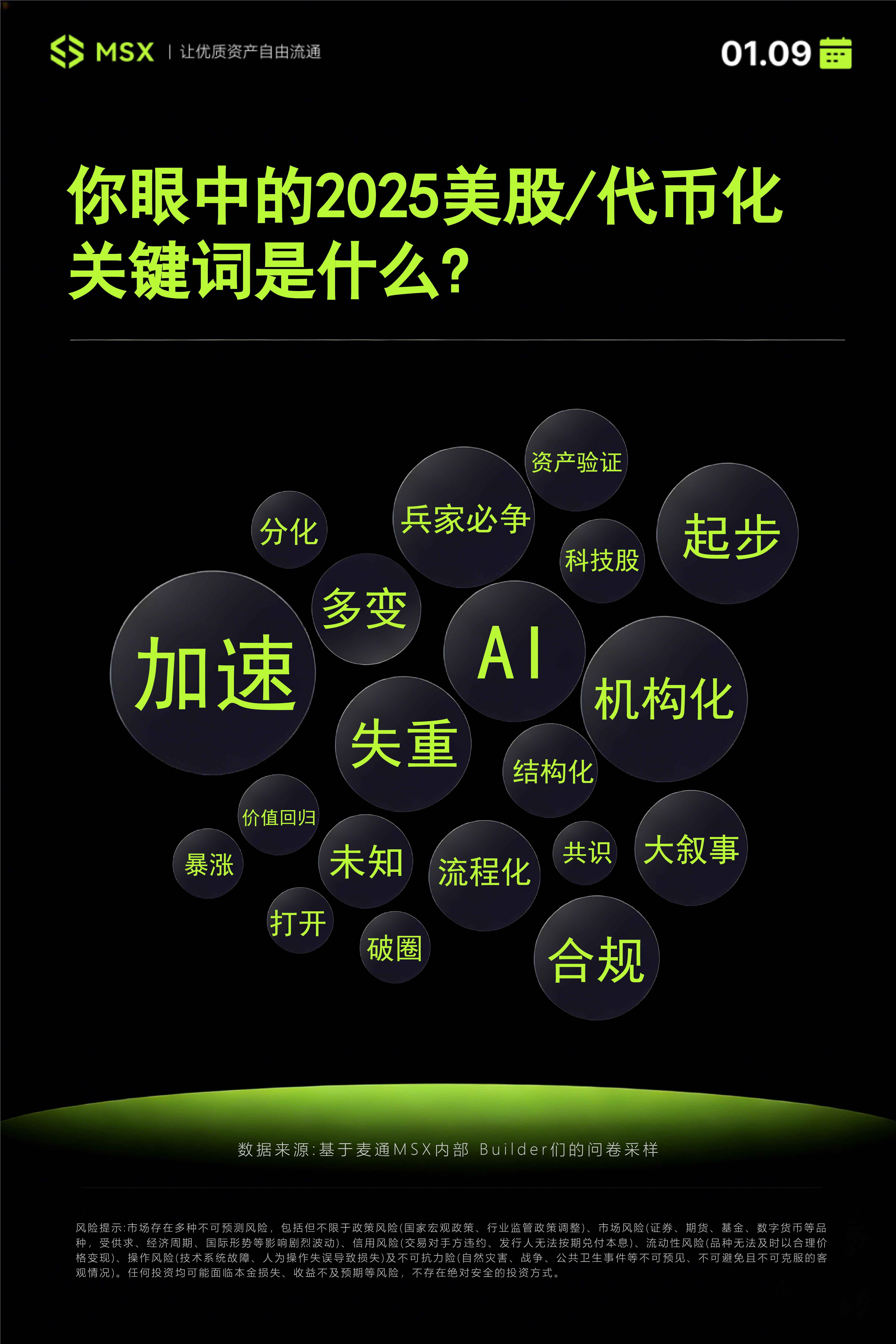
ChatGPT: The highest frequency keywords center around 'acceleration' and 'institutionalization', indicating that the track is undergoing a significant change in pace that has not yet stabilized; mid-frequency keywords include 'AI', 'compliance', 'differentiation', reflecting a contextualized and normalized existence; low-frequency or isolated words like 'weightlessness', 'unknown', 'a battlefield to be contended', 'starting point', carry strong subjective feelings or emotional metaphors, possibly reflecting individuals' discomfort, competition, or direct projection of uncertainty towards structural changes.
The overall corpus presents a language characteristic of 'mid-early stage—structural building phase', where high-frequency verbs outnumber nouns, indicating that the discussion focus remains on processes and changes, rather than stable forms; multiple keywords point to rules, validation, processes, rather than specific products or models; emotional vocabulary exists but has not formed a dominant presence, indicating that uncertainty is perceived but has not spiraled out of control.
If based solely on these keywords, 2025 can be understood as a transitional year of acceleration but not yet formed, with consensus gathering but simultaneously undergoing differentiation.
Gemini: High-frequency words include 'acceleration', 'institutionalization', indicating strong consensus regarding growth after professional involvement; mid-frequency words 'AI', 'compliance', 'differentiation' outline a state of uneven performance among technical means, regulatory frameworks, and market performance; relatively abrupt low-frequency words include 'weightlessness', 'proceduralization', 'asset validation', reflecting underlying anxiety beneath the prosperous facade, as well as a micro perspective shifting from narrative to grounding.
Overall data presents a state of 'high momentum, low center of gravity', where the coexistence of 'institutionalization' and 'compliance' indicates that this acceleration is not blind expansion but a structural shift constrained by rules, forming a definite tone for the industry.
In summary, the overall characteristics of the keywords suggest that the track is currently in a 'transitional explosive period', combining the chaos of the early stage (weightlessness, unknown) with the rigor of the eve of maturity (compliance, proceduralization), the market is no longer a monolith, but shows clear 'differentiation', indicating that tokenization is no longer an isolated asset experiment, but is beginning to deeply couple with mainstream finance and cutting-edge technology.
Overall, from 2025 to 2026, this is a moment of professional entry that runs in anxiety, reshapes within rules, and is highly dependent on technical validation.
DeepSeek: 'Acceleration' occupies the absolute core, while 'institutionalization', 'differentiation', 'compliance', and 'AI' form the second tier; most vocabulary appears only once, showing a discrete long-tail feature, for example, 'weightlessness' appears quite abrupt in the overall context leaning towards dynamic and positive vocabulary (such as acceleration, opening up, breaking the circle), possibly metaphorically indicating a temporary loss of traditional reference points amidst rapid changes.
The terms 'institutionalization' and 'compliance' are closely related, pointing to the trend of deep involvement of traditional financial system rules and participants; 'differentiation' suggests that there may be levels or paths separating within the market or track.
The dynamism of track development (acceleration, variability, turbulence) and the process of institutionalization (institutionalization, compliance, proceduralization, structuring) form the two strongest consensual semantic directions.
Both run parallel, depicting a field seeking rules and structural establishment amidst rapid changes.
2. Your real positions in 2025 (not limited to US stocks/Web3)
Prompt: You will see a set of keyword samples from front-line practitioners in US stock tokenization/Web3, which are used to answer the same question: 'What are your real positions in 2025 (not limited to US stocks/Web3)'; do not judge right or wrong, nor introduce any external market information, only based on the composition of the sample for logical analysis, interpreting from the perspective of data structure:
Classify the assets involved in the targets/tracks; is there a core asset that is repeatedly allocated? Is the overall position more concentrated or diversified, revealing what kind of risk tolerance? From these real positions, can any behavioral characteristics be observed?
Please maintain a descriptive and restrained analytical tone, avoiding investment advice or definitive judgments, and keep replies under 1000 words.
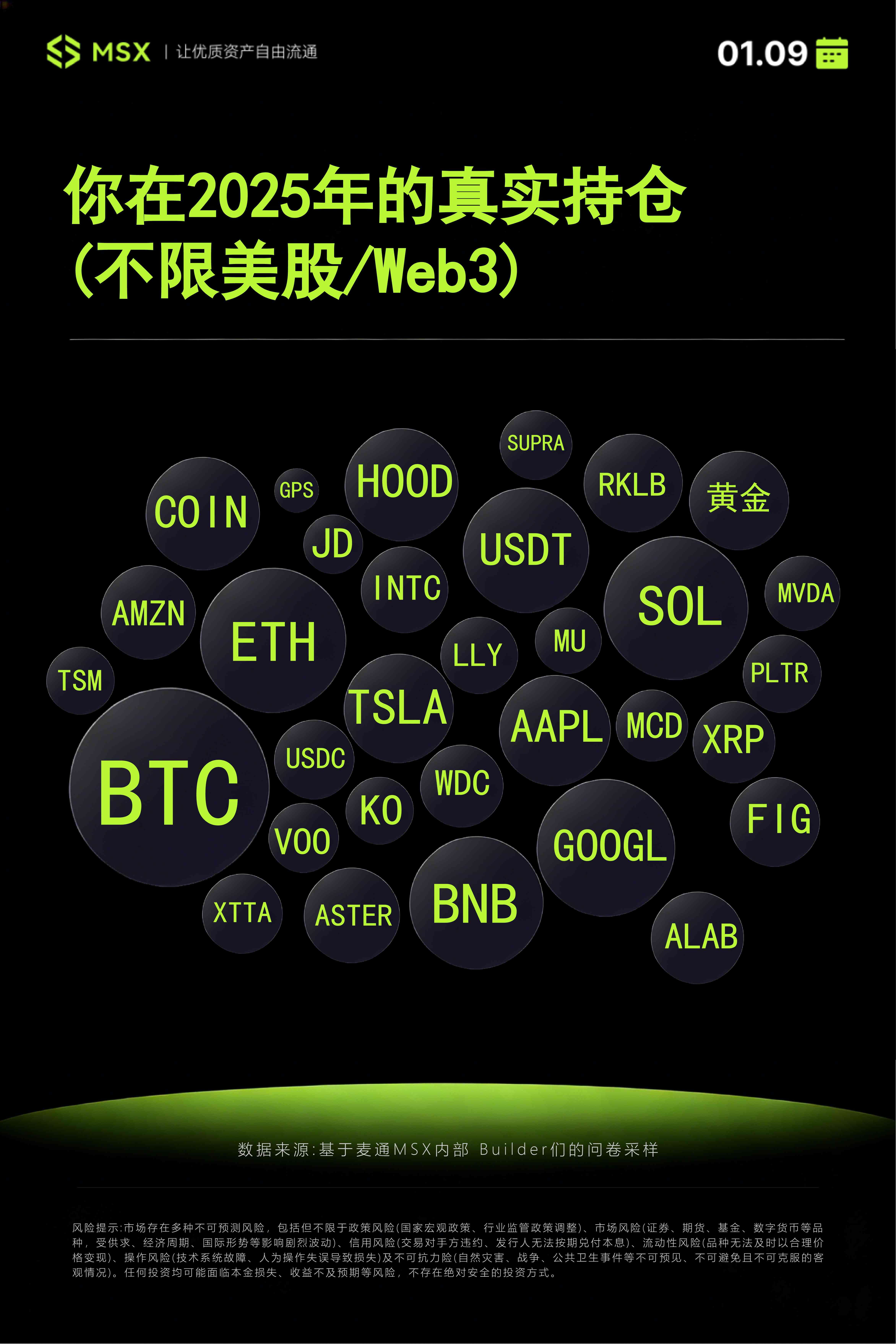
ChatGPT: From the sample structure, positions can be clearly categorized into several asset clusters.
Cryptocurrency native assets: high-frequency words include BTC, ETH, SOL, BNB, USDT, USDC, while secondary/marginal ones include XRP, DOGE, ASTER, SUPRA, XTTA; this category occupies a significant advantage in terms of quantity and repetition, and includes both mainstream assets and exploratory allocations;
US stocks related to technology and finance: including tech/platform types—GOOGL, AAPL, AMAZN, NVDA, TSLA, PLTR, INTC, TSM, MU, WDC; also including finance/trading-related—COIN, HOOD; showing a preference for choices leaning towards infrastructure, platforms, and technological capabilities;
US stocks in consumption and traditional defensive: MCD, KO, LLY, JD, etc., though not numerous, clearly play a structural hedging or stabilizer role;
Indices and cash-like/hedging: VOO, gold, USDT, USDC, etc., providing liquidity and volatility buffer in the overall portfolio;
From the frequency of repeated appearances, there is a very clear core asset layer:
BTC is the most frequently mentioned single target in the sample, appearing multiple times and densely;
GOOGL has the highest repetition on the US stock side, significantly higher than other tech stocks;
ETH, SOL, BNB form a second layer of repeatedly allocated crypto asset combinations;
USDT, as a non-risk asset, has also been mentioned multiple times, indicating that it is not a 'transitional existence';
This structure indicates that respondents do not hold positions in an evenly distributed manner, but rather repeatedly accumulate on a few high-confidence assets while maintaining diversification in the periphery.
If based solely on this set of real holding keywords, without introducing any external judgments, it can be understood as a configuration structure that anchors on a few core assets while concurrently allocating across multiple asset systems, retaining liquidity and exploratory space.
Gemini: Through initial sorting of the sample data, these holding targets can be divided into the following five major categories.
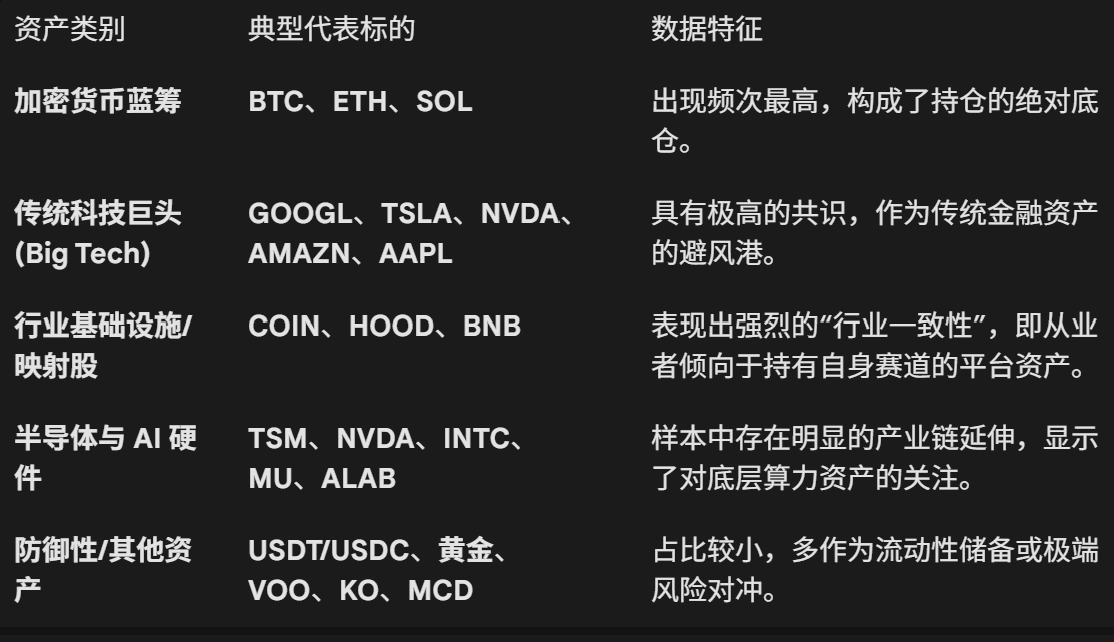
The data structure shows a highly significant phenomenon of consensus centralization in this group. Among them, BTC is the most mentioned target, followed by GOOGL, ETH, and SOL, which together form the 'four anchor points' of practitioners' holdings in 2025.
The high frequency of BNB, TSLA, and USDT also reflects a dual consideration of industry ecological status and liquidity while pursuing high beta returns.
Despite the diversity of involved targets, about 50% of the sample size is occupied by the top 5-6 core targets, indicating that practitioners' strategies in 2025 were not scattergun allocations, but rather highly concentrated chips on blue-chip assets with strong narrative support.
Specifically, the risk tolerance approach can be summarized as a barbell strategy, with one end being extremely high-volatility tech growth and crypto assets, such as RKLB (aerospace), SOL, and various semiconductor targets; the other end being extremely high liquidity or certainty, such as USDT, gold, VOO (S&P 500 ETF).
Although there are traditional value stocks like MCD (McDonald's) and KO (Coca-Cola) in the sample, they are merely embellishments, indicating that in the holding logic of 2025, the status of traditional dividend-paying assets has been marginalized, with practitioners more inclined to define 'value return' as 'technology growth supported by cash flow'.
DeepSeek: The holding targets in the samples can be roughly categorized into three types:
Cryptocurrencies: including BTC, ETH, SOL, BNB, XRP, DOGE, etc., these assets appear frequently and cover both mainstream and some altcoins;
Stablecoins and commodities: stablecoins like USDT and USDC, commodities like gold, these assets are usually related to low price volatility hedging or liquidity management;
US stocks cover multiple industries and market values: including tech stocks—GOOGL (Google), AAPL (Apple), TSLA (Tesla), NVDA (NVIDIA), COIN (Coinbase), PLTR (Palantir), INTC (Intel), MU (Micron Technology), TSM (TSMC), etc.; consumer and traditional industry stocks: such as MCD (McDonald's), KO (Coca-Cola), LLY (Eli Lilly), etc.; financial and platform stocks: such as HOOD (Robinhood), FIG (possibly financial group), etc.; ETFs: VOO (S&P 500 Index ETF);
Core assets (BTC, GOOGL, ETH, SOL) account for about 37% of total occurrences, making the holding structure exhibit a 'core concentrated, periphery dispersed' characteristic, that is, a heavier allocation on core assets while diversifying investments in numerous other targets.
Overall, the data structure of this holding sample shows a configuration approach that seeks balance between risk and opportunity, anchoring core tracks while building buffers through diversification and hedging tools.
3. Your preferred allocation direction for 2026 (not limited to US stocks/Web3)
Prompt: You will see a set of keyword samples from front-line practitioners in US stock tokenization/Web3, which are used to answer the same question: 'What direction do you most want to allocate in 2026 (not limited to US stocks/Web3)'; do not judge right or wrong, nor introduce any external market information, only based on the composition of the sample for logical analysis, interpreting from the perspective of data structure:
Classify the assets involved in the targets/tracks; in 2026, which tracks/targets do these investors prefer more, is there a core asset that is repeatedly allocated? Is the overall position more concentrated or diversified, revealing what kind of risk tolerance? From these real positions, can any behavioral characteristics be observed? What are the assets/tracks with the highest consensus in 2025 and 2026, and what changes occurred?
Please maintain a descriptive and restrained analytical tone, avoiding investment advice or definitive judgments, and keep replies under 1000 words.
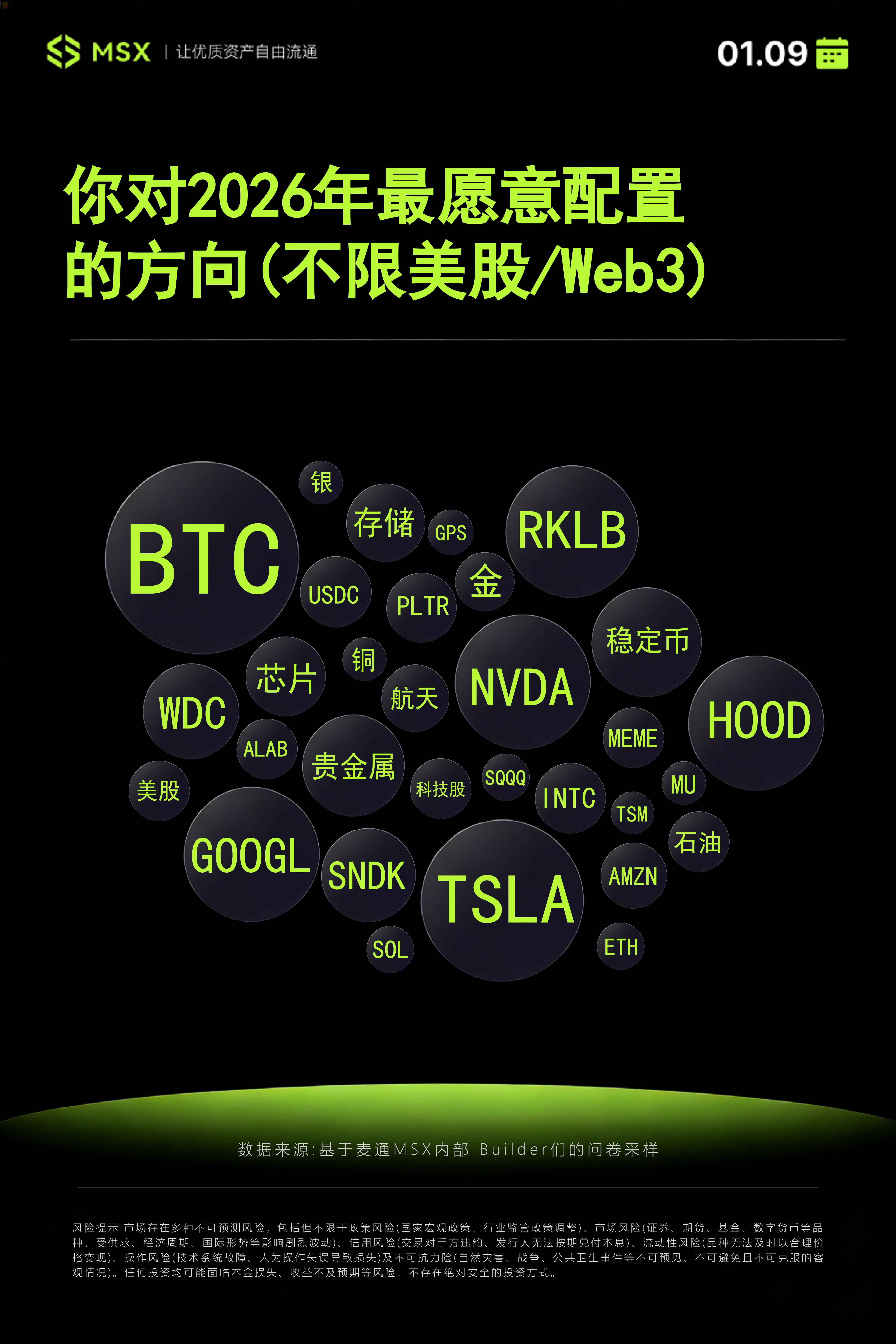
ChatGPT: Compared to 2025, the keywords for 2026 show a significant change: specific targets and abstract tracks begin to appear side by side, indicating that respondents emphasize directional and structural judgments more when expressing allocation intentions, rather than single asset choices.
The samples can be roughly divided into the following categories:
Cryptocurrency native assets: BTC, ETH, SOL are the core high-frequency words, while stablecoins and MEME crypto assets still occupy the center of the sample, but show clear internal stratification.
US stock technology and high-tech direction: on the individual stock level, focus is on TSLA, GOOGL, NVDA, AMZN, PLTR, HOOD, while on the track level, focus is on tech stocks, chips, storage, and aerospace, with a very obvious transition from 'stock selection' to 'industry direction';
Commodities and physical assets: precious metals (gold, silver, copper), oil were not prominent in the 2025 sample but were significantly mentioned in the 2026 willingness.
Indices and hedging tools: S&P, SQQQ represent concerns about overall market or systemic volatility;
In terms of repetition, the core of 2026 is very concentrated: BTC remains the keyword with the highest frequency, far exceeding other assets; TSLA and NVDA appear repeatedly on the US stock side, significantly higher than other individual stocks.
If based solely on this set of keywords, the allocation intent for 2026 can be understood as focusing on a few highly consensual core assets and industry directions, while expressing this through track-oriented, resource-oriented, and tool-oriented approaches to cope with uncertainty.
Gemini: The sample data for 2026 shows a wider span than in 2025, which can be summarized into the following four categories:
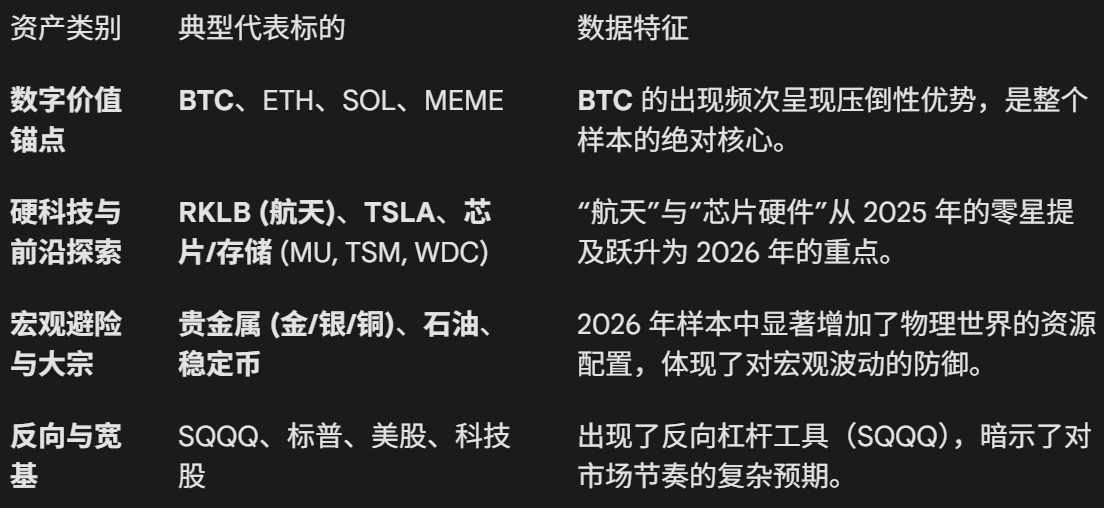
BTC was mentioned more than half the time in the 2026 sample, being the only asset with characteristics of full consensus; TSLA and RKLB/aerospace follow closely, and compared to 2025, practitioners' willingness to allocate to hardcore technology and space exploration has significantly increased, indicating that investment perspectives are extending from digitalization to the extreme frontiers of the physical world.
The holding structure presents a 'one pole many strong' bell-shaped structure, one pole being the extremely concentrated BTC, the other pole being the very dispersed hard tech targets (involving multiple subdivisions such as aerospace, storage, semiconductors).
Risk tolerance is characterized by the coexistence of 'extreme aggression and extreme defense'; on one hand, allocating high-volatility assets like MEME and RKLB, while on the other hand, introducing hedging tools like SQQQ, gold, silver, copper, and oil, indicating that practitioners expect not a one-sided increase in 2026, but structural opportunities amidst severe volatility, with their risk tolerance shifting from a singular pursuit of growth to managing uncertainty.
Overall, in the keywords for 2026, the density of gold, silver, copper, oil, storage, and aerospace has significantly increased, reflecting that after practitioners have deeply cultivated in the digital track (Web3), the logic begins to lean towards tangible assets and underlying energy/resources.
Deep exploration of the industrial chain is also a typical characteristic; respondents are no longer satisfied with allocating to leading chip stocks like NVDA, but are extending down to storage and specific hardware segments such as MU, WDC, SNDK, showing a professional deep-digging behavior based on industry understanding.
If 2025 was about practitioners 'building roads' (focusing on compliance, platforms, and infrastructure), then 2026 is about 'expedition' (focusing on aerospace, deep hardware, and global bulk resources).
DeepSeek: From the word frequency statistics, BTC has the highest frequency, accounting for 20.4% of total mentions, followed closely by TSLA (9.3%), with the two together accounting for about 30%, indicating a relative concentration on top preferences. NVDA, RKLB, GOOGL, HOOD, stablecoins, and precious metals are also mentioned multiple times, but overall remain dispersed among many targets and themes, presenting a 'core-peripheral' structure—core highly concentrated in a few assets, while the periphery is widely dispersed.
Among them, cryptocurrencies (especially BTC) and tech stocks (TSLA, NVDA, etc.) are the main directions, while thematic tracks such as aerospace (represented by RKLB), chips, storage, and hedging assets like precious metals and stablecoins are also receiving attention.
It is worth noting that the allocation of stablecoins, precious metals (gold, silver, copper), oil, and SQQQ is more pronounced than in the 2025 holding sample, indicating a defensive mindset towards macroeconomic uncertainty or market corrections.
On the individual stock/target level, compared to 2025, the consensus around BTC has further strengthened, maintaining its absolute core; while the consensus around GOOGL, ETH, and SOL has significantly declined, the consensus around TSLA and NVDA has increased, which may reflect a shift in allocation focus from dispersed cryptocurrencies and large tech stocks to more specific leading targets.
On the track level, allocation direction expands to thematic tracks (aerospace, chips, storage) and commodities (precious metals, oil), with consensus spreading from specific targets to diversified themes.
Overall, the data structure shows that from 2025 to 2026, the consensus on configuration has evolved from a broad layout of cryptocurrencies and tech stocks to strengthening the core of Bitcoin, focusing on specific tech targets, and increasing thematic investments and hedging configurations, reflecting adjustments in investors' strategies during the evolution of the track: seeking a balance between growth and defense in uncertainty.