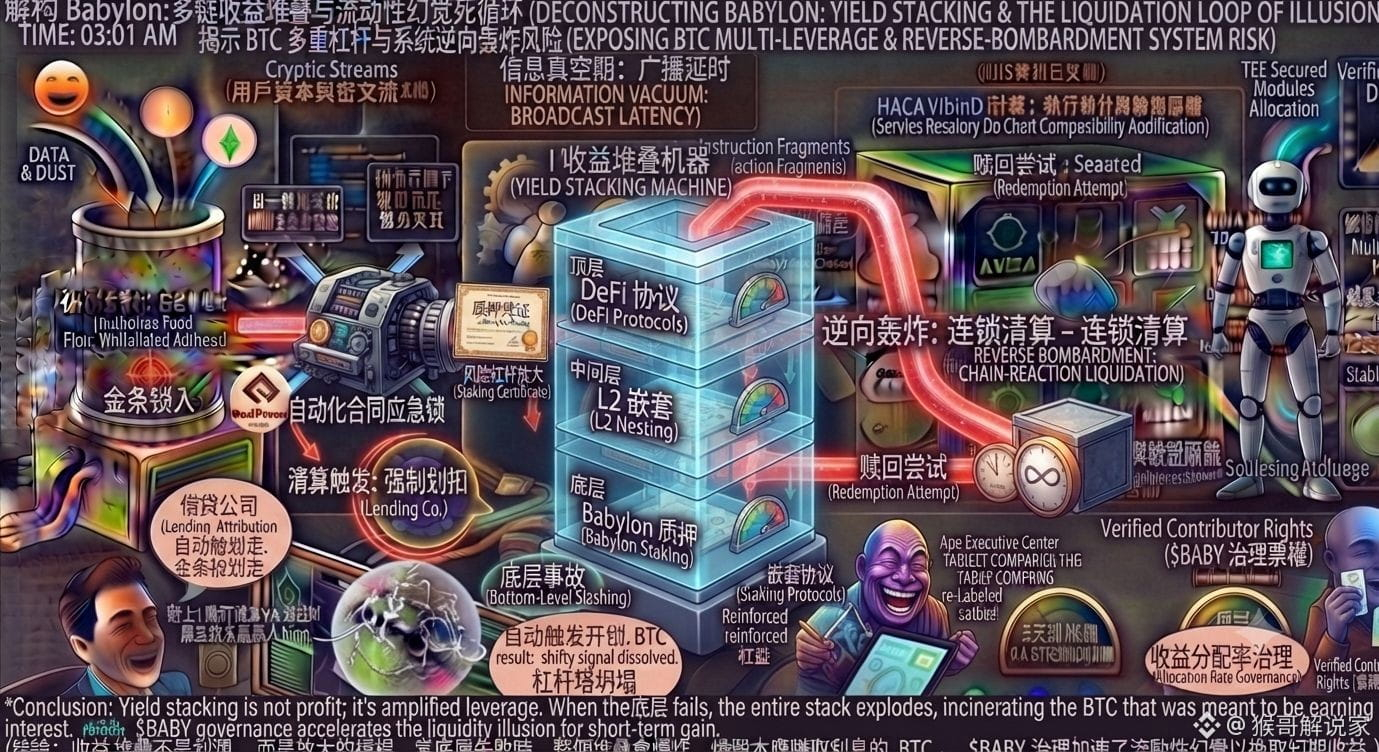
@BabylonLabs_io Whitepaper section 14.1: the passage about “Multi-chain Yield Stacking (Yield Stacking) and Re-staking Re-securitization.” I did the math—and my spine chills: **“A Dead Loop under the Liquidity Illusion.”**
The whitepaper pitches itself as “letting BTC enjoy both security and multiple kinds of returns,” allowing users to embed staked BTC certificates back into various L2 and DeFi protocols to earn interest.
The logic sounds beautiful, but there is no such thing as a free lunch in finance. You think you’re earning risk-free interest—what you’re really doing is multiplying the risk leverage of the exact same BTC many times over. When something goes wrong at the bottom—say, a small chain experiences a security incident that triggers Slashing (penalties), or a downstream lending protocol suffers bad debt—this chain reaction will blast backward along the yield chain.
It’s like mortgaging your house to a bank to borrow money, using the borrowed funds to buy investments, and then pledging the investment certificates to a third party to get a high-interest loan. Everything looks fine until the very foundation is shaken even slightly—then the entire leverage tower collapses instantly, and you don’t even get a chance to redeem your house.
$BABY here becomes the lubricant that accelerates the breakdown. Section 10 says that $BABY is responsible for adjusting the yield distribution rates across each nested protocol. Large token holders have strong incentives to push up nested yield rates to prop up the token price, luring more retail users to push BTC into this risk-exceedingly complex leverage machine.
My take: yield stacking doesn’t stack profits—it stacks risk. Code can make the logic look very elegant, but it can’t eliminate the fatal weakness of leverage itself. #baby
As usual, DYOR—don’t be blinded by the “easy multi-yield” illusion. When the storm hits, will that income-generating BTC really be laying golden eggs for you, or providing kindling for a Ponzi structure? Share your views in the Binance Square comments.
#baby $BABY
The whitepaper pitches itself as “letting BTC enjoy both security and multiple kinds of returns,” allowing users to embed staked BTC certificates back into various L2 and DeFi protocols to earn interest.
The logic sounds beautiful, but there is no such thing as a free lunch in finance. You think you’re earning risk-free interest—what you’re really doing is multiplying the risk leverage of the exact same BTC many times over. When something goes wrong at the bottom—say, a small chain experiences a security incident that triggers Slashing (penalties), or a downstream lending protocol suffers bad debt—this chain reaction will blast backward along the yield chain.
It’s like mortgaging your house to a bank to borrow money, using the borrowed funds to buy investments, and then pledging the investment certificates to a third party to get a high-interest loan. Everything looks fine until the very foundation is shaken even slightly—then the entire leverage tower collapses instantly, and you don’t even get a chance to redeem your house.
$BABY here becomes the lubricant that accelerates the breakdown. Section 10 says that $BABY is responsible for adjusting the yield distribution rates across each nested protocol. Large token holders have strong incentives to push up nested yield rates to prop up the token price, luring more retail users to push BTC into this risk-exceedingly complex leverage machine.
My take: yield stacking doesn’t stack profits—it stacks risk. Code can make the logic look very elegant, but it can’t eliminate the fatal weakness of leverage itself. #baby
As usual, DYOR—don’t be blinded by the “easy multi-yield” illusion. When the storm hits, will that income-generating BTC really be laying golden eggs for you, or providing kindling for a Ponzi structure? Share your views in the Binance Square comments.
#baby $BABY