
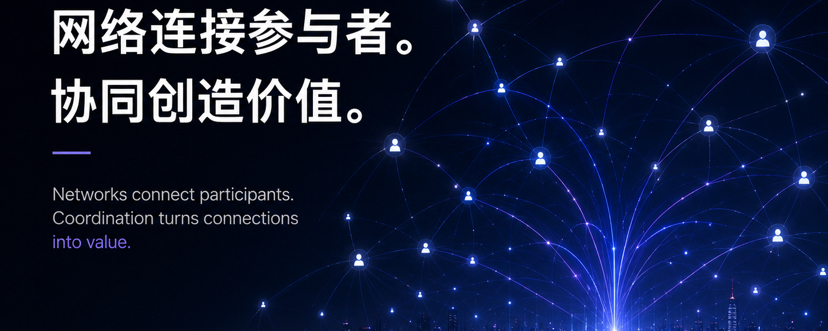

The previous article discussed network effects.
As more users, developers, capital, and applications enter the same system, the network value may continue to grow.
But after the network has formed, there is an even more important question:
Can these participants continue to create the value each other needs within the same set of mechanisms?
The more participants there are, it doesn’t necessarily mean the system is stronger.
If the goals conflict among different roles, incentives are unbalanced, and the rules are unclear, then the larger the network, the more friction there may be.
So what truly supports long-term market expectations isn’t just the size of the network.
Instead, it’s the system’s coordination capability.
⸻
1. Participants joining does not mean coordination is already in place
Many projects emphasize:
How many users
How many developers
How many partners
How many community members
These numbers can prove the project has gained attention, and they may also indicate that the network is expanding.
But they cannot directly prove:
Participants are jointly creating value
Users may come for rewards
Capital may flow in with hotspots, and also leave with hotspots
Developers might complete one deployment but not continue building.
Partners may also only complete a one-off joint promotion.
Just because everyone enters the same ecosystem doesn’t mean coordination has been formed.
⸻
2. True coordination does not require everyone to have the same goals
Participants in an ecosystem usually have completely different goals.
Users want a better experience.
Developers want users, traffic, and revenue.
Capital providers want a return.
App-side parties want to reduce build and integration costs.
Governance participants want the protocol to develop long term.
Truly excellent mechanisms are not those where everyone has the same goal.
It’s not that people with different goals can’t still create value together through the same set of rules.
In other words:
Coordination is not eliminating differences in interests; it is organizing those differences so they can be acted on.
⸻
3. Uniswap is a case well worth observing
Within Uniswap, there are multiple roles:
Liquidity providers provide assets and trading depth
Traders create real trading demand
Developers use the protocol and APIs to build new products
Wallets, aggregators, and apps provide new entry points for users
Governance participants decide part of the protocol’s rules and the way value is allocated
These participants do not have completely identical goals
But through open contracts, liquidity rules, fee structures, and composable infrastructure, the protocol allows them to form interdependent value relationships.
Liquidity attracts trades, and trades generate fees;
Better trading conditions attract more integrations; more integrations bring more users;
New users and assets also add demand for liquidity.
What’s truly important here is not merely that more participants are involved.
Instead:
Value created by one role can become a reason for another role to continue participating.
⸻
4. The meaning of v4 is not just adding new features
One thing about Uniswap v4 worth paying attention to is that it lets developers design more customizable mechanisms on top of liquidity pools through Hooks.
Recently launched Permissioned Pools can embed compliance constraints directly into on-chain trading rules via v4 Hooks, targeting tokenized funds, securities, and other permissioned assets. The DualPool Hook, meanwhile, lets market makers earn lending revenue while waiting for trading demand.
From the perspective of market expectations, the significance of these changes is not just that there are “two more functions.”
Instead, Uniswap is trying to connect more different types of participants:
DeFi users
Professional market makers
Asset issuer
Compliance institutions
Wallets and apps
Developers
When the protocol can accommodate more demands without turning all participants into the same kind of user, the system’s coordination boundaries expand.
⸻
5. The core of coordination capability is lowering the cost of forming value connections
Whether a system can form coordination largely depends on:
Are the value relationships among participants easy enough to build?
Do developers need to rebuild all the underlying infrastructure?
Can applications directly plug into existing liquidity?
Can the asset issuer configure rules that suit it?
Can users use the protocol directly through wallets or third-party apps?
Uniswap’s recent development direction has also gradually expanded from a single trading interface to APIs, wallet integrations, multi-chain deployments, developer tools, and customizable liquidity infrastructure. Its API has been integrated by products such as MetaMask, Zerion, and Privy; the protocol has also moved onto different networks such as Robinhood Chain, MegaETH, Linea, and Tempo.
This shows that competition for a mature protocol is no longer just:
“Whether users come into my product.”
Instead:
Can my capabilities be integrated into more people’s products and business workflows?
⸻
6. Why is coordination growth harder to replicate than user growth?
User growth can be achieved through subsidies, airdrops, and events.
But coordination capability needs to be formed over the long term.
Because it depends on:
Stable rules
Clear value relationships
Reliable infrastructure
Sustainable economic incentives
and the trust repeatedly formed through collaboration among different roles
An ecosystem may have many users in the short term.
But only when participants can continuously obtain value and keep creating value for other participants can the system plausibly shift from being externally driven to internally driven.
⸻
7. Uniswap also faces real contradictions in coordination
Coordination does not mean there are no conflicts.
For example, protocol fees may strengthen the link between UNI and the protocol’s economic activity, but they may also affect liquidity providers’ expectations of returns.
In recent governance discussions about activating v4 protocol fees, one of the core questions is: how to balance protocol value capture with LP competitiveness. In the discussions, Uniswap Labs said that after gradually enabling fees previously, the overall liquidity of some key v3 pools remained stable, while v4 growth came more from newly added assets, LPs, Hooks, and new use cases. However, this still needs ongoing observation and cannot be judged as a long-term outcome based on a single governance vote.
This precisely indicates:
Coordination is not making every participant get the maximum possible benefit; it’s finding a balance that the whole system can operate stably in the long run.
⸻
8. Why does the market reprice coordination ability?
Because coordination capability means:
The system no longer relies entirely on the project team to drive it.
Developers can keep building.
Applications can keep connecting.
Liquidity can serve different needs.
New assets and users can enter through existing networks.
What the market starts to see is no longer just how many products a team can launch.
Instead:
Whether the whole system can organize different participants and keep producing shared outcomes.
This will significantly change how the market judges the project’s long-term boundaries.
⸻
Inspiration for Web3 projects
When many projects manage market expectations, they first think of:
How to unify the narrative?
How to expand reach?
How to attract more users?
But before you can spread it, you also need to answer a more fundamental question:
Have clear value relationships already formed among users, developers, capital, the community, and partners?
Who creates value?
Who receives value?
Who bears the cost and risk?
Who gains more value when another role joins?
If coordination is lacking internally, even the strongest promotion can only expand attention; it’s hard to form long-term expectations.
⸻
My understanding is:
Rules define relationships.
Incentivized organizational behavior.
Behavior forms coordination.
Coordination creates shared outcomes.
Shared outcomes shape market expectations.
What’s worth studying about Uniswap is not just how many users or how much trading volume it has.
It’s whether it can continue to help liquidity providers, traders, developers, apps, and asset issuers create the value each other needs, continuously, within the same open mechanism.
Network-connect participants
Coordination determines whether these connections can continue to create value.
Not investment advice—just as an observation of market mechanisms and the industry.
#Uniswap #UNI #DeFi #Coordination #MechanismDesign #MarketExpectation #BinanceSquare