2026 will undoubtedly be a big year for crypto savings. On one hand, the poor performance of altcoins has continuously lowered users' risk appetite, and the early surge at the end of 2025 has already served as a lever reduction for the sector. On the other hand, Circle's upcoming IPO and the emergence of new stablecoins backed by major institutions indicate that the capital market subsidy model is still alive. In recent weeks, Binance and other CEXs/wallets have launched campaigns similar to the subsidies seen during the early days of internet-era ride-hailing and food delivery. Reliable APYs of 10%–30% could very well become the norm.
Given the current context, I think the most important factors in assessing the reliability of a savings project are the following:
1) Is the background trustworthy? Who are you entrusting your money to?
2) Business model reliability: Where does the return come from?
3) Data reliability: Can the data be verified?
For example, analyzing Binance Boost's newly launched Unitas using this logic:
#Conclusion: Feel free to participate during the campaign
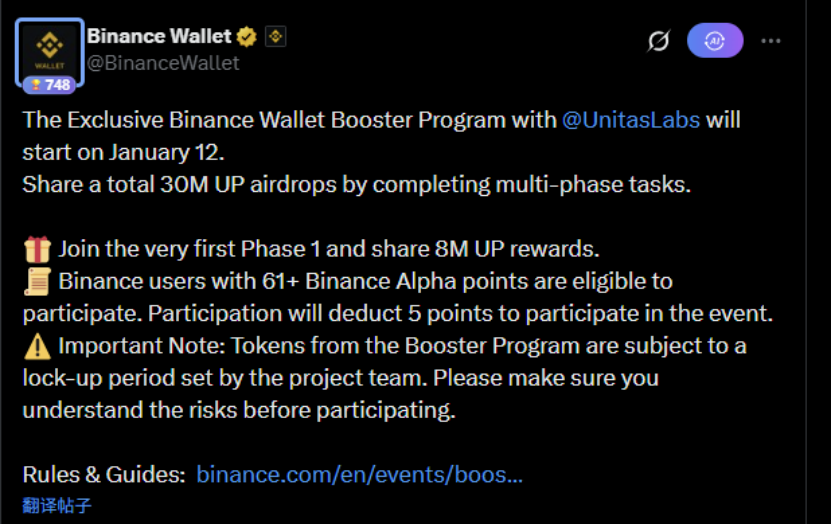
1) Background reliability. From my personal perspective, large funds should only be deposited in major exchanges (Top 2 globally + Top 2 in Europe and America) and Binance's campaign projects, especially those within the Binance Wallet campaign period. There are two reasons: first, before a project is listed on Binance, Binance conducts a series of due diligence checks, including security, project background, and mechanisms. Second, being listed on Binance campaigns comes with additional terms and restrictions, significantly reducing the risk of exit scams. While Boost campaigns tend to focus on small deposits, the protocol's total TVL is still relatively low. Depositing directly via the project's official website for potential rewards is also acceptable (no limits, and even without a token, you can expect an annual yield of around 13%).
2) Business model reliability. Simply put, where does the return come from? The key points here are two: ① Is the return sustainable? ② Is the return real? Unitas's strategy mainly involves using CEX + JLP to construct a Delta Neutral strategy. Under full hedging, the only potential risk points are those related to JLP and the CEX itself—both of which carry very low probabilities.
3)
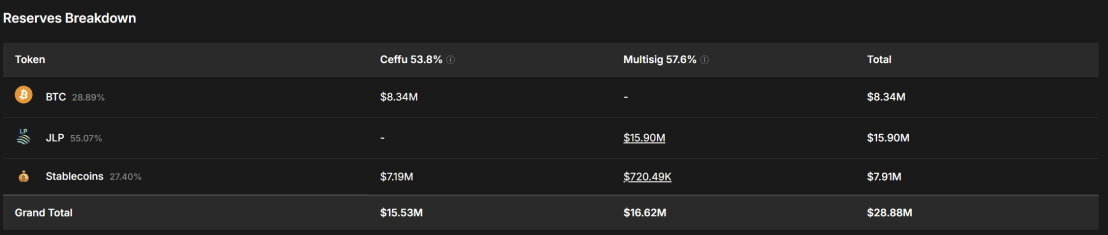
Data reliability. Almost every project claims their assets are transparent and verifiable, yet many still fail. The core reason is that many projects merely list their assets on paper but cannot truly prove control over them (e.g., so-called 'accounts receivable' or assets that aren't actually reliable—such as using their own issued XXToken as proof). Some even publish so-called 'accountant statements' to fool users who don't understand the technical details.
Data reliability depends on two key factors:
1) Assets are fully visible on-chain or held by a trusted third party. Just like in traditional finance, where stock account funds are held by banks to prevent brokers from directly accessing the funds. In crypto, if the project itself holds the funds, no matter what technology you use, it's essentially the same as sending money directly to the project founder's hot wallet.
Currently, the more reliable third-party custodians are: Bitgo, Fireblocks, Coinbase Custody. If it involves a centralized exchange, Ceffu (Binance-affiliated) is generally the best choice.
2) Asset proofs are issued by independent third parties. There's a detail here: some projects may engage lesser-known audit or verification firms, essentially having one hand prove something for the other hand. Such proofs are meaningless. Larger institutions with more diversified clients are more reliable. For instance, the Big Four would never collude with obscure projects. If a third-party verification firm has many mainstream project clients, the likelihood of them conspiring with any single project is very low.
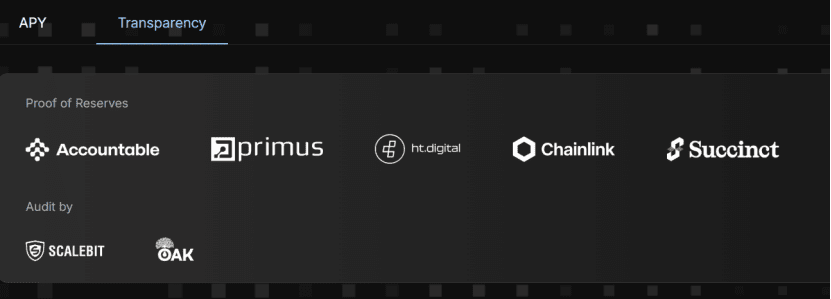
Unitas is one of the best projects in the crypto space. Funds are securely held through on-chain mechanisms (multi-signature, fully transparent) and CEX custody (managed by Ceffu). Asset proofs are issued by five different institutions. Accountable's Proof of Solvency currently lists 10 clients, with assets exceeding $2 billion. HT Digital and Promus also have numerous mainstream clients. In my view, these three are quite trustworthy.