
SMART HOME
The smart home revolution
How automation is transforming security, comfort, and energy efficiency
Cover
Main title
Smart Home
The future of housing is already in our hands
Cover image (full page):
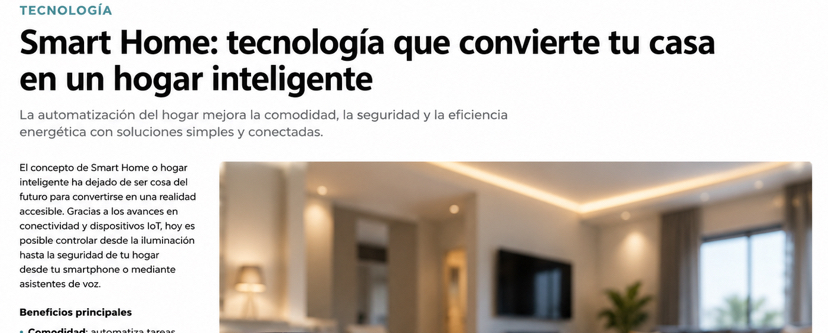
A modern home equipped with smart lighting, electronic locks, security cameras, and voice assistants.
Blue and white tones to convey innovation and technology.
Introduction
Over the last decade, Smart Home technology has evolved from a futuristic concept into a present reality in millions of homes. Thanks to the Internet of Things (IoT), Artificial Intelligence, and wireless connectivity, today it is possible to control virtually any household device from a mobile phone.
Smart homes offer a fully personalized experience, where comfort, security, and energy savings work together to improve quality of life.
What is a Smart Home?
A Smart Home is a home equipped with electronic devices connected to each other through the Internet.
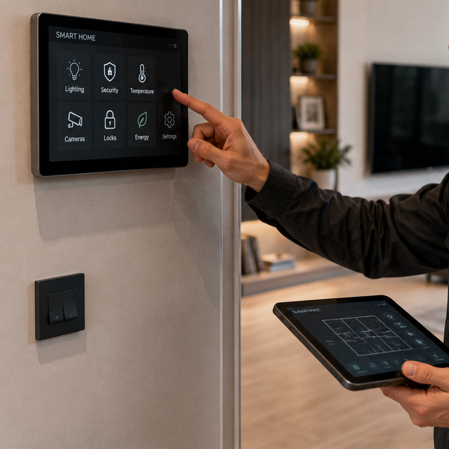
These devices make it possible to automate functions such as:
✓ Lighting
✓ Climate control
✓ Security
✓ Shutters
✓ Irrigation
✓ Appliances
✓ Energy consumption
All of this can be managed from a single mobile app or via voice assistants.
Main benefits
1. Maximum comfort
Automated routines allow the home to respond to our habits.
Examples:
• Automatic turning on of lights.
• Opening of shutters at dawn.
• Turning on the air conditioning before you get home.
• Personalized ambient music.
2. Smart security
Modern systems include:
• 4K IP Cameras
• Smart locks
• Motion sensors
• Smoke detectors
• Connected alarms
The entire system can be monitored from anywhere in the world.
3. Energy savings
A Smart Home helps reduce consumption by:
• Smart LED bulbs
• Automatic thermostats
• Smart plugs
• Monitoring of electricity consumption
The result is lower energy use and a more sustainable home.
Essential devices
Device
Function
💡 Smart bulbs
Lighting automation
🌡️ Smart thermostat
Temperature control
🔒 Smart lock
Secure access
📹 IP Camera
Remote monitoring
🎙️ Voice assistant
Central control
🔌 Smart plugs
Energy consumption management
🚪 Sensors
Automation and security
Smart Home ecosystem
Smartphone
│
▼
Smart Home Hub
│
├──────── Lights
├──────── Cameras
├──────── Locks
├──────── Thermostat
├──────── Shutters
├──────── Sensors
└──────── Voice assistant
Trends for 2030
The next generation of smart homes will integrate:
• Advanced Artificial Intelligence.
• Household robots.
• Energy management through solar panels.
• Smart charging for electric vehicles.
• Automatic consumption prediction.
• Preventive maintenance of appliances.
Homes will learn their inhabitants’ habits to anticipate their needs.
Conclusion
The smart home is no longer a thing of the future, but the present. The integration of connected devices, automation, and Artificial Intelligence are redefining how we interact with our domestic environment.
Investing in Smart Home technology means choosing a home that is safer, more efficient, more comfortable, and ready for the challenges of the future.
Editorial design proposal
Cover: panoramic photo of a modern smart home.
Inner pages: alternate text blocks with images of voice assistants, cameras, thermostats, and smart locks.
Infographics: include a diagram of the Smart Home ecosystem and a comparative chart of benefits.
Color palette: white, electric blue, and anthracite gray to convey a technological and professional identity.
Typography: titles in a modern sans-serif font and clean body text to make reading easier.