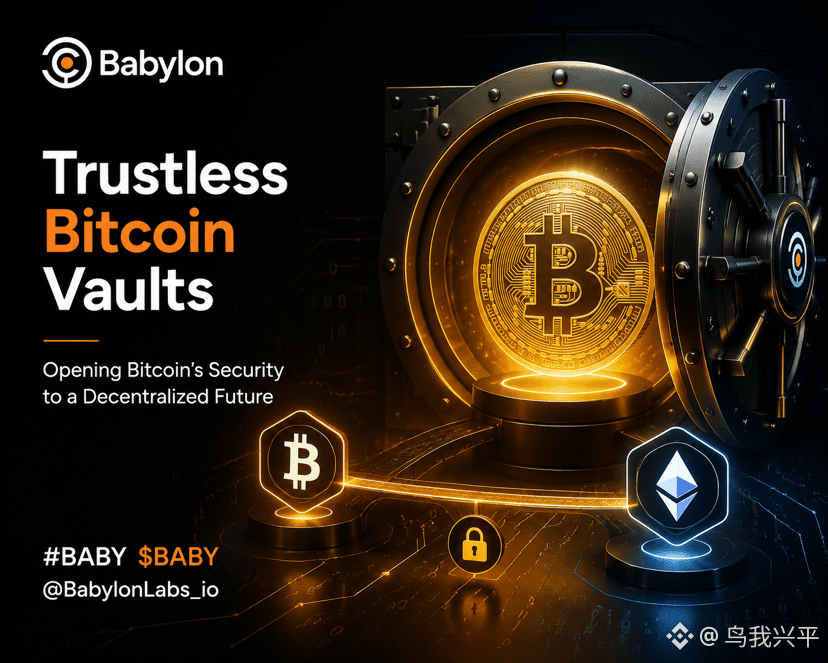
Research TBV (Trustless Bitcoin Vaults) to Day 7. What I believe is truly worth attention is not just scenarios where BTC earns more yield, but solving a deeper problem:
How can Bitcoin enter open finance while preserving its most core security properties?
In the past, when BTC entered DeFi, most relied on wrapped assets, cross-chain bridges, or custody solutions. These increase liquidity, but they also add new trust assumptions.
Users originally only needed to trust the Bitcoin network and their own private keys. But once they enter other ecosystems, they also need to trust bridge mechanisms, validators, and custody services.
TBV explores a different direction.
It doesn’t create a new BTC substitute. Instead, it attempts to use Bitcoin’s native capabilities—through cryptographic verification, timelocks, and public rules—so that BTC can remain within the Bitcoin network while participating in more financial applications.
I believe the greatest value lies in a change to the “trust model”:
From trusting an institution to manage assets, to verifying that rules are correctly executed.
Of course, the financialization of BTC still faces challenges, including liquidity management, settlement mechanisms, user experience, and the widespread adoption of complex processes.
But in the long run, a truly mature BTC ecosystem shouldn’t require users to give up control in exchange for yield. It should be built on transparent, verifiable foundations.
Over the past decade-plus, Bitcoin has proven the possibility of decentralized value storage.
The next phase, more worth exploring, is how to securely connect this value to a broader world of finance.
That is also the most important significance of Trustless Bitcoin Vaults.
#BABY $BABY @BabylonLabs_io
How can Bitcoin enter open finance while preserving its most core security properties?
In the past, when BTC entered DeFi, most relied on wrapped assets, cross-chain bridges, or custody solutions. These increase liquidity, but they also add new trust assumptions.
Users originally only needed to trust the Bitcoin network and their own private keys. But once they enter other ecosystems, they also need to trust bridge mechanisms, validators, and custody services.
TBV explores a different direction.
It doesn’t create a new BTC substitute. Instead, it attempts to use Bitcoin’s native capabilities—through cryptographic verification, timelocks, and public rules—so that BTC can remain within the Bitcoin network while participating in more financial applications.
I believe the greatest value lies in a change to the “trust model”:
From trusting an institution to manage assets, to verifying that rules are correctly executed.
Of course, the financialization of BTC still faces challenges, including liquidity management, settlement mechanisms, user experience, and the widespread adoption of complex processes.
But in the long run, a truly mature BTC ecosystem shouldn’t require users to give up control in exchange for yield. It should be built on transparent, verifiable foundations.
Over the past decade-plus, Bitcoin has proven the possibility of decentralized value storage.
The next phase, more worth exploring, is how to securely connect this value to a broader world of finance.
That is also the most important significance of Trustless Bitcoin Vaults.
#BABY $BABY @BabylonLabs_io