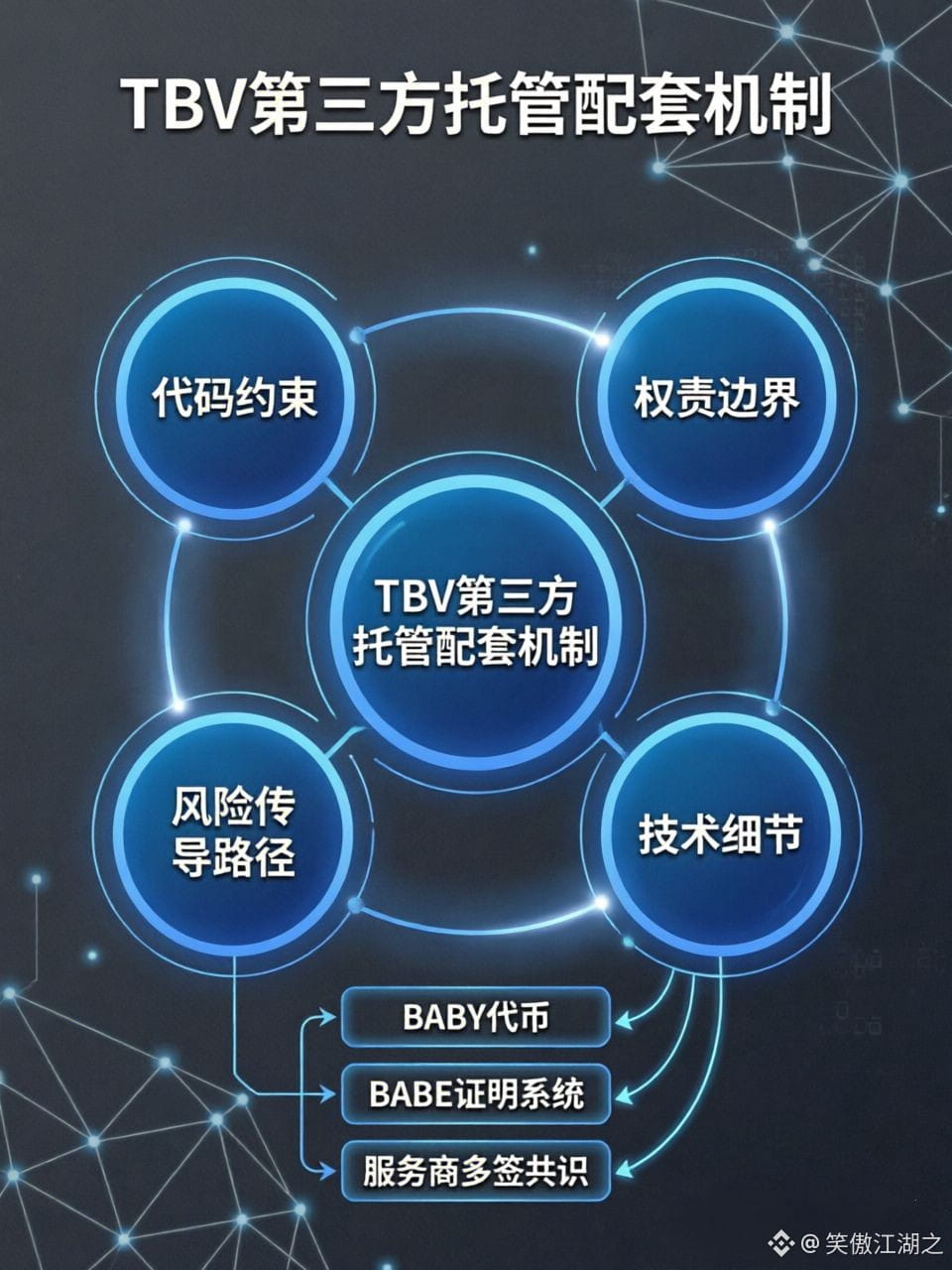
Recently, people in the industry have been discussing TBV’s third-party custody supporting mechanisms. I have tested the product interaction for two consecutive weeks, line by line comparing it with the text in Chapter 7 of the whitepaper, and simultaneously capturing on-chain service provider interaction data. My years of experience researching on-chain data mean I won’t make a conclusion based solely on promotional claims. At present, most Bitcoin vault projects generally shift all operational and maintenance pressure entirely onto ordinary users. The threshold for complex cryptographic computations deters a large number of BTC holders. My evaluation criteria consistently and objectively measure, in three dimensions: code-enforced constraints, the boundaries of rights and responsibilities, and the risk propagation path—without unilaterally inflating or belittling any single project.
@BabylonLabs_io By reading Chapter 7, it is clear that this Keeper custody system can genuinely reduce the operational cost for ordinary users to participate in TBV. In practice, users only need to complete signing locally to create a vault; all ZK proof scripts and monitoring are executed by a third-party service provider. Settlement fees are uniformly processed via $BABY . The contract hard-codes the vault redemption permissions; the service provider cannot transfer BTC arbitrarily. Compared with similar self-custodied vaults, the operational barrier is significantly lowered. The entire technical framework relies on the BABE proof system developed by Berkeley to compress computational overhead, allowing ordinary mobile devices to smoothly integrate with the vault contract.
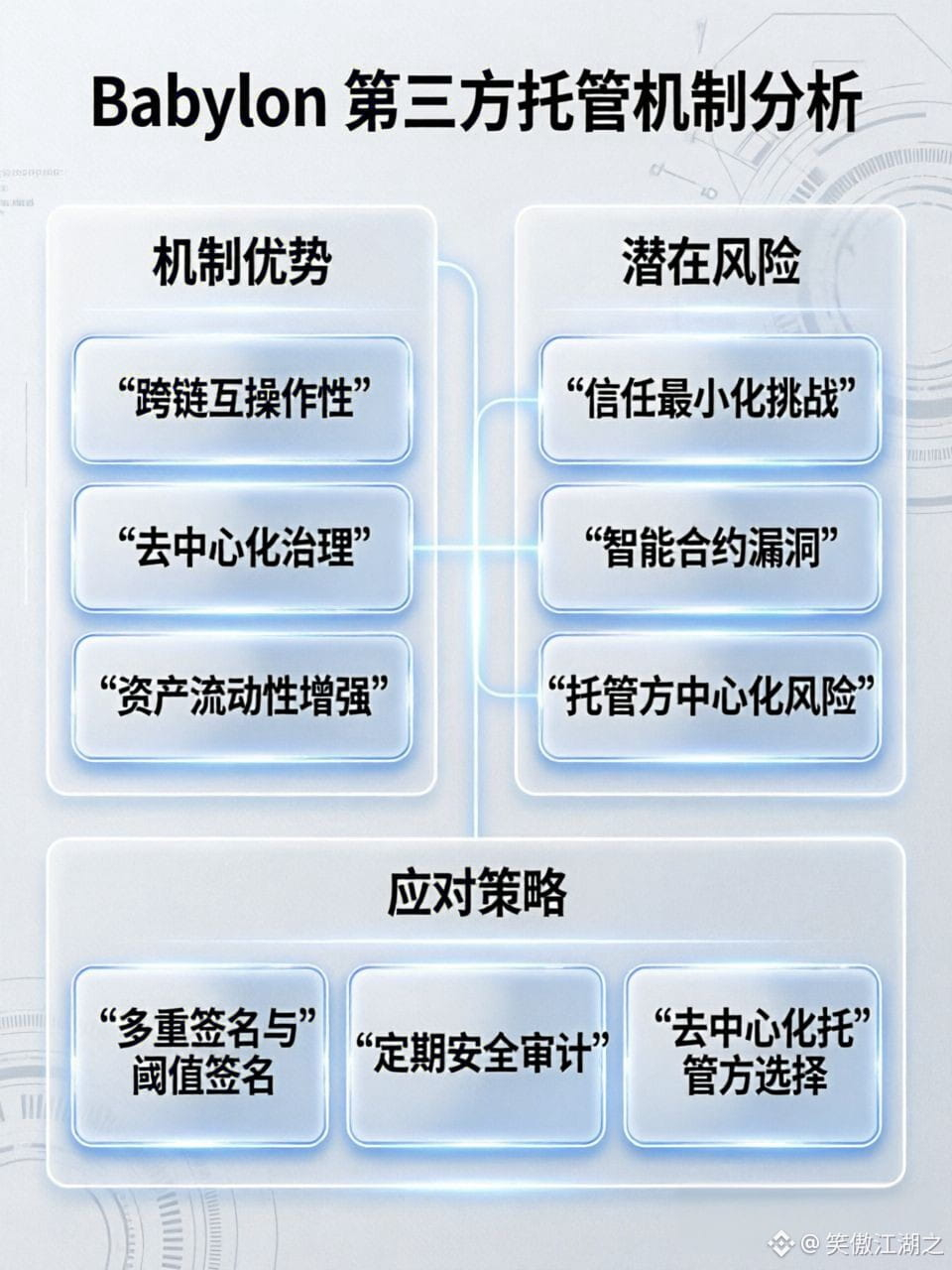
However, Chapter 7 does not completely eliminate risks in the underlying architecture. The whole mechanism is like outsourcing repair services for a household appliance: the service provider only handles the computation steps, yet it holds on-chain monitoring permissions for all time periods. The multi-service-provider multisig consensus only constrains settlement behavior, but it does not include an immediate “kill switch” logic to prevent collective malfeasance by service providers. In extreme market conditions, when BTC drops sharply and triggers mass liquidations, multiple service providers simultaneously show nodes offline and proof-generation delays. The vault collateral threshold cannot be synchronized on-chain in time, and users’ BTC may become temporarily locked, unable to be redeemed. The risk propagation chain is clear: node failures will slow down the liquidation process step by step. There is no rapid fallback plan. The whitepaper relies only on token governance to adjust service provider admission standards; governance voting has a time lag and cannot respond to sudden node failures in real time.
Based on hands-on experience with band-holding BTC over many years, ordinary participants should not rely solely on third-party Keeper custody. It is recommended to combine it with a small amount of BTC to build a simple self-managed vault to hedge the risk of node failures. Limit the proportion of assets delegated to service providers, regularly verify updates to the whitepaper, and retain local transaction receipts to reduce uncontrolled losses caused by multiple factors.#baby
@BabylonLabs_io By reading Chapter 7, it is clear that this Keeper custody system can genuinely reduce the operational cost for ordinary users to participate in TBV. In practice, users only need to complete signing locally to create a vault; all ZK proof scripts and monitoring are executed by a third-party service provider. Settlement fees are uniformly processed via $BABY . The contract hard-codes the vault redemption permissions; the service provider cannot transfer BTC arbitrarily. Compared with similar self-custodied vaults, the operational barrier is significantly lowered. The entire technical framework relies on the BABE proof system developed by Berkeley to compress computational overhead, allowing ordinary mobile devices to smoothly integrate with the vault contract.
However, Chapter 7 does not completely eliminate risks in the underlying architecture. The whole mechanism is like outsourcing repair services for a household appliance: the service provider only handles the computation steps, yet it holds on-chain monitoring permissions for all time periods. The multi-service-provider multisig consensus only constrains settlement behavior, but it does not include an immediate “kill switch” logic to prevent collective malfeasance by service providers. In extreme market conditions, when BTC drops sharply and triggers mass liquidations, multiple service providers simultaneously show nodes offline and proof-generation delays. The vault collateral threshold cannot be synchronized on-chain in time, and users’ BTC may become temporarily locked, unable to be redeemed. The risk propagation chain is clear: node failures will slow down the liquidation process step by step. There is no rapid fallback plan. The whitepaper relies only on token governance to adjust service provider admission standards; governance voting has a time lag and cannot respond to sudden node failures in real time.
Based on hands-on experience with band-holding BTC over many years, ordinary participants should not rely solely on third-party Keeper custody. It is recommended to combine it with a small amount of BTC to build a simple self-managed vault to hedge the risk of node failures. Limit the proportion of assets delegated to service providers, regularly verify updates to the whitepaper, and retain local transaction receipts to reduce uncontrolled losses caused by multiple factors.#baby