
When we talk about RWA these past two years, most people’s first thoughts are usually stablecoins, gold, U.S. stocks, or bonds.
Those directions are certainly important, but I’ve always felt that there’s another category of real-world assets that doesn’t get discussed seriously enough.
That is collectibles.
As a kid, collecting Water Margin cards and Three Kingdoms cards was more about interest. Later, when I started collecting star player cards, I gradually began to pay attention to grading, numbering, scarcity, and long-term value. Now I’m collecting My Little Pony with my child, and I’ve found that the act of collecting itself has never really left our lives.
Many people have collecting experiences, but very few connect it to financial infrastructure.
Recently, while looking at materials for Renaiss @Renaiss Collectibles , I realized what it wants to do is actually far bigger than just “opening packs.”
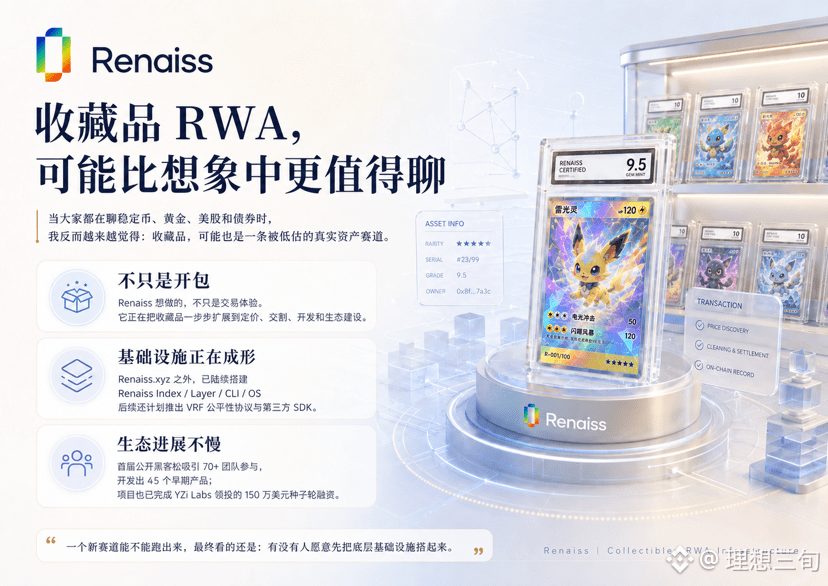
Besides Renaiss.xyz, which users can access directly, it has also been building infrastructure such as Renaiss Index, Renaiss Layer, Renaiss CLI, and Renaiss OS. It also plans to roll out permissionless VRF fairness protocols and third-party SDKs. This means it wants to expand collectibles—from the trading experience—step by step into pricing, settlement, development, and ecosystem building.
The ecosystem progress has been fairly fast too.
The first open hackathon a while back attracted more than 70 teams, and they developed 45 early products based on this infrastructure. For a still relatively new track, that level of developer participation is pretty encouraging.
Also, the project has just completed a $1.5 million seed round led by YZi Labs. Previously, it also successfully graduated from YZi Labs EASY Residency Season 3. Rather than viewing these as marketing talking points, I’d rather interpret them as a form of recognition—at the very least, it shows that teams have started taking the collectibles-finance track seriously.
I’ve always believed that whether a new track can truly take off ultimately depends not on whether there’s hype, but on whether someone is willing to build the underlying infrastructure early on.
Collectibles RWA may still be early days. But if, in the future, more real collectibles can have a unified system for verification, circulation, and settlement, then I think there’s still plenty worth continuing to watch on this path.
Those directions are certainly important, but I’ve always felt that there’s another category of real-world assets that doesn’t get discussed seriously enough.
That is collectibles.
As a kid, collecting Water Margin cards and Three Kingdoms cards was more about interest. Later, when I started collecting star player cards, I gradually began to pay attention to grading, numbering, scarcity, and long-term value. Now I’m collecting My Little Pony with my child, and I’ve found that the act of collecting itself has never really left our lives.
Many people have collecting experiences, but very few connect it to financial infrastructure.
Recently, while looking at materials for Renaiss @Renaiss Collectibles , I realized what it wants to do is actually far bigger than just “opening packs.”
Besides Renaiss.xyz, which users can access directly, it has also been building infrastructure such as Renaiss Index, Renaiss Layer, Renaiss CLI, and Renaiss OS. It also plans to roll out permissionless VRF fairness protocols and third-party SDKs. This means it wants to expand collectibles—from the trading experience—step by step into pricing, settlement, development, and ecosystem building.
The ecosystem progress has been fairly fast too.
The first open hackathon a while back attracted more than 70 teams, and they developed 45 early products based on this infrastructure. For a still relatively new track, that level of developer participation is pretty encouraging.
Also, the project has just completed a $1.5 million seed round led by YZi Labs. Previously, it also successfully graduated from YZi Labs EASY Residency Season 3. Rather than viewing these as marketing talking points, I’d rather interpret them as a form of recognition—at the very least, it shows that teams have started taking the collectibles-finance track seriously.
I’ve always believed that whether a new track can truly take off ultimately depends not on whether there’s hype, but on whether someone is willing to build the underlying infrastructure early on.
Collectibles RWA may still be early days. But if, in the future, more real collectibles can have a unified system for verification, circulation, and settlement, then I think there’s still plenty worth continuing to watch on this path.