
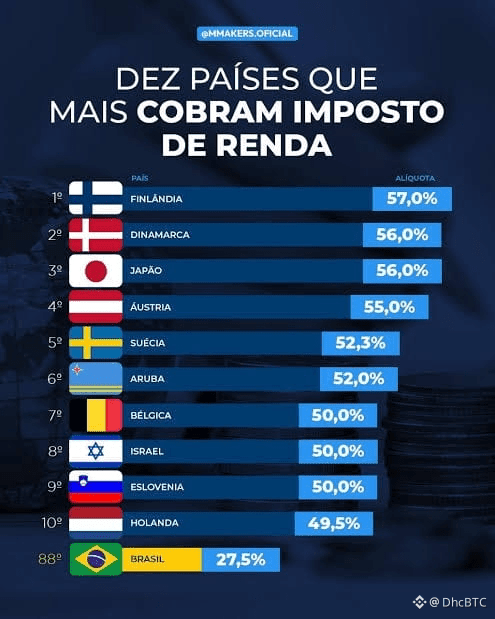
📊 1) Total Tax Burden — Brazil does not pay little tax
The first common fallacy is looking only at the top marginal income tax rate and saying "in Brazil it's only 27.5% compared to 56% in Finland." This comparison ignores the full concept of total tax burden (all taxes collected relative to GDP).
According to official OECD data, many Nordic and European countries have total tax collection rates above 40% of GDP—Denmark, Finland, Sweden, Austria, Belgium—while the OECD average is around 33.8%.
In Brazil, total tax burden is around 32%–34% of GDP, lower than many developed countries, but still among the highest in the world when compared to emerging nations.
➡️ Conclusion: comparing only income tax excludes total revenue and gives a misleading impression about who pays more taxes.
📉 2) Indirect taxation (consumption) — higher in Brazil than in developed countries
In Brazil, a large portion of revenue comes from indirect taxes, especially on consumption, such as ICMS, PIS/COFINS, IPI, and others. These taxes:
They occur every time you make a purchase;
They are passed on in prices, often without citizens directly noticing them;
Tend to be regressive (those with lower income pay a higher proportion), as consumption represents a larger share of the poor's income than of the rich's.
The very structure of taxation shows that Brazil taxes consumption far more and income and wealth far less than developed countries—this disproportionately affects the middle and lower classes.
👉 This means that even if the percentage of GDP seems "lower," the actual burden on the Brazilian citizen when buying goods and services is very high.
🧾 3) "Invisible tax": inflation / monetary expansion
There is a type of tax that does not appear as an explicit levy, but has a similar economic effect: inflation and monetary base expansion.
Economists such as Milton Friedman and other monetarists explained that inflation is a form of implicit tax—the government "captures" income from citizens by devaluing money, reducing purchasing power without a formal tax law.
📌 Simply put: when the central bank allows the monetary base to grow too quickly, prices rise and workers need higher wages to buy the same products—this is a transfer of wealth from the public to the financial sector/government.
This effect typically hits the poorest and wage earners the hardest, as they have fewer assets protected against inflation.
➡️ This "hidden tax" is especially relevant in countries with a history of high inflation, such as Brazil.
🏥 4) Health, education, security: real return on taxes
A purely nominal comparison of tax rates ignores the key point: what do taxes buy for society?
Health
Despite Brazil's high health spending as a percentage of GDP (9.6% in 2019, above the OECD average), 60% of these expenses are private, and the public system (SUS) faces efficiency and equity issues in service delivery.
In many European and Nordic countries, public systems offer:
Universal access with less inequality in service delivery;
Better general health indicators and shorter waiting times;
Costs better managed through organized public health systems.
Although Brazil has made significant progress, the quality and efficiency of public services still lag far behind developed nations with higher tax burdens.
Education and Security
By the same reasoning, countries with high tax burdens can achieve:
Invest heavily in public basic and higher education;
Offers programs to reduce inequality;
Maintain better public safety structures per capita.
This is reflected in indicators such as:
Higher HDI and life expectancy;
Higher education rates;
Better public safety indicators.
Global aggregated data show that Nordic and European countries with higher tax burdens are consistently at the top of global quality of life rankings (happiness, health, education, security).
📌 5) Summary
❌ It is not true that Brazil pays significantly less tax than these countries when viewed comprehensively.
📌 Even with lower nominal income tax rates, Brazil:
Has a high total tax burden—comparable to the OECD average.
Heavily taxes consumption in a regressive manner.
Suffers from "invisible taxes" such as inflation resulting from monetary expansion.
✔️ On the other hand, many countries with higher taxes deliver higher-quality public services, generating greater social well-being, more security, and more efficient education, fueling superior human development rankings.